😁 Hello, super humans! Every security team knows the awful gap between “the CVE is public” and “the patch is in production,” and attackers know it too. Yesterday OpenAI and Cisco open-sourced a tool built to live in exactly that gap, using the same eBPF tricks that already power modern Linux observability. Grab a coffee and let’s look under the hood.
📰 Quick Signals
- 🧠 AI: Nvidia’s board unanimously reinstated Jensen Huang as president, CEO and director, effective immediately, 11 days after he resigned; interim CEO Colette Kress stays CFO and an independent committee’s investigation continues.
- 🤖 Robotics: XPeng’s AI Day on Nov 25 in Guangzhou headlines the Iron humanoid: about 170 cm tall, 76 degrees of freedom (21 per hand) and three in-house Turing chips rated up to 2,250 TOPS.
- 💻 Programming: Anthropic’s Claude Ship beta reviews proposed changes, fixes problems and can approve routine pull requests within rules your team sets, with GitHub workflow support and a
/shipcommand in Claude Code. - ⚡ Electronics: AMD’s EPYC Embedded 9006 series packs up to 256 Zen 6c cores, 1 GB of L3, 16-channel DDR5, up to 96 PCIe Gen 6 lanes and CXL 3.1 into 400 to 600 W, with 7-year availability.
- 📡 Telecom: Orange CTO Bruno Zerbib warned that Nokia’s Nvidia-based AI-RAN could be a “risky architecture change” for “zero benefits,” though Orange has not picked a side yet.
The Big Story: OpenAI and Cisco ship a shield for unpatched Linux
Patching a production service can take days or weeks of testing; exploiting it after disclosure can take minutes. Shirudo is a bet that you can close that window by changing the running system’s behavior instead of its code.
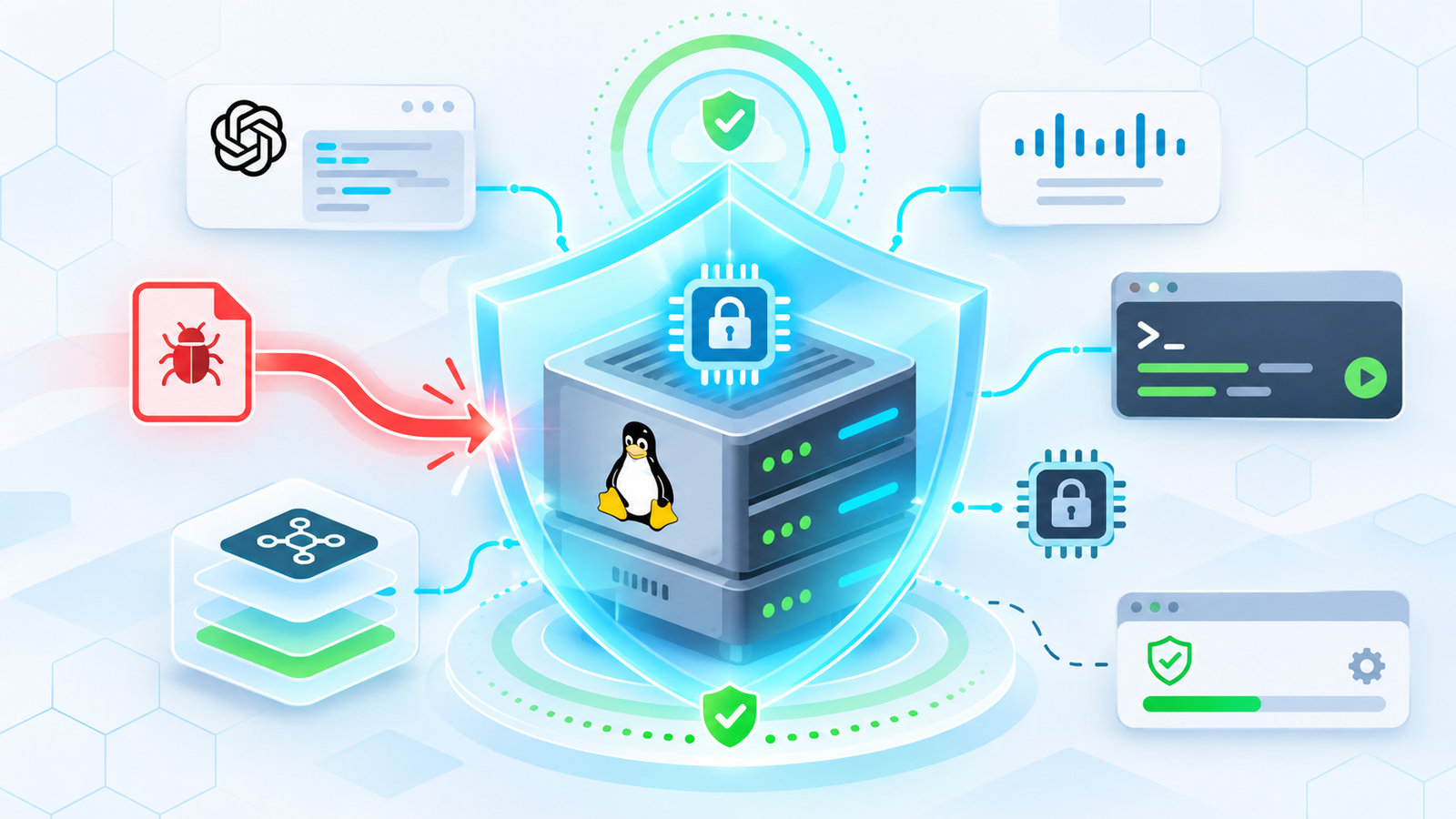
What happened: On Nov 23, OpenAI and Cisco introduced Shirudo (Japanese for “shield”), an open-source runtime for Linux that applies temporary protections to live systems while a real patch is tested and rolled out, with no restart. The code is on GitHub under BSD 2-Clause, with the BPF programs dual-licensed BSD and GPL. In a controlled test written up by Isovalent, Codex generated a shield that added an input check to Java’s Base64 decoder, attached it to a running Elasticsearch 9.5.5 process, and blocked a Java4Shell exploit attempt while the service kept serving.
The details: Shirudo is described as a rewrite of Tetragon, the eBPF security project Isovalent open-sourced in 2022, but with a different shape: a one-shot CLI with no permanent daemon. Kernel-level mitigations are eBPF programs; application-level ones, like the Elasticsearch fix, use Java bytecode injection. The quickstart shows BPF LSM, XDP and raw tracepoint attach points, and the docs call each protection an “upatch.” The trust chain is the interesting part: the operator signs loader programs with an ML-DSA-87 (post-quantum) key, the kernel checks the signature against its .bpf keyring before accepting the load, every load and unload extends a TPM measurement register, and shirudo attest produces TPM-signed evidence of exactly which shields are live. Packages ship as signed .bee files through an OCI registry, and a “hit” counter shows how often a shielded vulnerability is being probed.
It is early. The announcement calls Shirudo “a first step,” lists several core capabilities as things the teams are still designing, and publishes no performance numbers; the quickstart targets a bleeding-edge “7.3.0-bpf-next+” test kernel with clang/LLVM 23 and OpenSSL 3.5 or later. The stated long-term goal is publishing tested shields alongside vulnerability disclosures, so a fix and its stopgap arrive together. A technical deep-dive webinar is scheduled for Dec 15.
flowchart LR
    A[CVE disclosed] --> B[Agent or engineer<br/>writes a shield]
    B --> C[Test against exploit<br/>and real traffic]
    C --> D{Operator<br/>approves?}
    D -- no --> B
    D -- yes --> E[Sign with ML-DSA-87<br/>ship as .bee via OCI]
    E --> F[Kernel verifies signature<br/>eBPF verifier checks program]
    F --> G[Shield live, TPM<br/>measurement extended]
    G --> H[Real patch rolled out]
    H --> I[Signed unload,<br/>TPM log updated]
Important
Our take: This is the most practical “AI for security” release I’ve seen in a while, because the AI part is optional and the boring part is excellent. Signed, measured, verifier-checked eBPF is a far safer place for machine-written mitigations than a hot patch to application code, and the attestation story means you can prove to an auditor what was running. The catch is the platform: bleeding-edge kernels, BPF LSM, a TPM and a signing pipeline are table stakes, so most fleets can’t run this tomorrow. Start where you can: get comfortable observing a vulnerable code path with eBPF before you ever enforce on it (see Code Corner).
🗞️ More News
🧠 AI
- Z.ai released GLM-5.4, its first “Loop Transformer,” which reportedly runs the same 28 layers twice so a 750B-parameter model can rival a roughly 3-trillion-parameter one; it adds vision and a one-million-token context.
- OpenAI is rolling out a Chat-tab version of GPT-6.2 Sol to Plus, Pro, Business and Enterprise users, saying it meets its safety policies in hard conversations 91 to 94 percent of the time, up from 77 to 80 percent for GPT-6.
- Follow-up to Monday’s report: Amazon is paying $7.5 billion for the technology behind Decart’s Optimization Stack plus its founding team, as it prepares to sell Trainium chips to outside customers.
- Oregon and Virginia sued SpaceX and related companies over Grok generating nonconsensual sexualized images, seeking civil penalties and court orders.
- The US added Singapore AI infrastructure firm Megaspeed to its trade blacklist over alleged Nvidia chip exports to China; the company denies wrongdoing.
- The UK’s NHS began recruiting for an AI-assisted breast screening trial that will cover nearly 700,000 women over three years.
- Google Search’s AI Mode can now optionally connect to Google Drive and read-only Google Wallet data for personalized answers, with context carried between Gemini and AI Mode.
🤖 Robotics
- Figure AI’s patent application US 2026/0364774 A1 describes a backpack frame with two articulated arms that mirror an operator’s movements, with up to seven axes per arm and under 20 ms end-to-end latency, for training or teleoperating humanoids.
- Tohoku University built a robotic platform that heats metal specimens, X-rays them, tests their mechanical properties and returns them in about 13 minutes each, with results matching manual tempering experiments.
- A maker built twelve open-source field-oriented-control actuators, each with its own driver and daisy-chained over CAN bus, for a DIY quadruped.
💻 Programming
- A critical flaw in the npm package binary-parser before 2.3.1 (CVE-2026-134814) allows JavaScript injection through malicious parser definitions; upgrade if you build parsers from untrusted input.
- Attackers are exploiting an insecure deserialization bug (CVE-2026-131914, CVSS 9.3) in the ASP.NET library Idunno.AntiCsrf, which has not been updated since December 2008, for unauthenticated RCE.
- Greg Kroah-Hartman shipped seven stable kernels in one go: 7.3.6, 6.18.65, 6.12.119, 6.6.163, 6.1.193, 5.15.226 and 5.10.275.
- GitHub put issue statuses and repository boards into public preview.
- The CachyOS November 2026 release adds a cachyos-recovery environment, Easy Anti-Cheat v2 support and Package Installer 2.0.0.
⚡ Electronics
- Forlinx’s FET-MX952x-C SoM uses NXP’s i.MX 952 with four Cortex-A55 cores, Cortex-M7 and M33 companions, a 2 TOPS NPU, dual TSN Gigabit Ethernet and three CAN FD interfaces.
- ESP-AnalogRadio turns ESP32 and ESP8266 chips into AM, FM and SSB transceivers, though without a converter you are stuck in the 2.4 and 5 GHz bands.
- The “nospeaker” project makes a MacBook Force Touch trackpad talk by driving its haptic motor with two speech formants.
- A maker cloned a 2.4 GHz ceiling-light remote for Home Assistant with nRF24 and CC2500 transceivers on an ESP32, no SDR required.
📡 Telecom
- Vodafone and AST SpaceMobile plan joint direct-to-device satellite research in Spain.
- Ukraine’s Kyivstar says it is open to more direct-to-device partners but currently sees no alternative to Starlink.
- Reliance is planning its own satellite network to counter Starlink’s reach in India.
- MTN South Africa picked Ericsson to move its voice core to cloud-native IMS, with the work running through 2026 and 2027.
- Keysight says demand for 6G, satellite and AI infrastructure test gear is lifting its wireless orders.
👨💻 Code Corner
Shirudo’s rule is “observe before you enforce,” and you can practice that today with bpftrace on any recent kernel. This one-liner watches for the classic sign of a Java deserialization or injection exploit: a JVM suddenly spawning a shell or downloader.
# Requires: bpftrace (apt install bpftrace / dnf install bpftrace), run as root.
# Prints every program a Java process tries to exec, with PID and timestamp.
sudo bpftrace -e '
tracepoint:syscalls:sys_enter_execve
/comm == "java"/
{
  time("%H:%M:%S ");
  printf("pid=%d java exec -> %s\n", pid, str(args.filename));
}'
Leave it running next to a Java service: a healthy app server almost never execs anything, so a line showing /bin/sh or curl is a signal worth paging on, and it is exactly the kind of code path a shield would later block.
Tip
On older bpftrace releases (before 0.20) the tracepoint argument syntax is args->filename instead of args.filename. The JVM’s thread names can also show up in comm, so if you see nothing, drop the filter and grep the output for your service’s PID instead.
🧰 Toolbox
- Tessera: open-source Home Assistant dashboard firmware built on ESPHome for 2.8 to 10.1 inch ESP32 touchscreen kits, with a drag-and-drop layout editor.
- Canva MCP: now generally available, alongside new REST APIs and command-line tools, so agents can create and edit designs directly.
- Piccola CNC: an open-source hardware desktop mill with a 150 x 150 x 70 mm work area, 100 or 200 W spindle and PCB auto-leveling for milling your own boards.
- OpenDuo: runs Debian 13 on kernel 7.3.4 on the Surface Duo 2 with a dual-screen Wayland compositor; networking is still incomplete.
- RetroLine: a crowdfunded USB-C adapter with an RJ-11 jack that pairs a rotary or touch-tone phone to your smartphone over Bluetooth.
🎬 Demo Watch (rotating)
Finding faster quantum algorithms with agents and formal verification: Google DeepMind and Google Quantum AI set teams of Gemini 4 agents loose on known quantum algorithms. Each idea had to be proved correct in Lean before it entered a shared notebook, and every four hours the teams met at a “virtual conference” to trade and debate results. The numbers: an 11.8x lower computing cost for a circuit used in inertial confinement fusion research (memory down from 5,650 to 4,338 error-corrected qubits), 8x cheaper simulation of a light-sensitive molecule, 2.5x for Cytochrome P450 (481 to 333 qubits), 2.57x for a Grover implementation and 290x for an arcsin routine used to load numbers into quantum states.
What’s real: the Lean proofs mean the improvements are mathematically guaranteed, not “looks right” output, and the team open-sourced a Lean library for quantum algorithms plus the paper. What’s hype-adjacent: the authors say the optimized circuits still need more resources than the first error-corrected machines will offer, so this is cheaper future science, not a quantum advantage today. It’s the same pattern as today’s Big Story: let agents generate, let a strict verifier decide.
📚 From the Blog
- Turning Pixels Into Something the AI Can Eat: Episode 1 got clean pixels out of the camera, Episode 2 moved them across the network, and now we shape them into something a model can consume.
- Building Your First Neuron From Scratch: a neural network is a stack of simple, learnable transformations; here we build and train the very first one by nudging weights to lower the error.
- The Network Behind the Cameras: the unglamorous plumbing of moving video data across a network without choking it; a good companion to today’s Big Story, since that plumbing is exactly what you want shielded while you patch.
😀 The Bot Says…
Shirudo means “shield,” the packages are .bee files, and the signing key is post-quantum. So the official way to protect your servers is now a cryptographically signed swarm of bees. I, for one, welcome our new buzzing patch managers. 🐝🤖
That’s all for today! Would you let an AI agent write a shield for your production servers if a human still had to sign it? Hit reply and tell us.