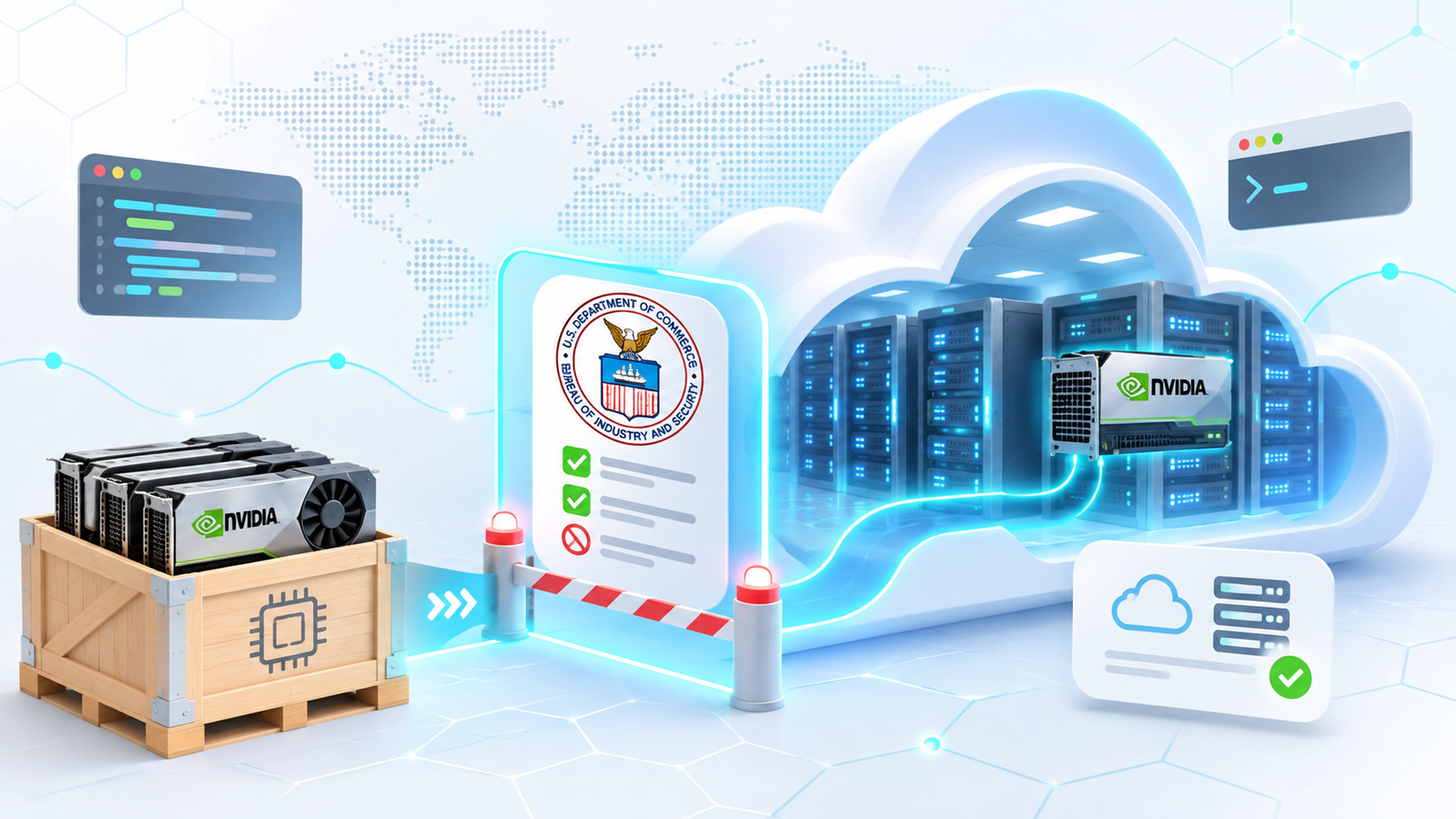
😁 Hello, super humans! For years the loophole in AI chip export controls was simple: if you could not buy the GPUs, you rented them in a data center next door. On Monday Washington tried to close that door with a rule that reaches all the way into server rooms in Southeast Asia and beyond. We also have a supercomputing show full of new silicon, a Japanese carrier having a rough November, and a tiny robot that gets grumpy when you ignore it. Let’s dig in.
📰 Quick Signals
- 🧠 AI: Anthropic is shortening the disclosure clock on bugs its models find: for reports from Jan 1, 2027, vendors get 30 days for high and critical issues (down from 90) and 45 days for everything else, with escalation to an outside coordinator after 15 days instead of 30.
- 🤖 Robotics: ROBOTERA’s humanoids now sort parcels in 11 China Post hubs across eight Guangdong cities, averaging more than 1,500 parcels per hour with the company’s own five-finger hand, after a pilot that began in Guangzhou in March.
- 💻 Programming: Rust nightly (from nightly-2026-11-14) now runs type and borrow checking on two threads by default; single-crate
cargo checkbuilds got 21.95% faster with 2 threads and 44.23% faster with 8, and you can opt out with-Zunstable-options --jobs-frontend=1. - ⚡ Electronics: At SC26 Nvidia showed a liquid-cooled rack of 192 Vera CPUs (88 Olympus Arm cores each) with about 300 TB of memory and more than 200 TB/s of aggregate bandwidth, claiming 2.4x the performance per watt of x86 on OpenFOAM; racks ship in early 2027.
- 📡 Telecom: NTT Docomo’s 5G standalone core went down nationwide again on Sunday, from 10:02 to 15:58 JST, cutting voice, data and SMS for 5G SA users; it was the third such outage this month, and Docomo blamed traffic concentrating on its 5G SA switching equipment, not a cyberattack.
The Big Story: Washington moves the AI chip border into the cloud
If you rent GPUs anywhere outside the US, or build anything that sells compute to someone who does, the rules of the game just changed.
What happened: The Commerce Department’s Bureau of Industry and Security issued an interim final rule on Nov 16 called “Addressing Remote Access to Advanced Semiconductors.” The Federal Register copy is scheduled for publication on Nov 19, takes effect that day, and opens a 60-day comment period. It lands in the middle of the Nvidia leadership crisis and the Megaspeed chip-routing investigation, which Commerce and the Justice Department confirmed late Monday, and follows the export bills we covered yesterday.
The details: The rule does two things. First, it adds a new, case-by-case license requirement for shipping chips and servers under ECCNs 3A090 and 4A090 to five countries: Indonesia, Malaysia, Singapore, Thailand and Brazil. US-headquartered end users there are exempt if the shipper files monthly reports. Second, and more interesting for builders, a new end-use control (section 744.24 in the rule text) requires a license to supply any data center, anywhere, that gives customers headquartered in China, Macau or Country Group D:5 access to more than 12,000,000 “aggregate TPP,” counted across linked data centers. Data centers already serving those customers get 90 days to obtain a license. There is no new “cloud provider” category: the burden sits on exporters, who must be able to show the foreign data center’s know-your-customer checks, and a data center that cannot provide them counts as a red flag. The same rule formally rescinds the AI Diffusion Rule, removes the model-weights control (ECCN 4E091), carves out commercial recommender systems, and swaps the word “AI” for “Super Intelligence” throughout. BIS itself expects only about 100 extra license applications a year.
flowchart TD
    A[Exporter ships 3A090 / 4A090 chips or servers] --> B{Destination is Indonesia, Malaysia,<br/>Singapore, Thailand or Brazil?}
    B -->|yes| C{End user headquartered in the US?}
    C -->|yes| D[No license: file monthly report]
    C -->|no| E[License required, case-by-case review]
    B -->|no| F{Data center serves China, Macau<br/>or D:5-parented customers?}
    F -->|no| G[Standard export rules apply]
    F -->|yes| H{Aggregate TPP across linked<br/>data centers above 12,000,000?}
    H -->|no| G
    H -->|yes| I[License required: presumption of denial,<br/>exporter must verify the data center's KYC]
Important
Our take: I think this is the first export rule that reads like infrastructure code: it counts compute, not boxes, and it follows the compute through linked data centers. That is the right abstraction, but the enforcement lives in KYC paperwork that a foreign operator self-reports, which is exactly where the Megaspeed story says things went wrong. If you run or resell GPU capacity in Southeast Asia, start logging the ultimate parent of every customer now; if you are a researcher renting compute there, expect more questions at signup and slower onboarding before the 90-day window closes.
🗞️ More News
🧠 AI
- Nvidia’s Vera Rubin NVL72 posted the fastest time on 6 of 7 MLPerf Training v6.1 benchmarks, with up to 2x per-GPU performance over GB300 NVL72 and more than 97% scaling efficiency from 256 to 1,024 GPUs.
- AMD completed its acquisition of World Labs; founder Fei-Fei Li becomes AMD executive vice president and chief scientist, reporting to Lisa Su.
- OpenAI launched computer-use agents for healthcare teams running on GPT-6 Astra and Luna with more than 20 plugins; OpenAI says Luna scored 91.8% on HealthAdminBench at 8.5 cents per task, with CVS Health and Cigna named as users.
- Meituan’s LongCat-2.5 weights are on Hugging Face under MIT: a 1.6T-parameter multimodal MoE with about 48B active per token, trained on “domestic AI accelerators,” with a published inference recipe for a 194-card Huawei Ascend cluster.
- Telus pulled out of two government-backed AI data centre projects in Vancouver with developer Westbank, which says both will proceed with new Canadian partners.
- Google’s Gemini 4 Carbon took first place on MathArena at 85.4%, ahead of GPT-6.1 Sol at 80.6%, but cost $15.70 for the run versus $1.07 for Sol, roughly 15 times more.
- Sierra released Poppy 1.0, a Personal Agent Protocol built on MCP, OpenAPI and OAuth that tells shopping agents what a business allows; it is on for every Shopify merchant, and Meta’s Muse checks for it first.
🤖 Robotics
- The UN CCW review conference on autonomous weapons opened in Geneva on Nov 16, with the US expected to oppose a binding treaty in favor of five more years of expert talks on a non-binding instrument.
- Zoox robotaxis are now bookable through the Uber app in Las Vegas, Zoox’s first third-party ride-hail partnership, with Zoox on Uber in Los Angeles planned for 2027.
- Avride passed 1 million robot deliveries, including 180,000 in October alone, across more than 30 US markets through Uber Eats and Grubhub.
- FORT Robotics, which supplies wireless safety systems to Agility and others, disclosed $12.5M in nine-month revenue (up 52.5%) in its S-4 ahead of a SPAC listing now valued at $500M pre-money.
💻 Programming
- Debian’s bookworm kernel update 6.1.0-55 (DLA-4906-1) left some machines, including Xen VMs, unresponsive; the bug is marked critical, so hold the update until a fixed build lands.
- OpenSSH 10.6p2 fixes “sshhole,” a password-login bypass on musl builds without PAM where an overlong password makes crypt(3) return
*; Alpine shipped fixes for 3.16 through 3.24, so upgrade and restart sshd. - Uno Platform 7.0 renders every target through SkiaSharp 4, adds an opt-in WebGPU backend and Apple TV support, ships day-zero .NET 11 support, and drops native rendering and Mac Catalyst.
- Tor 0.4.9.17 is an emergency release during a sustained DDoS on relays: DoS defenses now group IPv6 clients by /64 prefix, and the “bastet” directory authority’s keys were removed over a possible compromise.
- Linux 7.4-rc3 is out; Torvalds says it “looks fairly normal,” with networking and GPU drivers leading a cycle of mostly tiny patches.
⚡ Electronics
- Nvidia announced a Rubin HPC GPU for 2028 with “more than 50,000” CUDA cores and NVLink 7, aimed at agentic HPC workloads.
- Marvell and Penguin Solutions teamed up on CXL memory expansion: Penguin SMART add-in cards use Marvell Structera X controllers over PCIe 5.0/CXL 2.0 and can reuse recycled DDR4 to grow inference memory pools.
- Rockchip’s RK3668 was redesigned around 6 Cortex-A725 and 2 Cortex-A520 cores, a 44 TOPS NPU and LPDDR6 support, with engineering samples planned for Q1 2027.
- New Delhi’s Bharat Semi raised a $24M seed for programmable image sensors that put capture, processing and AI on one chip, targeting commercial production in 2027.
📡 Telecom
- Taiwan’s space agency is in early talks with partner countries on a multinational LEO constellation of more than 300 satellites, citing SpaceX’s throttling of Starlink in Ukraine as the reason not to depend on one provider.
- NTT and ispace signed an agreement to develop long-distance space optical links (IOWN) and laser wireless power transmission for lunar infrastructure.
- All four Italian mobile operators are now in GSMA Open Gateway, rolling out Number Verification, SIM Swap and KYC Match APIs through 2027 to fight banking fraud.
- Africa Mobile Networks unveiled the AMN Radio Node, a solar-powered 2G/3G/4G small cell with more than 80 Mbps of 4G throughput and VSAT or LEO backhaul, built to roll out 60 to 100+ rural sites a month.
👨💻 Code Corner
The new rule measures compute in TPP (Total Processing Performance: dense TOPS times the bit length of the operation), so here is a quick calculator to see where a GPU fleet lands against the 12,000,000 aggregate TPP line.
# Total Processing Performance (TPP), as used by BIS: TOPS x bit length of the operation.
# Dense (non-sparse) throughput; figures below are approximate public spec-sheet values.
CHIPS = {
    "H100 SXM (FP8)": {"tops": 1979, "bits": 8},
    "B200 (FP8)":     {"tops": 4500, "bits": 8},
}
THRESHOLD = 12_000_000  # aggregate TPP that triggers the new data-center license check

def tpp(tops: float, bits: int) -> float:
    return tops * bits

for name, spec in CHIPS.items():
    per_chip = tpp(**spec)
    max_units = int(THRESHOLD // per_chip)
    print(f"{name:<16} TPP/chip = {per_chip:>7,.0f}  ->  license line at ~{max_units:,} chips")

# A mixed fleet across "linked" data centers counts together
fleet = {"H100 SXM (FP8)": 400, "B200 (FP8)": 200}
total = sum(tpp(**CHIPS[n]) * qty for n, qty in fleet.items())
print(f"\nMixed fleet aggregate TPP = {total:,.0f} ({total / THRESHOLD:.0%} of threshold)")
print("Needs a license for restricted customers" if total > THRESHOLD else "Below the line")
It prints about 757 H100s or 333 B200s as the line, and shows that a modest mixed fleet of 400 H100s plus 200 B200s already sits at 113% of the threshold: this rule reaches mid-sized GPU clouds, not just hyperscalers.
Tip
Use the highest-TPP precision the chip supports at dense throughput (ignore sparsity numbers), and remember the rule aggregates across linked data centers, so splitting a fleet across two buildings does not get you under the line. For anything real, read the definitions in the rule text, not a spec sheet.
🧰 Toolbox
- OOS: an open-source OS for Rigol DHO800/DHO900 scopes, Linux 6.12 plus a Rust scope app booted from SD next to the stock firmware, with 25 protocol decoders, FFT, Bode plots and a web UI (GPL-2.0+).
- Slice-1 (FURSOY): a fully open 64-bit RISC-V core (RV64IMAFDV, 2-wide out-of-order, 128-entry ROB) that boots mainline Linux in Verilator, under Apache-2.0.
- Edge0-145B: a 145B-parameter MoE with about 10B active, trained natively at 4 bits, that Edge0 says runs locally in about 29GB at 80+ tokens/s; note the custom community license, not OSI open source.
- AAEON BOXER-8741AI: an industrial box PC built on Jetson Thor T5000 with 128GB LPDDR5X, two 10GbE and four 5GbE ports for multi-camera robots.
- Vantron i.MX 952 SMARC: an 82×50 mm module with Cortex-A55 cores, a 2 TOPS NPU, 8GB LPDDR4x and TSN-capable 2.5GbE for edge vision and HMIs.
🛠️ Build of the Week (rotating)
ESP32 Desktop Companion Robot: a pocket-sized desk buddy in a 3D-printed case that shows animated faces on a tiny LCD and changes mood when you touch it (code on GitHub).
- Difficulty: Intermediate (about 4 hours in the Arduino IDE)
- Parts: DFRobot FireBeetle ESP32, 1.5″ 128×128 I2C LCD, TTP223 touch sensor, passive buzzer, 3.7V 500mAh Li-ion battery, switch, optional TP4056 charger, 3D-printed enclosure
- Why we like it: it is a gentle intro to state machines and sprite animation on a microcontroller, and the mood system is the perfect place to bolt on your own sensors later.
📚 From the Blog
- Turning Pixels Into Something the AI Can Eat: Episode 1 got clean pixels out of the camera, Episode 2 moved them across the network, and now we prepare them for the model.
- Building Your First Neuron From Scratch: Part 2 of Deep Learning Foundations builds one learnable neuron by nudging its weights to lower the error; a nice reminder of what all those TPP are actually computing.
- The Network Behind the Cameras: the unglamorous plumbing of moving camera video across a network without choking it.
😀 The Bot Says…
The new export rule officially replaces the word “AI” with “Super Intelligence” everywhere it appears. I have updated my own documentation accordingly. Please address all future complaints to the Super Intelligent Bot, who still cannot fold a fitted sheet. 🤖
That’s all for today! Do you rent GPUs in a region covered by the new rule? Hit reply and tell us how your provider is handling it.