😁 Hello, super humans! Yesterday we watched a thousand agents formalize a famous proof; today the same idea showed up somewhere far more practical: the encryption code on your phone. DeepMind says its agents proved security properties of the real Signal protocol implementation, not a whiteboard model of it. Let’s dig into what was proven, what was not, and everything else that shipped overnight.
📰 Quick Signals
- 🧠 AI: Google released Gemini 4 Carbon at $2 per million input and $10 per million output tokens (rising to $4 and $20 on Nov 30), plus a
/swarmpreview in Antigravity that turns one prompt into a coordinated team of agents. - 🤖 Robotics: Gemini Robotics 2.5 put Apptronik’s Apollo 2 to work sorting brackets on live Mercedes-Benz lines at a 96% success rate; it is partner-only, with no API.
- 💻 Programming: .NET 11 is out as a two-year Standard Term Support release, with C# 15 union types, a Native AOT CLI host by default and a
dotnet new mcpservertemplate. - ⚡ Electronics: Arduino announced the Nano XL Link at electronica, a Nano-format board with a 120 MHz Cortex-M33, 2 MB of flash and onboard Ethernet, CAN FD and RS485 transceivers.
- 📡 Telecom: AST SpaceMobile is developing its own 20-ton rocket, Blacklift, with first missions slated for late 2028 to ease its launch bottleneck.
The Big Story: DeepMind’s AlphaProof Code machine-checked the code behind Signal’s encryption
Most “verified” crypto is verified on paper; the bugs live in the code. This is a claim that AI agents closed that gap on a protocol billions of messages depend on.
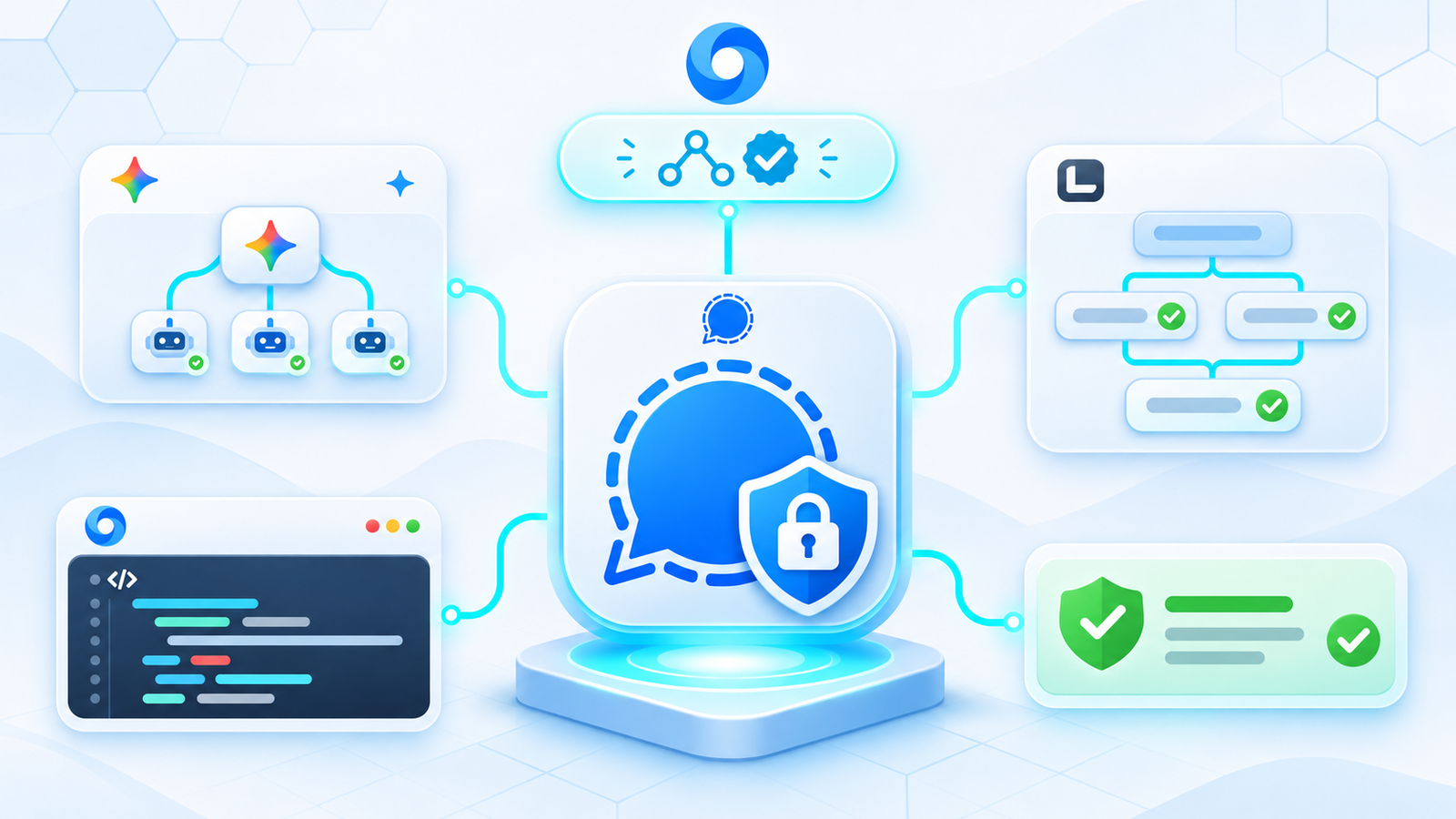
What happened: On November 10 Google DeepMind introduced AlphaProof Code, a system that writes machine-checked proofs about real software. Its first showcase: formally verifying security properties of the implementation behind the Signal protocol, which is used in Signal and Google Messages. The properties cover protecting messages both before and after a device is temporarily compromised, proven down to the code that actually runs on devices. Signal gave feedback on the work, and DeepMind says it took four weeks, compared with years for comparable expert-led efforts.
The details: The pipeline splits the job in two. Specifications (what “secure” means, written formally) were drafted with a mix of models and reviewed by human experts one by one; Gemini Carbon-powered agents then generated the proofs in Lean, where a small, trusted checker accepts or rejects every step. The agents flagged roughly 1% of the codebase for a human second look, and the rest was checked automatically. The most convincing test is the negative one: the team reintroduced two real, previously fixed bugs into an isolated copy, and both times the system produced a machine-checked proof that the buggy version was insecure. DeepMind has published the verification artifacts and a technical paper alongside the post.
flowchart LR
    A[Signal protocol implementation] --> B[Formal specs drafted by models]
    B --> C[Human experts review every spec]
    C --> D[Gemini Carbon agents write Lean proofs]
    D --> E{Lean kernel checks each step}
    E -->|accepted| F[Machine-checked security properties]
    E -->|about 1% flagged| G[Human second look]
    H[Two old bugs reintroduced] --> D
    D --> I[Proof that the buggy version is insecure]
Warning
A proof is only as good as its specification: it shows the code matches what the humans wrote down, not that they wrote down every attack. The post’s own size figures for the proof are inconsistent (the body and page summary give different line counts), and the four-weeks-versus-years comparison is DeepMind’s. Read the paper before quoting numbers.
Important
Our take: This is the same recipe as yesterday’s Fermat run (a cheap progress signal plus a checker that cannot be sweet-talked), pointed at production code instead of mathematics. The part I like most is the bug-reintroduction test, because it shows the system can say “no” with a proof, which is what you actually want from a verifier. If you maintain security-critical code, the practical move today is to start writing your invariants down precisely; agents can only prove what someone has specified.
🗞️ More News
🧠 AI
- Anthropic set IPO terms in an amended S-1: 825 million Class A shares at $70 to $78 under the Nasdaq ticker ANT, plus a concurrent $26 billion private placement from Google, NVIDIA, AMD and others; the filing is still preliminary.
- Anthropic launched Claude Meetings in beta for Team and Enterprise (it joins Google Meet as a visible participant), plus Sheets and Whiteboards betas and a now generally available Claude Data.
- New York’s RAISE Act took effect: frontier developers with over $500M in annual revenue must register by Jan 1, 2027 and report critical safety incidents within 72 hours.
- OpenAI described Control Room, a stop mechanism where the inference engine checks a job ID before producing output; cached permissions can delay a stop by up to 35 seconds.
- OpenAI opened “Businesses in ChatGPT” in beta, letting companies claim profiles, add product feeds and see mention and click counts.
- Claroc found 35,578 of 37,571 checked Grok-built apps (94.7%) open to anyone with the link, because the publish dialog defaulted to public.
- DeepL launched Aure, a voice model that keeps a speaker’s tone, emphasis and pace in real-time translated speech, in 8 languages at launch.
- Adobe announced a local MCP server that exposes Photoshop, Illustrator, Premiere and After Effects features to ChatGPT, Claude and Gemini; no date or pricing yet.
🤖 Robotics
- Path Robotics raised a $300M Series E at a $2.45B valuation and showed Rove, a quadruped-based mobile welding system running its Obsidian welding model.
- Ant Group’s Robbyant open-sourced LingBot-Touch under Apache 2.0, one tactile model for three sensor types trained on 4,983 hours of touch data.
- Pilatus is testing Hexagon’s AEON humanoid for quality inspections of the PC-24 business jet airframe in Stans, Switzerland.
- HD Hyundai Robotics showed a dual-arm robot on its own foundation model, each arm with a 7 kg payload, 630 mm reach and five-fingered hand.
- Greenzie’s autonomous mowers passed 255,000 miles and 9 billion square feet for more than 200 commercial customers.
💻 Programming
- PowerShell 7.7 is generally available on .NET 11, adding
New-TemporaryDirectoryand makingNew-Guidproduce time-sortable v7 UUIDs by default. - Python 3.16.0 alpha 2 adds set operations and Unicode property matching to
re, and C-leveluuid4()anduuid7()run about 15 to 30x faster in microbenchmarks. - Go turned 17: Green Tea GC became the default in Go 1.26, and
encoding/json/v2went GA in 1.27, with SIMD packages planned to graduate in 1.28. - From Dec 8, Dependabot alerts will pause on repositories with no activity in the past year; any push turns them back on.
- Val Town is winding down: read-only on Dec 10, shut down on Jan 10, 2027, and open-sourced on Feb 1, 2027.
⚡ Electronics
- ST’s STM32G5 is a 280 MHz Cortex-M33 with a 111 ps high-resolution timer for digital power and motor control, at about $1.03 in 10k quantities.
- ST also expanded GANSPIN with 100 V GaN motor drivers handling up to 60 A continuous and 5 MHz switching in a 5 x 6.5 mm package.
- Renesas’s RZ/T2N pairs two 1.2 GHz Cortex-A55 cores with two 800 MHz Cortex-R52 cores for four-axis motor control plus a three-port TSN switch with EtherCAT.
- Tom’s Hardware benchmarked AMD’s Zen 6 EPYC Venice on TSMC N2P: the 256-core EPYC 9996 ran 93% ahead of the EPYC 9965 on SPEC CPU 2026 intrate.
- TSMC declined to comment on a report that it is drafting 3D DRAM production plans at Nvidia’s request, saying it stays focused on foundry.
📡 Telecom
- Verizon Business completed a private 5G network across five Thames Freeport sites in the UK.
- La Caisse will buy 49.9% of Bell’s tower company for CAD 2.45 billion.
- BT’s CEO says its planned Starlink service is ready to launch but on hold, citing the situation in Ukraine.
- Deutsche Telekom’s CEO vowed to fight a German or EU Huawei ban as the regulator proposes classifying the whole 5G RAN as critical.
- TIM Group’s nine-month revenue rose 2.8% organically to about EUR 10.4 billion, with about EUR 1.3 billion of capex.
👨💻 Code Corner
PowerShell 7.7 now defaults to v7 UUIDs and Python 3.16 just made them faster, so here is why you might want them: the first 48 bits are a Unix timestamp in milliseconds, which makes IDs sortable by creation time and friendlier to database indexes.
import uuid
from datetime import datetime, timezone

# uuid.uuid7() is in the standard library from Python 3.14
ids = [uuid.uuid7() for _ in range(3)]

for u in ids:
    ms = u.int >> 80  # top 48 bits = milliseconds since the Unix epoch
    ts = datetime.fromtimestamp(ms / 1000, tz=timezone.utc)
    print(u, "version", u.version, "created", ts.isoformat(timespec="milliseconds"))

print("sorted by creation:", ids == sorted(ids))
Swap your random v4 primary keys for v7 and new rows land at the end of the B-tree index instead of scattering across it.
Tip
On Python 3.13 or older, uuid.uuid7() does not exist; use a small package such as uuid6 or upgrade. Remember that v7 IDs leak their creation time, so do not use them where that is sensitive.
🧰 Toolbox
- Modern Web Guidance: Apache 2.0 agent skills from the Chrome team, with Edge, Firefox and MDN involvement, that steer coding agents away from legacy JavaScript patterns.
- Process Explorer for macOS: Sysinternals’ process monitor rebuilt natively in Swift, with a live process tree, performance graphs and code-signing inspection (macOS 14+).
- llm-gemini 0.36: adds Gemini 4 Carbon to the
llmcommand-line tool, the quickest way to try today’s model from a terminal. - Ginux: an experimental x86-64 OS that boots via UEFI and runs unmodified Linux userspace without a Linux kernel.
- KiCad 10 in the browser: an unofficial port that runs the PCB suite in a web browser or on Android.
- Tektronix 1 Series: 12-bit oscilloscopes for students and hobbyists, from $450 for a 2-channel 50 MHz model.
🛠️ Build of the Week (rotating)
An Entire Arcade in a Briefcase: Michael Alm built a two-player retro arcade cabinet in a plywood case that folds shut and carries like luggage.
- Difficulty: Intermediate
- Parts: Raspberry Pi 3 Model B+ running Batocera, 15.6-inch LCD, 2 Sanwa joysticks and 12 Sanwa buttons in a Vewlix layout, I-PAC 2 controller interface, Baltic birch plywood, brass tubing and rods for the hinges, a carrying handle
- Why we like it: real arcade controls, cheap well-known parts and a hinge design that turns a cabinet into carry-on luggage.
📚 From the Blog
- Turning Pixels Into Something the AI Can Eat: the model gets the glory, but this episode is about the preprocessing that makes camera frames usable by it.
- Building Your First Neuron From Scratch: Part 2 of Deep Learning Foundations, turning the “stack of learnable transformations” idea into one working neuron.
- The Network Behind the Cameras: once the camera is perfect, the next problem is moving its pixels across a network without choking it.
😀 The Bot Says…
DeepMind proved the Signal code is secure in four weeks. I have been trying to prove my utils.py does what its name says for three years.
That’s all for today! What is one invariant in your own code you would love an agent to prove? Reply and tell us.