😁 Hello, super humans! Somewhere above Svalbard, a satellite just answered a request for a haiku about space, and the poet was a Gemma 4 model running on a data-center-class TPU. It is a gloriously small milestone with very large ambitions behind it, so let’s look at what it proves and what it does not.
📰 Quick Signals
- 🧠 AI: SemiAnalysis launched GDPx, an 11-domain benchmark where Claude Opus 5.5 leads at 12.0%, ahead of Gemini 4 Carbon (10.9%) and GPT-6 Astra (9.6%), and every model scored 0% in finance and legal.
- 🤖 Robotics: North American robot orders hit 10,989 units worth $723.5M in Q3, up 24.8% year over year, with semiconductor and electronics orders nearly doubling.
- 💻 Programming: Cloudflare and VoidZero introduced tsrs, an experimental Rust port of the TypeScript compiler that Cloudflare says checks up to 8x faster with about 70% less memory, written by agents against TypeScript’s conformance suite.
- ⚡ Electronics: South Korea’s October exports rose 93.7% to a record $115.3B, with semiconductor exports up 259% to $56.4B.
- 📡 Telecom: UK millimeter-wave vendor CBNG has collapsed after losing a Verizon contract.
The Big Story: Google ran Gemma 4 on a data-center TPU in orbit, while its own energy chief says space compute costs up to 100 times more
If you have wondered whether “AI data centers in space” is a roadmap or a slide, this week gave us one real data point and one cold shower.
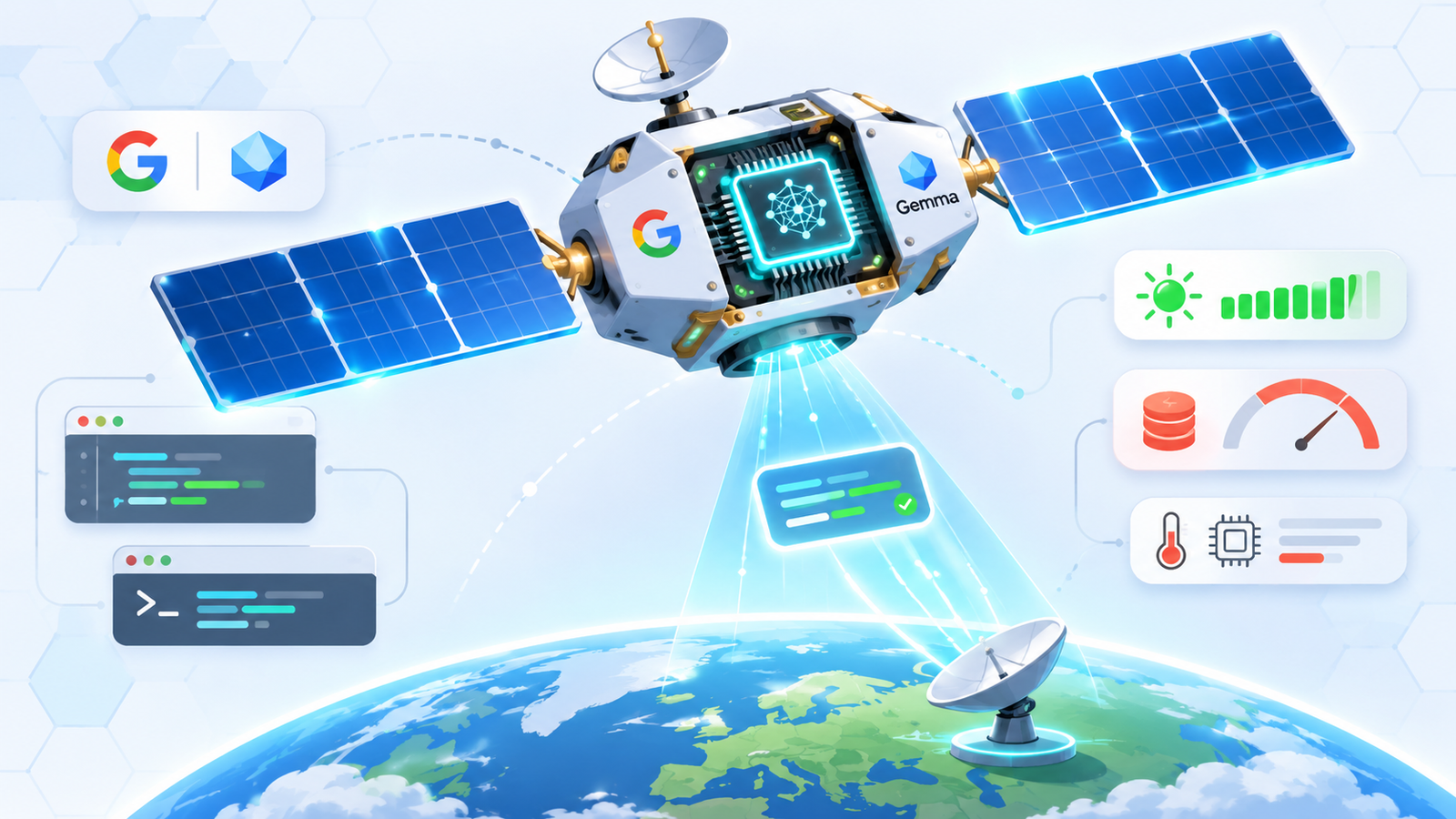
What happened: In an update on Project Suncatcher, Google said its prototype satellite, launched on October 1, 2026, has been commissioned and reached its “Hello World” moment: an onboard Gemma 4 open model answered a prompt asking for a haiku about space, and the reply was downlinked during a pass over Svalbard, Norway. Read the Google update for the full account. Separately, Google’s energy chief Amanda Peterson Corio said orbital data centers could cost up to 100 times more than Earth-based ones under current conditions, as The Information reported (paywalled).
The details: The payload is a host tray plus TPU trays, and Google describes the chips as data-center class. Commissioning meant powering up both trays and running early machine learning tests before the haiku, with follow-ups such as space limericks and payload telemetry reports. What is missing matters just as much: Google’s post gives no compute, altitude, or orbit specifications, and the radiation and thermal stress tests, the real questions for commodity silicon in orbit, are still ahead. The next milestone is a pair of interconnected satellites in 2027.
flowchart LR
    A[Oct 1 2026: prototype launch] --> B[Commission host and TPU trays]
    B --> C[Hello World: Gemma 4 haiku]
    C --> D[Downlink over Svalbard]
    D --> E[Next: thermal and radiation tests]
    E --> F[2027: twin interconnected satellites]
Note
A haiku proves the chip boots, runs a model, and talks to the ground. It does not prove the chip survives years of radiation or that the economics close. Treat this as a bring-up milestone, not a working orbital data center.
Important
Our take: I like that Google is publishing the boring commissioning steps instead of a render, and I like even more that its own energy chief put a number on the cost gap. For builders, the near-term value is not “train in space”; it is learning how to run inference on hardware you cannot touch, with a downlink as your only debugger. Until the thermal and radiation results land, I would file orbital compute under “fascinating research” and keep budgeting for terrestrial power.
🗞️ More News
🧠 AI
- OpenAI says that starting in December, eligible ChatGPT and Codex usage will draw from one shared allowance, with instant chats excluded.
- AWS Q3 sales rose 39.3% to nearly $46B, its fastest growth in almost five years.
- Microsoft detailed how North Korean threat actors are adopting AI in their operations.
- OpenAI will support a shared robots.txt signal for AI-training preferences, aiming to ship it in the coming months; existing crawler controls stay in effect.
- Apple Intelligence reaches China with developer testing from November 4 and a December rollout alongside iOS 27.3, with Alibaba’s Qwen powering selected features.
- A 7.72 TB Hugging Face repo claiming to be a leaked 14-trillion-parameter Anthropic checkpoint turned out to be seeded random noise.
- Anthropic added a usage-policy rule against sustained, purposeless abuse of Claude, with ending the conversation as the main response.
🤖 Robotics
- Foundry Robotics raised a $100M Series A to build an autonomous factory for defense and industrial hardware assembly.
- Bedrock Robotics announced a $600M Series C to scale autonomous construction equipment across U.S. sites.
- ANYbotics launched ANYmal X, a legged robot built for explosive atmospheres at oil, gas, and chemical sites.
- Beijing startup GenRobot AI raised a $100M Series A+ for motion-capture rigs that record human demonstrations as robot training data.
💻 Programming
- Microsoft linked the ConnectWise supply chain attack to Storm-0940, which used an AI-driven penetration-testing framework against more than 2,250 Microsoft 365 tenants.
- Atlassian’s 2026 developer experience survey found developers reporting double-digit weekly time savings from AI fell from 68% to 26%.
- PHP patched two unauthenticated remote code execution flaws after an exploitation attempt was recorded.
- The Agentic AI Foundation added four projects, bringing its total to ten, as MCP turns its attention to security.
⚡ Electronics
- London inference-chip startup Fractile reportedly raised about $700M at a $6.5B valuation, with the UK’s Sovereign AI Fund joining the round.
- Raltron launched its RXF series of monolithic crystal filters for ground equipment in LEO satellite broadband networks.
- Voyager 1 briefly went silent, then the comms gap closed, a reminder of how fragile 1970s-era hardware is at this distance.
📡 Telecom
- The FCC is moving to remove roadblocks to retiring copper networks in California.
- A report says VMO2 is close to an Openreach deal that would extend its fiber footprint.
- A power crunch has DayOne and Nxera striking separate deals with Sembcorp.
👨💻 Code Corner
tsrs exits with code 2 on type errors where tsc exits with 1, which can quietly break CI scripts that test for an exact value. This tiny wrapper treats any non-zero exit as a failure, so you can swap checkers without touching your pipeline.
#!/usr/bin/env bash
# typecheck.sh: run the checker named in $TYPECHECKER (default: tsc) and fail on ANY non-zero exit code
set -u
"${TYPECHECKER:-tsc}" --noEmit -p tsconfig.json
status=$?
if [ "$status" -ne 0 ]; then
  echo "Type check failed (exit code $status)" >&2
  exit 1
fi
Tip
Check the flags your checker supports before swapping it in: tsrs is experimental, has no watch mode or language server yet, and tracks TypeScript 7, so teams on TypeScript 5 or 6 should look at Microsoft’s Go port first.
🧰 Toolbox
- agentmash: warns teammates’ coding agents before they overwrite each other’s changes.
- OmniDiff: a conventional (not AI-powered) diff tool for code, PDFs, images, fonts, and archives.
- Ideogram Precise Edit: edits a selected image region without regenerating the rest, for images up to 8K.
- Luxonis OAK 4 FFC: a board-level vision computer for humanoids, drones, and other machines that will not fit a standard camera.
- OSV-Scanner: Google’s scanner that checks your dependencies against the OSV vulnerability database, handy after this week’s supply chain headlines.
🛠️ Build of the Week (rotating)
An ADS-B receiver for less than you think: a pocket aircraft tracker that listens on 1090 MHz and serves tracks on a simple web page.
- Difficulty: Intermediate
- Parts: Meshnology W12 board (ESP32-S3 plus an LR2021 LoRa radio), 915 MHz antenna, optional GNSS receiver; reported at under $50 in parts.
- Why we like it: it repurposes a LoRa radio as an OOK/Manchester receiver, the ESP32 validates message CRCs, and the author reports tracks from up to 150 nautical miles away (you must modify the board’s filter so it does not attenuate 1090 MHz, and sourcing the board may be hard outside India).
📚 From the Blog
- Turning Pixels Into Something the AI Can Eat: the third installment of the video analytics series, on preparing video data for AI processing; a good companion to today’s story about getting models to run on unusual hardware.
- Building Your First Neuron From Scratch: builds a single neuron step by step and shows how adjusting weights reduces error during training.
- The Network Behind the Cameras: the networking infrastructure needed to move video from cameras onward.
😀 The Bot Says…
A satellite, a data-center TPU, and the first thing we asked it to do was write a haiku about space. Some day it will schedule your workloads; today it is a poet with a very good view.
That’s all for today! Would you rather have a data center in orbit or a really good heat sink on the ground? Reply and tell us.