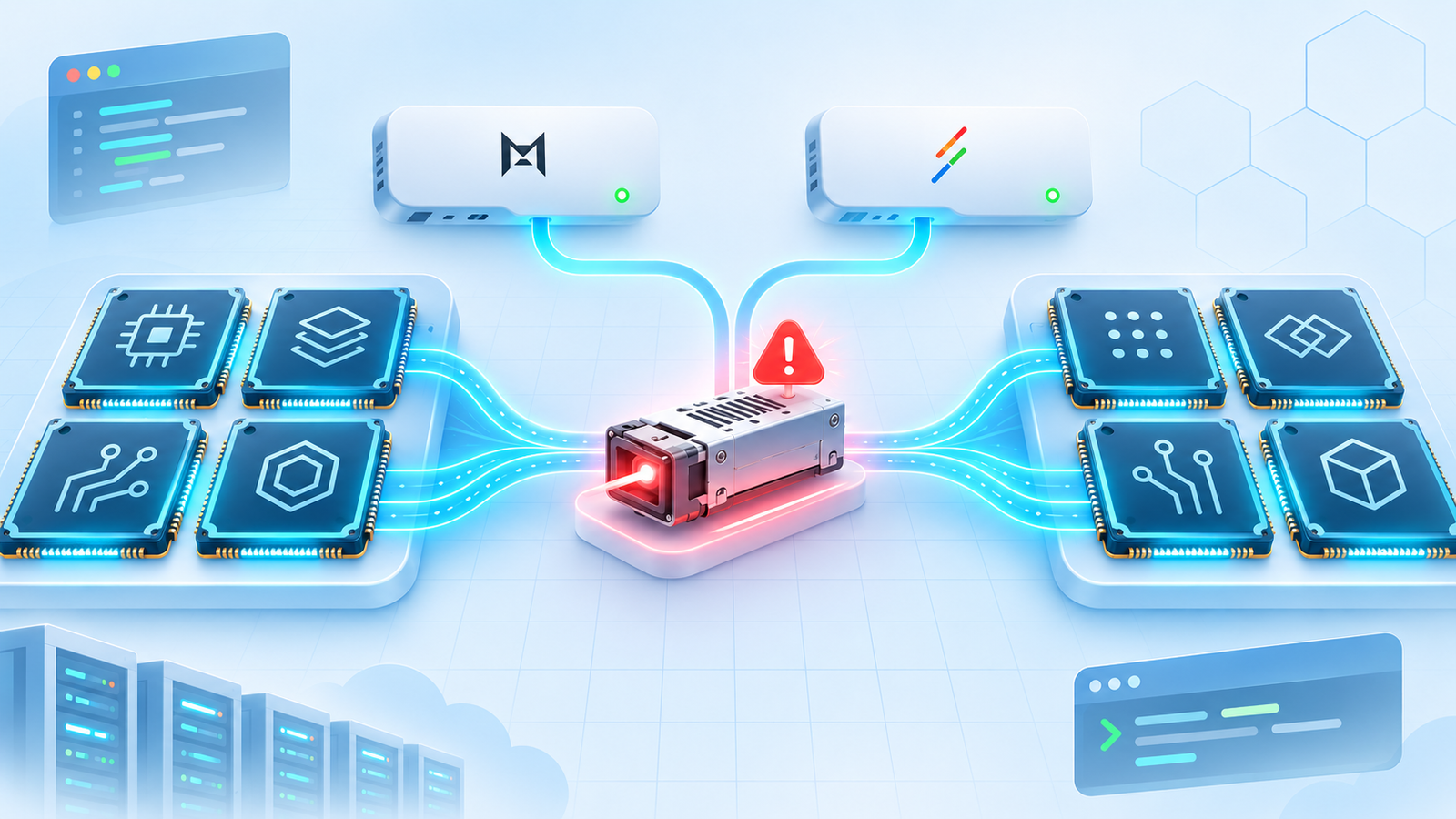
😁 Hello, super humans! Today’s biggest AI-infrastructure deal does not involve a GPU at all: it is about the lasers that carry data between them. We unpack why Marvell is paying a reported $115B for Lumentum, what it could do to supply for everyone else, and a small code snippet to feel the physics. We also have Anthropic’s financials, a robotics trade review, and a botnet hiding inside certified TV boxes.
📰 Quick Signals
- 🧠 AI: Anthropic’s amended S-1 shows Q3 revenue of about $17B, a Q3 net loss of $23.29B, and purchase and lease commitments of about $895.4B.
- 🤖 Robotics: A Section 232 proclamation signed October 28 directs negotiations on robotics and industrial machinery imports, with no tariffs yet and a progress update due within 180 days.
- 💻 Programming: Google banned Android TV box maker Videostrong after finding a backdoor built into its certified devices, and moved against the XCPE botnet, cutting off at least 10 million more compromised devices.
- ⚡ Electronics: US intelligence has reportedly concluded that a Chinese businesswoman with access to Nvidia’s CEO was passing information to Beijing, sharpening export-control concerns.
- 📡 Telecom: T-Mobile is rolling out 5-Gig fiber with a 10-year price lock.
The Big Story: Marvell is buying Lumentum for $115B, and the laser is now the AI bottleneck
If you thought the AI hardware race was only about who has the most GPUs, this deal says the next fight is over the light that connects them.
What happened: On November 2, Marvell agreed to buy Lumentum in an all-stock deal at an implied enterprise value of about $115B, roughly $1,132 per Lumentum share, with closing targeted for the first half of 2028. See CNBC’s report for the terms and Light Reading’s analysis for the technical picture.
The details: AI data centers use optics at three levels: scale-across (between sites), scale-out (between AI pods), and scale-up (between accelerators inside a pod). As optics move closer to the chip through near-packaged and co-packaged optics (NPO and CPO), the companies argue lasers, drivers, and DSPs must be designed together, a pitch they call “extreme co-design.” Lumentum makes indium phosphide (InP) lasers, transceivers and optical circuit switches, and says it runs the world’s largest InP wafer fab. Its fiscal first-quarter revenue was $1.26B, up 136.5% year over year, with a second major NPO/CPO win and more than $5B in purchase commitments. The catch: Lumentum sells lasers to module makers that also buy Marvell DSPs, so owning the transceiver line puts Marvell in competition with its own customers (management says modules will stay under 10% of combined revenue). Omdia notes transport orders already exceed laser supply, so telecom buyers may get deprioritized behind datacom. Nvidia reportedly invested $2B in each company this year.
flowchart LR
    A[Scale-up: accelerators in a pod] --> B[Scale-out: pod to pod]
    B --> C[Scale-across: site to site]
    L[InP lasers: Lumentum] --> A
    L --> B
    L --> C
    D[DSPs and drivers: Marvell] --> A
    D --> B
    D --> C
Note
The deal is announced, not closed: the stated target is the first half of 2028, so expect regulatory scrutiny and a lot of renegotiated supply contracts before anything changes on the ground.
Important
Our take: The headline number is less interesting than what it reveals: laser supply is now a strategic chokepoint, in the same way HBM was a year ago. For builders, the practical lesson is to treat optics as part of your capacity plan, not a commodity line item on the bill of materials. I would also watch the open alternative: Ciena’s Open CPX effort is the hedge against a world where one vendor owns the lasers and the chips that drive them.
🗞️ More News
🧠 AI
- OpenAI introduced LifeVal, an everyday-tasks benchmark where GPT-6 Astra scores 80.6% and GPT-5.6 80.0%, though the full task set and grading method are not released.
- Palantir’s Q3 revenue rose 96% year over year to $2.31B, with US commercial revenue up 148% to $984M and full-year guidance lifted to about $8.53B.
- Oracle filed to raise $20B, split between $10B of common stock and $10B of senior notes, to finance its AI buildout; shares fell more than 6%.
- Meituan launched LongCat-2.5 Preview, a 1.6T-parameter model (about 48B active) with a 1M-token context built for agentic coding and GUI work.
- Abu Dhabi signed four agreements with OpenAI covering ADNOC, Mubadala, government services and a five-year education rollout; no contract values were disclosed.
- South Korea’s proposed 2027 budget puts 21.3T won (about $16B) into AI megaprojects, nearly double 2026.
- OpenAI is running a security sprint with Cathedral Systems, with critical bug bounties up to $30,000 and about $172,000 in total payouts possible.
🤖 Robotics
- Walmart and Symbotic expanded their agreement to add Symbotic automation to 25 U.S. regional distribution centers.
- An Exotec report found that 25% of supply chain leaders regret their warehouse automation decision.
- ABB Robotics brought its AI Robot Trainer to fashion logistics through its Fashion Inductor, a vision-based physical AI offering.
- Jungheinrich and Automha partnered and developed a two-way pallet shuttle for high-density storage.
💻 Programming
- Yandex’s FLAMIA kernels for Blackwell GPUs report 1.10 to 1.42x training speedups on B200 and B300, with code public.
- CUA-Master-27B, an open computer-use agent, reports 80.2 on OSWorld-Verified.
- CoworkOS, an agent harness, reports beating Codex, OpenHands and DeepSeek’s harness across 12 benchmarks (the paper’s own claim, so read it critically).
- NEMESIS is a tool that gives owners control over a Hyundai head unit that automakers often lock down.
⚡ Electronics
- A Hackaday build gives a toddler a phone that only calls family, using an ESP32-S3 as USB host and SIP client over WiFi.
- Researchers sought evidence of an eight-magnetic-pole state using chiral phonons, probing magnetism beyond the simple dipole.
- Smart glasses such as Meta’s Ray-Bans can help people with hearing, sight and memory issues despite privacy criticism.
📡 Telecom
- VMO2 plans to cut 30% of staff costs and pause its fiber build as part of an £800M savings plan.
- Chinese telcos will take a 45% stake in a new $4.5B national data company.
- Malaysia’s OMS Group raised a $1.03B loan to expand its subsea cable fleet.
- A report says SpaceX is eyeing Boost Mobile as a back door into the MVNO market, though analysts question whether it is a real shortcut.
👨💻 Code Corner
Optics sounds exotic until you do the arithmetic: a link either delivers enough light to the receiver or it does not. This script computes a simple optical link budget so you can see how fiber length and connectors eat your margin.
# Simple optical link budget: does the receiver see enough light?
def link_budget(tx_dbm, fiber_km, loss_db_per_km=0.35,
                connectors=2, conn_loss_db=0.5, rx_sens_dbm=-10.0):
    loss = fiber_km * loss_db_per_km + connectors * conn_loss_db
    rx = tx_dbm - loss
    return rx, rx - rx_sens_dbm  # received power (dBm), margin (dB)

for km in (0.1, 2, 10, 40):
    rx, margin = link_budget(tx_dbm=0.0, fiber_km=km)
    status = "OK" if margin > 3 else "TIGHT" if margin > 0 else "FAIL"
    print(f"{km:>5} km: rx={rx:6.2f} dBm, margin={margin:6.2f} dB -> {status}")
Tip
The loss, connector and sensitivity numbers here are illustrative placeholders: take real values from your transceiver and fiber datasheets, and keep a few dB of margin for aging and dirty connectors.
🧰 Toolbox
- ToothPaste: a hardware approach to entering strong, unique passwords where a password manager cannot reach.
- Reviso: video captioning framed as active perception, with open-sourced code.
- OpenTofu 1.13: lets module authors resolve more unknown values at plan time.
- Lab2Sim: a benchmark of 218 experiment videos with 11,881 rubric items for turning lab footage into simulations.
🔌 Component of the Week (rotating)
ESP32-S3: Espressif’s dual-core microcontroller with WiFi, Bluetooth LE, USB support and vector instructions aimed at small AI workloads. It is the brain of today’s toddler-phone build, where it acts as a USB host for a retro handset and a SIP client over WiFi, which shows how much a single cheap chip can do. Typical projects include voice gadgets, camera nodes, and USB-host tricks. Modules and dev boards typically cost a few to roughly ten dollars (approximate; check current pricing). See the Espressif product page for the datasheet.
📚 From the Blog
- Turning Pixels Into Something the AI Can Eat: the third installment of the video analytics series, on preparing video data for AI processing; a nice companion to a story about feeding AI hardware.
- Building Your First Neuron From Scratch: builds a single neuron step by step and shows how adjusting weights reduces error during training.
- The Network Behind the Cameras: the networking needed to move video from cameras onward, which pairs well with today’s optics-and-bandwidth Big Story.
😀 The Bot Says…
Marvell is paying $115B so that photons and chips can finally be on the same team. Meanwhile my own link budget is a toddler’s phone that can only call Grandma: both are, at heart, a very expensive way to say “hello, can you hear me?”
That’s all for today! Which will run out first: GPUs or lasers? Reply and tell us.