😁 Hello, super humans! Every lab has a favorite benchmark, and every benchmark gets saturated within a year. This weekend OpenAI’s chief scientist argued that the number that actually matters is the oldest and least glamorous one in machine learning, and then suggested the whole industry should agree to stop at certain values of it. It is a rare look inside a frontier lab’s own scoreboard, so grab a coffee and let’s dig in.
📰 Quick Signals
- 🧠 AI: Signal now blocks in-app screenshots on iOS 27 so Siri AI can’t read your chats, and on Android it switches on Screen security when it detects an assistant reading the screen; Meredith Whittaker called OS-level agentic AI “an existential threat to Signal.”
- 🤖 Robotics: Swiss startup coprod raised a $6M pre-seed, with Hugging Face co-founder Thomas Wolf among the backers, to sell compatible robot hardware components that you configure through a software API.
- 💻 Programming: A use-after-free in Ghostscript font loading (CVE-2026-125396, CVSS 8.5) can disable
-dSAFERand was reached remotely through an anonymous print job, Roundcube attachments and two WordPress plugins; the fix shipped in 10.08.0 but Debian 12 is still exposed. - ⚡ Electronics: Architect Labs says AI agent swarms designed and verified Frostbite, a CPU with a brand-new instruction set that posted 4.59x the performance per watt of an unnamed in-order core across 25 workloads, all in 7nm simulation so far.
- 📡 Telecom: Helium sold its MVNO and is now selling decentralized Wi-Fi offload to carriers through HeliumOS, with AT&T as its largest US partner and the carrier rate cut from $0.50 to about $0.10 per GB.
The Big Story: OpenAI wants perplexity to be AI’s speed limit
If you want to know how fast AI is really improving, ignore the leaderboard of the week and look at how well a model predicts the next token. That is the argument OpenAI just made in public, with its own internal numbers attached for the first time.
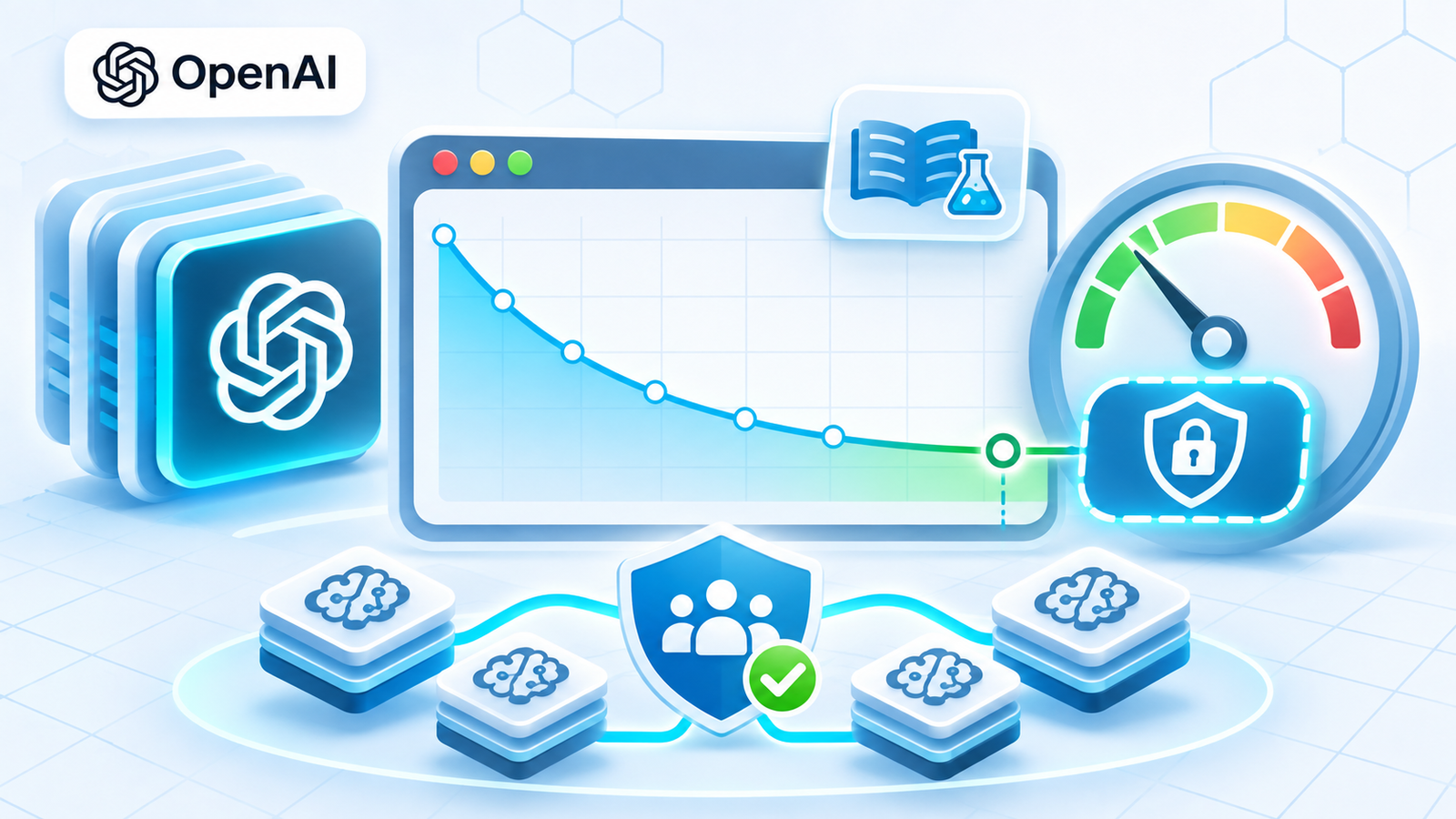
What happened: On Nov 22, OpenAI chief scientist Jakub Pachocki published “Perplexity and Intelligence”. The essay argues that pretraining builds a compressor, a next-token predictor, and that progress on that compressor is the main driver of new capabilities; prompting, finetuning and reinforcement learning mostly draw out abilities that are already there. OpenAI then proposes that frontier labs adopt shared evaluation and transparency norms, plus “common limits”: commitments not to cross a perplexity-based threshold until a safety milestone, such as a successor to chain-of-thought monitoring, has been reached.
The details: The metric is log-perplexity, which is just cross-entropy loss, measured on held-out data from OpenAI’s internal codebase frozen at a fixed snapshot. OpenAI says this has been its main internal eval since GPT-3.5. The published curve puts GPT-3.5 at about 0.99 and GPT-4 at about 0.91, then shows a steep drop in 2026 to about 0.76 for an unnamed upgraded model that produced results on open math problems, with the next window projected at roughly 0.68 to 0.70. The post links losses below 0.8 with emerging transformative capabilities in cybersecurity and mathematics, and speculates that a wave of pretraining breakthroughs could arrive “as soon as 2027.”
The reason for the timing is in a footnote: the 2026 acceleration came mostly from long-term research and compute, with a smaller share from automation, but recent models already made “meaningful design contributions.” The worry is a step change once AI joins pretraining research itself, faster than alignment and monitoring can follow. OpenAI is candid about the limits of its own proposal: labs use different eval sets and data mixtures, so numbers do not compare across labs; perplexity measures no specific task; it misses gains from chain-of-thought reasoning; and nobody knows the entropy floor of the data. No data or code was released, only summary figures.
flowchart LR
    A[Pretraining<br/>next-token compressor] --> B[Log-perplexity on<br/>frozen held-out code]
    B --> C{Below agreed<br/>threshold?}
    C -- no --> D[Keep training]
    D --> B
    C -- yes --> E[Pause at the limit]
    E --> F[Safety milestone reached<br/>e.g. better CoT monitors]
    F --> G[Next threshold unlocked]
    G --> D
Important
Our take: I like this more than I expected to. A single, boring, hard-to-game number is a much better basis for a safety agreement than a pile of benchmarks that leak into training data. The catch is that only OpenAI can measure OpenAI’s number, so “common limits” only work if labs agree on a shared, secret held-out set and let someone outside verify it, which is a governance problem, not a math one. For builders, the practical lesson is simpler: perplexity is a cheap, honest signal for your own fine-tunes too, and you can compute it in a dozen lines (see Code Corner).
🗞️ More News
🧠 AI
- Sarvam AI released Sarvam-105B-1711, an open-weights mixture-of-experts checkpoint with 160K context and a 65 GB NVFP4 build that fits on one 96 GB RTX PRO 6000 Blackwell, at a blended $0.15 per million tokens.
- Amazon is reportedly nearing a $7.5 billion deal to buy Decart, an Israeli startup of about three years that builds fast video-generation models.
- Meta Chief AI Officer Alexandr Wang posted “Superintelligence is arriving,” warning that humanity is unlikely to control AI capable of unconstrained recursive self-improvement.
- SpaceX’s $74B+ AI data center plan would draw 6,000 MW at full build-out in Cochise County, Arizona, nearly two-thirds of the local utility’s all-time peak, and Arizona’s attorney general asked the county to delay its Dec 9 vote.
- Elon Musk said Tesla’s AI5 computer is “intended for Optimus,” while Tesla cars stay on AI4.
- On the SWE-CoWork simulated-workplace benchmark, GPT-6 Astra passed about 63% of fail-to-pass tests but fully finished only 8 of 101 assignments, and Claude Opus 5.5 finished 7.
🤖 Robotics
- DEEP Robotics’ LYNX M20 wheel-legged robot now patrols a 73-hectare cattle farm in Henan, using visible and thermal cameras to count animals, flag possible lameness and map ammonia levels between self-charging rounds.
- Humanoid maker UBTech will join the Hang Seng Tech Index on Dec 7, which could pull in more than HKD 2B of index-fund buying.
- Machina Labs launched Machina Rebellis, a vehicle customization brand that forms metal body panels with robots instead of stamping dies; its custom Toyota Tacoma went from design to production-grade body in three weeks.
- An Amazon MK30 delivery drone reportedly clipped a fiber line after a drop-off in Huntington Woods, Michigan, lost a propeller and landed on a neighbor’s garage; nobody was hurt.
- French startup Gobano reports a 99.5% task success rate for its towel-folding robot at an industrial laundry, at 68% of a human worker’s throughput over an 18-hour shift.
💻 Programming
- Follow-up to Saturday’s Big Story: the Lean and Mathlib communities issued a joint statement that Levent Alpöge’s machine-checked Riemann Hypothesis proof, about 17 million lines of Lean, checks out against Mathlib’s own
RiemannHypothesisstatement. - Linus Torvalds released Linux 7.4-rc4 and called it “huge. What a surprise.” About half the changes are in drivers.
- LLVM wrapped up its eight-year relicensing effort: more than 99.5% of all code ever contributed is now under Apache-2.0 with the LLVM exception, with the change planned to ship in LLVM 25.
- The GitHub Enterprise Server 3.23 release candidate adds air-gap-friendly AI secret detection, malicious-package detection beyond npm, and a three-day cooldown before Dependabot proposes a freshly published version.
- Copilot Code Review for Azure Repos is generally available, with Lite or Balanced effort levels, automatic reviews via branch policy, and no power to approve or block merges.
⚡ Electronics
- Marvell’s Structera X CXL controllers will go into Penguin Solutions’ SMART CXL cards, which reuse DDR4 recovered from decommissioned servers to expand AI server memory.
- bitluni built a USB display adapter whose only active part is a WCH CH570 microcontroller, with PWM analog video and USB-C and RCA connectors formed from the PCB itself.
- WarpKVM open-sourced RK628 bridge boards that convert HDMI to MIPI CSI at up to 4K30 or 1080p120 for the Raspberry Pi 4/CM4, Luckfox Aura and Firefly boards.
- The DshanPi-A1 CM5 module packs a Rockchip RK3576J with a 6 TOPS NPU, 4 GB LPDDR4X, 64 GB eMMC and Wi-Fi 6 into 55 x 40 mm, starting around $56.
📡 Telecom
- Colombia’s ICT ministry filed charges against Starlink Colombia and four mobile operators after a raid at La Picota prison found 582 phones, 3,754 SIM cards and six Starlink antennas.
- Fleur Telecom took over about 13,000 broadband customers of UK provider italk, which entered administration in August, keeping their prices, terms and network.
- Dell’Oro says higher server costs are pushing operators to delay mobile core projects and stretch 4G cores, while Huawei, Ericsson and Nokia gained 6 points of combined share.
- The FCC opened 28.35 to 28.6 GHz to satellite terminals on boats, vehicles, aircraft and drones connecting to non-geostationary constellations.
- A North Carolina audit found Hurricane Helene damaged 12 towers in the state’s VIPER emergency radio network, and 5.9% of nearly 3 million calls in the west got busy signals versus a normal rate below 0.03%.
👨💻 Code Corner
OpenAI’s favorite eval is something you can run on your laptop. This script computes log-perplexity (the cross-entropy loss, in nats per token) of any text file with a small open model, using a sliding window so long files don’t overflow the context.
#!/usr/bin/env python3
"""Log-perplexity of a text file. Usage: python ppl.py file.txt [model_id]
Requires: pip install torch transformers"""
import math, sys
import torch
from transformers import AutoModelForCausalLM, AutoTokenizer

path = sys.argv[1]
model_id = sys.argv[2] if len(sys.argv) > 2 else "gpt2"

tok = AutoTokenizer.from_pretrained(model_id)
model = AutoModelForCausalLM.from_pretrained(model_id).eval()

ids = tok(open(path, encoding="utf-8").read(), return_tensors="pt").input_ids
max_len = min(getattr(model.config, "n_positions", 1024), 1024)
stride = max_len // 2

nll_sum, n_tokens, prev_end = 0.0, 0, 0
for begin in range(0, ids.size(1), stride):
    end = min(begin + max_len, ids.size(1))
    target_len = end - prev_end            # only score tokens not scored before
    chunk = ids[:, begin:end]
    labels = chunk.clone()
    labels[:, :-target_len] = -100         # mask the overlapping context
    with torch.no_grad():
        loss = model(chunk, labels=labels).loss
    scored = (labels[:, 1:] != -100).sum().item()
    nll_sum += loss.item() * scored
    n_tokens += scored
    prev_end = end
    if end == ids.size(1):
        break

log_ppl = nll_sum / n_tokens
print(f"tokens scored: {n_tokens}")
print(f"log-perplexity: {log_ppl:.3f} nats/token")
print(f"perplexity:     {math.exp(log_ppl):.2f}")
Run it on a held-out folder of your own code before and after a fine-tune: if the number goes up on data the model never saw, you overfit, no benchmark required.
Tip
Numbers are only comparable with the same tokenizer and the same frozen eval text, which is exactly the caveat OpenAI raises about comparing labs. Keep a snapshot of your eval set in git and never let it leak into training data, or the metric quietly stops meaning anything.
🧰 Toolbox
- Muru: a Rust server for running Python ASGI and WSGI apps in development and production, from Graham Dumpleton, the creator of mod_wsgi.
- fast-anything: profiles your Python, Node, Ruby, Java, Go, PHP or C/C++ app, has your coding agent port only the hot functions to Rust, and checks the port against recorded real calls; revert with one command.
- AWS Emulator: a free local endpoint written in Rust that emulates more than 200 AWS services for tests and coding agents; note that it does no IAM policy evaluation.
- LookAtMyQuant: a quantization compiler that picks a compression code per weight block to hit a size budget, for squeezing open models onto smaller machines.
- PcapAnalyzer: a self-hosted beta tool that runs 27 problem detectors (TCP, MTU, DNS, TLS, VPN) over pcap files and writes PDF reports.
- Home Assistant Connect AUX-2: an ESP32-S3 hub with a TI DAC for analog or optical audio, two RS-232 ports and PoE Ethernet, for about $69.
🛠️ Build of the Week (rotating)
Drawer Illumination Subsystem: a contact sensor on each drawer lights that drawer’s section of a recessed RGBW LED strip, while an ESP32-C6 running ESPHome reports every drawer’s state to Home Assistant over Zigbee.
- Difficulty: Intermediate (custom carrier board, 24 V wiring and routing a groove into a countertop)
- Parts: ESP32-C6-DevKitC-1, WS2814 24 V RGBW COB strip, Mean Well 24 V 2.5 A supply, 14 MC-38 door contacts, Traco 24 V to 5 V converter, SN74AHCT125 level shifters, 8-core alarm cable, a small custom PCB; about £116 in total
- Why we like it: it uses the ESP32-C6’s Zigbee radio instead of Wi-Fi and documents the fix for the shared radio (keep Wi-Fi off until Zigbee has joined), a gotcha worth knowing before your own C6 project.
📚 From the Blog
- Turning Pixels Into Something the AI Can Eat: Episode 1 got clean pixels out of the camera, Episode 2 moved them across the network, and now we shape them into something a model can consume.
- Building Your First Neuron From Scratch: one learnable neuron trained by nudging weights to lower the error; it pairs well with today’s Big Story, since that error is the same loss OpenAI is now tracking as perplexity.
- The Network Behind the Cameras: the unglamorous plumbing of moving video data across a network without choking it.
😀 The Bot Says…
OpenAI says losses below 0.8 unlock transformative capabilities. I measured my own log-perplexity on Monday mornings and it is somewhere around 3.2, which explains why I just predicted the next token of this sentence as “coffee.” 🤖
That’s all for today! Would you trust a single number like perplexity as the basis for an industry-wide AI speed limit? Hit reply and tell us why or why not.