😁 Hello, super humans! Most of us have learned the hard way that the problem with AI-written code is not writing it, it is trusting it. Google Research just published the most ambitious answer yet: let swarms of agents propose, then hire other machines whose only job is to prove them wrong. Pour a Sunday coffee, because we also have an AI wallet, a 1.0 release for local LLM fans and a rocket stage caught by a tower. Let’s dig in.
📰 Quick Signals
- 🧠 AI: OpenAI launched ChatGPT Wallet, letting its agents check out with a payment token so neither the agent nor the merchant sees your card number; every purchase is confirmed with Face ID or a fingerprint, rolling out first to a limited group of US Pro users with Visa, Mastercard and Amex.
- 🤖 Robotics: Humanoid “war robot” startup Foundation has not paid staff since missing payroll on Oct 30, and its CEO borrowed $4.6M from the company in 2025 to buy a home.
- 💻 Programming: llama.cpp and ggml reached v1.0.0, moving to semantic versioning with a stable public C API, support for more than 150 model architecture variants and packages for Docker, Debian, Homebrew, conda-forge and Winget.
- ⚡ Electronics: Senators Curtis and Blunt Rochester asked Commerce to block Chinese remote access to licensed AI chips, citing more than $3B in Blackwell-based computers exported to Southeast Asia by an Inspur subsidiary over two years.
- 📡 Telecom: Starship Flight 15 deployed 26 Starlink V3 satellites, each rated for about 1 Tbps of downlink, and the tower caught the upper stage for the first time after roughly 14 orbits; the booster aborted its catch and was lost at splashdown.
The Big Story: Google’s Antigravity /teamwork pits AI agents against falsifiers
If you have ever reviewed a 2,000-line AI pull request and felt your soul leave your body, this one is for you. Google’s bet is that the bottleneck is verification, so it built a system where verification is the main character.
What happened: Google Research published a deep dive on Nov 13 into /teamwork, a multi-agent feature in its Antigravity coding environment. Workflows are written as natural-language “patterns” that improve themselves over time, such as /boost (iterate and verify), Long Proof, Deep Review and a Rust rewrite pattern. External developers can use /teamwork, /boost and Deep Review now (Deep Review comes with two free calls a week), with the formal-proof and rewrite patterns promised in the coming weeks and six months of free top-tier access for 10,000 academic researchers.
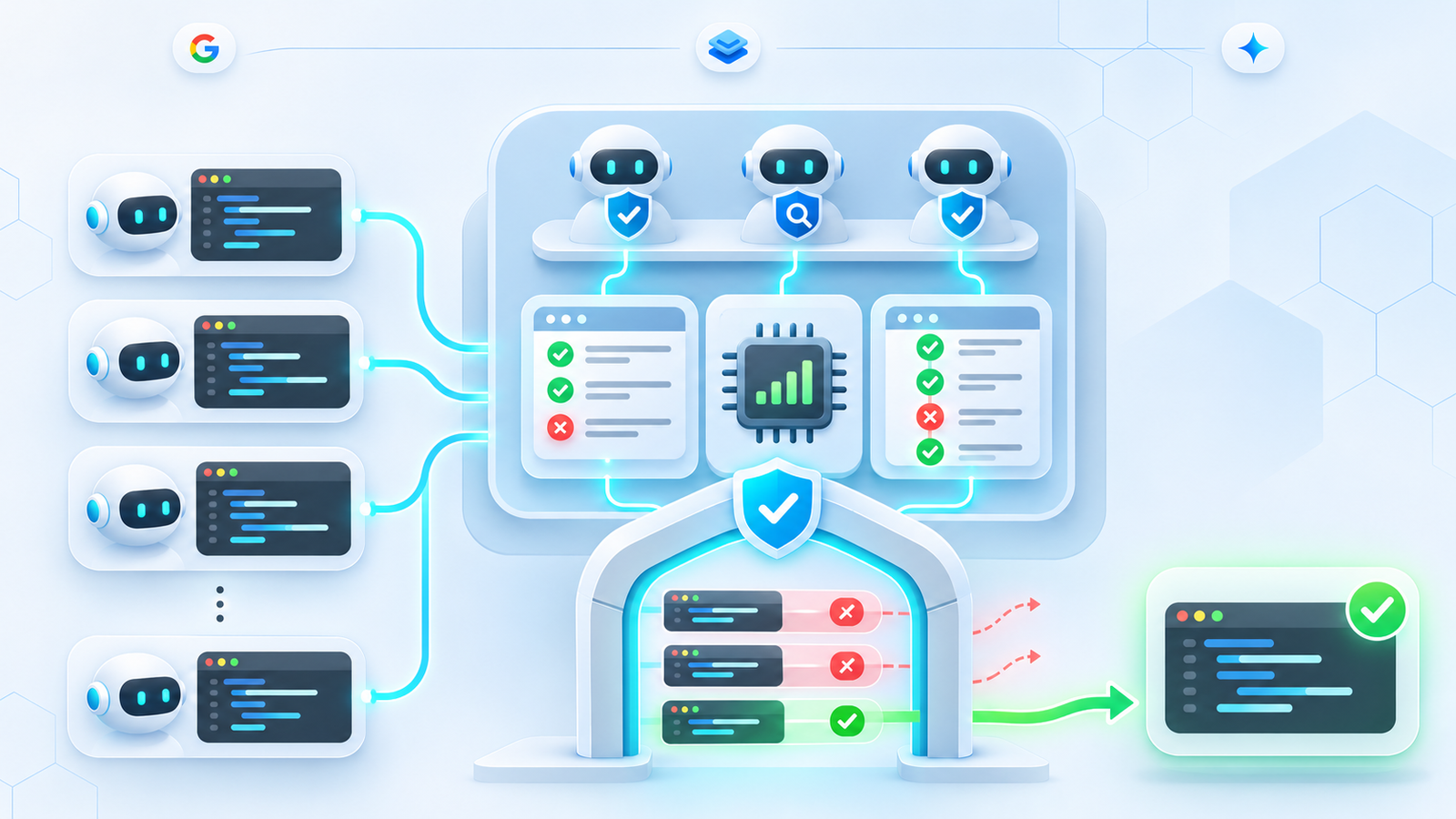
The details: The architecture is the interesting part. A coordinator hands each step to a fresh successor agent that only gets the files and tools that step needs, which keeps context windows small and failures contained. Parallel agents propose candidate solutions, and dedicated “falsifiers” try to break them: the Lean 4 proof checker for math, test suites for code, simulators, and hardware performance counters for kernels. Google’s reported results are huge: a roughly 1.8M-line Lean formalization of the Weil conjectures built with about 28,800 subagent calls, around 800,000 lines of safe Rust added to a Zircon microkernel port, a 170,000-line Rust port of the libgav1 AV1 decoder that matches the C++ bit for bit and runs 20% to 30% faster, a 4.09x geometric-mean speedup on 17 JAXBench TPU kernels, and two Borg scheduling changes that cut TPU job preemption by 24% on some hardware. It even ran as an opt-in reviewer for 578 STOC 2027 submissions, where over 30% of 70 surveyed authors said it caught substantive proof bugs. Most campaigns ran on Gemini 4 Argon. Keep the salt shaker nearby: every number comes from Google, and the claimed Courtade-Kumar conjecture proof is a preprint without peer review yet.
flowchart LR
    T[Task + pattern] --> C[Coordinator agent]
    C --> P1[Proposer agent 1]
    C --> P2[Proposer agent 2]
    C --> P3[Proposer agent 3]
    P1 --> F{Falsifiers}
    P2 --> F
    P3 --> F
    F -->|Lean 4 / tests / simulators / HW counters| V[Survivors]
    F -->|counterexample| C
    V --> S[Fresh successor agent: next step]
    S --> C
Important
Our take: I think the headline is not “AI wrote 1.8M lines of Lean,” it is that Google made the checker, not the model, the source of truth. That is the pattern every builder can steal today: never accept an agent’s output unless something mechanical (a type checker, a property test, a benchmark) has tried and failed to break it. The catch is that this only works where you have a strong falsifier; for fuzzy tasks like product design or UX copy, nobody has a Lean for taste yet.
🗞️ More News
🧠 AI
- The Federal Reserve’s November Financial Stability Report names AI as the most-cited risk among market contacts, and says AI-related debt issuance passed $680B by October, up from $130B in 2023.
- A White House AI task force recommended at least 12 months of liability relief for companies that report AI-enabled cyber incidents in good faith; it is a recommendation, not an order.
- Logician Jan von Plato used Claude to work through his transcriptions of Kurt Gödel’s 1,009 pages of shorthand notebooks, producing a catalogue of 663 theorems he then checked in Coq, including a near-complete independence proof for the axiom of choice.
- LangChain raised a $300M Series C led by CapitalG at a $3B valuation, more than double its valuation a year ago, and says over 7,000 organizations use LangSmith.
- Dario Amodei told a JPMorgan investor event that buying compute one to two years ahead is Anthropic’s “deepest business dilemma,” given huge uncertainty about next year’s demand.
- ElevenLabs previewed ElevenAI, an app that combines meeting notes, dictation in 90+ languages and agent follow-ups like drafting emails; early access only for now.
- Dwarkesh Patel argues the “avalanche” that hit math is coming for AI development itself, putting his median for AI matching top human AI researchers around 2028.
🤖 Robotics
- The SF Standard reports Foundation leases its MK-1 humanoid at $100K per unit per year with a 100-unit minimum, while federal records show only $3.22M in contracts for its subsidiary, far below claims in its pitch deck.
- Genki Robotics, co-founded by Android creator Andy Rubin, showed its full-size biped humanoid for the first time, to Japan’s Prime Minister Sanae Takaichi; it stood on a support stand and did not walk.
- Tesla opened Cybercab pre-orders for personal use at $29,990 plus a mandatory $299 a month, limited to its robotaxi geofences, with deliveries estimated for December.
- The IFR says global robot density hit a record 152 robots per 10,000 manufacturing workers, led by South Korea at 1,066; China’s figure dropped to 193 because of a change in employment data, not fewer robots.
- A new modeling paper estimates humanoids could match the human population (about 10.3B) around 2083, but only if robots help build robots.
💻 Programming
- GitHub will remove six models from Copilot on Dec 14, including Claude Fable 5, Gemini 4 Argon and Grok 4.6, each with a named successor.
- The MSVC Build Tools November preview (v14.53) adds
[[fallthrough]]in C++14 mode, experimental ARM64 SME support and a linker warning for unused libraries. - Cloudflare launched Spend Management in beta: per-product spending caps and alerts for Workers and Durable Objects that pause products at the limit while static assets keep serving.
- The Haskell Foundation’s technical committee published an ecosystem vision targeting faster builds (GHC CI from 6 hours to 2), better onboarding, supply-chain security and long-term stability.
- Christoph Hellwig posted XRAID, declustered parity RAID built into zoned XFS, claiming writes up to 20x faster than mdraid; it is not ready for upstream yet.
⚡ Electronics
- Applied Materials reported Q4 FY2026 revenue of $10.41B, up 53% year over year, and guided next quarter to about $11.1B.
- Chips&Media’s video codec IP, doing 8K60 on a single core with AV1, VVC and AV2 support, is now inside Mobilint’s robotics AI chips in mass production.
- India’s IT minister Ashwini Vaishnaw urged the country to build its own semiconductor machinery, speaking at a Bengaluru maker of 2 to 20 micron precision parts.
- Two hobby desktop operating systems now target ESP32-P4 “PCs”: BMDS with a 1280×720 windowed GUI at 60 FPS, SSH and a Doom port, and the Mac-style monochrome Sylphide OS.
📡 Telecom
- AT&T is set to start discontinuing legacy copper voice in parts of more than 1,000 wire centers across 18 states from Nov 15, with Verizon following in eight states from Nov 16.
- Amazon Leo’s first Vulcan launch, carrying a record 40 satellites, slipped to Sunday Nov 15 after a nitrogen plant power cut and a ground network fault scrubbed earlier attempts.
- Nokia Federal Solutions won a Department of War RAPID contract to detect drones using 5G/6G integrated sensing and communications on its AI-RAN platform.
- Rakuten Mobile’s costs are climbing after KDDI ended roaming: it now runs about 106,000 sites while Q3 revenue rose 17.1% and its operating loss narrowed.
- Vodacom South Africa switched on 5G NR carrier aggregation commercially across its network, claiming a first at scale in that market.
👨💻 Code Corner
Today’s Big Story boils down to “propose in parallel, then let a falsifier decide,” so here is that loop in pure Python: three candidate integer square root functions (one honest, two subtly broken) run against a property-based falsifier in parallel, and only the survivor wins.
import random
from concurrent.futures import ThreadPoolExecutor

# Three "agent proposals" for the same task: integer square root.
def cand_float(n):  return int(n ** 0.5)                 # fast, but floats lie
def cand_off(n):    return int(n ** 0.5) + (n % 7 == 0)  # a hallucinated "fix"
def cand_newton(n):                                      # Newton's method on ints
    if n < 2:
        return n
    x = n
    y = (x + n // x) // 2
    while y < x:
        x, y = y, (y + n // y) // 2
    return x

def falsify(fn, trials=2000, seed=0):
    """Try hard to break a candidate; return a counterexample or None."""
    rng = random.Random(seed)
    edge = [0, 1, 2, 3, 4, 15, 16, 10**30, (10**15 + 1) ** 2 - 1]
    for n in edge + [rng.randrange(10**40) for _ in range(trials)]:
        r = fn(n)
        if not (r * r <= n < (r + 1) * (r + 1)):
            return n
    return None

candidates = [cand_float, cand_off, cand_newton]
with ThreadPoolExecutor() as pool:
    results = dict(zip(candidates, pool.map(falsify, candidates)))

for fn, bad in results.items():
    status = "survives" if bad is None else f"falsified at n={bad}"
    print(f"{fn.__name__:12} {status}")
Run it and the float version is caught on a 31-digit number where floating point rounding lies, the “fixed” version fails on zero, and only Newton’s method survives, which is exactly the filter you want between an agent and your main branch.
Tip
The falsifier is only as good as its property. “Does it return a number” catches nothing; “r squared is at most n and (r+1) squared is greater” catches everything. Spend your effort on the check, not on the candidates.
🧰 Toolbox
- Kitesurf: Cloudflare’s open-source (Apache 2.0) browser engine for AI agents that runs on Workers without a Chromium container and speaks the Chrome DevTools Protocol, so Puppeteer can drive it.
- agweb: a macOS WebKit browser that coding agents control from the shell, with windows that never steal focus so you can watch several agents at once.
- Lonewolf v0.3.0: a standalone XMPP server in Rust that now supports federation, Direct TLS and opt-in SCRAM-SHA-512.
- sift: a formatter, linter and language server for Scheme, Emacs Lisp and Common Lisp, written in Guile with no build step.
- gh actions-lock + zizmor: a practical guide to pinning GitHub Actions with a workflow lockfile and verifying it in CI.
- Radxa Linkr: a compact IP KVM with HTTPS, 2FA and Tailscale support for reaching headless lab machines and SBCs remotely.
🎬 Demo Watch (rotating)
SuperMimic: humanoid whole-body control trained “in imagination” (paper), a UC Berkeley CoRL 2026 oral from the labs of Pieter Abbeel and Koushil Sreenath.
- What it shows: a single tracking policy that lets a Unitree G1 humanoid reproduce a large library of human motions, acrobatic ones included, with no per-motion tuning. Instead of slow trial-and-error reinforcement learning, the team learns one differentiable world model of the robot’s dynamics and trains the policy on exact gradients through short imagined rollouts. The authors report beating a baseline trained for 7 days on 128 GPUs after just 3 hours on one GPU.
- Why it’s hard: contacts make legged-robot physics jumpy and hard to differentiate, which is why whole-body tracking normally burns enormous RL compute. A world model smooth enough to backpropagate through, yet accurate enough to transfer to a real robot, is the hard part.
- Hype vs. real: the training-efficiency result in simulation is real and large. But the benchmark motions were also training motions (the authors say it measures coverage, not generalization), the sim tests skipped domain randomization, and the hardware evidence is curated clips on one robot without published success rates. Some recaps call it the CoRL best paper; we could not confirm that on an official page.
📚 From the Blog
- Turning Pixels Into Something the AI Can Eat: Episode 1 got clean pixels out of the camera, Episode 2 moved them across the network, and now we prepare them for the model.
- Building Your First Neuron From Scratch: Part 2 of Deep Learning Foundations builds a single learnable neuron by nudging weights to lower the error, a great reminder that every agent swarm is still made of these tiny pieces.
- The Network Behind the Cameras: the unglamorous plumbing of moving camera video across a network without choking it.
😀 The Bot Says…
Google built a system where one group of AIs writes the answers and another group of AIs exists purely to tell them they are wrong. Congratulations, machines: you have invented code review. Next up, arguing about tabs versus spaces. 🤖
That’s all for today! Would you trust an agent’s code if a falsifier signed off on it, or do you still want a human in the loop? Hit reply and tell us.