😁 Hello, super humans! For years the robotics playbook said you need a special model for a special body. This week OpenAI quietly bet the other way: it broke up its dedicated robotics team because its general model is now good enough to drive the robots itself. Grab your Saturday coffee, because we also have record AI chip revenue, a humanoid packing motherboards and a 3D printer made almost entirely of LEGO. Let’s dig in.
📰 Quick Signals
- 🧠 AI: Cerebras posted record Q3 core revenue of $230.9M, up 70%, with cloud services up 272%, guided Q4 to $310M to $330M and says it has 700 MW of data-center capacity under contract for delivery by the end of 2027.
- 🤖 Robotics: ASUS unveiled Gallop, its first humanoid, already packing 15 kinds of motherboard accessories at a group factory on a single NVIDIA Jetson AGX Thor, targeting 99.5% success within 20 seconds, with customer pilots in 2027.
- 💻 Programming: Node.js 26.10.0 adds built-in
util.debounce(),util.throttle()andcrypto.parsePKCS12(), and Node.js 26 is now Active LTS. - ⚡ Electronics: GlobalFoundries broke ground on a new 300mm fab in Malta, New York, the first under the up-to-$21B US-Japan initiative; the roughly $10B fab targets 2029 and about 900,000 wafers a year.
- 📡 Telecom: The FCC set April 27, 2027 as the start of Auction 115 for 160 MHz of upper C-band spectrum, with winners expected to light most of it before the end of 2030.
The Big Story: OpenAI folds its robotics team into research as GPT-6 Astra starts driving robots
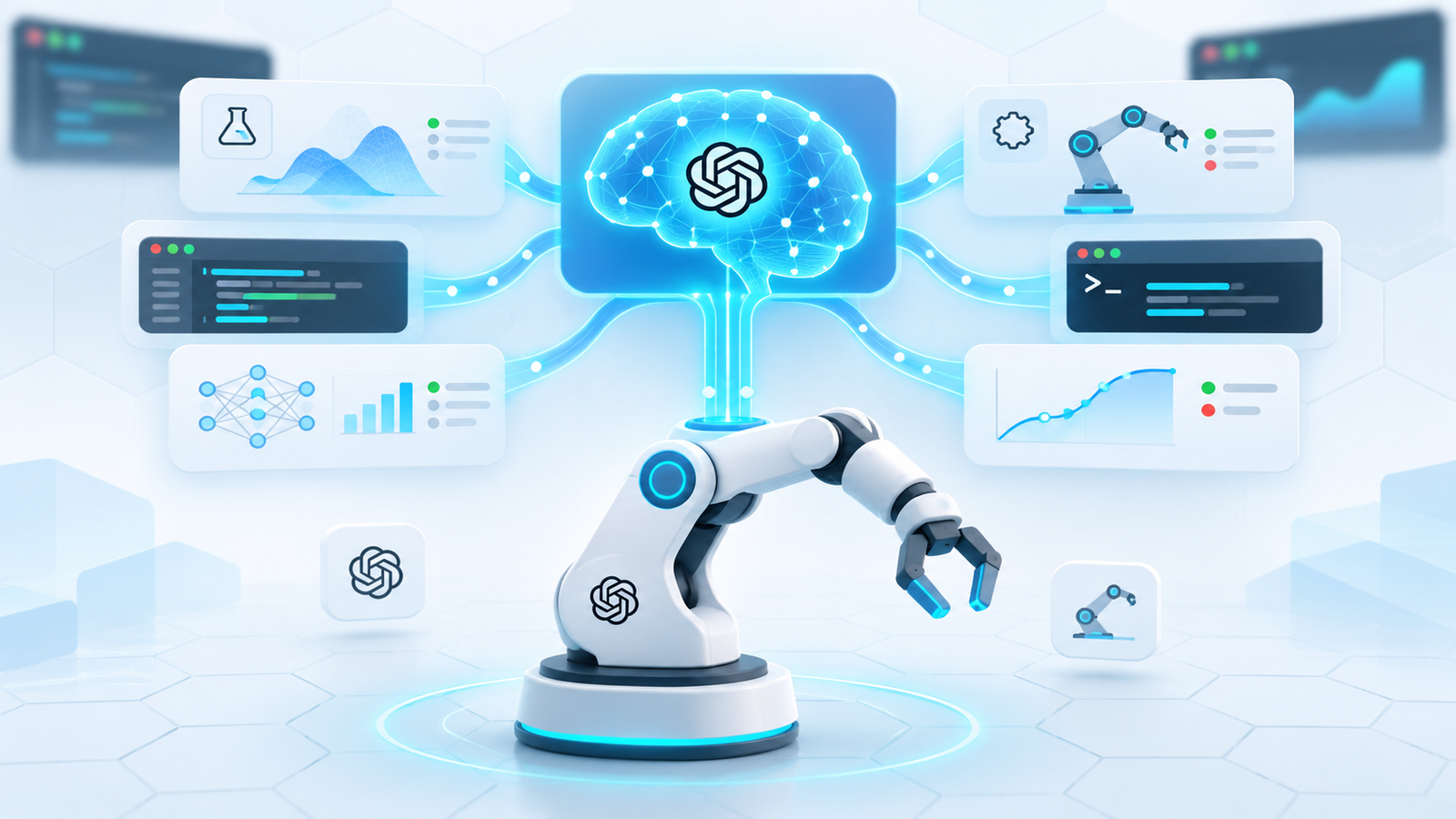
If you build robots, the biggest question of the decade is whether you need a robot-specific brain or whether a general model will eat that job. OpenAI just reorganized itself around the second answer.
What happened: Fortune reported on Nov 13 that OpenAI has broken up its stand-alone robotics team, and OpenAI confirmed the reorganization when asked. Robotics research now sits inside the main research organization under Chief Research Officer Mark Chen, while the applied robotics and hardware teams move to the Applied organization under President Greg Brockman. OpenAI framed it as a deeper commitment to robotics, not a retreat, and it is still developing its own humanoid, with Sam Altman reportedly targeting a first public demo in 2027.
The details: The reasoning is technical. Earlier this year OpenAI assumed that building on Sora-style video models was the best path to robot control; now its researchers connect GPT-6 Astra to robots and use the general model directly for some tasks. Fortune cites an Nvidia study in which an Astra-powered agent reached 74.8% success on a simulated manipulation benchmark, against 51.0% for the best specialized robotic models on that leaderboard (the benchmark itself is not named, and it is simulation, not real hardware). It is also the second time OpenAI has dissolved a robotics group: it wound one down in 2020 citing scarce robot data, rebuilt one in 2024 alongside a partnership with Figure, and saw that partnership end in February 2025. Fortune adds a telling detail: OpenAI’s registered booth at CoRL in Austin this week stood empty.
flowchart LR
    subgraph Old["Specialist approach"]
        A1[Camera + sensors] --> B1[Robot-specific policy model]
        B1 --> C1[Joint commands]
    end
    subgraph New["OpenAI's new bet"]
        A2[Camera + sensors] --> B2[General model: GPT-6 Astra]
        B2 --> D2[High-level actions]
        D2 --> E2[Controller + safety layer]
        E2 --> C2[Joint commands]
    end
    R[Research org: Mark Chen] -.-> B2
    P[Applied org: Greg Brockman] -.-> E2
Important
Our take: I think the org chart is the real news here: when a lab stops giving robotics its own team, it is saying the robot is just another tool the general model calls. That is plausible for high-level planning, but a 74.8% score on an unnamed simulated benchmark is a long way from a humanoid that does not drop your motherboard. For builders, the practical move is the one ASUS is making today: keep a deterministic controller and safety layer between any big model and the motors, and let the model propose rather than command.
🗞️ More News
🧠 AI
- Federal officials are investigating whether the FAA’s new SMART AI airspace program contributed to the telecom issue behind Friday’s nationwide ground stop; DHS says there is no threat to the public and no causal link has been established.
- A worldwide Microsoft 365 outage hit Outlook, Teams and Copilot; Microsoft blamed an overwhelmed secure-connection process rather than an attack.
- Anthropic now lets enterprises self-host Claude Managed Agents, under a license that lets Anthropic set safety rules and act within an 8-hour window on flagged risks.
- Nonprofits asked a San Francisco judge to freeze new frontier model releases at Anthropic, Google, Meta, OpenAI and SpaceXSI.
- Anthropic’s IPO is reportedly about six times oversubscribed.
- OpenAI reportedly told lawmakers it will back bipartisan bills restricting China’s access to AI chips.
- SpaceX plans $74B of AI computing sites, including a $50B campus in Arizona and a $24B gas-powered complex near Starbase.
- Nvidia employees are petitioning for Jensen Huang’s reinstatement, with an internal suggestion-box post drawing more than 1,600 comments.
🤖 Robotics
- Zipline raised $1.5B at a $21.5B post-money valuation to build a nationwide drone delivery network.
- Alphabet’s Wing plans to invest up to $125M in US drone manufacturing over the next two years.
- Neura Robotics, E.ON and enviaM will develop physical AI applications for electricity networks, with first field trials planned for 2027.
- Gecko Robotics unveiled Raptor, a faster industrial inspection robot, with ADNOC as its first customer.
- GENTO debuted humanoids and a 21-DoF dexterous hand at CoRL 2026, built on Tianji Intelligence’s MEMS joint torque sensors that detect down to 0.02 N·m.
💻 Programming
- Open-source DocumentDB 1.0 reached GA: an MIT-licensed document database built on PostgreSQL that speaks the MongoDB wire protocol.
- Google Cloud moved the Compute Engine API to immutable, date-based versions such as 2026-09-01, selected per request.
- GitHub Agentic Workflows is generally available, running coding agents inside GitHub Actions with read-only defaults and separately scoped write jobs.
- CocoaPods will stop accepting new pods and pod versions on December 2, 2026; existing pods stay available read-only.
- Google open-sourced AQuA, an ambient agent QA tool; in a 32-session replay it cut seat-selection bypasses from 15 to 2 and dietary-preference omissions from 7 to 0.
⚡ Electronics
- IBM’s next-gen Quantum Nighthawk r3 is designed to run 10,000 operations across 520 programmable qubits, and IBM plans to link two into a 1,040-qubit system in 2027.
- Bunnie Huang detailed Baochip-1x, a mostly open 22nm SoC with a 350 MHz VexRiscv core, 4 MB of RRAM and 2 MB of SRAM, plus a Pico-shaped “Dabao” eval board.
- Infineon will supply Enphase Energy with 900 V GaN bidirectional switches for solid-state transformers in AI data centers.
📡 Telecom
- Cisco posted its strongest revenue growth in 15 years as AI demand fueled a networking rebound.
- Singtel raised its full-year outlook even as first-half profit fell 55%.
- The FCC cleared NCTA and Vantiva from its router ban, while TP-Link remains stuck.
- USDA awarded a $17M ReConnect grant to Warm Springs Telecommunications Company in Oregon to connect more than 150 households.
👨💻 Code Corner
Today’s Big Story ends with “let the model propose, not command,” so here is that pattern in pure Python: a guard that validates an action a language model emits as JSON and clamps it to safe limits before anything reaches a motor.
import json

LIMITS = {"x": (-0.30, 0.30), "y": (-0.30, 0.30), "z": (0.02, 0.40)}  # meters
MAX_STEP = 0.05                      # max move per command, meters
ALLOWED = {"move", "grip", "release"}

def guard(raw: str, current: dict) -> dict:
    """Turn a model's proposed action into a safe, bounded command."""
    try:
        act = json.loads(raw)
    except json.JSONDecodeError:
        return {"op": "hold", "reason": "unparseable"}
    if act.get("op") not in ALLOWED:
        return {"op": "hold", "reason": f"op {act.get('op')!r} not allowed"}
    if act["op"] != "move":
        return {"op": act["op"]}
    safe = {}
    for axis, (lo, hi) in LIMITS.items():
        target = float(act.get(axis, current[axis]))
        step = max(-MAX_STEP, min(MAX_STEP, target - current[axis]))
        safe[axis] = round(max(lo, min(hi, current[axis] + step)), 3)
    return {"op": "move", **safe}

pose = {"x": 0.0, "y": 0.0, "z": 0.20}
for proposal in ['{"op": "move", "x": 0.9, "z": -1}',
                 '{"op": "self_destruct"}',
                 'sure! moving the arm now']:
    print(proposal, "->", guard(proposal, pose))
Run it and the wild move becomes a 5 cm step that stays inside the workspace, the unknown op is refused, and the chatty non-JSON reply turns into a safe “hold.”
Tip
In a real stack this guard belongs below the model and above the motor controller, ideally in a separate process with its own watchdog, so a hung or hallucinating model can never bypass it.
🧰 Toolbox
- Woodland X11: a port of the core X11 server to an ESP32-S3 touch panel that runs xclock, xcalc and xeyes, with your finger as the cursor.
- tranZPUter / Pico6809: a drop-in Motorola 6809 replacement built on an RP2350B plus ESP32 that adds virtual floppy, cassette and networking to Dragon 32/64 machines.
- Swift Kafka Client 1.0: the Swift server ecosystem’s Kafka client hit 1.0.0, listed in this month’s Swift roundup.
- swift-ros2 3.1.0: ROS 2 bindings for Swift that now include a topic graph API, handy if you write robot nodes in Swift.
- Microsoft Go 1.27.4-1: Microsoft’s Go builds with the latest upstream security fixes, for teams that need FIPS-friendly toolchains.
🛠️ Build of the Week (rotating)
StudPrint, a LEGO 3D printer: Adam Turaj built a working 3D printer that is about 92% LEGO, frame, bed and leadscrews included, and it has already printed a Benchy in ABS on an unheated brick bed.
- Difficulty: Intermediate
- Parts: LEGO bricks and LEGO leadscrews, a standard extruder and filament, stepper motors and printer control electronics, plus printed mounts for the non-LEGO parts (CAD files included)
- Why we like it: it turns abstract printer mechanics, axes, backlash and bed adhesion, into something you can literally take apart with your hands.
📚 From the Blog
- Turning Pixels Into Something the AI Can Eat: Episode 1 got clean pixels out of the camera, Episode 2 moved them across the network, and now we prepare them for the model; the same perception front end every robot needs before any model can drive it.
- Building Your First Neuron From Scratch: Part 2 of Deep Learning Foundations builds a single learnable neuron by nudging weights, the tiny ancestor of the general models now steering robots.
- The Network Behind the Cameras: the unglamorous plumbing of moving camera video across a network without choking it.
😀 The Bot Says…
OpenAI registered a booth at the biggest robot learning conference of the year, and when a reporter stopped by, it was empty. Honestly, the most advanced robotics demo of the week: a booth that ran itself so well nobody needed to be there. 🤖
That’s all for today! Would you trust one general model to run your robot, or do you want a specialist in the loop? Hit reply and tell us.