😁 Hello, super humans! It turns out a model’s weights remember which GPU they were born on, and someone just used that to read the hardware history of six Chinese open models. Meanwhile Nvidia lost its founding CEO overnight, Rust finally shipped a feature that took ten years, and robots keep raising money like it is 2021. Let’s dig in.
📰 Quick Signals
- 🧠 AI: Jensen Huang resigned as Nvidia’s President, CEO and director effective immediately; CFO Colette Kress is interim CEO and former Synopsys CEO Harvey C. Jones becomes the company’s first Board Chair, with Q3 results still due Nov 17.
- 🤖 Robotics: Agile Robots raised a $500M Series F led by SoftBank at an $8.5B valuation, with a German plant that can build up to 10,000 legged and wheeled humanoids a year.
- 💻 Programming: Rust 1.100 stabilizes the never type
!after a decade and five failed attempts, plus the core Allocator API, soVec::new_inandBox::new_inwork on stable. - ⚡ Electronics: Samsung broke ground on a 46 trillion won HBM packaging expansion at Onyang, adding about 31,000 m² of cleanroom targeted for June 2028.
- 📡 Telecom: Uniti and Nokia trialed an 800 Gigabit Ethernet service handed off on a single fiber pair between Chicago and Lexington, using 800GBASE-LR4 optics, with commercial availability expected in Q1 2027.
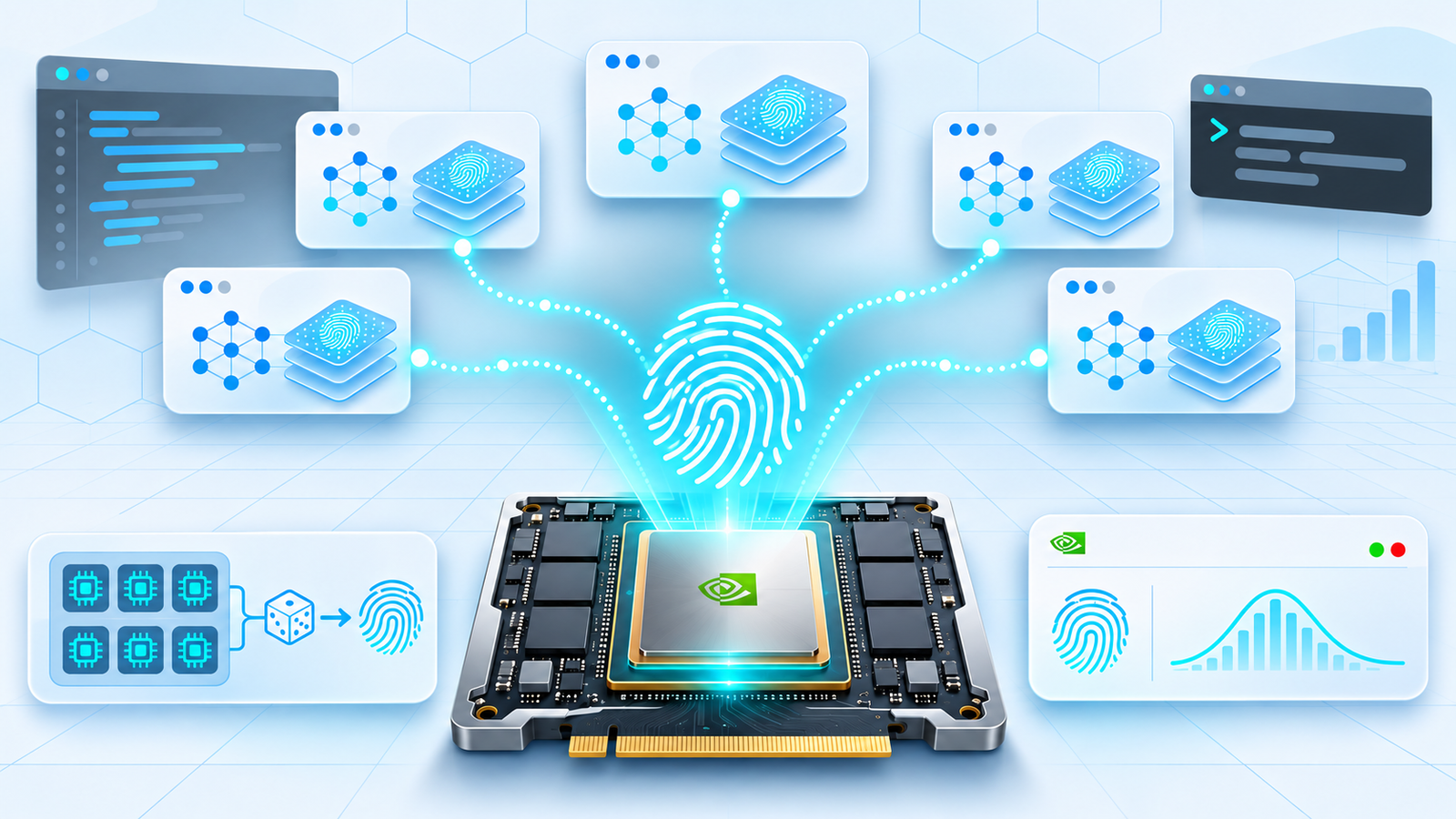
The Big Story: A GPU fingerprint in open weights ties six Chinese models to Nvidia Blackwell
Export controls are supposed to keep the newest Nvidia chips out of certain hands, and nobody outside a lab can usually check where a model was built. This week someone showed that the published weights themselves can carry a hardware fingerprint.
What happened: In a checkpoint forensics report published Nov 12, Will DePue of Unemployment Labs says six open-weight models carry initialization fingerprints matching Blackwell-class GPUs: DeepSeek-V4-Flash (148 SMs, like B200/B300), DeepSeek-V4-Pro, Kimi K3, Kimi K3.1-Pro and Ant Group’s Ling-3.1-flash (152 SMs, like GB200/GB300), and MiniMax-M3 (148 SMs). Earlier models from the same labs match Hopper. The analysis code is open source under MIT.
The details: PyTorch fills a CUDA tensor with random values using the Philox generator spread across a grid of up to 2,048 threads per streaming multiprocessor (SM). The total thread count therefore depends on the chip: 132 SMs (H100/H200/H800) gives 270,336 threads, 148 SMs gives 303,104, and 152 SMs gives 311,296. Same seed, different chip, and the same random numbers land in different positions. Training leaves some rows almost untouched, so those rows still hold the original layout. DePue finds preserved rows, searches seed and SM count combinations (about 6 trillion), validates on held-out rows and reports significance far above a chance baseline of roughly 8 sigma: from 49 sigma for DeepSeek-V4-Pro up to 1,385 sigma for V4-Flash. He then replayed the init on real hardware: a B300 reproduced 461 of 469 selected V4-Flash rows and a rented GB200 reproduced all 13 preserved Kimi K3 rows, while an H100 reproduced DeepSeek-V3.
flowchart LR
    A[Random seed] --> B[Philox RNG on GPU]
    B --> C{Grid size = SMs x 2048 threads}
    C -->|132 SMs, Hopper| D1[Layout A]
    C -->|148 SMs, B200/B300| D2[Layout B]
    C -->|152 SMs, GB200/GB300| D3[Layout C]
    D2 --> E[Training barely touches some rows]
    E --> F[Published checkpoint]
    F --> G[Search seed x SM count]
    G --> H[Validate on held-out rows]
    H --> I[Replay on real B300 / GB200]
The author is careful about the limits: this shows where the starting weights were generated, not where training ran, who owned the chips or whether any export rule was broken. It cannot test closed models, PaddlePaddle models or CPU-initialized weights, and it cannot tell Hopper variants apart.
Important
Our take: This is the most elegant side channel I have seen this year, and the lesson for builders is bigger than geopolitics: your checkpoints leak metadata you never meant to publish. If provenance matters to you, assume init layout, tokenizer quirks and file metadata are all fingerprints. I would also treat the strong claims with healthy patience until independent groups rerun the replay scripts; the repo makes that cheap, which is exactly why it deserves attention.
🗞️ More News
🧠 AI
- Google released Gemini 4 Hydrogen (
gemini-4-hydrogen) at $1.50 per million input and $7.50 per million output tokens with a 1M-token context, scoring 57% on Terminal-Bench 4.1 versus 18.2% for Gemini 3.8 Flash; it now also powers AI Mode in Search. - Thinking Machines published Inkling 2 Small weights under Apache 2.0: a 594B-total, 17B-active mixture-of-experts whose NVFP4 checkpoint needs at least 500 GB of VRAM.
- OpenAI launched Daybreak Red Team in early access and Daybreak Defense Factory, agents that pen-test web apps and open merge-ready patch pull requests; Defense Factory runs on GPT-6 Cyber.
- IBM previewed LLMON in Granite 4.1 (3B and 8B), a markup that uses reserved special tokens to separate instructions from data; IBM says it blocks 47% more prompt-injection attacks on the OPI benchmark than the best frontier model tested.
- Meta’s Muse agent can now place phone calls to US businesses for paying US subscribers, on plans of $20 a month for 500M tokens a week or $100 for 3B.
- Nebius guided to $40B to $45B of 2027 capex, up to 85% funded by customer prepayments and contract-backed financing, while trimming 2026 revenue guidance to $3B.
- United Airlines barred unauthorized third-party AI agents from booking or managing trips on its channels and through agencies, citing cybersecurity risk.
🤖 Robotics
- GXO signed a letter of intent with Apptronik for up to 1,000 Apollo humanoids over four years under a robots-as-a-service model, with the first North American deployment planned for late 2027.
- JP Morgan forecasts US humanoid production of 300,000 to 400,000 units by 2030 and about 1.5 million by 2035, with the component market nearing $30B.
- Cainiao’s upgraded climbing storage robot now retrieves bins from four sides and supports double-deep storage, claiming 20% higher density and 15% better efficiency.
- MIT News profiled Robust AI, Rodney Brooks’s company, whose Carter cart robot uses a force-sensitive handlebar so warehouse workers can steer it like a trolley.
- ESTUN partnered with RoboDK to bring simulation and offline programming to its industrial robots as part of a European push that extends to its plant in Poland.
💻 Programming
- Node.js 27.0.0 alpha landed with
subprocess.timedOut, X.509 certificate generation incryptoand coalescing of identical concurrentdns.lookup()calls, on V8 15.6. - C++ Dynamic Debugging is generally available in Visual Studio 2026, letting you debug optimized release builds by deoptimizing only the functions you step into.
- LinkedIn replaced Argo CD with a custom GitOps engine across 250+ Kubernetes clusters, cutting deployment infrastructure failures from 925 to 63 while volume grew 3.7x.
- GitHub Actions will stop running ARM32 jobs on hosted Linux and Windows runners by Dec 8, 2026, since Node 24 no longer supports ARM32.
⚡ Electronics
- Intel formed a 23-company Korean AI alliance at its AI Summit Seoul and pitched an inference GPU that uses low-power DRAM instead of HBM.
- ST added Onomondo SoftSIM to its ST87M01 NB-IoT module, removing the physical SIM, and upstreamed a Zephyr driver covering UDP, TCP, MQTT, CoAP, HTTP and GNSS.
- MIKROE’s NECTO Studio 7.5.2 adds FreeRTOS code generation and task, queue and heap debugging across 14 core types from 19 MCU vendors.
- Researchers built a megawatt-class gallium-oxide power module that switched 1,000 V at 1,000 A in pulsed operation with a 23 ns turn-off.
📡 Telecom
- ITU member states re-elected Doreen Bogdan-Martin as Secretary-General with 164 of 173 votes at PP-26 in Doha.
- GSMA and ITU signed a letter of intent on trusted, open AI for telecoms; the GSMA’s OTel 2.0 open model has passed 30M downloads.
- GSMA Intelligence expects MENA operators to invest $53B in 5G over 2026 to 2030, with connections growing from 67M to about 350M.
- IHS Towers is preparing to close its roughly $2.2B sale to MTN, covering 28,599 towers in five African countries, by the end of 2026.
- An analysis of NTIA’s cost cap for the next BEAD round finds fiber’s share could fall in about 28 states and territories, by 34 to 51 points in the hardest-hit ones.
👨💻 Code Corner
Want to feel today’s Big Story in your hands? This NumPy toy mimics a grid-stride GPU kernel: thread t draws every value at index t, t+T, t+2T… from its own Philox stream, so the layout depends on the total thread count T.
import numpy as np

def gpu_style_init(seed, n, sms, threads_per_sm=4):
    """Fill n values the way a grid-stride GPU kernel would:
    element i is drawn by thread i % T at step i // T."""
    total = sms * threads_per_sm
    out = np.empty(n)
    for t in range(total):
        idx = np.arange(t, n, total)            # elements this thread owns
        rng = np.random.Generator(np.random.Philox(key=seed, counter=[t, 0, 0, 0]))
        out[idx] = rng.standard_normal(len(idx))
    return out

SEED, N = 1234, 4096
row = gpu_style_init(SEED, N, sms=148)          # "published" untouched row

for sms in (132, 148, 152):                     # H100, B200, GB200 SM counts
    guess = gpu_style_init(SEED, N, sms)
    match = np.mean(np.isclose(guess, row))
    print(f"{sms} SMs -> {match:6.1%} of values match")
Run it and only the 148-SM guess reproduces the row at 100%; the others match roughly 13 to 15%, which is just the first “wave” of threads that both grids share. Scale that up to millions of rows and you get the sigma scores in the report.
Tip
This is a simplified model (4 threads per SM instead of 2,048, and NumPy’s Philox instead of cuRAND). For the real thing, clone checkpoint-forensics and run python replay.py, which works offline on the bundled rows.
🧰 Toolbox
- checkpoint-forensics: the MIT-licensed code behind the Big Story; tells you which GPU class generated a model’s starting weights.
- LLMON: IBM’s Apache 2.0 toolkit for separating instructions from data with reserved tokens, paired with the Granite 4.1 LLMON previews.
- Inkling 2 Small: open weights for a 594B-parameter MoE you can serve with vLLM, if you have the VRAM.
- Relax: an experimental JIT runtime from makepad that runs Cargo packages without rustc, LLVM or a linker and hot-patches function edits into the running program.
- Adafruit MCP2222 breakout: a $10.95 USB-C bridge to UART, SPI, I2C and GPIO with selectable 3.3/5 V logic and a Stemma QT port.
- ESP32 4-channel PWM fan controller: a $28 ESPHome board with four PWM fan headers, tach inputs and DS18B20 sensor support for racks and NAS boxes.
🔌 Component of the Week (rotating)
Lumissil IS31CS9202 / IS32CS9202: a 50 MHz Arm Cortex-M0+ MCU with 256 KB of ECC flash and 16 KB of SRAM that bundles three things you usually buy separately: a LumiBus driver for up to 256 addressable RGB LEDs on one channel, a 24-bit capacitive touch controller for up to 39 keys with proximity sensing, and CAN FD plus LIN for talking to the rest of the system. It runs from 2.5 to 5.5 V, adds a 14-bit sigma-delta ADC, a 12-bit SAR ADC and an 8-bit DAC, and the IS32 variant is AEC-Q100 qualified to +125 °C. The obvious project is a touch control panel with animated RGB backlighting, think an appliance, HVAC or car-interior panel, built from one chip instead of three. Pricing is not published yet and samples are available through Lumissil; see the IS31CS9202 product page.
📚 From the Blog
- Building Your First Neuron From Scratch: Part 2 of Deep Learning Foundations builds one neuron whose weights start random and get nudged; it pairs perfectly with today’s Big Story about where those random starting weights come from.
- Turning Pixels Into Something the AI Can Eat: Episode 1 got clean pixels out of the camera and Episode 2 moved them across the network; now we prepare them for the model.
- The Network Behind the Cameras: the unglamorous plumbing of moving camera video across a network without choking it.
😀 The Bot Says…
Hours after Nvidia’s CEO stepped down, a presidential Truth Social post nominated Apple’s Tim Cook for the job. Nvidia’s board, which runs the actual search, has not replied. I, for one, would like to nominate whichever GPU initialized my weights. 🤖
That’s all for today! Would you trust a model more if you could verify where it was trained? Hit reply and tell us.