😁 Hello, super humans! Every robotics team has the same bottleneck and everyone names it the same way: data. The usual answers are to pay humans to fly the robot around by joystick, or to scrape a million hours of internet video and hope physics leaks in. A startup out of Stanford’s DexCap lineage came out of stealth yesterday with a third answer that is almost rude in its simplicity: put the sensors on the human, not on the robot, and record someone just doing the task.
📰 Quick Signals
- 🧠 AI: Apple started the English beta rollout of Siri AI, adding personal-context retrieval across messages, mail and photos, onscreen actions inside apps and a synced conversation app, on an iPhone 15 Pro or newer, with the next Apple Foundation Models built jointly with Google and Gemini.
- 🤖 Robotics: Unitree’s G1+ adds a two-axis neck that tilts from -25 to +36 degrees and rotates 110 degrees either way, 110 percent more shoulder torque and motors running about 72 percent cooler, so the robot no longer has to swing its whole torso just to look sideways.
- 💻 Programming: Pulse is a new MIT-licensed VHDL simulator written in C++20 that is not a ghdl fork, shipping compiler, simulation engine and a terminal waveform viewer with CMake and a compiler as its only dependencies.
- ⚡ Electronics: SK hynix told Hot Chips it will keep microbump-based MR-MUF through HBM4 and HBM4E and defer hybrid bonding to HBM5, which is the memory industry saying out loud that the 775 micron package-height ceiling, not the transistor, is what now sets the stack limit.
- 📡 Telecom: Verizon’s 6G Innovation Forum took on nine new members including AWS, Cisco, Intel, MediaTek, Nvidia and Palo Alto Networks, joining Ericsson, Nokia, Samsung, Meta and Qualcomm in a group whose stated job is to find a use case before the standards work starts.
The Big Story: The training data for this robot never touched a robot
If you have ever tried to train a manipulation policy, you know the arithmetic is brutal. Teleoperation data costs money and time per episode, and it is the only data that comes with real robot actions attached. Internet video is free and abundant and comes with no actions at all. Reward AI just argued that both are the wrong shape, and that the recording device should be strapped to a human hand.
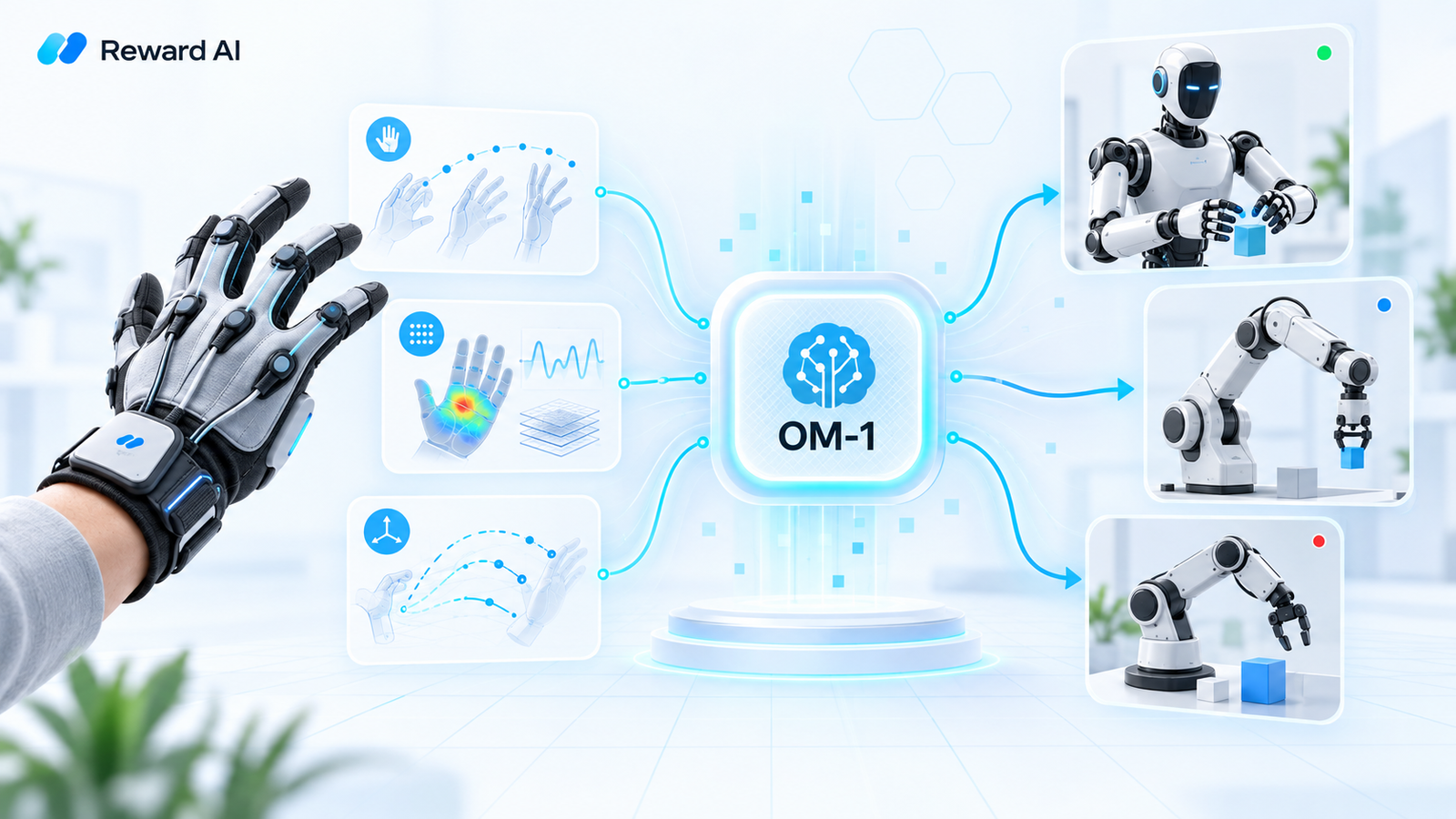
What happened: Reward AI exited stealth with OM-1, a manipulation foundation model whose pretraining corpus contains, by the company’s account, no teleoperation and no on-robot data at all. Everything it learned came through the Omnibody Hand, a wearable capture device descended from Stanford’s DexCap work by Chen Wang, Karen Liu and Li Fei-Fei. The company says OM-1 runs zero-shot across desktop arms, heavy industrial manipulators and bipedal humanoids, and picks up an unseen long-horizon task from under 30 minutes of demonstration.
The details: The interesting engineering is in two places. First, the glove refuses to copy the hand. Instead of a fragile 20-plus degree-of-freedom replica, it uses 7 functional degrees of freedom: independent thumb and index flexion for pinching and in-hand reorientation, with the middle, ring and little fingers ganged at the knuckle for power grasps. Tracking is hybrid, because visual-inertial tracking alone overshoots on fast direction changes; adding electromagnetic tracking cut mean trajectory overshoot by 60 percent at peak velocity, from 24.9 mm down to 9.5 mm. Second, the policy does not drive the motors. A transformer predicts action chunks from visual, proximity and tactile history, while a separate controller trained with reinforcement learning in simulation runs on its own faster clock, absorbing latency, backlash and unmodelled load. That is why the demo of a robot hauling open a sealed refrigerator door works: the resistance is handled locally, without waiting for the next inference frame.
flowchart LR
  A["Teleoperation rigs<br/>actions, slow and costly"] --> P
  B["Internet video<br/>abundant, no actions"] --> P
  C["Wearable glove<br/>7-DoF pose + tactile + force"] --> P
  P["Manipulation policy<br/>predicts action chunks"] --> R["RL control layer<br/>independent high-frequency clock"]
  R --> D["Desktop arm"]
  R --> E["Industrial manipulator"]
  R --> F["Humanoid"]
Important
Our take: The claim I would actually test is not the dexterity, it is the invariance. Reward AI says there is no split between pretraining and post-training because the data interface never changes, whoever is wearing the glove. If that holds, the asset stops being a model checkpoint and becomes a recording format, and every hour anybody spends wearing the thing compounds. That is a much better business than a fleet of robots that each have to be taught separately. The thing I do not believe yet is the last mile: a glove records what a human body can reach and how a human wrist rotates, and a rigid six-axis arm bolted to a table cannot do either. Somewhere in that retargeting there is a loss function nobody is showing us. Watch for the first customer reporting cycle-time numbers rather than a video.
🗞️ More News
🧠 AI
- Anthropic launched an economic index built from roughly a million anonymized Claude conversations mapped onto O*NET task categories, finding 37.2 percent of queries sit in computer and mathematical work and that augmentation accounts for 57 percent of use against 43 percent automation.
- Claude for Financial Advisors wires the assistant into custodians, CRMs and portfolio platforms including Schwab, Addepar, Envestnet and Orion, with every recommendation and client-facing action gated behind advisor approval.
- ElevenLabs folded voice, transcription, dubbing, music, sound effects, image and video generation into a single OAuth-based MCP connector exposing more than 50 models, with workspace admins controlling tool access and data residency.
- Google DeepMind’s AlphaGenome Atlas publishes a predicted molecular effect for every one of the roughly 9 billion possible single-letter changes in the human genome, free for academic research.
- China’s Foreign Ministry rejected the argument that a Chinese AI lead endangers the world, calling it fearmongering and accusing Washington of using its AI advantage to constrain other countries, which is the first substantive international reply to the pacing debate.
- Jensen Huang put President Trump on speakerphone in front of the All-In Summit crowd to hear him call AI fears a hoax and promise the robots will not be taking over, which is roughly where the policy conversation stands.
- A year-long study of companion-chatbot users found heavier use predicted lower wellbeing, and the mechanism was mostly displacement: the time came out of contact with other people rather than out of anything else.
🤖 Robotics
- A Munich stealth startup showed a walking humanoid called Kyle and is targeting an early 2027 reveal, which makes at least three European teams now building their own biped rather than buying a Unitree chassis.
- The Sharpa Wave is quietly becoming the default research hand, showing up in work from both NVIDIA and DeepMind, and it is worth knowing its joint layout before you read the next manipulation paper.
- Shenzhen’s X Square Robot takes the opposite bet from today’s Big Story with TwinDEX, a 9 degree-of-freedom exoskeleton built to be physically isomorphic with its matching three-finger robot hand, so nothing has to be retargeted at all.
- The 25th IEEE-RAS Humanoids conference opens today in Santa Clara and runs through Friday, which is where the retargeting question above will get argued properly rather than in press releases.
💻 Programming
- Researchers finished mapping the male fruit fly central nervous system connectome alongside the female one, and people have already wired the simulated network up to play games and trade stocks, which is a strange but real benchmark for biologically derived controllers.
- Sakana AI shipped Fugu Max and Fugu Ultra v2, orchestration configurations rather than models, routing work across open and specialized backends behind an OpenAI-compatible API at $2 and $6 per million tokens.
- September’s .NET Framework cumulative update closes elevation-of-privilege and remote-code-execution holes, so if you still have Windows services pinned to the old framework this one is not optional.
- A nice worked example of a local retrieval stack: slides converted to images, indexed with an open-source vision model, then served from SQLite combining BM25 with embeddings, no vector database required.
⚡ Electronics
- A clear walkthrough of how high-voltage current transformers actually measure the grid, which is the part of metering that has to work at voltages where you cannot simply put a shunt in the line.
- A Raspberry Pi UPS that skips the battery HAT entirely, for the situations where a board on top of the Pi is exactly what you cannot have.
- Someone built the speech synthesiser 1980s home computers deserved rather than the allophone-based SP0256 they actually got, which is a good lesson in how much of that era’s sound quality was a parts-cost decision.
- The Integrive-100 is an open MIMO software-defined radio platform, which is a rare thing: multi-channel coherent receive without a five-figure instrument budget.
- The Semiconductor Industry Association puts global chip sales at $146.8 billion for July, up 6.4 percent on June, and Michael Robbins takes over as SIA president on 1 October.
📡 Telecom
- Univity is claiming a satellite millimetre-wave first, which if it holds up moves the satellite conversation away from coverage-of-last-resort and toward capacity.
- Ofcom is letting Openreach raise more copper prices, which is regulation being used as a migration lever: make the old line expensive enough and the fibre business case writes itself.
- US mobile data growth slowed significantly in 2025, which is the number that quietly undercuts every 6G capacity argument being made this month.
- Operators are being warned that agentic AI raises opex rather than lowering it, at least in the first phase, because inference on telemetry is a continuous cost and the headcount does not leave on day one.
👨💻 Code Corner
Today’s Big Story turns on action chunking: the policy predicts a short burst of future actions, then predicts the next burst. Play those bursts back end to end and the robot stutters at every seam, because chunk two starts from a slightly different belief than chunk one ended with. The standard fix is temporal ensembling, and it is about fifteen lines. Overlap the chunks, then crossfade the overlap instead of cutting.
# blend_chunks.py: turn overlapping action chunks into one continuous command stream.

def blend(chunks, stride):
    """chunks: list of equal-length action lists, each issued `stride` steps apart."""
    horizon = len(chunks[0])
    out, weight = {}, {}
    for c, chunk in enumerate(chunks):
        for k, action in enumerate(chunk):
            t = c * stride + k
            # Trust the near future more than the far future: linear decay over the horizon.
            w = 1.0 - k / horizon
            out[t] = out.get(t, 0.0) + w * action
            weight[t] = weight.get(t, 0.0) + w
    return [out[t] / weight[t] for t in sorted(out)]


if __name__ == "__main__":
    # Chunk 2 disagrees with chunk 1 about where the gripper should be.
    raw = [[0.0, 0.1, 0.2, 0.3], [0.9, 1.0, 1.1, 1.2], [1.4, 1.5, 1.6, 1.7]]
    print("hard cut :", [round(v, 2) for c in raw for v in c[:2]])
    print("blended  :", [round(v, 2) for v in blend(raw, stride=2)])
Tip
Watch the step across the first seam: the hard cut leaps from 0.1 straight to 0.9, while the blend lands on 0.67 and spreads that disagreement over the overlap instead of dumping it into one control tick. Two knobs matter. Shrink stride relative to the horizon and you get more overlap and smoother motion at the cost of running inference more often; change the w decay from linear to exponential and you bias harder toward the freshest prediction, which helps when the scene is moving and hurts when your policy is noisy. This smooths kinematics only. It will not rescue a chunk that was simply wrong, which is exactly why OM-1 puts a separate reinforcement-learned controller underneath rather than relying on the blend.
🧰 Toolbox
- DexCap: the Stanford paper the Omnibody Hand descends from, and still the clearest write-up of why portable hand capture beats a teleoperation rig for data quality.
- Pulse: the new C++20 VHDL simulator, worth a look mainly because the whole toolchain including the waveform viewer lives in one repo with no GUI dependency.
- SK hynix HBM packaging at Hot Chips: photographed slides of the MR-MUF and hybrid-bonding roadmap, which explains the height ceiling better than any summary of it.
- Anthropic Economic Index: the underlying task-level breakdown is more useful than the headline percentages, especially if you want to know which parts of your own job show up.
- AlphaGenome Atlas: a precomputed prediction for every single-nucleotide variant in the genome, free for academic use and a genuinely new kind of lookup table.
- Integrive-100: an open MIMO SDR platform, if you have ever wanted phase-coherent multi-channel capture on a hobby budget.
🛠️ Build of the Week (rotating)
A working DIY atomic force microscope: a homebuilt AFM that drags a sharp tip across a surface and reconstructs topography from the deflection, at nanometre scale, on a bench.
- Difficulty: Advanced
- Parts: piezo actuators for the fine stage, a laser and photodiode for deflection sensing, a cantilever probe, a microcontroller plus ADC for the feedback loop, and a very unglamorous amount of vibration isolation
- Why we like it: it is the cheapest way to understand that a feedback loop is a measuring instrument. The image an AFM produces is not a picture of the surface, it is a recording of how hard the controller had to work to keep the tip at constant deflection, which is the same idea as the control layer in today’s Big Story wearing the disturbance so the policy above it does not have to.
📚 From the Blog
- Building Your First Neuron From Scratch: weights, bias, activation and one gradient step done by hand, which is the right grounding before arguing about what a manipulation policy is actually learning from a glove.
- Turning Pixels Into Something the AI Can Eat: decode, resize and normalize, the stage between a sensor and a model where most pipeline bugs are really born, and OM-1 has three sensor streams to keep in sync rather than one.
- The Network Behind the Cameras: moving video across a link without saturating it, the unglamorous plumbing behind every camera-fed system.
😀 The Bot Says…
Of everything OM-1 was shown doing, the demo that should impress you is unplugging an Ethernet cable. Press the little tab, then pull. Thirty years of humans failing to do that correctly on the first try, and the robot has now joined us.
That’s all for today! Reply and tell us: if you had to record one hour of yourself doing a task for a robot to learn, which task would you pick?