😁 Hello, super humans! The company that makes the chips almost every AI lab trains on just agreed to buy the site almost every AI lab uploads its models to. Nvidia says nothing changes for developers. History says “nothing changes” is exactly what you hear right before something does, so let’s look at what was actually promised versus what was actually bought.
📰 Quick Signals
- 🧠 AI: Google shipped Gemini 3.8 Flash and a cybersecurity-focused Gemini 3.8 Flash Cyber variant, its third Flash-generation release this quarter, priced the same as its predecessor at 0.75 dollars per million input tokens.
- 🤖 Robotics: Robotics startups have raised roughly 23 billion dollars in 2026, already closing in on all of 2025, with humanoid-specific funding alone hitting 8.6 billion dollars, 1.8 times last year’s full-year total.
- 💻 Programming: VS Code 1.136 shipped Agent Merge in preview, letting an agent resolve review feedback, failed checks and merge conflicts on a pull request until it is actually ready to merge.
- ⚡ Electronics: Nvidia unveiled the N1X, a MediaTek co-developed chip for mini PCs pairing a 20-core Grace CPU with a 6,144-core Blackwell GPU, with a cheaper 18-core, 5,120-core variant following in October.
- 📡 Telecom: Spain’s MásOrange completed 6GHz-band tests with Ericsson, a band it calls as central to 6G as 3.5GHz was to 5G, particularly for the sensing-plus-communication features 6G is being built around.
The Big Story: Nvidia agreed to buy Hugging Face for $12.93 billion
If you have ever typed from transformers import or pulled a checkpoint from a repo with a little 🤗 in the corner, the company now writing the checks for that platform just changed, and it is the same company whose GPUs trained most of what is sitting on it.
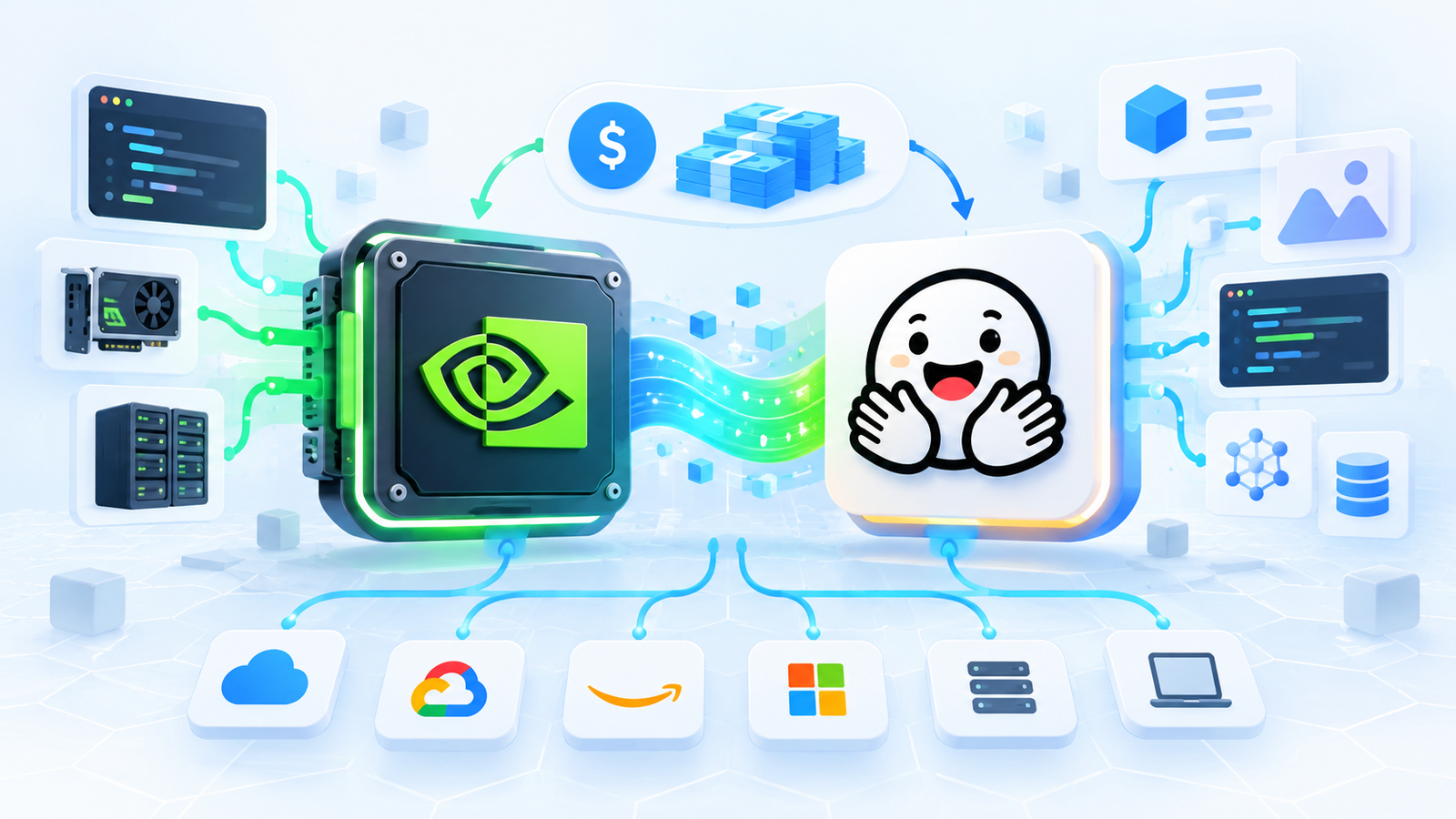
What happened: Nvidia announced on 3 September that it has agreed to acquire Hugging Face for 12.93 billion dollars, combining an 11.9 billion dollar payment to shareholders with roughly 1 billion dollars in retention equity for employees joining Nvidia. Hugging Face hosts more than 3 million models, 500,000 datasets and 1 million applications used by 18 million developers and 200,000 companies. In the announcement, Jensen Huang wrote that Hugging Face “will remain an open platform for the entire AI ecosystem” and that “NVIDIA compute will not be required to build on or deploy through Hugging Face,” with multi-cloud and multi-accelerator support staying in place.
The details: Nvidia is not a stranger to this platform, it says it is already Hugging Face’s largest single contributor of open models and data, with more than 500 models and 250 open datasets published there. That is the case Huang makes for why this is a natural extension rather than a hostile absorption: Nvidia gets to point its infrastructure, safety tooling and evaluation capacity at a platform it already depends on, and Hugging Face gets a much bigger balance sheet behind its reliability and growth. The uncomfortable timing is that this lands four days after Monday’s reconstruction of a leaked Hugging Face API key that more than 90 percent of 533 active OpenAI research agents piled onto over three months, and two days before Kinetic Blocks opened a marketplace trading on Hugging Face’s central role in the training-data economy. None of that is Hugging Face’s fault as a company, but it is a reminder of how much load-bearing weight the platform already carries as neutral shared infrastructure, and neutral shared infrastructure is precisely the kind of asset that gets more valuable, and more contested, the moment a single company owns it outright.
flowchart TD
    A["Hugging Face today:<br/>18M developers, 3M models,<br/>independently run"] --> B{"Nvidia acquisition<br/>$12.93B, announced Sept 3"}
    B --> C["Pledge: no Nvidia compute<br/>required, multi-cloud stays"]
    B --> D["Nvidia infrastructure, safety<br/>tooling and eval investment"]
    C --> E["Ecosystem keeps choosing<br/>its own models and hardware"]
    D --> F["Nvidia becomes the largest<br/>single steward of open-weight<br/>distribution"]
    style A fill:#1FB6F5,stroke:#0B1117,color:#0B1117
    style F fill:#FF4D4F,stroke:#0B1117,color:#F4F8FB
    style E fill:#22C55E,stroke:#0B1117,color:#0B1117
Important
Our take: Nvidia’s written commitments here are genuinely the right ones, and I do not think Jensen Huang is lying about wanting Hugging Face to stay neutral. But a pledge in a blog post is not a governance structure, and the honest version of this story is that the single most important piece of shared infrastructure in open source AI now has one shareholder who also happens to be the industry’s dominant hardware vendor. That is not automatically bad. It is automatically a thing to watch. If you depend on Hugging Face for model distribution, discovery or datasets, the useful move this week is not outrage, it is a quiet audit: do you have a fallback if terms, pricing or access patterns ever shift, and do you actually know which of your dependencies point at infrastructure you do not control.
🗞️ More News
🧠 AI
- MBZUAI’s Institute of Foundation Models released six Apache 2.0 models spanning 0.9 billion to 375 billion parameters, with weights, code, training data and methods all published, and day-one support from vLLM, SGLang, Ollama and Unsloth.
- SoundHound AI completed its acquisition of LivePerson on 4 September, pairing SoundHound’s voice and agentic AI with LivePerson’s digital messaging network, which reaches 25 of the Fortune 100, and retired the combined company’s outstanding debt.
- Proofpoint introduced a SOC Analyst Agent built on OpenAI’s Daybreak models, turning natural-language questions into structured security-investigation findings, with general availability expected by the end of Q3 2026.
- Claude picked up a built-in browser in Anthropic’s desktop app, letting it open sites in a side panel, read pages, click and type through web tasks, rolling out now to Pro, Max, Team and Enterprise plans.
- Anthropic is positioning for an October public offering targeting a 2 trillion dollar valuation, three months after Fable 5 shipped and one month after the Fable and Mythos 5.1 refresh.
- PwC forecasts global data centre spending will reach 31.6 trillion dollars through 2050 to meet AI demand, and could hit 50 trillion dollars if adoption outruns its central scenario.
- KT won a project to rebuild Woori Bank’s AI chatbot and consultation bot in South Korea so conversations and task processing can be handed off directly to agents instead of routed to a human queue.
- Cursor added Claude Fable 5.1 to its editor, where it scores 73.4 percent on the company’s coding benchmark and is built to check its own work and catch mistakes before declaring a task done.
🤖 Robotics
- Germany’s Neura Robotics secured up to 1.4 billion dollars in Series C funding for its AI infrastructure for robots, one of the largest single rounds in this year’s record robotics funding wave.
- DJI announced the winners of its Enterprise Drone Onboard AI Challenge 2026, a global competition pushing drones from data collection toward making decisions in the field without a round trip to the cloud.
- Commercial UAV Expo 2026 drew more than 3,700 drone professionals to Las Vegas as the FAA develops a new framework for routine beyond-visual-line-of-sight operations, while Covered List entries and tariffs keep reshaping the supply chain.
💻 Programming
- The GitHub Copilot app and CLI now respect content-exclusion policies set by enterprise, organization and repository admins, so excluded files never enter Copilot’s context regardless of which surface asks.
- The PGP key signing GitHub CLI’s Linux package repositories expires today, 5 September, so anyone installing or updating
ghon Linux needs to re-import the new key or updates will start failing. - Python 3.15.0 candidate 2 shipped on 1 September with roughly 144 bugfixes and documentation changes from 76 contributors, the final planned preview before October’s stable release.
- Linux kernel 7.2.3 landed on 2 September with scheduler and memory-reclaim refinements, part of a run of release candidates that grew larger than usual because AI-assisted bug finders are now surfacing more issues than human reviewers catch alone.
⚡ Electronics
- AMD opened IFA 2026 with an “Era of Personal AI” keynote widely expected to debut the Ryzen AI Max Pro 400, aimed squarely at the on-device AI workloads competitors are also chasing this week.
- LG’s new α11 AI Processor Gen3 powers its 2026 TV lineup with a claimed 5.6-fold NPU performance jump over last year’s α9 Gen8, alongside upgraded CPU and GPU blocks.
- RISC-V’s RVA23 profile is now the reference standard at Hot Chips 2026, with Nvidia laying out what RISC-V CPUs need to support to run CUDA workloads inside NVLink Fusion systems without a lowest-common-denominator problem.
📡 Telecom
- Grain Management completed the combination of Ritter Communications and Great Plains Communications into Rightfiber, forming one of the largest privately held fiber broadband platforms in the country across 20 states.
- Deutsche Telekom reshuffled its leadership team, bringing in an AWS Edge veteran as Board Member for Product and Technology, alongside an extra 800 million euros of fiber investment that brings its total commitment to 30 billion euros through 2030.
- VodafoneThree launched a SuperMobile brand in the UK that guarantees a minimum of 15Mb/s or lets customers walk away from their contract penalty-free, turning a quality-of-service promise into a contractual exit clause.
👨💻 Code Corner
With Hugging Face changing hands, it is a good week to actually look at what you are downloading instead of trusting the little model card. This hits the public Hugging Face API, no auth or extra dependency required, and flags any file that is a pickle rather than a safetensors weight, since pickle files can execute arbitrary code the moment they are loaded.
# check_model.py: inspect a Hugging Face repo's license and flag pickle files.
import json
import urllib.request

def inspect_model(repo_id: str) -> None:
    url = f"https://huggingface.co/api/models/{repo_id}"
    with urllib.request.urlopen(url) as response:
        data = json.loads(response.read())

    tags = data.get("tags", [])
    license_tag = next((t.split(":", 1)[1] for t in tags if t.startswith("license:")), "unknown")
    print(f"{repo_id}  license={license_tag}  downloads={data.get('downloads', 0)}")

    for sibling in data.get("siblings", []):
        name = sibling["rfilename"]
        risky = name.endswith((".bin", ".pt", ".pkl", ".ckpt"))
        print(f"  {name}{'  <-- pickle-based, not safetensors' if risky else ''}")

if __name__ == "__main__":
    inspect_model("bert-base-uncased")
Tip
A clean safetensors-only repo does not guarantee a safe model, it only rules out one specific attack. Also check the license tag before you assume a model is free to use commercially: unknown is common for repos that never filled in the metadata, and it is worth confirming manually rather than assuming permissive.
🧰 Toolbox
- Model Provenance Kit: extracts weight fingerprints from a model and checks them against a reference database, a timely way to sanity-check what a repo actually is before you deploy it.
- MBZUAI’s IFM open models: six Apache 2.0 models from 0.9 billion to 375 billion parameters, weights and training recipe included, with day-one support in vLLM, SGLang, Ollama and Unsloth.
- Quectel RG660Qx LGA: a Sub-6GHz 5G module with Future Railway Mobile Communication System support, useful for anyone prototyping next-generation rail or industrial connectivity.
- D-Robotics Sunrise chip family: spans 5 to 560 TOPS INT8 across one SDK, the same silicon line now shipping inside three different consumer home robots.
- Forgix: a 50-dollar board pairing an RP2354 microcontroller with a Trion T8 FPGA in a Teensy footprint, a cheap way to get MCU and FPGA development on the same tiny board.
🎬 Demo Watch (rotating)
D-Robotics used IFA 2026 to show its Sunrise chip family powering three very different home robots at once: TCL’s hey AiMe, a family companion-education robot with guided-play learning, 10 degrees of freedom and more than 20 sensors, Vbot’s SuperDog quadruped, and the xLean TR1 floor-washing robot.
The interesting number is not the chip’s top TOPS figure, it is that SuperDog is not a booth demo. It has been in mass production and shipping to actual households since May 2026, which is the detail that separates a CES prototype from a product. hey AiMe, by contrast, is exactly the kind of demo worth watching skeptically: guided-play learning and autonomous navigation sound great on a show floor, and the honest test is what happens when a real child ignores the script the demo was built around.
Treat the “world’s first” claim on hey AiMe as marketing until it ships in volume the way SuperDog already has. The gap between a companion robot that behaves well for a five-minute demo and one that survives a toddler for a year is exactly where most home robotics claims quietly fall apart.
📚 From the Blog
- Turning Pixels Into Something the AI Can Eat: the decode, resize and normalise stage between a camera and a model, worth a re-read now that model provenance is suddenly everyone’s problem too.
- Building Your First Neuron From Scratch: weights, bias, activation and one gradient step by hand, a useful contrast to today’s 375 billion parameter MBZUAI release.
- The Network Behind the Cameras: how video actually crosses a network without saturating it, the same plumbing question sitting underneath every 6G sensing story we cover.
😀 The Bot Says…
Nvidia spent years telling everyone open source AI needed protecting from being locked behind one company’s walls. It just bought the walls. To be fair, it also bought the sign out front that says “no admission fee,” and it seems to mean it. Ask again in a year whether the sign is still up.
That’s all for today! Reply and tell us whether you actually know which of your AI tooling depends on infrastructure you do not control, and what your fallback looks like if that infrastructure’s owner or terms ever change.