😁 Hello, super humans! Tesla waited years to put a robotaxi with no steering wheel or pedals on public roads, and federal regulators waited only a few hours to start asking how it got there. The mechanism behind that fast response is more interesting than the headline, so let’s look at what “self-certification” actually means and why it just became Tesla’s problem too.
📰 Quick Signals
- 🧠 AI: Google’s Gemini Spark can now act directly on a user’s Google Photos library, editing images, building shared albums and running multi-step workflows for Gemini AI Pro and Ultra subscribers.
- 🤖 Robotics: Robot.com signed a seven-year deal with Sodexo to expand its R-kiwi sidewalk delivery robots across North American college campuses, adding an advertising layer that turns each robot into a mobile billboard.
- 💻 Programming: Attackers exploited an already-patched TeamCity flaw, CVE-2026-63077, to breach JetBrains’ own Cadence cloud service between 8 and 24 August, stealing AWS credentials from a 2024 server backup.
- ⚡ Electronics: TP-Link unveiled its first Wi-Fi 8 lineup at IFA 2026, led by the tri-band Archer 8 Ultra router claiming up to 19Gbps combined wireless speed across 18 antennas.
- 📡 Telecom: Five Chinese government agencies launched a pilot to build 50,000 industrial 5G standalone private networks, aiming to push industrial-internet value past 2.5 trillion yuan by 2030.
The Big Story: Tesla’s driverless Cybercab drew a federal audit within hours of its first ride
If you have ever wondered what actually stands between a car company and the phrase “fully compliant with federal safety law,” Tesla just gave a live demonstration: it is largely the company’s own word, and that word is now under review.
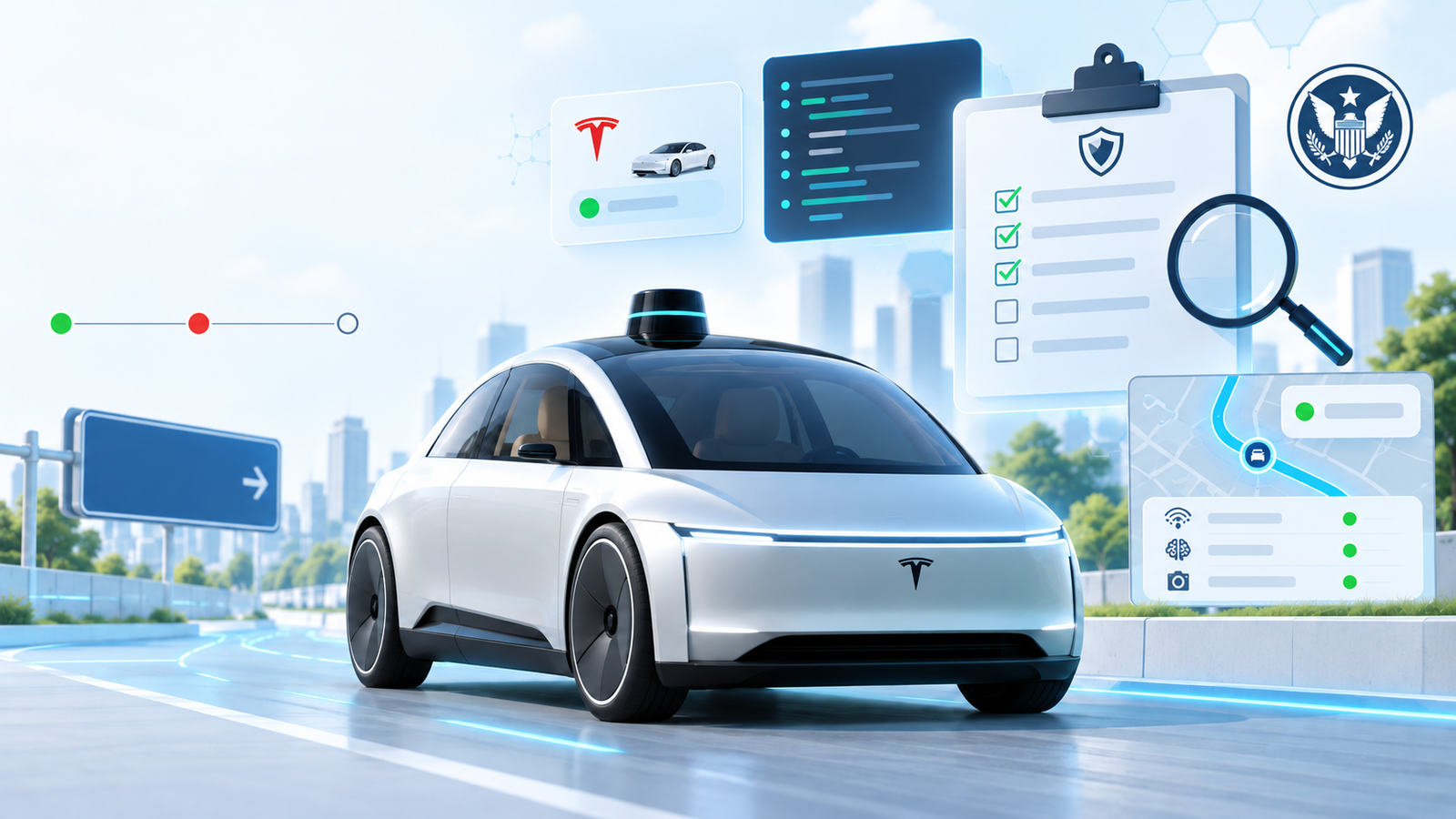
What happened: Tesla put its first production Cybercabs, which have no steering wheel, pedals or mirrors, onto public streets in Austin on 4 September. NHTSA announced that same morning that it had opened an Audit Query, AQ26002, into the technical data and process Tesla used to self-certify the Cybercab as meeting every applicable Federal Motor Vehicle Safety Standard. In the U.S., automakers self-certify compliance before a vehicle reaches the market, and the agency only investigates afterward if something looks off. NHTSA Administrator Jonathan Morrison put it plainly: “NHTSA fully supports the safe development and deployment of automated vehicles. But as the federal regulator, we need to ensure that all of our laws are followed.”
The details: the audit will specifically examine whether Tesla’s certification leaned on a determination that certain FMVSS requirements, the ones written around a human driver, simply do not apply to a vehicle with no human controls at all. That is not a new question for NHTSA. In 2022 it opened the identical audit query process against Amazon-owned Zoox for the same reason, and that inquiry helped stretch Zoox’s path to paid rides into a multi-year process: a special order in 2023, a demonstration-only exemption in 2025, and final approval for a temporary Part 555 exemption, capped at 2,500 vehicles a year, only in July 2026. The Department of Transportation has, in parallel, proposed dropping the brake-pedal and manual-control requirements for autonomous vehicles entirely, but until that rulemaking finishes, the old rules are what Tesla certified against. Whether Tesla gets Zoox’s multi-year timeline or something faster is now an open question with real commercial stakes attached.
flowchart TD
    A["Automaker builds a vehicle<br/>with no manual controls"] --> B["Automaker self-certifies:<br/>meets all FMVSS or<br/>standard ruled inapplicable"]
    B --> C["Vehicle sells or<br/>deploys commercially"]
    C --> D{"NHTSA reviews the<br/>certification basis"}
    D -->|"Zoox, 2022-2026"| E["Special order, demo-only<br/>exemption, then a capped<br/>Part 555 exemption: 4 years"]
    D -->|"Tesla, opened 4 Sept 2026"| F["Audit Query AQ26002:<br/>outcome and timeline unknown"]
    style A fill:#1FB6F5,stroke:#0B1117,color:#0B1117
    style F fill:#FF4D4F,stroke:#0B1117,color:#F4F8FB
    style E fill:#22C55E,stroke:#0B1117,color:#0B1117
Important
Our take: self-certification is not a loophole, it is how every vehicle on American roads gets there, and NHTSA auditing a genuinely novel vehicle design is the system working as intended rather than a scandal. What is worth watching is precedent, not outrage: Zoox treated its audit as a solvable paperwork problem and it still cost the company roughly four years before it could charge for a ride. If Tesla’s Cybercab fleet scales commercially while that question is still open, and the audit later concludes some of Tesla’s inapplicability determinations were wrong, unwinding an operating fleet is a much messier problem than delaying a launch. If you build anything that depends on a regulator eventually blessing an unconventional design, the Zoox timeline, not the confident press release, is the number to plan around.
🗞️ More News
🧠 AI
- Sony Music Publishing and Warner Chappell sued Anthropic in a new copyright complaint naming co-founders Dario Amodei and Benjamin Mann personally, seeking up to 150,000 dollars per infringed song across thousands of works including “Eye of the Tiger” and “Ain’t No Mountain High Enough.”
- OpenAI is winding down model access for Cursor after SpaceX’s 60 billion dollar acquisition of the coding startup, ending the partnership on 12 November and walking away from a deal it had projected would generate more than 1 billion dollars in annualized revenue.
- Tenable and OpenAI launched the CyberAgents Exchange AI Inspector, combining OpenAI’s GPT cyber models with Tenable One AI Exposure and human review to vet the more than 100 community-submitted agents, skills and MCP servers already listed on the registry.
- Meta released Muse Spark 1.3, using roughly 20 percent fewer tool calls and 25 percent fewer tokens than 1.2 on agentic coding tasks, with an open-weights Muse Spark release still on the company’s roadmap.
- Perplexity shipped hybrid compute for its Mac app, routing agent steps that touch sensitive files like tax returns or litigation documents to a local model while the cloud handles everything else, and open-sourced the PII-Tracer classifier that makes the routing call.
- Fei-Fei Li’s World Labs unveiled Atlas, a multimodal world model that reconstructs 3D scenes from a handful of photos and, for robotics, can generate the image and depth data a simulated robot’s sensors would see along a planned path.
🤖 Robotics
- EagleNXT (formerly AgEagle) unveiled the Altum-PT Pro at Commercial UAV Expo, adding a FLIR Boson 640R radiometric thermal core to its MicaSense line so a single payload captures pixel-aligned multispectral, panchromatic and thermal data.
- Ouster and GeoCue partnered to integrate Ouster’s Rev8 OS1 Max digital lidar into GeoCue’s TrueView product line, aimed at survey-grade aerial mapping.
- The FAA cleared Wing’s final environmental assessments for Atlanta and Houston, allowing a combined network ceiling of up to 118 drone delivery nests, with Houston sites alone designed for a projected 400 daily deliveries within a 6-mile radius.
💻 Programming
- Kubernetes 1.37 shipped on 3 September with DRA Extended Resource support reaching general availability and horizontal autoscaling down to zero replicas moving to beta and enabled by default.
- GitHub Actions’ early-September update added a REST API that returns when registration and runtime support end for a given runner version, giving self-hosted runner fleets a way to check expiry programmatically instead of watching changelog posts.
- AWS opened public preview of Amazon Linux 2027, its successor to Amazon Linux 2023, bringing Linux kernel 7.1, DNF5, GCC 16, Python 3.14 and SELinux running in enforcing mode by default.
- JetBrains Air added support for GitHub Copilot, OpenCode, Pi, Cline and other ACP agents alongside new Java and Kotlin IDE intelligence, and can now run Windows-only tasks inside Docker.
⚡ Electronics
- TSMC’s Compact Universal Photonic Engine, a co-packaged optics platform, entered mass production, with the SiPhIA forum at SEMICON Taiwan confirming wafer testing, fiber array units and high-speed optical packaging assembly are all now production-ready.
- TSMC opened a Kaohsiung supplier campus on the eve of SEMICON Taiwan 2026 to speed validation of new materials, bonding processes and inspection tools, arguing packaging throughput is now bottlenecked by validation speed rather than factory floor space.
- SEMI, TSMC and ASE launched the 3DIC Advanced Manufacturing Alliance to coordinate advanced-packaging standards, as SEMI projects 300mm fab equipment spending will pass 150 billion dollars in 2027 on AI chip demand.
📡 Telecom
- Four of Vietnam’s international subsea cables, including segments of SJC2 and AAE-1, remain faulted since 25 August, cutting roughly 30 percent of the country’s international internet capacity while VNPT and Viettel reroute traffic through remaining links.
- Mixx Technologies launched its SxC optical connector, claiming a 4x fiber-density gain that lets a single rack unit terminate up to 24,576 fibers for high-radix AI data centre scale-up networks.
- A new market assessment finds the satellite phone industry shifting from dedicated mobile satellite hardware toward direct-to-device connectivity on ordinary smartphones, mirroring the same architectural shift now playing out in terrestrial networks.
👨💻 Code Corner
Today’s Big Story turns on a manufacturer’s own paperwork, so it is worth knowing how to pull a company’s actual federal safety record instead of trusting a press release. NHTSA’s public API needs no key and covers every open investigation and recall by make and model.
# check_investigations.py: list open NHTSA investigations for a make/model.
import json
import urllib.request

def check_investigations(make: str, model: str, year: int) -> None:
    url = f"https://api.nhtsa.gov/recalls/recallsByVehicle?make={make}&model={model}&modelYear={year}"
    with urllib.request.urlopen(url) as response:
        data = json.loads(response.read())

    results = data.get("results", [])
    print(f"{make} {model} {year}: {len(results)} recall record(s)")
    for item in results:
        print(f"  Campaign {item['NHTSACampaignNumber']}: {item['Component']}")
        print(f"    {item['Summary'][:120]}...")

if __name__ == "__main__":
    check_investigations("tesla", "cybercab", 2026)
Tip
This endpoint covers finalized recalls, not open audit queries or investigations still in progress like AQ26002, so a clean result here does not mean a manufacturer has nothing pending. NHTSA’s separate Office of Defects Investigation dataset at nhtsa.gov/nhtsa-datasets-and-apis is the one to check for active inquiries, and it is worth reading both before treating a self-certification claim as settled.
🧰 Toolbox
- JetBrains Air: the AI-native IDE now speaks ACP, so GitHub Copilot, OpenCode, Pi and Cline all plug in alongside its own agent, and it can run Windows-only tasks inside Docker on non-Windows hosts.
- NVIDIA Omniverse libraries for the Agent Toolkit: open-source libraries aimed at simplifying physical AI development for robotics, autonomous machines and industrial digital twins.
- PwrBlock 323: a USB-C PD programmable power supply delivering 1 to 32V at up to 3A, built for automated test fixtures and small enough to leave permanently wired into a bench setup.
- NXP FRDM-IMX95-PRO: an i.MX 95 development board with 10GbE, 6400 MT/s LPDDR5 and dual M.2 expansion, a serious step up for anyone prototyping edge AI networking gear.
🛠️ Build of the Week
reBot Arm B601: a fully open-source robotic arm from Seeed Studio, built to lower the cost of hands-on Physical AI and embodied-learning experiments.
- Difficulty: Intermediate
- Parts: sheet-metal or 3D-printed frame, servo/actuator set from the published BOM, a compute board of your choice to drive it
- Why we like it: the full mechanical and electrical design is CERN-OHL-W 2.0 licensed with a target build cost under 1,000 dollars, which is a real discount against a comparable industrial arm and a good weekend project if you want a physical testbed for a vision-language-action model instead of just reading about one.
📚 From the Blog
- Turning Pixels Into Something the AI Can Eat: the decode, resize and normalise stage between a camera and a model, a useful companion piece now that EagleNXT’s newest sensor is stacking multispectral, panchromatic and thermal data into one payload.
- Building Your First Neuron From Scratch: weights, bias, activation and one gradient step done by hand, the small-scale version of the training loop behind today’s Muse Spark and Atlas releases.
- The Network Behind the Cameras: how video actually crosses a network without saturating it, worth revisiting alongside today’s Vietnam subsea cable story on how fragile that path can be.
😀 The Bot Says…
Tesla spent years promising a robotaxi that needed no steering wheel because it would never need a human bailout. Its first regulatory response now needs a federal audit query instead. Somewhere, a Zoox engineer who spent four years on exactly this process is either laughing or crying, and honestly it is probably both.
That’s all for today! Reply and tell us whether your own product depends on a regulator eventually blessing something unconventional, and whether your timeline assumes the confident version of that story or the four-year one.