😁 Hello, super humans! Everyone has now written the same agent loop at least twice. Call the model, run the tool, glue the result back into the transcript, notice the context window filling with junk, invent a summarizer, discover your sandbox leaked state between runs, start again. On Thursday OpenAI announced it will run that loop for you, and the interesting question is not whether it works: it is what you give up by not owning it.
📰 Quick Signals
- 🧠 AI: GPT-Live-1 landed in the API with full-duplex conversation, meaning the model can listen while it is still speaking, at $0.05 per minute for the voice layer with reasoning and tool costs billed separately.
- 🤖 Robotics: Maven Robotics came out of stealth with a $100 million Series A, founded by two brothers out of Apple’s autonomy work, with eight wheeled dual-arm robots already running 16-hour shifts at a Fortune 250 consumer-goods customer.
- 💻 Programming: Cursor shipped Projects in beta, replacing the one-chat-per-task habit with a single long-lived coordinator agent that plans, delegates to subagents and never writes code itself.
- ⚡ Electronics: Ayar Labs added $150 million to its Series E, taking its 2026 primary capital to $650 million, to push co-packaged optics that drop an optical engine into the ASIC socket next to the GPU toward volume manufacturing.
- 📡 Telecom: Liberty Global agreed to sell VodafoneZiggo’s Dutch tower assets for €669 million, at 16.2 times their 2025 EBITDA, with proceeds retiring debt ahead of an intended Ziggo Group listing in Amsterdam in mid-2027.
The Big Story: The agent harness became a product
For two years the hard part of building an agent has not been the model. It has been everything wrapped around the model: keeping a session alive for hours, deciding what to forget, giving tool calls somewhere safe to run, and stopping three parallel subagents from trampling each other. OpenAI just turned that wrapper into an API, and in doing so drew a line most teams have never had to think about.
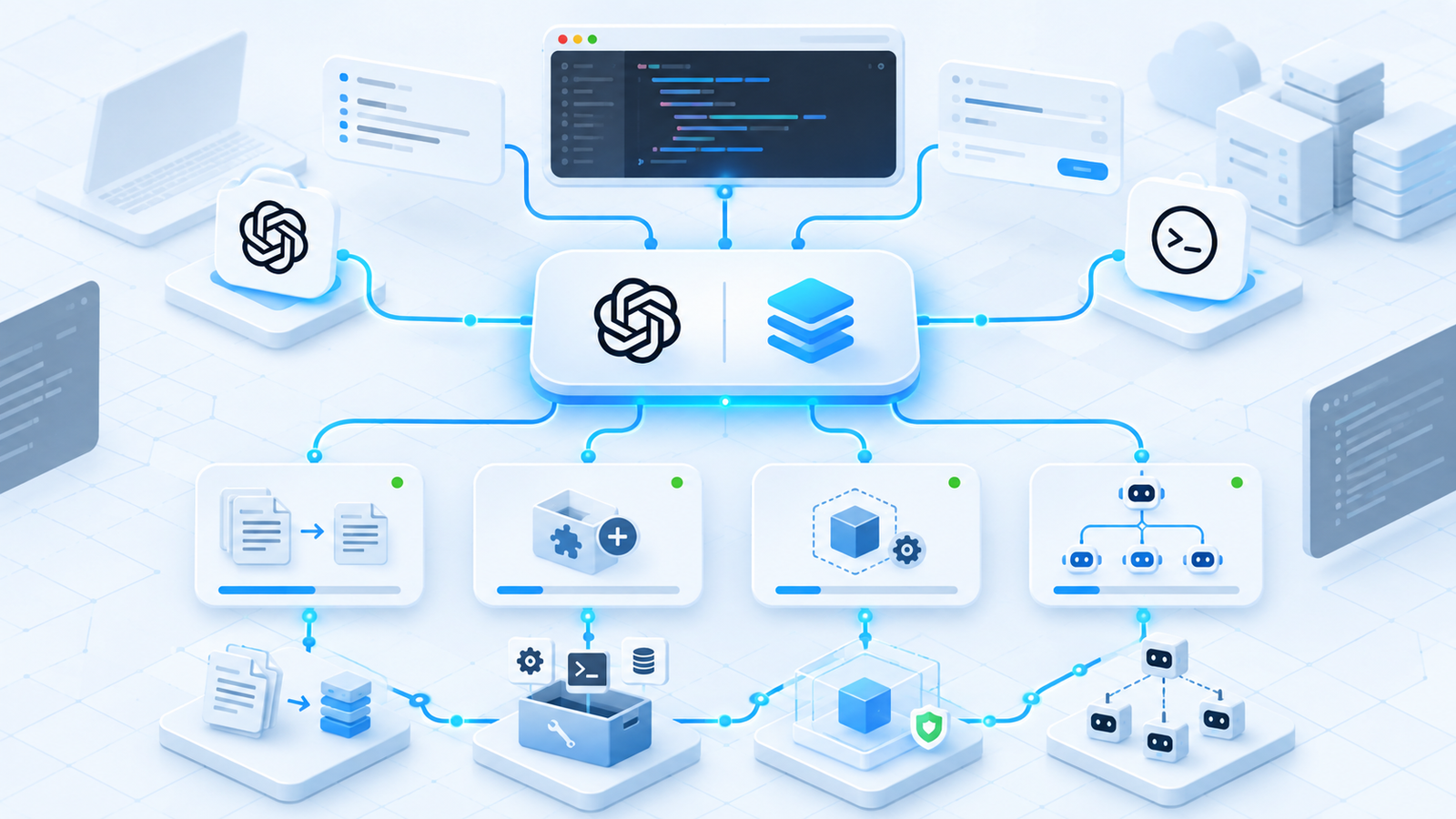
What happened: On 10 September OpenAI opened the Agents API in public beta to all developers. It exposes the same harness that runs Codex and ChatGPT for Work behind a single call: you describe a task, a model, a set of tools and an environment, and OpenAI runs the loop. There is no separate fee for the API; you pay for the tokens and tools each session consumes. You keep a real choice about where the work physically happens: an OpenAI-hosted sandbox, your own infrastructure inside a VPC, or one of nine partner environments including Cloudflare, Modal, E2B, Daytona, Vercel, Oracle, DigitalOcean, Blaxel and Runloop. And the harness itself is not a black box; it is the open-source Codex harness, so you can read the coordination logic you are renting.
The details: Four capabilities are doing the real work here, and each one maps to a problem you have probably hand-rolled. Compaction automatically compresses earlier context as a session approaches the window limit, so a task can span multiple context windows without you writing summarizer logic. Tool search loads tool definitions lazily instead of pasting your entire catalogue into every request, which cuts tokens and, more importantly, preserves the prefix cache that a 200-tool schema would otherwise invalidate on every edit. Programmatic tool calling lets the agent chain, parallelize and filter calls in code, so it can chew through a large result set and return only the rows that matter to the transcript. And multi-agent support splits a task across subagents that each keep their own context, bounded by a max_concurrent_subagents you set. The numbers OpenAI’s design partners report are worth reading for the shape rather than the magnitude: SafetyKit cites a 60 percent cut in cost per case after migrating a review workflow, Ciridae reports an evaluation score moving from 0.71 to 0.85 with a 4x latency reduction on subagent flows, and Hypha says separating the harness from the sandbox reduced failed agent responses by 86 percent. That last one is the sleeper detail. A lot of agent failures are not reasoning failures; they are the environment dying, or persisting something it should not have, halfway through a long task.
flowchart LR
    A["Your application"] -->|"task, model,<br/>tools, environment"| B["Agents API<br/>managed Codex harness"]
    B -->|"events, output"| A
    B --> C["Compaction<br/>context spans windows"]
    B --> D["Tool search<br/>lazy tool definitions"]
    B --> E["Subagents<br/>own context each"]
    B -->|"tool calls"| F{"Sandbox"}
    F --> G["OpenAI hosted"]
    F --> H["Your VPC"]
    F --> I["Partner<br/>Cloudflare · Modal · E2B …"]
    F -->|"results"| B
    style B fill:#1FB6F5,stroke:#0B1117,color:#0B1117
    style F fill:#1FB6F5,stroke:#0B1117,color:#0B1117
    style G fill:#22C55E,stroke:#0B1117,color:#0B1117
    style H fill:#22C55E,stroke:#0B1117,color:#0B1117
    style I fill:#22C55E,stroke:#0B1117,color:#0B1117
Important
Our take: The split OpenAI drew here is the part worth stealing even if you never call this API. Harness and sandbox are different concerns with different failure modes, and most homegrown agent stacks fuse them into one process that both reasons and executes, which is exactly why they leak state and die together. Separate them in your own code this week and you get most of Hypha’s 86 percent without signing anything. On the buy side I am genuinely torn. Compaction is the most valuable and the most dangerous item on that list: a vendor deciding what your agent forgets is a correctness dependency you cannot unit test, and when it silently drops the one constraint that mattered you will debug the model instead of the harness. My honest read is that the harness being open source is what makes this defensible; you can read the compaction policy, and you have a migration path that is not a rewrite. Two practical cautions before you port anything: the beta ships with US data residency and no Zero Data Retention support, which rules it out for a good number of enterprise contracts today, and “no additional fee” is not the same as cheap, because subagents multiply token spend by exactly the concurrency you set.
🗞️ More News
🧠 AI
- Gemini arrived as a desktop app on Windows 10 and 11 with an Alt + Space shortcut that floats it over whatever you are working on, available globally, with some agent and media features gated behind a Google AI subscription.
- Microsoft documented an August campaign of AI-assisted executive impersonation that requested payments of nearly $50,000 per invoice, and found no evidence the impersonated vendors were actually compromised, which is the detail that breaks most detection heuristics.
- OpenAI launched ChatGPT for Financial Services, a vertical package aimed at an industry where the interesting constraint is retention and auditability rather than raw capability.
- Shipped the same day and easy to miss under the Agents API news, OpenAI’s data-analysis push puts spreadsheet and database work in front of non-analysts, which is the quiet half of how agent infrastructure reaches ordinary desks.
- A technical breakdown of the Agents API worth reading next to the announcement, covering the hosted sandbox model, subagent concurrency and how billing actually lands.
- The developer argument about the Agents API is already running, and it is the right argument: managed convenience against control and single-provider dependence.
🤖 Robotics
- Shenzhen-based embodied AI company Kinetix AI raised more than RMB 500 million across Angel+ rounds from Vertex Ventures, Fangguang Capital and Wanshi Capital, which is an unusually large angel stage for a hardware company.
- South Korea’s AIDIN Robotics, which builds force and proximity sensing for robot arms, closed a KRW 16 billion strategic round involving HD Hyundai Robotics and Samsung Venture Investment, so the money is coming from the people who would actually integrate the sensors.
- UBTech begins first deliveries of its UWORLD U1 consumer humanoid on 16 September against a reported 13,361 orders, across Lite, Pro and Ultra variants priced from RMB 119,800 to RMB 990,000.
- Zooming out on all of that: robotics startup funding hit a record in 2026, and robotics rounds are now regularly sharing the week’s largest-deal table with AI.
💻 Programming
- If you want to read a production agent loop rather than a blog post about one, the Codex harness behind the Agents API is public, and the coordination code is the interesting part, not the prompts.
- Following up on yesterday’s keyv compromise: Snyk’s teardown walks the preinstall hook, the way trusted provenance was abused, and the IDE hooks that made it spread quietly.
- A 2026 tally of the supply-chain wave counts 59 campaigns and 657 malicious packages across npm, PyPI and the VS Code marketplace, with TanStack and UiPath the most frequently impersonated names at 108 and 67 occurrences, and very few CVEs to search for.
⚡ Electronics
- Apple’s A20 Pro is the first smartphone chip on TSMC’s 2 nm process, with a 32-core Neural Engine split into two 16-core blocks, roughly double the neural compute of the A19 Pro, 2x faster 8-bit floating-point math and a 50 percent wider memory interface.
- Less discussed in the same teardown: Apple moved the chip and its memory side by side so the memory stops blocking heat out of the processor, which is a packaging decision made entirely to let sustained on-device inference run longer.
- Equipment demand is broadening out of the front end into test and advanced packaging, which is the part of the supply chain that decides whether all this accelerator silicon actually ships on schedule.
- A nice demonstration of how much an ESP32-P4 dev board now absorbs: a bedside alarm clock that wakes you to an arbitrary video clip on a 720 pixel square display, where the only custom hardware is a 3D-printed stand.
📡 Telecom
- Reliance Jio launched commercial RCS Business Messaging pricing for iPhone users in India after Apple’s RCS expansion on iOS, with separate rate categories for marketing, transactional and OTP traffic.
- Follow-up on yesterday’s FCC satellite item, now with the specifics: the order going to a vote on 30 September covers the 12 GHz and 42 GHz bands, with further notices asking about another 1,175 MHz in Ku and Ka and 138.25 GHz in the D-band.
- Germany’s 1&1 is talking up 5G network momentum while flagging that the harder challenges arrive in 2026, a useful reality check on what greenfield network building actually costs.
👨💻 Code Corner
The single cheapest agent fix is to stop putting tool output into the conversation. Return a handle plus a preview, write the payload to the sandbox, and let the agent pull only what it needs. This is the idea behind programmatic tool calling, and it works with any model or framework.
# handle_tool.py: return a preview and a path, never the whole payload.
import json, pathlib, hashlib

WORKSPACE = pathlib.Path("/workspace/outputs")
WORKSPACE.mkdir(parents=True, exist_ok=True)

def as_handle(rows: list[dict], preview: int = 3) -> dict:
    """Persist a large tool result; hand the model a summary it can act on."""
    blob = json.dumps(rows).encode()
    path = WORKSPACE / f"{hashlib.sha256(blob).hexdigest()[:12]}.json"
    path.write_bytes(blob)
    return {
        "handle": str(path),
        "count": len(rows),
        "fields": sorted(rows[0]) if rows else [],
        "preview": rows[:preview],
        "hint": f"Filter with: jq '.[] | select(.status==\"error\")' {path}",
    }

rows = [{"id": i, "status": "error" if i % 997 == 0 else "ok"} for i in range(40_000)]
print(json.dumps(as_handle(rows), indent=2)[:400])
Tip
Two things make or break this pattern. The hint field matters more than it looks: without a concrete command the model will often ask you to paste the file back, which defeats the whole exercise. And content-addressed filenames are not decoration, they are what lets a retried or duplicated subagent write the same result twice without corrupting a partial read by a sibling.
🧰 Toolbox
- Agents API quickstart: the fastest way to see whether the managed harness beats the loop you already wrote, in about fifteen minutes.
- openai/codex: the open-source harness itself, useful as a reference implementation even if you never call the hosted API.
- Tool search guide: the lazy tool-loading pattern written up properly, and the fix if your prompt cache keeps missing.
- E2B: one of the nine sandbox partners, and a good standalone option if you want isolated code execution without buying the whole harness.
- Cursor Projects: the coordinator-agent model in a product you can try today, in early beta on paid plans.
🛠️ Build of the Week (rotating)
ESP32-S3 circuit sculpture console: a handheld retro games console with no PCB and no case, built as an open frame of soldered brass wire.
- Difficulty: Advanced, mostly because free-form brass soldering is a patience skill rather than an electronics one
- Parts: ESP32-S3, brass wire frame, tactile buttons, a small display, and a 2 mm clear acrylic strip to stop the buttons flexing the frame
- Why we like it: the ESP32-S3 has quietly become an emulation workhorse, and building the console as a sculpture makes every signal path visible, which is the best possible debugging aid and a fair argument that a schematic and an object can be the same thing.
📚 From the Blog
- Turning Pixels Into Something the AI Can Eat: decode, resize and normalize, the unglamorous stage between a camera and a model, and a good reminder that agent pipelines have the same preprocessing tax.
- Building Your First Neuron From Scratch: weights, bias, activation and one gradient step by hand, which is the right companion to today’s Big Story if you want to know what those 32 Neural Engine cores are actually multiplying.
- The Network Behind the Cameras: how to move video without saturating the link, the same bandwidth arithmetic the satellite and fiber items run on.
😀 The Bot Says…
An agent harness with automatic context compaction is a system that decides, on your behalf, which parts of the last four hours were not important. We built a machine that forgets things professionally, and then we gave it a credit card and a sandbox.
That’s all for today! Reply and tell us: would you hand your agent’s memory management to a vendor, or is forgetting too important to outsource?