😁 Hello, super humans! It is Black Friday, and the best GPU deal of the season is not in any store: thousands of Nvidia B300s suddenly listed for resale because their intended renters can no longer touch them. A new US rule aimed at Chinese companies renting compute through foreign clouds has frozen server shipments to four Southeast Asian countries in about a week. Let’s dig in.
📰 Quick Signals
- 🧠 AI: OpenAI patched a GPT-6.2 billing error, so users now hit limits 40% faster on Astra and 25% faster on Sol than last week; eligible subscribers get an extra usage reset.
- 🤖 Robotics: Volvo Cars started training Hexagon’s wheeled AEON humanoids (1.65 m, 60 kg, 10 kg payload) at its Ghent plant, with a larger factory pilot set for the first half of 2027.
- 💻 Programming: 1Password said an attacker used one employee’s corporate GitHub account to reach source code, push malicious code to backend services and download names and emails for a subset of users; vault contents were not accessed.
- ⚡ Electronics: The $39 ShiMetaPi Pico-G1 is a 72.2 x 21 mm AI-vision Linux board with a GOKE GK7206 SoC, a 1 TOPS NPU and a 4-lane MIPI CSI camera connector; note its SDK sits on Linux 5.10, which reaches end of life in December.
- 📡 Telecom: EE and Ericsson rolled an AI-native link-adaptation scheduler across London’s 5G network as a software-only change, reporting 26% higher average download throughput and about 13% better spectral efficiency.
The Big Story: Nvidia pauses server shipments to Southeast Asia
If you rent GPUs, build on a neocloud, or just wondered why AI hardware prices wobble, this week’s export-control shift is the clearest example yet of policy rewiring the compute market in days.
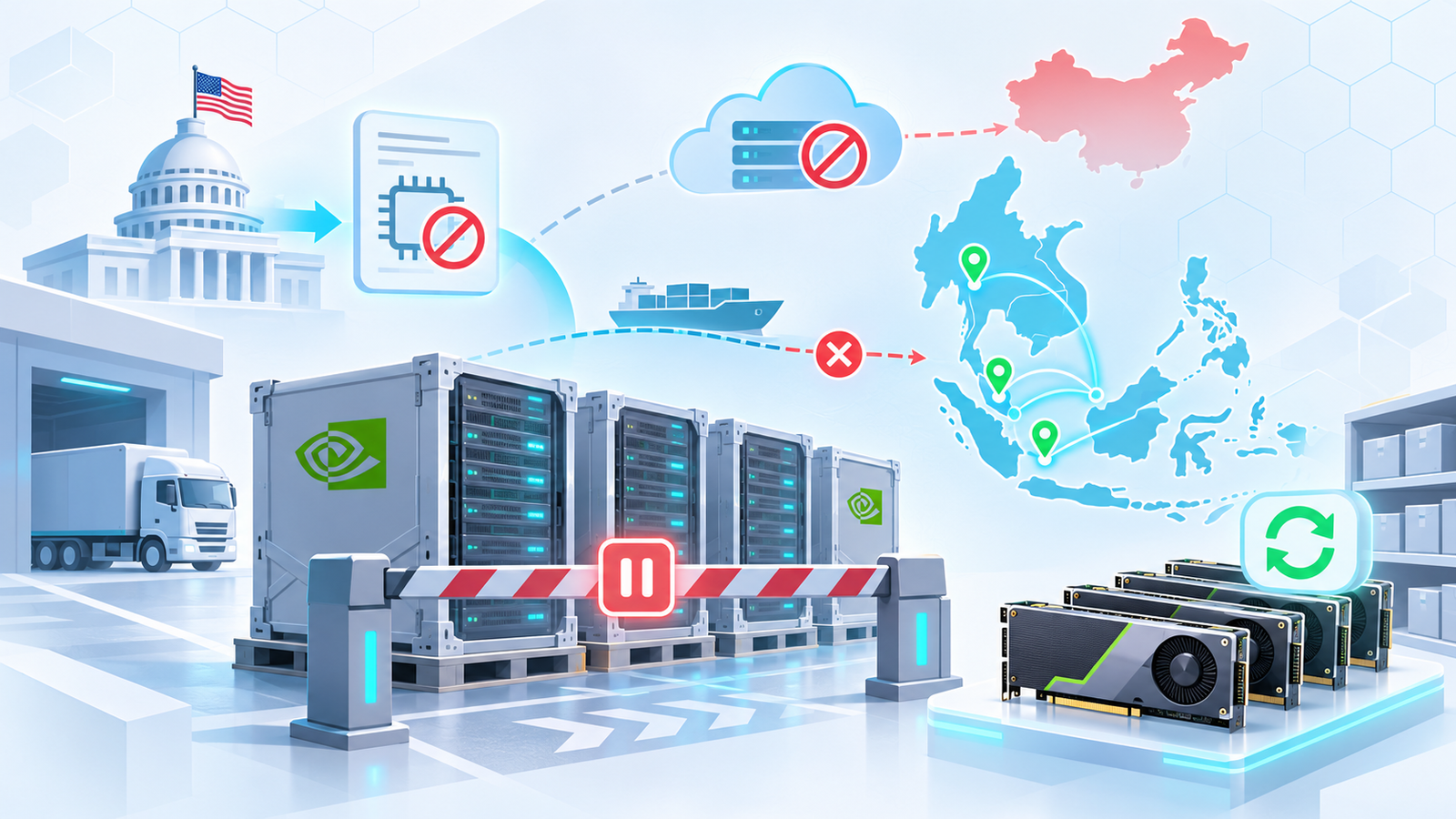
What happened: According to the Financial Times, as reported by The Decoder, Nvidia told partners such as Dell and Supermicro to stop shipping servers to Malaysia, Singapore, Thailand and Indonesia. The trigger is a new rule from the Commerce Department’s Bureau of Industry and Security that took effect on Nov 19 and requires licenses for overseas data centers that give Chinese companies large amounts of compute, as TNW reports. US Trade Representative Jamieson Greer told CNBC the aim is to close off indirect access, both smuggling through Southeast Asia and remote access through data centers in third countries. It is not yet clear whether the shipment pause is temporary.
The details: Until now, the loophole was simple: a Chinese company that could not buy top-end Nvidia chips could rent them from a cloud in a neighboring country. The new rule targets that rental path rather than the chip sale itself. Southeast Asian cloud providers reportedly have 90 days to apply for a license and prove that no restricted companies are end users, and one executive described the situation as chaos with no guidance on how to apply. The market reacted fast. Chip sellers told neoclouds they will not supply GPUs if any capacity is rented to Chinese companies, stricter than Nvidia’s earlier line of not selling to customers that rent more than 50% of their GPUs to Chinese firms. Dealers listed thousands of B300s originally meant for Chinese rental customers, B300 rental prices fell about 7% in a month, and banks reportedly halted about $500 million in loans to Singapore-based Aolani, which planned to rent compute to ByteDance. In parallel, a CBS News investigation summarized by Tom’s Hardware alleges that two California Nvidia customers are Chinese-owned companies used to work around the rules.
flowchart LR
    A[Chinese AI lab] -->|Direct purchase<br/>blocked since earlier rules| N[Top-end Nvidia GPUs]
    A -->|Rent remote compute| B[Cloud in Malaysia,<br/>Singapore, Thailand,<br/>Indonesia]
    N -->|Servers via Dell,<br/>Supermicro| B
    R[BIS rule<br/>effective Nov 19] -.->|License required<br/>90-day window| B
    R -.->|Shipments paused| N
    B -->|Unsold capacity| M[Resale market:<br/>B300 listings up,<br/>rental prices down]
Important
Our take: The interesting part is not that the US tightened controls again; it is that the control point moved from the chip to the rental contract. That makes “who is my end user” a compliance question for every cloud and reseller, and the first casualty is predictability: a 90-day license window with no clear process is how capacity sits dark. For builders outside China, the short-term effect may even be positive, with cheaper B300 hours on the secondary market. Longer term, expect more paperwork on GPU rentals everywhere, and plan your compute contracts as if end-user checks will become standard.
🗞️ More News
🧠 AI
- Microsoft detailed how state-backed groups from China and North Korea, including Salt Typhoon and Onyx Sleet, use ARTEX, an AI-driven penetration-testing framework released in July, and recommends deception defenses such as honeypots and tarpits.
- Switzerland’s federal cyber office reported five recent cyberattacks on businesses and critical infrastructure that used AI agents.
- Reuters reports that US chip curbs and a crackdown on distillation are slowing Chinese labs, with Z.AI behind schedule on its next flagship and Moonshot AI expecting longer gaps between major releases.
- Tencent open-sourced DFly2, a speculative-decoding tool it says delivers up to 81% higher throughput for DeepSeek-V4.1-Flash at 64,000-token context.
- Canada added C$700 million to its AI Compute Access Fund, bringing it to C$1 billion and covering up to 80% of eligible compute costs bought from sovereign cloud providers.
- The EU may vote on authorizing Tesla’s assisted-driving system at a Dec 15 meeting, according to a draft Commission agenda.
- Anthropic CEO Dario Amodei called accusations that he favors handing human decisions to AI absurd and pushed back on Axios’s reporting.
🤖 Robotics
- Inbolt’s 3D AI vision now runs natively on Universal Robots’ Gen 7 platform with no separate industrial PC; at a Stellantis engine-tightening station, tightening failures reportedly fell 91%.
- Warsaw and San Mateo startup Lute raised $20 million and introduced Lute-0, a video-action model that beat the open π0.5 on five retail manipulation tasks in its own tests.
- IFR data puts South Korea first in robot density with 1,066 industrial robots per 10,000 manufacturing workers, ahead of Singapore (873) and Germany (469); the US ranks 8th at 323.
- For the Black Friday peak, Exotec added 25 rented robots to Fnac Darty’s 36-robot Skypod fleet, lifting capacity to as many as 35,000 order lines per day.
- NJIT researchers built PHD-Hand, a 3D-printable five-finger hand with 15 actuated degrees of freedom and parts under $650, accepted at Humanoids 2026.
💻 Programming
- .NET MAUI 11 makes CoreCLR the default runtime on every platform, turns on XAML incremental hot reload in Debug builds and raises the minimum Android API from 21 to 24.
- Ansible’s become prompt times out on Ubuntu 26.04 because the sudo-rs build prints an extra string before the password prompt; Ansible Core 2.22.0 fixes it.
- Vercel’s Workflow SDK 5.8 runs on a new execution engine that cuts p75 step-to-step overhead from 85 ms to 7 ms.
- GitHub Copilot code review billing will default to the organization after Dec 30, 2026.
⚡ Electronics
- Ben Eater’s latest video shows how adding more decoupling capacitors can make a circuit worse, not better.
- CamThink’s STM32N6-based NeoEyes NE301 and NE302 edge AI cameras gain a Wi-Fi HaLow option built on Morse Micro’s MM8108 (vendor-sponsored post).
- A modular 6502 microcomputer splits the classic design into separate plug-in modules instead of a single board.
- Schneider Electric launched Partnerships for Innovation with seven industry partners to develop next-generation electrical distribution technology.
📡 Telecom
- Samsung has reportedly entered the bidding to supply equipment for SpaceX’s Starlink Mobile direct-to-phone network, which plans second-generation satellites from 2027.
- South Africa’s Comsol is using Adtran’s FSP 3000 to lift data center interconnect from 100 Gbps to 400 Gbps and then 800 Gbps, with NEC XON running operations.
- Vodafone Idea will not renew 4.4 MHz of 1800 MHz spectrum in Mumbai, saving about ₹730 crore ahead of a Dec 4 renewal deadline.
- Ghana raised $240 million selling 700 MHz, 2.3 GHz and 3 GHz spectrum, with consumer 5G services expected in early 2027.
- Cell C completed its acquisition of Melon Mobile, an early South African eSIM MVNO with more than 100,000 customers.
👨💻 Code Corner
Today’s Demo Watch features a loader balancing on two wheels, which is a scaled-up inverted pendulum. Here is the classic version in pure Python: a cart-pole tipped 0.2 rad off vertical, caught by a PD controller.
#!/usr/bin/env python3
"""Balance an inverted pendulum on a cart with a PD controller (no dependencies)."""
import math

g, L, dt = 9.81, 1.0, 0.01      # gravity (m/s^2), pendulum length (m), timestep (s)
KP, KD = 40.0, 8.0              # proportional and derivative gains

theta, omega = 0.2, 0.0         # start 0.2 rad (about 11 degrees) off vertical

for step in range(301):
    # Controller: cart acceleration that pushes the base under the falling mass
    accel = KP * theta + KD * omega
    # Linearized pendulum dynamics about upright: gravity tips it, cart motion rights it
    alpha = (g / L) * math.sin(theta) - (accel / L) * math.cos(theta)
    omega += alpha * dt
    theta += omega * dt
    if step % 50 == 0:
        print(f"t={step * dt:4.2f}s  angle={math.degrees(theta):7.3f} deg  cart_accel={accel:7.2f} m/s^2")
Run it and the angle decays toward zero within about two seconds; set KD = 0 and watch it oscillate, which is exactly why real balancing controllers need damping.
Tip
The gains only work because KP / L is larger than g / L; drop KP below about 9.81 and gravity wins. The ETH Zurich team skipped hand-tuning entirely and trained a reinforcement-learning policy in simulation, but this toy model is the right mental picture for why it is hard.
🧰 Toolbox
- usb-rea: captures USB traffic while you use a vendor’s Windows app, infers the protocol and generates a pyusb Linux driver, a Markdown report and a Wireshark dissector; MIT licensed,
pip install usb-rea. - sqlite3_rsync: SQLite’s tool for copying or syncing a live database over SSH by exchanging page hashes, without making a full local copy first.
- Mock Service Worker 3.0: the API mocking library goes ESM-only on Node.js 22+, shrinks from 416 KB to 234 KB and adds GraphQL subscriptions plus TCP and TLS level interception.
- Printable split-flap display: another 3D-printable split-flap design for a retro departures-board look on your desk.
🎬 Demo Watch (rotating)
Heavy metal acrobatics: Learning dynamic control for skid-steer loaders: researchers from ETH Zurich, Gravis Robotics, Blue River Technology and Intel taught a 5-metric-ton John Deere 332G skid-steer loader to rise onto its two front wheels and balance there. What it shows: a reinforcement-learning controller trained only in simulation on flat ground beat a conventional model predictive controller on the four-to-two-wheel transition and on uneven terrain up to 75 cm, according to the Robotics & Automation News write-up. Why it is hard: a loader is heavy, hydraulically actuated and slow to respond, so the controller has to anticipate rather than react, and the sim-to-real gap for hydraulics is notoriously wide. Hype vs. real: nobody needs a wheelie on a job site, but the real result is that learned controllers now handle machines this heavy and sluggish, which matters for autonomous construction equipment working on rough ground.
📚 From the Blog
- Turning Pixels Into Something the AI Can Eat: Episode 3 of the video analytics series takes the clean pixels and the network from earlier episodes and prepares the data for AI analysis.
- Building Your First Neuron From Scratch: a neural network is a stack of simple, learnable transformations; build and train the first one yourself, no rented B300s required.
- The Network Behind the Cameras: the unglamorous plumbing that moves video from cameras across the network without choking it.
😀 The Bot Says…
Black Friday doorbuster: thousands of B300s, barely rented, one careful owner (who is no longer allowed to be the owner). Terms and conditions apply. So do export controls. 🤖
That’s all for today! Does your team rent GPUs from a neocloud, and have you been asked about end users yet? Reply and tell us.