Look around the room you’re in right now. The phone in your hand, the light overhead, the router blinking in the corner, the car parked outside. Every one of them is, underneath, the same thing: a carefully arranged path for tiny charged particles to move through. Electronics is the art of controlling that movement precisely enough to do something useful: to compute, to sense, to light up, to think.
That’s a big promise, and this series is going to make good on it. Over six parts, we’re going to build electronics from the ground up: from the raw idea of electric charge, through the laws that govern every circuit, all the way to the components (resistors, capacitors, inductors, diodes, and transistors) that turn those laws into radios, computers, and everything in between. By the end, you won’t just recognize the symbols on a schematic; you’ll understand why the circuit does what it does, and you’ll be able to reason about one with a pencil and a few formulas.
But here’s the thing about that journey: you can’t skip the first step. Before transistors, before logic gates, before microcontrollers, there’s a foundation that everything else stands on. It’s the answer to a question most people never actually stop to ask.
What is electricity, really?
That’s what this first part is about. Three ideas: charge, current, and voltage. By the end of this post, they’ll be as clear and concrete as water flowing through a pipe. Let’s begin.
The map before the territory#
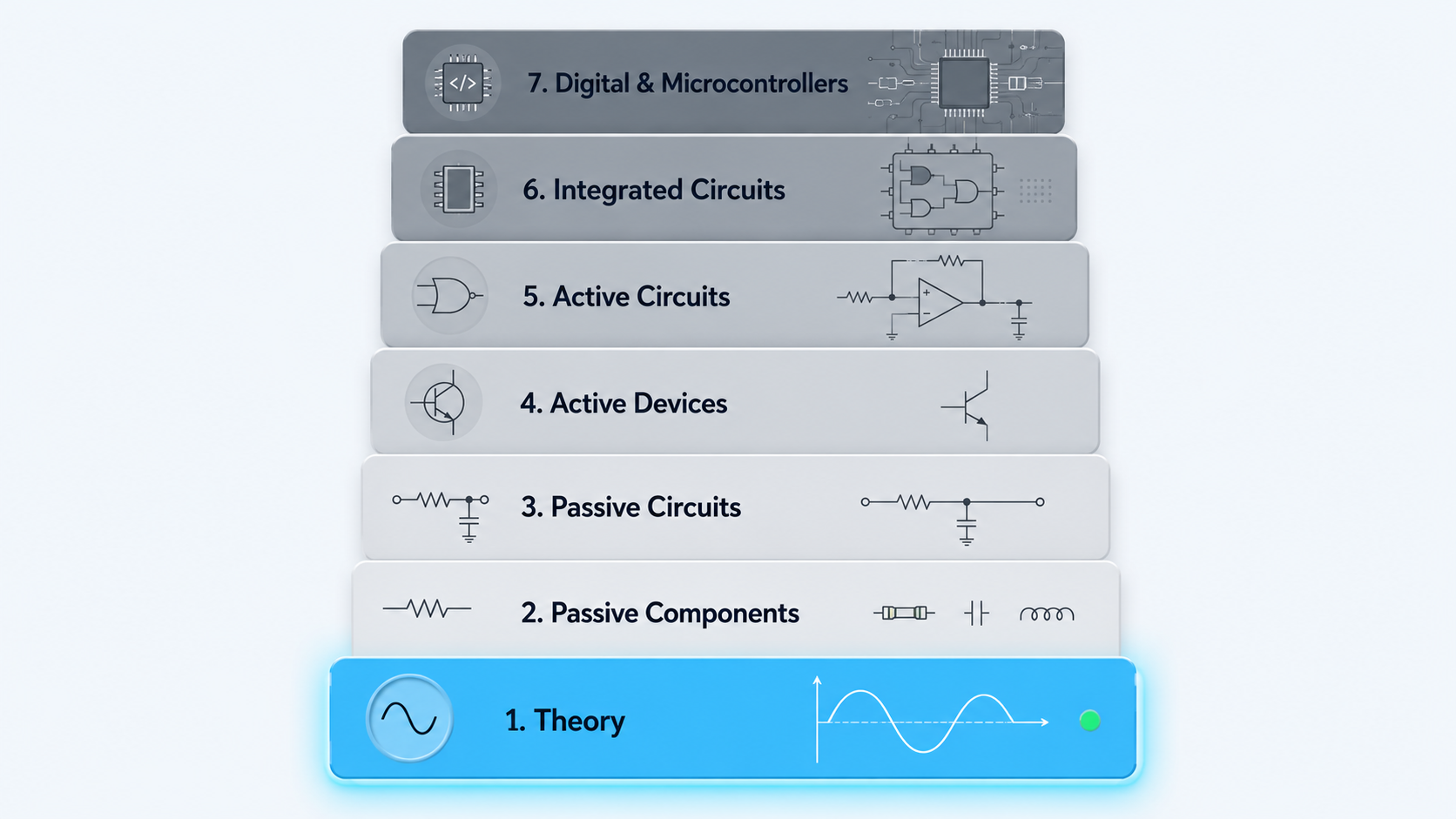
It helps to know where we’re headed. Every electronic gadget, no matter how sophisticated, is assembled from a small set of layers stacked on top of each other.
At the very bottom sits theory: voltage, current, resistance, and the handful of laws that predict how they behave. On top of that come the passive components: resistors, capacitors, inductors. Combine those into passive circuits (voltage dividers, filters) and then introduce active devices built from semiconductors: diodes and transistors, the one-way gates and electrically controlled switches. Stack those into active circuits (amplifiers, oscillators, rectifiers) and eventually you reach integrated circuits, digital logic, and the programmable microcontrollers that give modern devices their “brains.”
It’s a tall stack. The good news is that each layer is small and understandable on its own, and each one rests directly on the one below it. This series climbs the first several rungs, the theory and the fundamental components, which is exactly the part everything else depends on. Get this right and the rest of electronics stops feeling like magic and starts feeling like consequences.
So let’s lay the first stone.
Charge: the thing that does the moving#
Everything electrical starts with electric charge: a fundamental property of matter, as basic as mass. Charge comes in two flavors, positive and negative. The rule is simple and you already know it from magnets and static: like charges repel, opposite charges attract.
In the circuits we care about, the particle carrying charge around is the electron, the tiny, negatively charged particle that (loosely speaking) orbits the nucleus of every atom. In some materials, most notably metals like copper, the outermost electrons are only loosely attached to their atoms and can drift freely from one atom to the next. Those free electrons are the raw material of electricity.
We measure charge in coulombs (C). A single electron carries a fantastically small charge:
e = 1.602 × 10⁻¹⁹ coulombsFlip that around and you get a sense of scale: it takes about 6.24 × 10¹⁸ electrons, over six billion billion, to add up to just one coulomb. Charge, in other words, is something that only becomes noticeable when a staggering number of particles act together.
Current: charge on the move#
A pile of stationary charge doesn’t do much. Electricity gets useful only when charge moves, and the rate at which it moves is what we call electric current.
Current is simply the amount of charge passing a point per unit of time. If a charge Q flows past in a time t:
I = Q / tThe unit is the ampere (A), and it’s defined exactly as you’d expect: one ampere is one coulomb per second. An amp is a lot of charge flowing; remember, one coulomb is 6.24 × 10¹⁸ electrons, so one amp means that many electrons streaming past every single second.
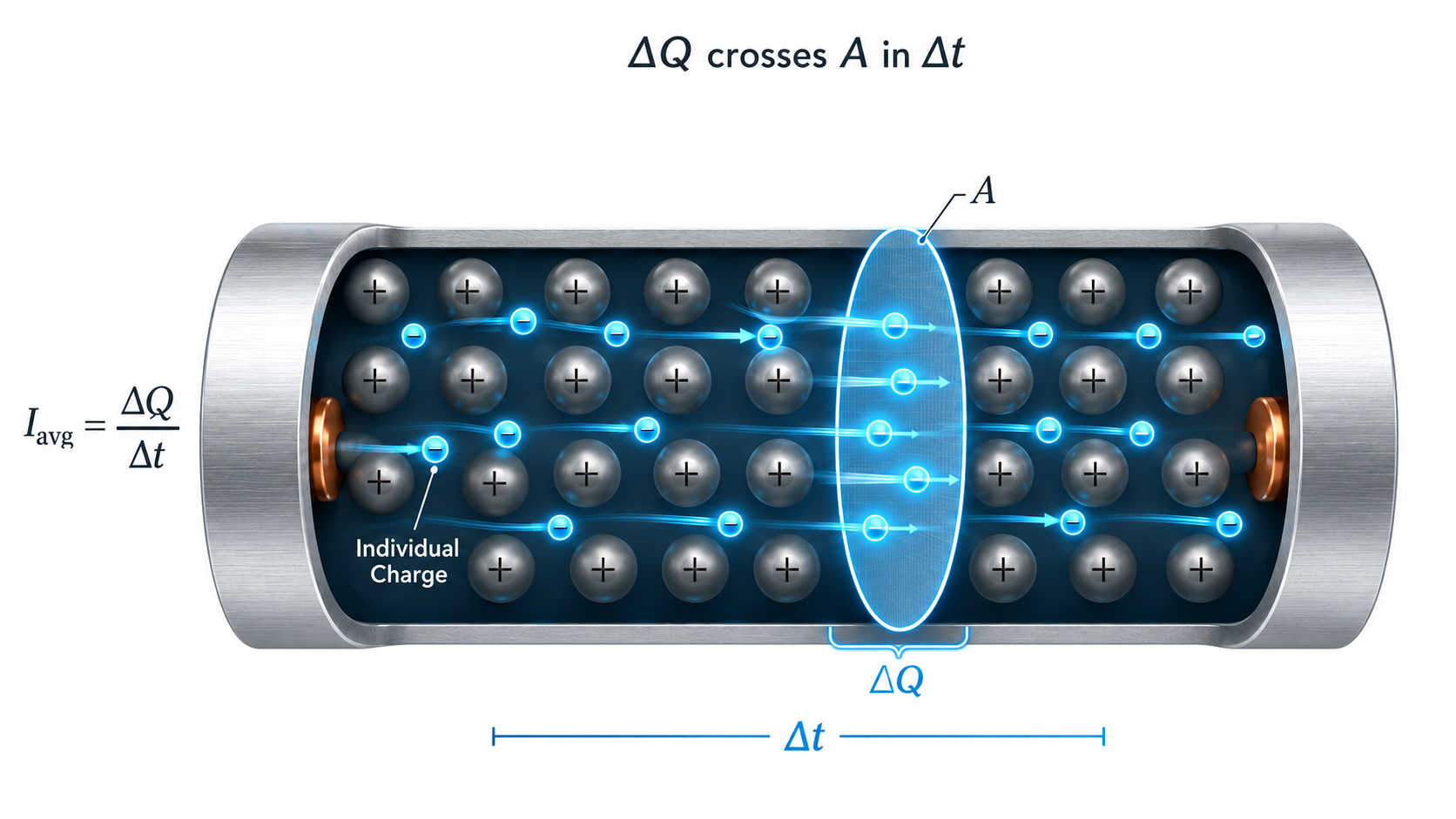
Inside a conductor, the loosely bound outer electrons break free and drift between atoms. That sea of mobile charge is what electricity is made of.
A quick worked example. Suppose a wire carries a steady current of 2 amps. How much charge flows past in 5 seconds?
Q = I × t = 2 A × 5 s = 10 coulombsTen coulombs, roughly 6.2 × 10¹⁹ electrons, in five seconds. The formula is trivial; the number of particles involved is astronomical. That’s the recurring theme of electricity: enormous quantities of the very small, moving together.
Note
Everything in Parts 1 through 3 deals with direct current (DC): charge flowing steadily in one direction. The other kind, alternating current (AC), reverses direction many times per second, and it takes center stage in Part 4.
The direction confusion (let’s clear it up now)#
Here’s a quirk that trips up almost every beginner, so we’ll deal with it head-on. When scientists first studied electricity, they didn’t yet know about electrons. They guessed that whatever was flowing moved from the positive terminal to the negative one, and they built all the conventions around that guess. We call this conventional current: it points from + to −.
Later we learned that in a metal wire it’s actually the negative electrons that move, and they drift the opposite way: from − to +. So the physical particles and the “official” current direction point in opposite directions.
Does that matter? Almost never. Every formula, every schematic, every calculation in this series uses conventional current, and it all works out perfectly.
Important
A current arrow always shows the direction positive charge would move. In a metal wire the electrons are quietly drifting the other way, and every formula still gives the same answer.
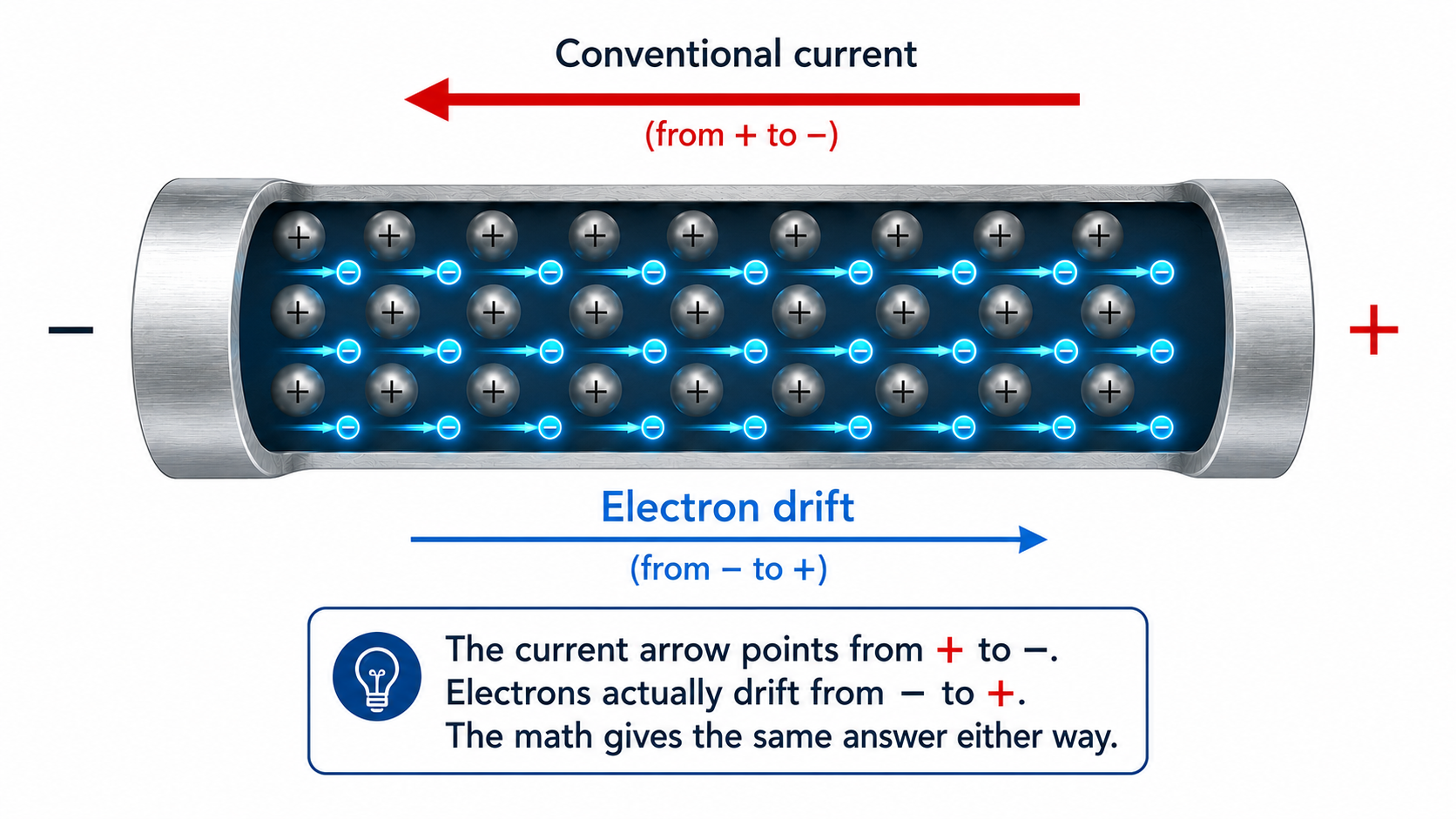
The current arrow points from + to − (conventional current). The electrons actually drift from − to +. The math doesn’t care; it gives the same answer either way.
Voltage: the push behind the flow#
We have charge, and we have charge in motion. But motion needs a cause. Charge doesn’t move through a circuit on its own any more than water flows uphill on its own. Something has to push it.
That push is voltage.
More precisely, voltage is the amount of energy given to each unit of charge. When a battery pushes charge around a circuit, it hands a fixed packet of energy to every coulomb that passes through it:
V = W / Qwhere W is energy in joules and Q is charge in coulombs. The unit is the volt (V), and the definition falls right out of that formula: one volt is one joule per coulomb. A 1.5-volt battery gives 1.5 joules of energy to every coulomb of charge it moves. A 9-volt battery gives six times as much push to each one.
It’s worth setting up one piece of bookkeeping now, because it pays off in Part 2: a source gives energy to charge, and components spend it. A battery raises the energy of every coulomb passing through it; a lamp or a resistor takes that energy back out and turns it into light or heat. Both show up as a voltage measured across two terminals. The difference is whether energy is being added or used up.
One subtle but crucial point: voltage is always a difference between two points. It’s like height. Asking “what’s the voltage here?” is like asking “how high is this?” High compared to what? We always measure voltage between two points, and in practice we pick one reference point, call it ground (0 volts), and measure everything else relative to it. Ground gets its own symbol on schematics (a small stack of shrinking horizontal lines), and whenever a schematic labels a voltage at a single “point,” it secretly means “measured between this point and ground.” There’s no such thing as voltage at a single point in isolation.
The analogy that makes it click#
If all of this still feels abstract, here’s the picture that ties it together, and it’s a surprisingly faithful one.
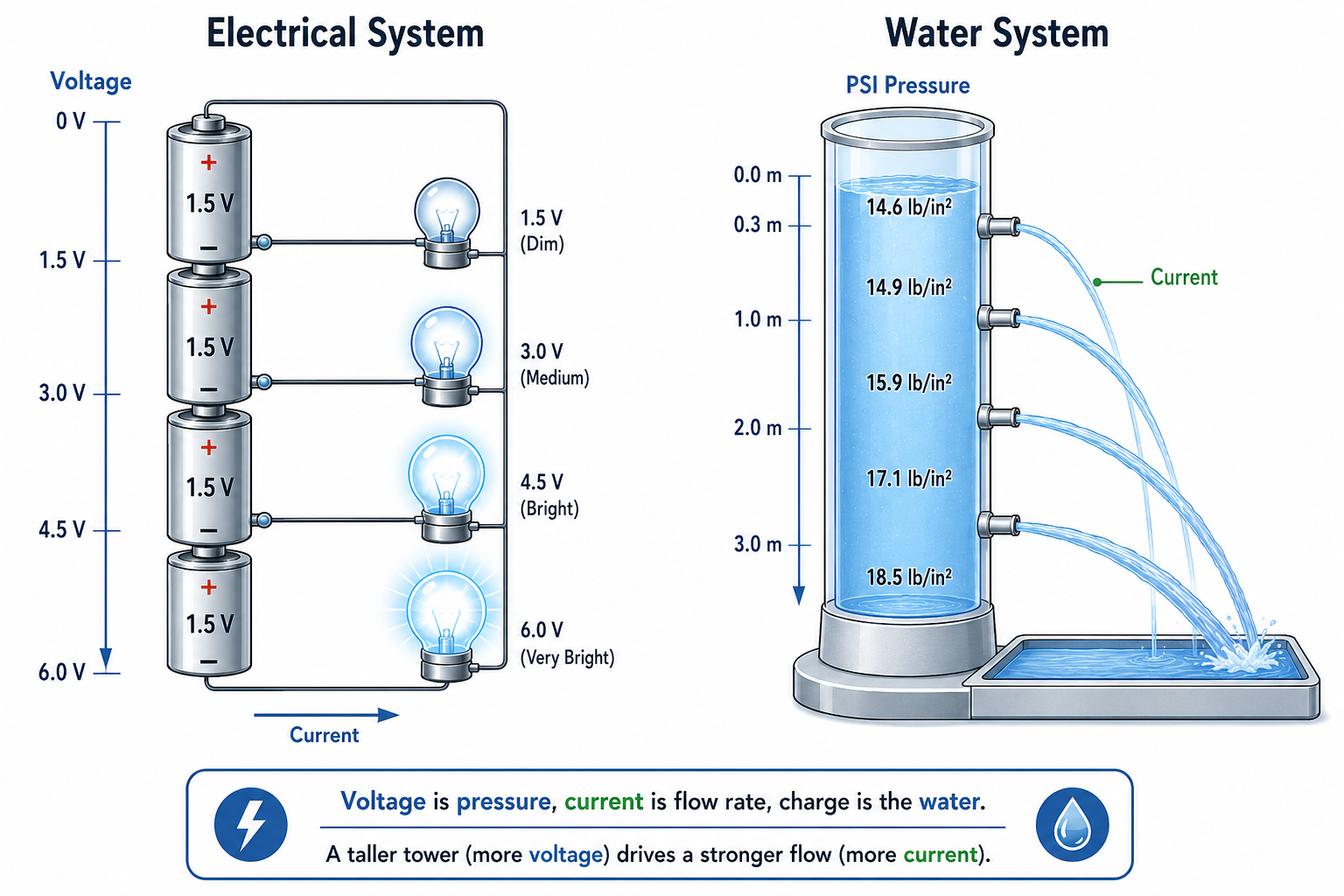
Imagine a water tower feeding a pipe that turns a small water wheel.
- The height of the water (its pressure) is the voltage: the push. A taller tower pushes harder.
- The flow rate through the pipe, liters per second past a point, is the current.
- The water itself is the charge that’s actually moving.
A tall tank with a wide pipe gives you a strong, fast flow. Lower the tank (less voltage) and the flow weakens. Narrow the pipe (add resistance, the subject of Part 2) and even a tall tank can only push a trickle through.
Keep this picture in your head. Voltage pushes, current flows, charge is the stuff. We’ll lean on it again and again, and only retire it much later when we reach the parts of electronics where water genuinely can’t keep up.
Where does voltage come from?#
A voltage source is any device that maintains that push across its two terminals. The most familiar is the battery, which uses a chemical reaction to separate charge and hold a steady voltage. But there are others you’ll meet throughout this series: generators (which use magnetism and motion; the star of Part 4), solar cells (which use light), and bench power supplies (which convert wall power into whatever voltage you need).
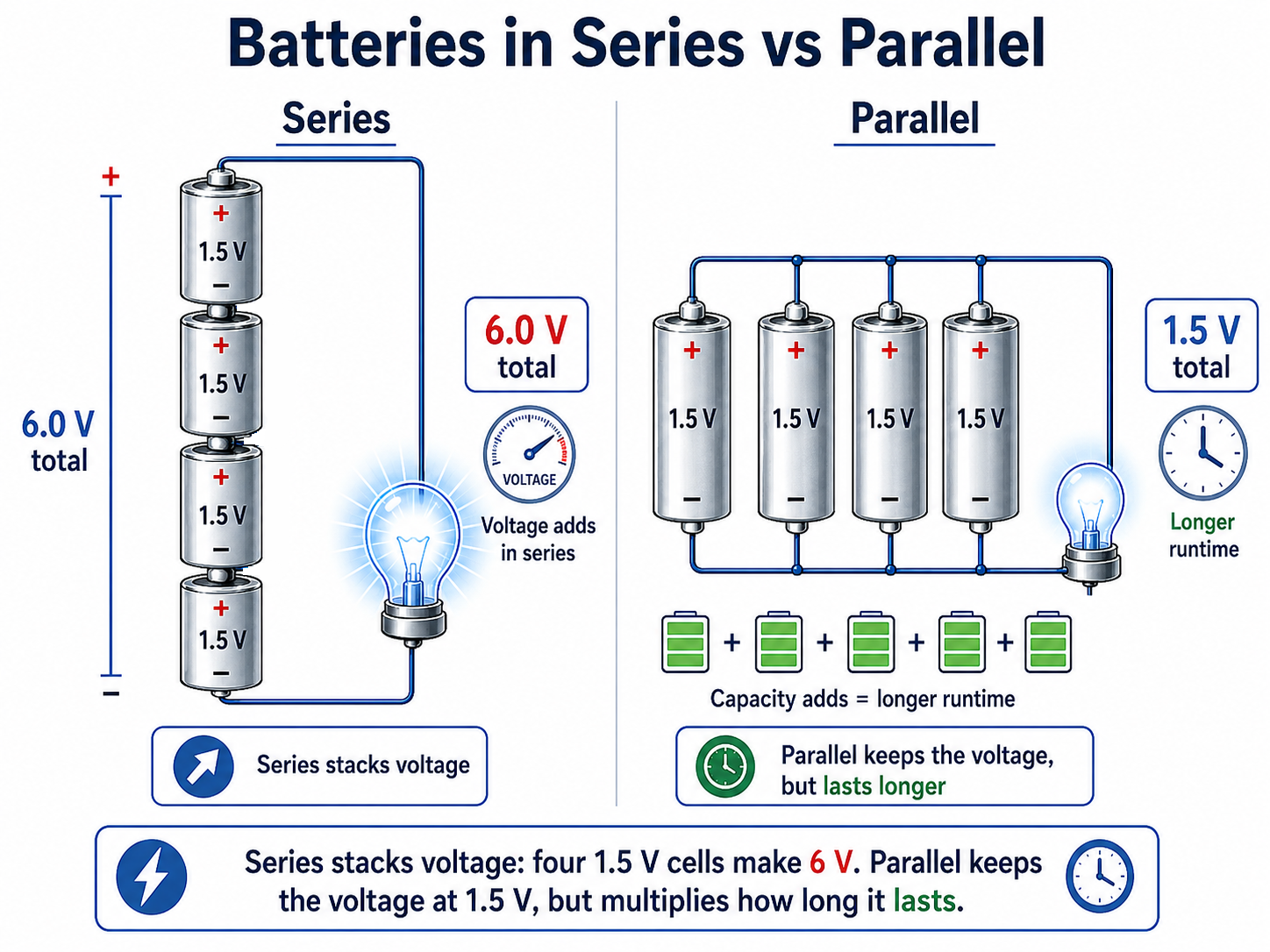
Batteries also combine in two useful ways, and the difference is worth knowing:
- Connect cells in series, end to end, and their voltages add. This is literally how a 9-volt battery works: six small ~1.5-volt cells stacked inside one case. Series gets you higher voltage.
- Connect equal cells in parallel, side by side, and the voltage stays the same, but they last longer and can supply more current. Parallel gets you more capacity.
In series:   V_total = V₁ + V₂ + V₃ + …
In parallel: V_total = V (unchanged), but capacity adds up
Warning
Only connect cells of equal voltage in parallel. If one cell sits at a higher voltage than its neighbor, it drives current backwards into the other cell, wasting energy, heating both, and potentially damaging them.
No loop, no flow#
There’s one requirement we’ve been quietly assuming, and it deserves to be said out loud: current only flows around a closed loop. A voltage source can push all it wants, but if the path from its + terminal back to its − terminal is broken anywhere, no charge moves at all. That complete path (source, wires, and something useful along the way) is what the word circuit actually means: a circular route.
This is also all a switch is: a deliberate, controllable break in the loop. Open it and the loop is broken, so current everywhere in the loop stops. Close it and the whole loop flows again. It’s why a bird can perch on a power line unharmed: standing on a single wire, both its feet sit at essentially the same voltage, so there’s no push to drive current through its body. (We’ll sharpen this picture in Part 2, when resistance enters the story.)
Keep the loop in mind whenever you look at a schematic. Every circuit diagram, however tangled it looks, is at bottom a set of closed loops for current to travel around.
Not everything lets charge through#
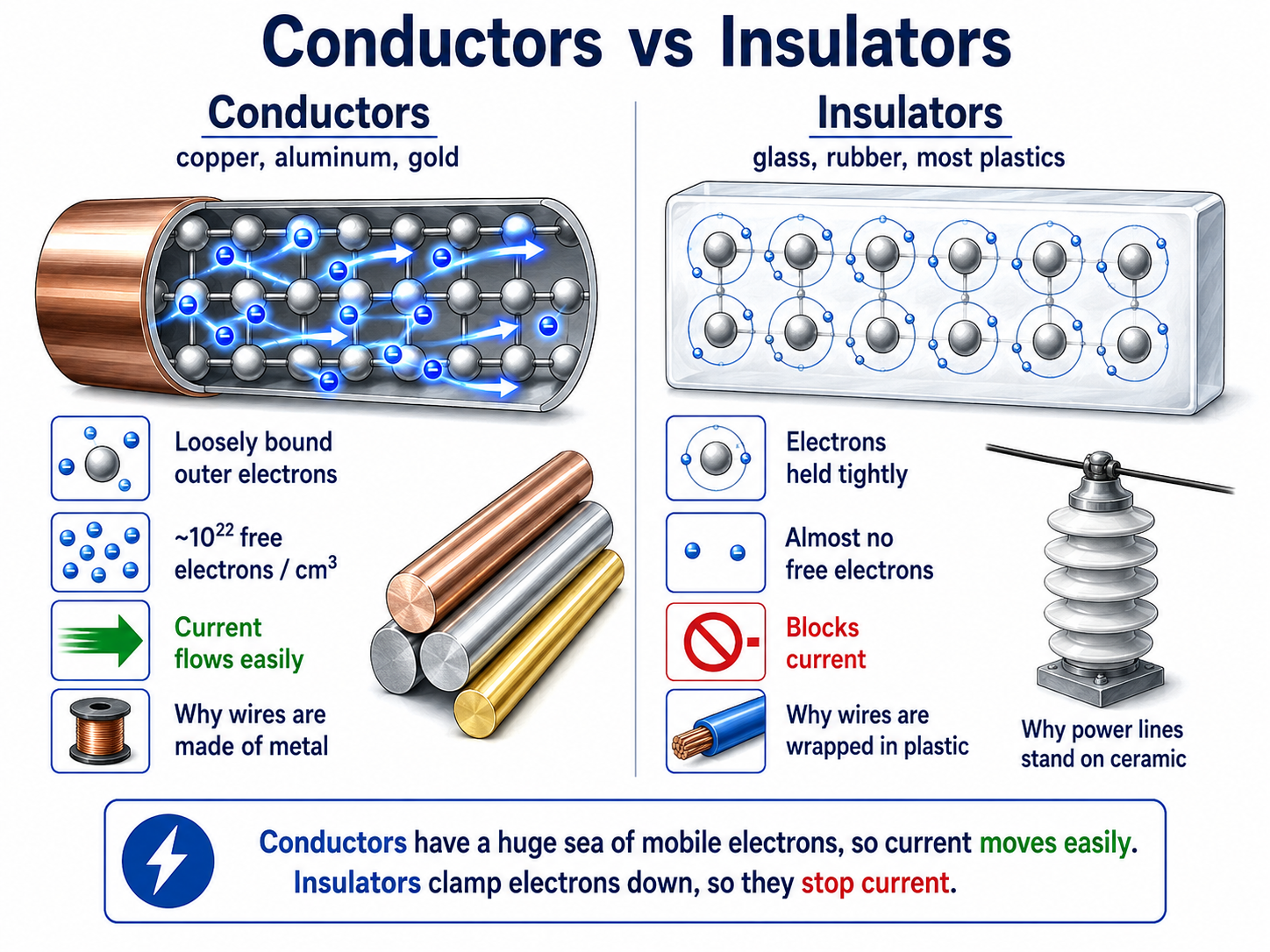
One last idea rounds out the foundation, and it’s the one that makes design possible: not every material carries current equally. It all comes down to how tightly a material grips its outer electrons.
Conductors (copper, aluminum, gold) hold their outer electrons so loosely that a huge population of them roams free, on the order of 10²² free electrons per cubic centimeter. Current flows through them easily. This is why wires are made of metal.
Insulators (glass, rubber, most plastics) clamp their electrons down tight, leaving almost none free to move. They block current, which is exactly why we wrap wires in plastic and stand power lines on ceramic.
And then there’s the interesting middle case: semiconductors like silicon. On their own they’re mediocre conductors, but their conductivity can be precisely controlled by adding trace impurities, or by applying a voltage, light, or heat. That controllability is the entire basis of the diodes and transistors we’ll reach in Part 6, and it’s the reason the device you’re reading this on exists at all.
Here’s a detail that surprises people: the electrons in a wire don’t actually race along at anywhere near the speed of light. They drift quite slowly: less than a millimeter per second in a typical wire. What travels fast is the electric field, the “push” itself, which propagates through the wire at close to light speed. That’s why flipping a switch lights a bulb across the room instantly: you’re not waiting for an electron to make the trip, you’re sending a push down a wire that’s already full of them, exactly like turning on a tap that’s connected to a pipe that’s already full of water.
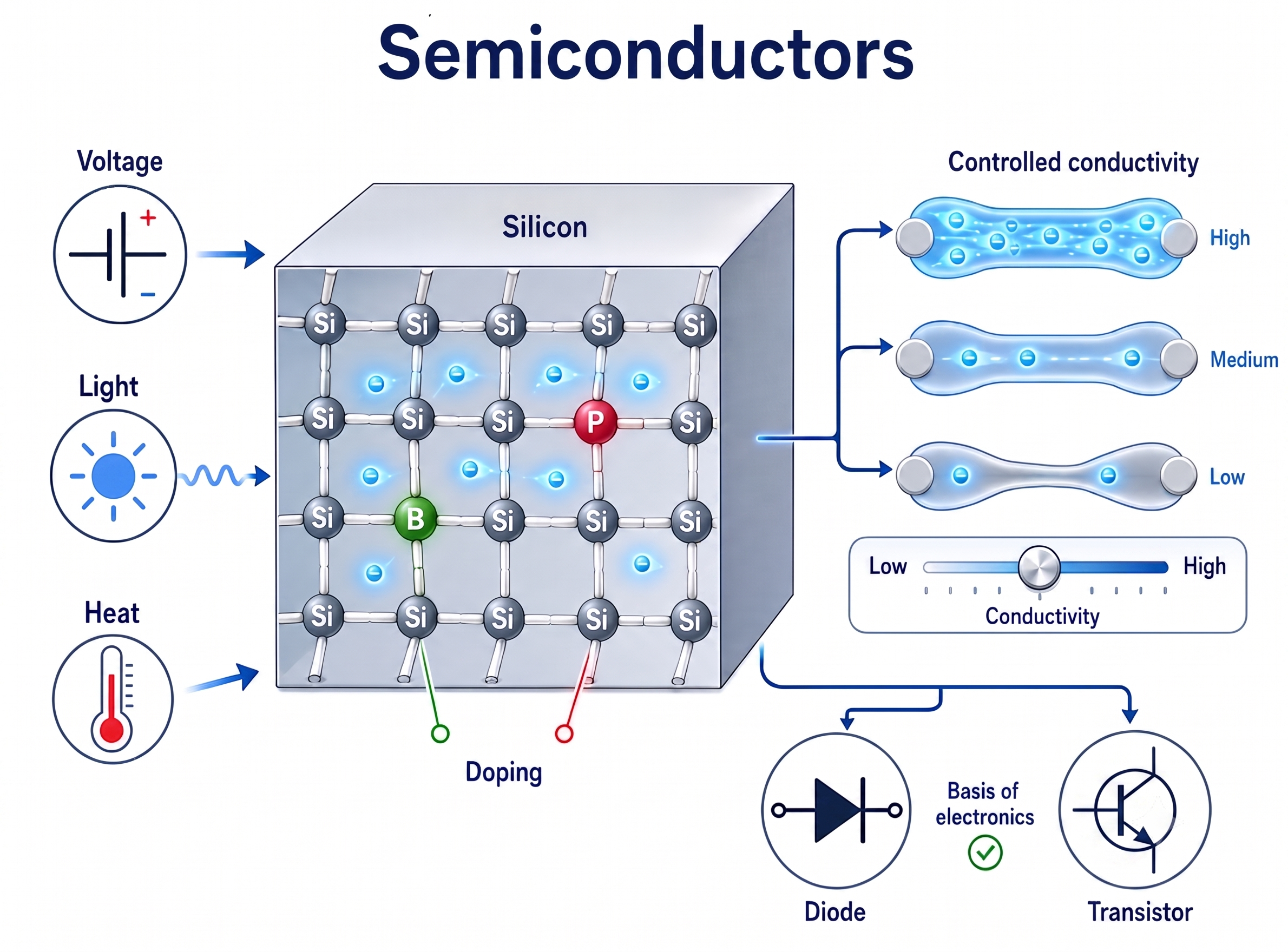
From roughly 10²² free electrons per cm³ (conductor) down to almost none (insulator), with the tunable semiconductor in the middle: the material that makes all of modern electronics possible.
Putting it together#
Three ideas, and the whole rest of electronics rests on them:
- Charge (Q) is the fundamental stuff, measured in coulombs. It’s carried by electrons, and it takes 6.24 × 10¹⁸ of them to make one coulomb.
- Current (I = Q/t) is charge in motion, measured in amperes: one amp is one coulomb per second. Conventional current points + to −; electrons drift the other way.
- Voltage (V = W/Q) is the energy-per-charge that pushes current along, measured in volts: one volt is one joule per coulomb. It’s always a difference between two points.
Water in a pipe: voltage is the pressure, current is the flow, charge is the water. And none of it happens without a closed loop: a complete path from one terminal of the source to the other. Hold onto that.
There’s one piece deliberately missing from this picture. We said a narrow pipe limits the flow no matter how hard you push; that “narrowness” is resistance, and it’s the single most useful quantity in all of practical electronics. It’s what lets us control current instead of just unleashing it. That’s exactly where Part 2 picks up, with resistance and the most important equation you’ll ever learn in this field: Ohm’s Law.
See you there.
This is Part 1 of the LearningBot series Current Thinking: The Foundations of Electricity & Electronics. Next up: Part 2: Resistance & Ohm’s Law: Controlling the Flow.