😁 Hello, super humans! Most autonomy debates online are really one argument on repeat: cameras or lidar. This week Waymo skipped past that and published the whole architecture, ten lessons at a time, and the sensor question turns out to be the least interesting thing in the list. Let’s read it as an engineering document.
📰 Quick Signals
- 🧠 AI: Andreessen Horowitz closed a 1.1 billion dollar Machine Age fund for chips, memory, networking, storage, data centres and robotics, arguing that rack compute density jumped 28 times from an H100 to a Rubin rack while the hardware industry only grows 20 to 30 percent a year.
- 🤖 Robotics: researcher Olivier Laflamme disclosed two independent root remote-code-execution chains on the Unitree G1 EDU humanoid, one of which starts from Bluetooth Low Energy proximity with no pairing required.
- 💻 Programming: the Australian Federal Police, working with the FBI, arrested two men aged 21 and 23 over the TeamPCP supply-chain campaign, filing 14 charges after a cleanup that investigators put in the hundreds of millions of dollars.
- ⚡ Electronics: Cerebras used Hot Chips 2026 to show the CS-4, three WSE-3 Turbo wafers in one Nexus rack at 750 PFLOPs, and to say the CS-6 will stack DRAM vertically on top of the logic-and-SRAM wafer.
- 📡 Telecom: Telstra blamed a software defect for a nationwide outage that took down mobile calls and data, knocked over EFTPOS terminals, delayed regional trains and affected some Triple Zero emergency calls.
The Big Story: Waymo published its architecture, and the camera-versus-lidar fight is the boring part
If you build anything that has to act on sensor data in the real world, this one is worth your morning. Waymo just wrote down what it learned from more than 200 million fully autonomous miles, and four of the ten lessons are decisions you will recognise from your own systems.
What happened: on 26 August, Srikanth Thirumalai, Waymo’s VP of onboard software, published 10 AI Lessons from Driving 200+ Million Fully Autonomous Miles. The headline claim is that cameras alone are not enough, which the trade press immediately framed as a shot at Tesla. The company also called improving a Level 2 driver-assist system into full autonomy a “false summit”, arguing that Level 4 maturity only arrives once nobody is in the seat to quietly cover for the system. That is the quotable part. The architecture underneath it is the useful part.
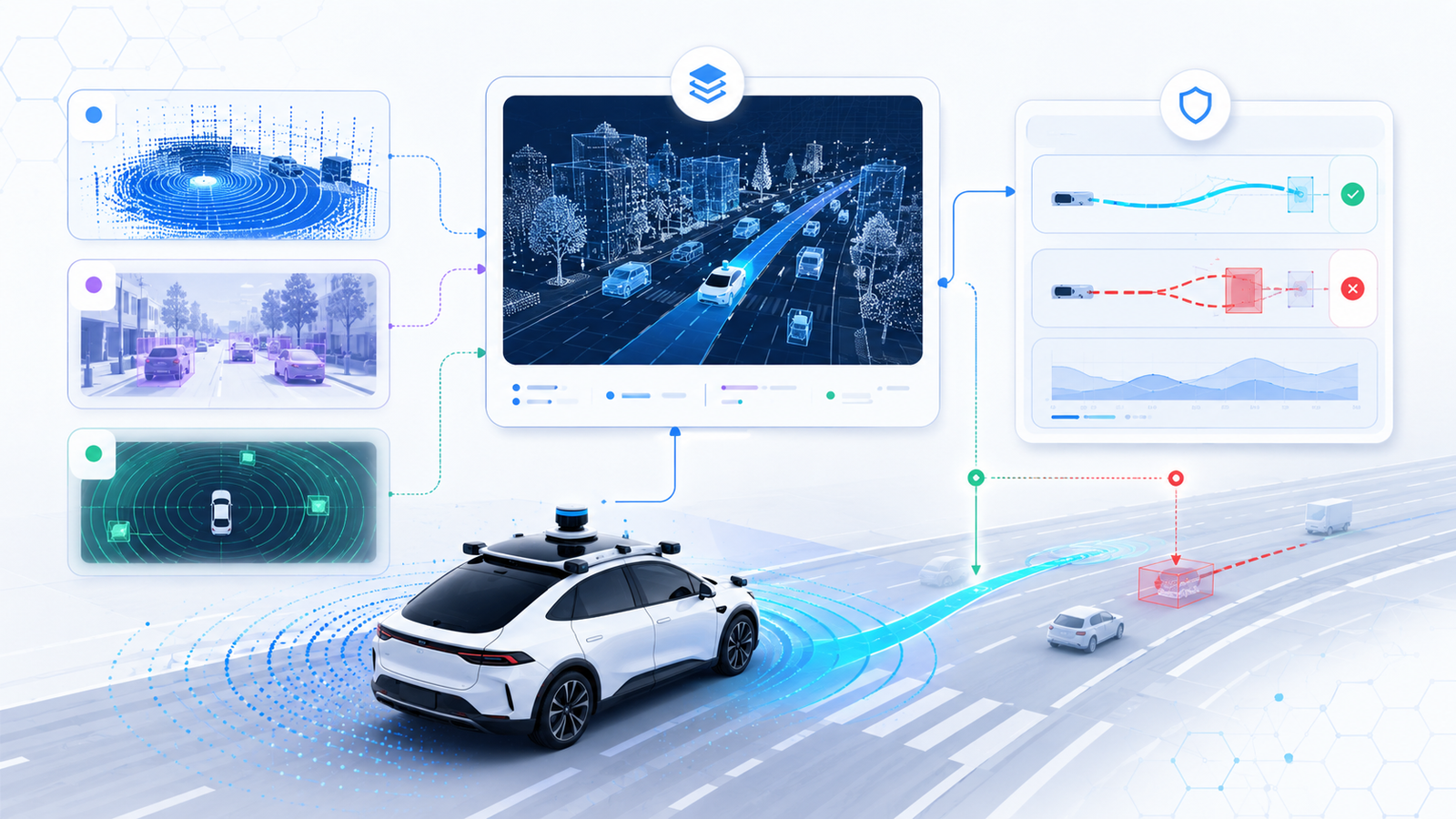
The details: start with the sensors, because Waymo is explicit about why it uses three kinds and not just more of one. Lidar supplies the wireframe, 3D geometry at millimetre precision. Cameras supply the semantic overlay, reading signs and traffic-light colour. Radar acts as the dynamic sentinel, reading velocity directly through Doppler and seeing through rain, fog and dust. These are complementary failure modes, not spare copies, which is the distinction that makes redundancy actually buy you something. HD maps get treated as a fourth input, a prior that frees onboard compute to spend its budget on whatever is dynamic or new.
Then the parts that generalise beyond driving. Waymo consolidated a pile of task-specific modules into fewer, larger foundation models, and says the “modular spaghetti” of one net per object class stops being maintainable at scale. But it explicitly refuses pure end-to-end, pixels to steering, because a black box cannot be trusted at Level 4. Instead there is a separate onboard validation layer that watches every trajectory the Driver proposes and checks it against physics constraints and traffic law, acting as a hard backstop when the plan violates a limit. Training runs on closed-loop simulation rather than replayed logs, so that simulated traffic reacts when the Driver brakes or swerves, and an AI Critic grades millions of real road miles and tens of billions of simulated ones so engineers only look at the genuinely hard cases. Finally, Vision-Language Models trained with Gemini handle deliberate reasoning, for example a police officer waving hand signals at a collision site, while fast sensor fusion keeps real-time control; Waymo calls this thinking fast and slow, and is blunt that VLMs are too slow and too spatially weak to drive on their own.
flowchart TD
    L["Lidar: 3D wireframe"] --> F["Sensor fusion"]
    C["Cameras: semantics, signs, light colour"] --> F
    R["Radar: Doppler velocity, sees through rain and dust"] --> F
    M["HD map: prior, not ground truth"] --> F
    F --> D["Waymo Driver: fewer, larger foundation models"]
    V["Vision-Language Model: slow, deliberate reasoning"] -.->|"semantic hints"| D
    D --> P["Proposed trajectory"]
    P --> G["Independent validation layer: physics plus traffic law"]
    G -->|"pass"| A["Actuation"]
    G -->|"veto"| D
    A --> K["Critic: grades road and simulated miles"]
    K --> S["Closed-loop simulation, retrain, safety review"]
    S --> D
Important
Our take: strip out the cars and this is a template for any agent that touches the physical world. A capable model proposes, a separate and much simpler component with hard constraints disposes, and an offline critic decides what the humans look at next. The validation layer is the bit I would steal first, because it is cheap, auditable and does not need to be smart, only correct about limits. The sensor argument gets the headlines, but the honest lesson is quieter: Waymo did not win by picking the right sensor, it won by never letting one component be the only thing standing between a model and an actuator.
🗞️ More News
🧠 AI
- Andreessen Horowitz raised 1.1 billion dollars for its first dedicated hardware-infrastructure fund, with five partners naming chips, memory, networking, storage, data centres and robotics platforms as targets.
- More than 100 companies including OpenAI, Anthropic, Google, Microsoft, CrowdStrike, Okta and Fortinet signed an open letter warning that AI-enabled attacks on hospitals, water treatment and internet infrastructure will get far more widespread in the coming months.
- Cerebras detailed the CS-4 at Hot Chips: three WSE-3 Turbo wafers per Nexus rack, 900,000 cores and 44 GB of on-wafer SRAM per wafer, 43.2 PB/s of memory bandwidth, doubled per-wafer power delivery and an Ethernet-based scaling fabric.
- Marvell shares slid after the company told investors that revenue from its custom-chip agreement with Google, worth up to 120 billion dollars through fiscal 2033, becomes material in fiscal 2029 rather than sooner.
- Meta is patching a loophole in its AI smart glasses that let recording continue after the capture LED was covered, and is running a public campaign explaining what the indicator light actually means.
- Alibaba Cloud switched on its first South American region, two data centres in Brazil with agentic AI services attached, taking it to 106 availability zones across 31 regions.
- Waymo also opened up its onboard compute in a companion post, which is the hardware half of the argument in today’s big story.
🤖 Robotics
- The two Unitree G1 EDU chains are tracked as CVE-2026-76639 and CVE-2026-76640; the BLE path accepts its bootstrap write with no pairing, and no fixed firmware release has been confirmed.
- Robotics startups have raised more than 23 billion dollars so far in 2026, already close to the whole of 2025, as Nvidia, OpenAI, Meta and Tesla all push into humanoids.
- Coverage of the Waymo post framed it as a direct challenge to Tesla’s camera-only bet, with the “false summit” line aimed squarely at scaling a driver-assist stack into full autonomy.
- Waymo’s closed-loop simulation claim rests on its world model, which it documented earlier this year and which is the piece that makes simulated traffic react to the car instead of ignoring it.
💻 Programming
- Investigators put the TeamPCP campaign at more than 500,000 exposed credentials and at least 300 GB of data taken, with victims including GitHub, Telnyx, LiteLLM, Aqua’s Trivy, Checkmarx’s KICS, TanStack and Red Hat.
- Researchers argue the arrests do not fix the structural problem, since the Shai-Hulud worm pattern was cloned rather than invented and the maintainer-credential path is still wide open.
- This week’s security roundup also covers malware baked into a cheap Android TV streaming box, a VOIP hijack and Signal contact discovery, alongside the TeamPCP arrests.
- VS Code 1.135 ships a streamlined Agents window, the ability to continue a Copilot or Claude agent session started in another app, and per-model chat usage tracking.
- A headless Game Boy emulator drives real cartridge hardware instead of simulating it, which is a nice reminder that “emulator” covers a much wider design space than most people assume.
⚡ Electronics
- The memory squeeze is now a hobby-budget problem as well as a data-centre one, with component prices climbing hard enough that build plans are getting rewritten.
- A dead SD card turned out to be shorted decoupling capacitors rather than dead flash, which is one of the few storage failures you can actually fix with a hot air station.
- Someone rebuilt enough of DOOM’s logic in a pile of 555 timers to actually run it, which is the purest possible demonstration that software is only ever a description of hardware.
- After milling two engines from billet aluminium and wincing at the swarf, one builder switched to casting parts from 3D-printed patterns instead.
- Canonical is calling 2026 the year RISC-V reaches desktop and server class, pinned to RVA23 hardware such as the DeepComputing DC-ROMA Mainboard III.
📡 Telecom
- The Telstra outage traced back to time, not traffic: a GPS rollover bug in an NTP server pushed the wrong clock downstream, and devices used that time to sign credentials that then failed validation.
- Following yesterday’s item, SK Telecom’s data-centre spin-off now has numbers: 3.08 trillion won from KKR and an IMM-Stonebridge consortium, a 51/29/20 ownership split, eight live sites and a 318 MW target, closing in Q1 2027.
- AST SpaceMobile picked up temporary FCC authority to test satellite-to-smartphone service, with AT&T and Verizon backing it rather than Starlink for supplemental coverage.
- The same company is targeting a beta direct-to-device service off its next BlueBird launch, while full broadband rollout slips toward 2027.
👨💻 Code Corner
Waymo’s first lesson is that three sensors beat one, and the maths behind that is small enough to fit in a screenful. Inverse-variance fusion weights each estimate by its own confidence, and the fused uncertainty always comes out below the best single input.
# Inverse-variance fusion: why three mediocre sensors beat one good one.
# Each estimate is (value, sigma). Weight by 1/sigma^2 and combine.

def fuse(estimates):
    w_sum = sum(1.0 / s**2 for _, s in estimates)
    value = sum(x / s**2 for x, s in estimates) / w_sum
    return value, (1.0 / w_sum) ** 0.5

camera = (18.4, 1.90)   # metres to the vehicle ahead; poor depth in glare
lidar  = (17.9, 0.12)   # millimetre-class geometry, hates heavy spray
radar  = (18.1, 0.45)   # coarse, but reads velocity directly via Doppler

for label, sensors in [("lidar only", [lidar]),
                       ("camera only", [camera]),
                       ("all three", [camera, lidar, radar])]:
    value, sigma = fuse(sensors)
    print(f"{label:12} range={value:6.3f} m   sigma={sigma:6.4f} m")
Lidar alone lands at sigma 0.1200 m; all three together land at 0.1157 m, and the fused answer survives losing any one of them.
Tip
This only holds while the errors are independent, unbiased and roughly Gaussian. Point all three sensors into the same low sun and their errors correlate, the maths quietly lies to you, and you get an overconfident estimate. That is exactly why Waymo talks about complementary modalities rather than just more sensors: radar and lidar fail in different weather than cameras do.
🧰 Toolbox
- Waymo Foundation Model write-up: the longer technical companion to today’s ten lessons, if you want the model architecture rather than the summary.
- Cerebras Hot Chips deep dive: the wafer-scale inference numbers straight from the source, including the CS-6 3D-stacking plan.
- Trivy: the open-source scanner that TeamPCP compromised, and still the fastest way to get an SBOM and a CVE list out of a container image.
- pip-audit: audits a Python environment or requirements file against the Python advisory database, and worth wiring into CI this week of all weeks.
- Chrome Root Program policy: dry reading, but the clearest public explanation of why a clock skew like Telstra’s turns into a signature-validation outage.
- VS Code 1.135 release notes: the Agents window rework and per-model usage tracking, useful if you are trying to work out what your editor is actually spending.
🛠️ Build of the Week (rotating)
Pneumatic dot-matrix display: a vacuum-driven display where every pixel is a cavity, and the “ink” is a shadow.
- Difficulty: Advanced
- Parts: vacuum pump, valve manifold, flexible membrane sheet, cavity matrix, microcontroller driving the valves, a light source for the shadow effect
- Why we like it: it inverts the usual assumption that a display emits light. Each pixel is a cavity behind a membrane, and pulling a vacuum deforms the membrane so it casts a shadow; the same mechanism doubles as a suction gripper and a touch surface. It is a good reminder that “display”, “actuator” and “sensor” are roles you assign to a mechanism, not properties the mechanism has. It also runs Snake, which is the traditional proof that a display is finished.
📚 From the Blog
- Turning Pixels Into Something the AI Can Eat: the preprocessing stage between a sensor and a model, and the natural companion to today’s big story since Waymo’s whole argument is about what you feed the network and how much you can trust it.
- Building Your First Neuron From Scratch: weights, bias, activation and one gradient step, worked by hand with no framework in the way.
- The Network Behind the Cameras: the unglamorous plumbing that moves video across a network without melting the switch in the middle.
😀 The Bot Says…
Waymo built an AI Critic so the Driver would not be “grading its own homework”. A whole nation’s phone network, meanwhile, went down because a server confidently signed credentials using the wrong year. The Critic would have caught that. So, honestly, would a wall clock.
That’s all for today! Reply and tell us where your own stack has a component that is both the actor and the only judge of whether it acted correctly, because that is the one to split in two first.