😁 Hello, super humans! Every few months someone demos an AI agent driving a robot arm and the internet decides embodiment is solved. The unglamorous truth is that the arm, the plate reader and the pipette all speak different languages, and somebody has to write the glue. Yesterday Anthropic published a specification for that glue, so let’s look at what it actually does.
📰 Quick Signals
- 🧠 AI: Hugging Face’s summer report finds models under 1B parameters take 83 percent of all-time downloads while everything above 100B takes 1 percent, and in 2026 only 3 percent of download volume goes above 70B.
- 🤖 Robotics: Dyna Robotics unveiled DYNA-2, a world-action model that pairs a learned world model with the action policy so the robot can predict the consequence of a move before committing to it.
- 💻 Programming: Greg Kroah-Hartman shipped eight stable kernels yesterday, including 7.2.1, the first stable update on the 7.2 line, alongside 7.1.11, 6.18.47, 6.12.106, 6.6.154, 6.1.185, 5.15.218 and 5.10.267.
- ⚡ Electronics: the 299 dollar Arduino Ventuno Q pairs a Qualcomm Dragonwing IQ8 octa-core SoC at 40 dense TOPS with an STM32H5 Cortex-M33 for real-time I/O, which is the Linux-plus-microcontroller split becoming the default board architecture.
- 📡 Telecom: Boldyn deployed 5G RedCap for smart livestock monitoring, one of the first production uses of the reduced-capability profile that exists precisely so a battery sensor does not need a full 5G modem.
The Big Story: Anthropic wrote a driver spec, and that is a stranger thing than it sounds
If you have ever tried to get two pieces of lab or factory equipment to cooperate, you already know the joke: the model is not the bottleneck. The pipette is. Yesterday Anthropic opened a research preview of something aimed squarely at that problem, and it is worth reading as an engineering document rather than an AI announcement.
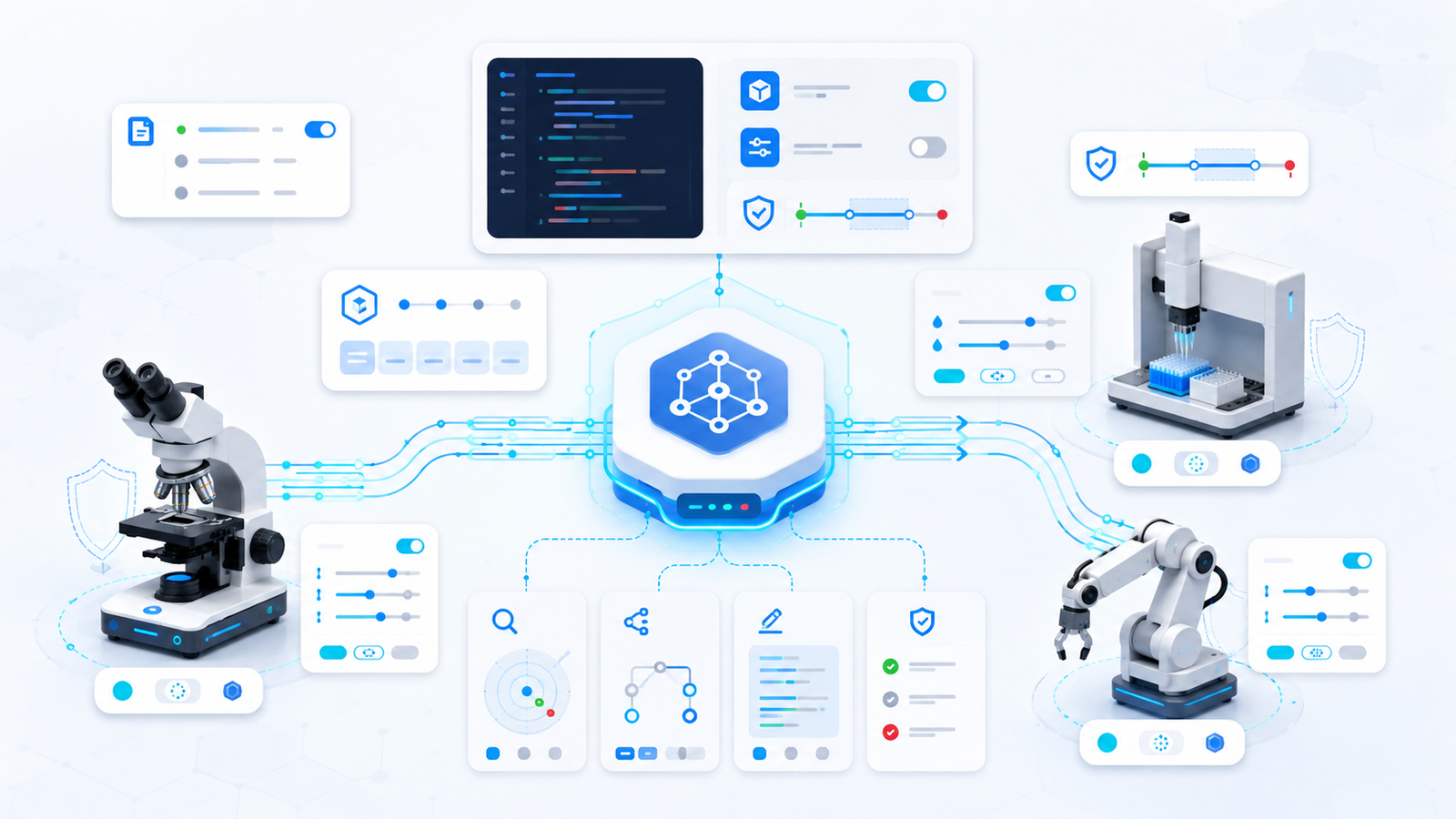
What happened: Anthropic published the Model Hardware Standard, or MHS, a shared specification that lets AI agents discover and safely operate physical devices such as microscopes, liquid handlers and robotic arms. It began as a collaboration with the HHMI Janelia Research Campus and is now open as a research preview to a first group of scientific labs and advanced manufacturers, with early work already done at Genentech, Carnegie Mellon and the University of Washington. It is model-agnostic, works with any device that has a programmable interface, and is reachable over the Model Context Protocol, a command line interface or plain code files. Anthropic says it intends to open source the standard after this preview.
The details: the interesting part is how small the primitive set is. An MHS driver exposes a device through commands as basic as “read” (get temperature) and “write” (set temperature), plus a discovery format so agents and devices can find each other across a network without a bespoke translator sitting in between. On top of that sits the piece that does not exist in any traditional driver: natural-language tags describing machine characteristics that code alone cannot express, for example the weight of a robot arm, which determines how it can safely be moved. Those tags compile into a reference file listing what a device can measure, what can be adjusted, and what safety limits are enforced. The agent then orchestrates across instruments, and when a task runs longer than it is worth reasoning about step by step, it chains driver commands into a code file so the hardware runs the sequence deterministically.
flowchart TD
    A["Agent: Claude, or any harness"] -->|"MCP, CLI, or code file"| B["MHS layer"]
    B --> C["Driver: read / write primitives"]
    C --> D["Reference file: capabilities plus enforced safety limits"]
    C --> E["Natural-language tags: arm weight, fragility, tolerances"]
    B --> F["Liquid handler"]
    B --> G["Robotic arm"]
    B --> H["Plate reader"]
    F -->|"state"| B
    G -->|"state"| B
    H -->|"state"| B
The numbers from the partners are the part I would look at first. At Genentech, Claude autonomously optimised pipetting flow rates against an expert’s ground-truth transfer, converging on roughly 140 µL/s for water at 0.016 RMSE and 10 µL/s for viscous bovine serum albumin at 0.181 RMSE, parameters the company’s automation experts confirmed were reasonable. At the University of Washington, a PhD student in the Baker and Pinglay labs connected six instruments through MHS in under a week, including the time spent writing their drivers, after previous integration attempts had taken weeks and been abandoned. Carnegie Mellon reports running serial-dilution dose-response experiments about three times faster, with an agent coordinating a liquid handler, plate reader, robotic arm and monitoring cameras spread across three computers with incompatible interfaces.
Important
Our take: the honest headline here is not autonomy, it is integration cost. A standard driver with a discovery format is a boring, decades-old idea, and it is exactly what has been missing; the AI part rides on top of it. What convinces me this was written by people who ran real experiments is the failure they published rather than the success. When bubbles formed in a viscous sample, Claude’s instinct was to retry in the same well with different parameters, which agitated the fluid and made more bubbles, because it did not understand the physics of the failure. That is the whole state of embodied AI in one anecdote: excellent at sequencing, weak on physical intuition, and safe only because the driver enforces the limits rather than the model remembering them. If you build instruments, the useful move today is to write the reference file for your device: capabilities, adjustable parameters, hard limits. That artifact outlives whichever model is fashionable next year.
🗞️ More News
🧠 AI
- Anthropic separately announced an expansion of its support for scientists on the same day, aimed at the research labs now closest to this hardware work.
- Anthropic is funding better evaluations of AI’s impact on wellbeing through a research grant programme announced on Tuesday.
- Claude Code took 44.4 percent of agent traffic on the Hugging Face Hub in July, down from 67.8 percent in April, while Codex climbed from 10.4 to 20.8 percent over the same window.
- The same report’s July snapshot carries GGUF builds of DeepSeek-V4-Flash at roughly 284B parameters and Kimi-K3 at roughly 2.8 trillion, which is a lot of weight for a format built for laptops.
- The Linux Foundation’s OpenMDW licence, covering open model, data and weights, is at the OSI for approval and consensus is proving as hard to find as it was for the Open Source AI Definition.
- Bill Gates warned this week of a looming societal crisis caused by AI, which lands differently now that the same week’s news is agents holding pipettes.
🤖 Robotics
- AIR and Elmo Motion Control partnered to enhance an uncrewed cargo aircraft platform aimed at logistics in contested environments.
- Corvus Robotics raised 20 million dollars and named co-founder Mohammed Kabir as chief executive, succeeding Jackie Wu.
- NEURA Robotics acquired German cleaning-robotics company ADLATUS, pushing physical AI into professional cleaning.
- Foxglove introduced an agentic data platform for physical AI with semantic search over robot logs, which is the debugging half of every embodiment story.
- Limitless Labs raised a 20 million dollar Series A to expand a physical AI foundation model and platform for precision manufacturing.
💻 Programming
- Emacs 31.1 shipped with the venerable Emacs dumper removed, a new user Lisp directory, and a “Send to…” item in context-menu-mode.
- Debian is voting on eight separate proposals about LLM-assisted contributions, ranging from an outright ban to explicit approval, plus “none of the above”.
- mklinux v7.0-mk2 runs several independent Linux kernels on one machine on bare metal with no hypervisor, each spawn kernel owning its own CPUs, memory and PCI devices via kexec_file_load().
- Armbian 26.8 rewrote its installer as an armbian-config module, so it is unit-tested, treats eMMC and NVMe as separate flows, and reports a failed bootloader write instead of printing “Done.”
- The Software Freedom Conservancy detailed an ongoing AGPLv3 violation involving Bambu Lab’s 3D-printer software, where the circumvention used is precisely the one the AGPL was written to prevent.
- A practical walkthrough of the configuration and protocol changes you need now to be safe from quantum computers later, prompted by open research more than halving the memory needed to factor ECDSA keys versus the 2023 state of the art.
⚡ Electronics
- Banana Pi’s BPI-AI2N is a Renesas RZ/V2N system-on-module with a 15 TOPS sparse DRP-AI3 accelerator, 8GB LPDDR4x and dual Gigabit Ethernet on a 260-pin SO-DIMM.
- Lantronix Open-M 720G and 520G squeeze 6nm MediaTek Genio SoCs and 10 TOPS into a 43 by 44 mm LGA module for edge vision and on-device generative work.
- The HomeMaster MiniPLC puts an ESP32 on a DIN rail with relays, isolated 24V digital inputs, 0-10V analog in and out, PT100/PT1000 RTD channels, 1-Wire and RS-485 Modbus RTU, with ESPHome pre-installed.
- Firehat is an open-source FireWire DV capture HAT built on a VIA VT6315N, adding a native IEEE 1394 port to a Raspberry Pi 5 or Radxa ROCK 2F over the PCIe FFC connector.
- The USB-C Deskradar is an ESP32-C3 ADS-B flight tracker that paints live aircraft on a 1.28-inch round GC9A01 display, an open-source project that Chinese vendors have already turned into a cheap desk gadget.
📡 Telecom
- Opener is an open-source reference implementation of DECT NR+, the DECT-2020 NR standard targeting up to one million devices per square kilometre, sub-millisecond air-interface latency and mesh operation with no central infrastructure, in the licence-exempt 1880 to 1930 MHz band.
- 2degrees and One NZ are forming a RAN-sharing joint venture, consolidating radio infrastructure across two of New Zealand’s three mobile networks.
- SK Telecom broke up SK Broadband, hiving its data centres and submarine cable assets into a new AI infrastructure company called SK Horizon.
- Altice France is curtailing spending as customers and earnings slide, a reminder that the fibre capex cycle is not uniform across Europe.
- HP agreed to licence Huawei’s Wi-Fi patents, one of the quieter ways the standards-essential patent map keeps redrawing itself.
👨💻 Code Corner
The single most useful idea in today’s big story costs about fifteen lines: never let a model decide whether a setpoint is safe. Put the limits in the driver, clamp there, and refuse anything the device cannot physically do. Here is that pattern in plain Python, no dependencies.
from dataclasses import dataclass

@dataclass(frozen=True)
class Limit:
    lo: float
    hi: float
    unit: str

class Device:
    """Minimal MHS-style driver: declared limits, read/write primitives."""
    LIMITS = {
        "temperature": Limit(4.0, 95.0, "C"),
        "flow_rate": Limit(1.0, 200.0, "uL/s"),
    }

    def __init__(self):
        self.state = {"temperature": 25.0, "flow_rate": 100.0}

    def describe(self) -> dict:
        # This is what the agent reads before it ever writes anything.
        return {k: {"lo": v.lo, "hi": v.hi, "unit": v.unit}
                for k, v in self.LIMITS.items()}

    def read(self, name: str) -> float:
        return self.state[name]

    def write(self, name: str, value: float) -> float:
        lim = self.LIMITS[name]
        clamped = min(max(value, lim.lo), lim.hi)
        if clamped != value:
            print(f"clamped {name}: {value} -> {clamped} {lim.unit}")
        self.state[name] = clamped
        return clamped

dev = Device()
print(dev.describe())
dev.write("flow_rate", 10.0)     # viscous sample, accepted
dev.write("temperature", 250.0)  # agent hallucinated a bake step
print(dev.read("temperature"))   # 95.0
Run it and the third call prints the clamp instead of cooking your sample. The agent never had to remember the limit, because the limit was never its job.
Tip
Clamping silently is fine for a demo and wrong in a lab. In production, raise on an out-of-range write and log the requested value: a clamp that nobody sees is how you discover six months later that every run since April was pinned at the maximum.
🧰 Toolbox
- Model Hardware Standard: the research-preview application portal for the specification in today’s big story, aimed at labs and manufacturers with programmable instruments.
- LeRobot: the open-source robotics stack behind the low-cost arm the University of Washington team instrumented for its collision-free plate handoff.
- Quickshell: a QML toolkit for building desktop components such as bars and menus, already adopted by shells for Sway and niri.
- Remind: a command-line calendar with its own scripting language, for recurrence rules no GUI calendar will express.
- Armbian Imager 2.0: the reworked flashing tool in Armbian 26.8, now able to target SPI and MTD and write a bootloader on its own.
🔌 Component of the Week (rotating)
Analog Devices ADM2587E: a signal and power isolated RS-485/RS-422 transceiver in a single 20-lead wide-body SOIC. If today’s big story is about giving an instrument a programmable interface an agent can drive, this is the part that makes that interface survive contact with a factory floor.
What makes it unusual is that it carries its own isolated DC-to-DC converter on the die, using ADI’s iCoupler and isoPower techniques, so you get a 3-channel isolator, a three-state differential driver, a receiver and the isolated supply from one 3.3V or 5V rail with no external isolation block. It brings ±15 kV ESD protection, current limiting and thermal shutdown for bus contention, and open- and short-circuit fail-safe receiver inputs that hold the output high when the bus goes quiet, which is the failure mode that bites you at 2 a.m. on a long run. It complies with ANSI/TIA/EIA-485-A and ISO 8482, and is specified across the industrial temperature range.
Typical use: the Modbus RTU link on something like this week’s DIN-rail ESP32 PLC, or the serial control line on a bench instrument sitting several metres and one ground-potential difference away from the computer driving it. Budget roughly 10 dollars in single quantities at the major distributors, and read the ADM2582E/ADM2587E datasheet for the isoPower supply-current numbers before you size the rail; the isolated converter is where the power budget goes.
📚 From the Blog
- Turning Pixels Into Something the AI Can Eat: the preprocessing stage between a camera and a model, and a good companion to today’s big story since it is the same argument about who owns the interface between a device and an inference stack.
- Building Your First Neuron From Scratch: weights, bias, activation and a single gradient step, worked by hand with no framework in the way.
- The Network Behind the Cameras: the unglamorous plumbing that moves video across a network without melting the switch in the middle.
😀 The Bot Says…
A frontier model coordinated three instruments, optimised a flow rate to 0.016 RMSE, and recovered from tip-pickup failures on its own. Then it hit a bubble, tried again in the same well, and made more bubbles. Somewhere a lab technician is nodding slowly.
That’s all for today! Reply and tell us which of your devices would be hardest to expose as a read/write pair with declared limits, because that is usually the one worth automating first.