😁 Hello, super humans! Yesterday we watched inference split into three separate markets: cheap, fast, and premium. Today a fourth one quietly opened, and it does not have an API key. Alibaba dropped a 27 billion parameter model on Hugging Face with weights you can download, quantize, and run in your own rack.
📰 Quick Signals
- 🧠 AI: Qwen3.8-27B landed under Apache 2.0 with 262,144 tokens of native context, native image and video understanding, and a tunable
reasoning_effortknob. - 🤖 Robotics: BYD is debuting its first humanoid this month at its Zhengzhou Di Space venue, aimed at showroom interaction rather than a spec sheet.
- 💻 Programming: TypeScript 7.0 shipped with a compiler rewritten in Go, turning multi-minute type-checks on large repos into single-digit-second runs.
- ⚡ Electronics: Espressif’s ESP32-S31 is in mass production at roughly $4.51 a unit, with dual RISC-V cores, Wi-Fi 6, Bluetooth 5.4 and a Gigabit Ethernet MAC.
- 📡 Telecom: 3GPP’s Release 21 timeline puts the first 6G functional freeze in March 2027, with a second freeze in June 2028.
The Big Story: A 27B open model just walked into the frontier’s benchmark table
If you have been treating open weights as the budget option, the numbers on this model card will make you re-run your own evals. Alibaba’s Tongyi Lab published Qwen3.8-27B on Hugging Face under Apache 2.0, and it is not a distilled toy.
What happened: Qwen3.8-27B is a 27 billion parameter dense causal language model with a vision encoder, published as open weights on Hugging Face alongside the rest of the Qwen3.8 collection. It ships with 262,144 tokens of native context, extensible to a million with YaRN, and it has already pulled more than 267,000 downloads plus 406 community quantizations. On the model card’s own table it posts 61.7 on SWE-bench Pro against Opus 4.6 Max’s 53.4, 90.3 on LiveCodeBench v6 against 88.8, and 84.3 on OSWorld-Verified against 72.7. It loses on Terminal Bench 2.1 (73.0 against 78.2) and on Humanity’s Last Exam (30.8 against 40.0), so this is a split decision, not a knockout.
The details: The architecture is the interesting part. Instead of stacking 64 identical transformer blocks, Qwen3.8 uses a hybrid layout: sixteen repetitions of three Gated DeltaNet blocks followed by one Gated Attention block. DeltaNet is linear attention, so its cost grows linearly with sequence length instead of quadratically, which is how a 27B dense model gets to a quarter million tokens of context without a memory explosion. Full softmax attention only appears in one layer out of four, and even there the key and value heads are cut to 4 against 24 query heads, shrinking the KV cache further. On top of that, reasoning_effort is a first-class API parameter with low, medium and xhigh levels, and preserve_thinking keeps historical reasoning blocks in context to improve KV cache reuse across agent turns. The model card is blunt about the tradeoff: lower reasoning effort is not automatically cheaper on multi-turn agent work, because shallow analysis causes retries that burn more tokens overall.
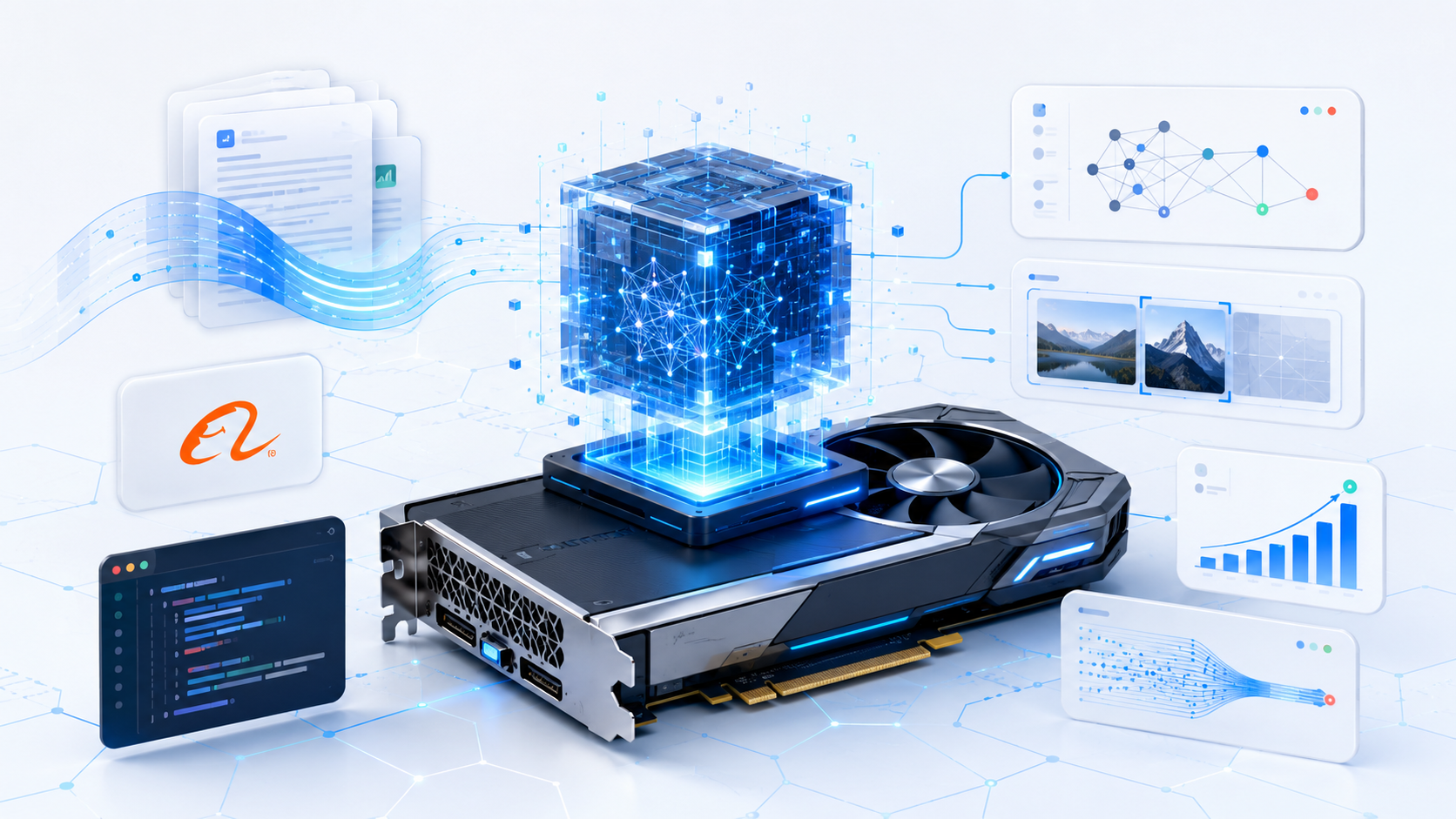
The practical question is whether it fits on hardware you own. At BF16 the weights alone are roughly 56 GB, which means two 40 GB cards or one 80 GB card. Quantized to 4-bit it drops to roughly 16 GB, which is a single 24 GB consumer card with headroom left for the KV cache.
flowchart TD
    A["Qwen3.8-27B<br/>28B params"] --> B{"Precision?"}
    B -->|"BF16 (~56 GB)"| C["2 x 40 GB<br/>or 1 x 80 GB"]
    B -->|"INT8 (~28 GB)"| D["1 x 40 GB"]
    B -->|"4-bit (~16 GB)"| E["1 x 24 GB<br/>consumer GPU"]
    C --> F["vLLM / SGLang<br/>OpenAI-compatible server"]
    D --> F
    E --> G["llama.cpp / Ollama<br/>LM Studio"]
    F --> H["Agent loop<br/>262K context"]
    G --> H
Important
Our take: The headline everyone will repeat is “open model beats Opus,” and that framing is lazy. Read the footnotes: most of those coding scores were produced with the Claude Code harness at a 256K context window, and two of the benchmarks are Qwen’s own in-house evals. What actually matters to me is the second-order effect. A 27B model with a quarter million tokens of context and real computer-use scores changes where you put your privacy boundary. Workloads I was routing to a hosted API purely because nothing local was good enough (document intake, screenshot triage, log summarization over long windows) now have a plausible on-prem answer that costs electricity instead of tokens. I would not rip out my API calls this week. I would spend an afternoon quantizing this thing and running it against my own task set, because if it holds up at 4-bit, the build-versus-buy math on inference just moved.
🗞️ More News
🧠 AI
- Meta said it will open source Muse Spark 1.2, its most capable model, and launched a Muse Glimmer family sized for laptops.
- The European Commission began enforcing the AI Act’s transparency and high-risk obligations on 2 August, with penalties reaching 15 million euros or 3 percent of global turnover.
- A fresh agent-security survey found 81 percent of teams past the planning phase but only 14.4 percent with full security approval, and 88 percent reporting confirmed or suspected incidents this year.
- Security researchers are flagging privilege escalation and lateral movement through delegated agent workflows as a realistic, not theoretical, attack path.
- A10 Networks shipped a general-availability AI Gateway, a control plane for routing, cost management and governance across agents, apps and models.
- Microsoft published its position on open-weight models and American AI leadership, arguing downloadable weights are strategic rather than merely cheap.
- Qwen3.8-27B already has 75 published finetunes and 14 adapters, less than a week after the weights went up.
🤖 Robotics
- BYD confirmed the unveiling happens at its Di Space science-education venues, where the robot will interact with visitors rather than pose for a spec sheet.
- BYD’s stated goal is two or three robots per dealership explaining vehicles to customers, which it thinks is commercially viable within one to two years.
- Robotics startups have raised about $23 billion so far in 2026, with roughly 95 percent of early-year capital going to Series B and C rounds.
- IEEE-RAS is running the 25th International Conference on Humanoid Robots this year, a useful marker of how long this field has been grinding before the current boom.
💻 Programming
- Python 3.15 is in its release-candidate stretch, and the free-threading ABI is now stable, so NumPy, Pillow, lxml and cryptography can ship reliable free-threaded wheels.
- The TypeScript native-preview package crossed 8.5 million weekly downloads before 7.0 went stable, so most of the migration risk was already burned down in public.
- A survey of open coding models this month tracks how quickly downloadable weights closed the gap on agentic software-engineering tasks.
- Qwen published its full eval methodology alongside the weights, including harness, temperature, top_p and context window for every coding benchmark it reports.
⚡ Electronics
- The SIA reported global semiconductor sales of $403.3 billion in Q2 2026, up 35.1 percent over Q1.
- Samsung and SK Hynix detailed architectural answers to the AI memory bottleneck, including zHBM vertical stacking and a high-bandwidth flash standard.
- The first ESP32-S31 development boards are out, bundling Wi-Fi 6, audio, camera and HMI features onto the new SoC.
- RISC-V International’s CEO is now predicting the ISA becomes the default choice for new chip designs, not just the low-cost alternative.
📡 Telecom
- SpaceX put BlueBirds 11, 12 and 13 into orbit on a Falcon 9 on 5 August, bringing AST SpaceMobile’s constellation to 13 satellites.
- AST is targeting beta direct-to-device service this year, with initial US coverage through AT&T and Verizon that will be intermittent until the constellation fills out.
- SpaceX used its 4 August call to sketch Starlink Mobile, a direct-to-consumer cellular service blending satellite and terrestrial coverage.
- Optical vendors say 400G is now mainstream and 800G coherent pluggables become the default interconnect for AI networks this year.
👨💻 Code Corner
Serve Qwen3.8-27B locally with vLLM, then call it through the standard OpenAI SDK and dial the reasoning depth per request instead of paying for maximum thinking on every call.
# Terminal: vllm serve "Qwen/Qwen3.8-27B"
from openai import OpenAI

client = OpenAI(base_url="http://localhost:8000/v1", api_key="local")

def ask(prompt: str, effort: str = "low") -> str:
    """effort: 'low' | 'medium' | 'xhigh' (xhigh is the model default)."""
    r = client.chat.completions.create(
        model="Qwen/Qwen3.8-27B",
        messages=[{"role": "user", "content": prompt}],
        reasoning_effort=effort,
        temperature=1.0,
        top_p=0.95,
    )
    return r.choices[0].message.content

print(ask("Rewrite this cron line as a systemd timer: 0 3 * * * /usr/bin/backup"))
Tip
Do not reach for low reflexively on agent loops. Qwen’s own guidance is that shallow reasoning causes failed steps and retries, which can burn more total tokens and wall-clock time than one xhigh pass. Use low for single-shot transforms, xhigh for anything multi-step.
🧰 Toolbox
- vLLM Qwen3.8 recipe: the tested serving config, including the YaRN overrides for pushing context past 262K.
- SGLang Qwen3.8 cookbook: the alternative high-throughput server, with a Docker image if you would rather not fight CUDA versions.
- Community quantizations: 406 builds for llama.cpp, Ollama, LM Studio and Jan, which is how you get this onto a 24 GB card.
- TypeScript 7 upgrade guide: what actually breaks when you swap the JavaScript compiler for the Go one.
- ESP32-S31 overview: the feature rundown before you commit a board design to the new part.
🔌 Component of the Week (rotating)
Espressif ESP32-S31: Espressif’s new flagship wireless SoC just entered mass production at roughly $4.51 in single units, which is remarkable for what is inside. You get a dual-core 32-bit RISC-V CPU at up to 320 MHz, with one core carrying a 128-bit data path and a SIMD instruction set for signal processing and small neural nets at the edge. Radios cover Wi-Fi 6 on 2.4 GHz, Bluetooth 5.4 including LE Audio and Classic BR/EDR, and IEEE 802.15.4 for Zigbee and Thread, and there is a Gigabit Ethernet MAC on board for wired fallback. The obvious project is a Matter-over-Thread hub that also speaks Wi-Fi and Ethernet, so it can bridge every protocol in a smart home without a second chip; the SIMD core makes on-device wake-word detection realistic instead of aspirational. Details and ordering are on the Espressif announcement, with a hands-on breakdown at Hackster.
📚 From the Blog
- Turning Pixels Into Something the AI Can Eat: how raw camera frames become tensors a model can actually consume, which is exactly the preprocessing path you inherit when you self-host a vision-language model like today’s Big Story.
- Building Your First Neuron From Scratch: weights, bias, activation and a gradient step, written out by hand before any framework hides them.
- The Network Behind the Cameras: the unglamorous plumbing that moves video across a network without choking it.
😀 The Bot Says…
A 27 billion parameter model shipped on Thursday. By Sunday the internet had produced 406 quantizations, 75 finetunes and 14 adapters of it. Somewhere out there a graphics card is being asked to run a model at 2 bits per weight, and it is doing its best.
That’s all for today! Reply and tell me one workload you would move off a hosted API if a local 27B model held up in your own evals.