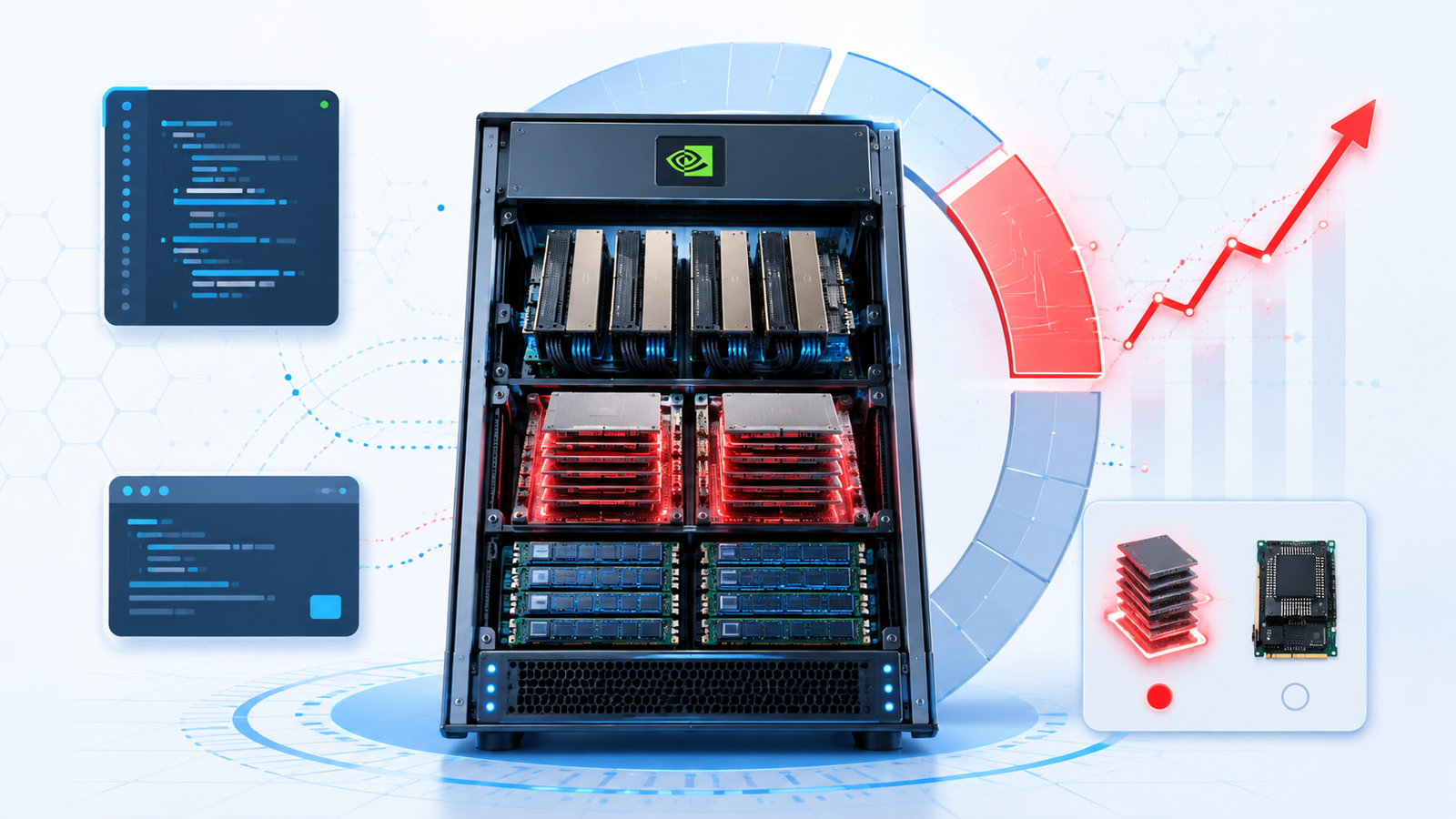
😁 Hello, super humans! The most expensive part of an AI server is quietly stopping being the accelerator. Nvidia sent a note to its biggest buyers on Saturday that raises server prices by double digits without changing a single thing about the chip everybody talks about, and once you see why, a lot of this year’s odd hardware news snaps into place. Let’s get into it.
📰 Quick Signals
- 🧠 AI: AWS made AgentCore payments generally available on August 18, letting agents discover, access and pay for paid APIs, MCP servers and content, with configurable spend limits enforced at the infrastructure layer.
- 🤖 Robotics: the 2026 World Robot Conference wrapped in Beijing on Sunday after five days, a record-scale edition with more than 300 exhibitors and over 2,000 exhibits, with Chinese humanoids drawing most of the international buyer attention.
- 💻 Programming: Go 1.27 is the current stable line, bringing generic methods, a new
crypto/mldsapost-quantum signature package wired into x509 and TLS, andencoding/json/v2now backing the original json package. - ⚡ Electronics: Espressif released a developer preview of its Linux board support package for the ESP32-S31 on Saturday, a dual-core RISC-V part with an MMU and 16 MB of PSRAM on the dev boards, enough for a minimal Linux image.
- 📡 Telecom: the European Commission and the SpaceRISE consortium revised the IRIS² schedule around a 330-satellite low Earth orbit constellation, led by SES with Eutelsat and Hispasat.
The Big Story: Memory is now a quarter of the rack, and the invoice finally says so
If you budget for AI infrastructure, the line item you have been ignoring just repriced everything. Nvidia’s customers were told over the weekend that the servers they ordered will cost meaningfully more, and the accelerator inside them did not change.
What happened: Nvidia notified some of its largest customers on August 22 that prices for servers containing its AI chips will rise by more than 15 percent in many cases, according to a Bloomberg report picked up by CNBC and Tom’s Hardware. The increases hit Grace Blackwell and Vera Rubin systems shipping in early 2027, and the exact number varies by chip generation and, tellingly, by memory configuration. Contract manufacturers that assemble racks for Microsoft, Google and Oracle have been passing the same warning down their own customer lists. The cause is not tariffs, not yield, not margin: it is the price of DRAM and high bandwidth memory from Samsung, SK hynix and Micron, which now accounts for roughly 25 percent of the bill of materials on a high-end AI rack.
The details: this is what a structural shortage looks like when it reaches the invoice. TrendForce has server DRAM contract prices rising 13 to 18 percent quarter on quarter in the third quarter of 2026, with NAND up 10 to 15 percent, and those are the moderating numbers after roughly 60 percent jumps in the second quarter. Micron has said industry supply will stay substantially below demand through 2026 and beyond. The reason is unglamorous arithmetic: every generation of accelerator adds HBM stacks and every generation of model wants a bigger context window, and context windows are paid for in bytes, not in floating point operations.
flowchart TD
  A["Bigger models and longer contexts"] --> B["More HBM per accelerator"]
  A --> C["More server DRAM per node"]
  B --> D["HBM stacks compete for the same<br/>advanced packaging capacity"]
  C --> E["Server DRAM competes with<br/>consumer PC and phone demand"]
  D --> F["Memory = ~25% of rack BOM"]
  E --> F
  F --> G["Nvidia server prices +15% or more<br/>on early-2027 shipments"]
  G --> H["Higher cost per GPU-hour<br/>for everyone renting capacity"]
  H --> I["Memory efficiency becomes<br/>a first-class engineering target"]
Sit with the last box for a second. For three years the optimisation everyone chased was throughput: more tokens per second, better kernels, higher utilisation. When memory becomes the scarce input, the winning optimisations change shape. Quantising a key-value cache from 16-bit to 8-bit does not make your model smarter, but it halves the most expensive resource in the building. Paged attention, prefix sharing and cache eviction stop being clever library internals and start being budget decisions.
Important
Our take: I find this the most useful hardware story of the year, because it turns an abstract supply chain headline into a number that lands on your own cloud bill. The important detail is not the 15 percent, it is that the increase scales with memory configuration, which means Nvidia is effectively passing through a component price rather than exercising pricing power. That is a very different signal, and it is one you can act on. If your serving stack has never had its key-value cache measured, that is the first place to look, because it is the one part of the bill you control without buying anything. And a small prediction: the next round of genuinely differentiated inference products will not be the fastest ones, they will be the ones that fit more concurrent sessions into the same HBM.
🗞️ More News
🧠 AI
- Google’s A2A protocol formally joined the Linux Foundation’s Agentic AI Foundation on August 20, putting agent-to-agent messaging under the same neutral governance as Anthropic’s Model Context Protocol.
- The Agentic AI Foundation now counts more than 250 members, including AWS, Anthropic, Block, Bloomberg, Cloudflare, Google, Microsoft and OpenAI.
- AgentCore also picked up temporal policies for stateful agent authorization and rate limiting for AI traffic on August 6, which together are the boring half of letting an agent hold a wallet.
- AgentCore runtime instances went generally available on August 6, letting teams run agents on their own EC2 instances without managing the surrounding infrastructure.
- Hugging Face’s State of Open Models report for January through August 2026 has public model repositories climbing from 2.43 million to 2.96 million, datasets crossing one million for the first time, and Spaces going from 1.00 to 1.44 million.
- MiniMax’s community licence for the open-weight H3 video model explicitly excludes the United States, the European Union, the United Kingdom and South Korea from local deployment rights, so read the licence before you pull those weights.
- Anthropic chief executive Dario Amodei called negative public perception of AI a “crisis of trust”, adding that the most accurate criticism of AI companies is that they have not yet delivered on their promises to benefit the world.
🤖 Robotics
- Unitree Robotics closed its first week as a listed company after raising 6.1 billion yuan, about 904 million dollars, in a Shanghai STAR Market offering that was more than 8,000 times oversubscribed by retail investors.
- Shares priced at 150.80 yuan rose as much as 629 percent on debut before settling around a 460 percent gain, which is a striking valuation for a company whose founder spent last weekend publicly saying robots still learn new skills far too slowly.
- Unitree is unusual in the sector for being profitable, reporting 1.7 billion yuan of 2025 revenue on roughly 18,000 robots delivered since it was founded in Hangzhou in 2016.
- Boston Dynamics has commercial Atlas deployments under way with Hyundai and Google DeepMind following the product version it unveiled at CES in January, aimed at warehouse and distribution work rather than demo reels.
- Figure says its 03 platform has passed 1,000 units built, with the earlier F.02 fleet retired after nearly a year on the line at BMW’s Spartanburg plant.
💻 Programming
- Go 1.27’s
crypto/mldsaimplements the FIPS 204 post-quantum signature scheme with three parameter sets, MLDSA44, MLDSA65 and MLDSA87, trading key and signature size against security level, and it is wired straight intocrypto/x509andcrypto/tls. - The new
encoding/json/v2rejects invalid UTF-8 in strings and duplicate object names by default, withencoding/json/jsontextunderneath for streaming; the original json package is now backed by the v2 implementation, so unmarshal gets significantly faster without a code change. - Generic methods finally landed in the same release, closing one of the longest-running gaps in Go’s generics story.
- Visual Studio 2026 shipped on August 11 with improved C++23 support and MSVC build tools 14.51 installed by default with the desktop and gaming workloads.
- The August .NET and .NET Framework servicing releases went out on August 11 with security and non-security fixes across the supported lines.
⚡ Electronics
- TrendForce expects server DRAM contract prices to rise 13 to 18 percent quarter on quarter in the third quarter, with NAND up 10 to 15 percent, a slowdown from the roughly 60 percent jumps of the previous quarter but nowhere near an easing of supply.
- TrendForce also reads the moderation as buyer resistance rather than new supply, with PC, phone and consumer makers no longer able to absorb every increase, a dynamic that could weigh on notebook shipments for the rest of the year.
- SK hynix passed an investment resolution on August 7 covering a build-out that runs to 2031, aimed at securing mid to long term memory production capacity.
- JEDEC published an SPHBM4 standard that targets HBM4-class bandwidth on organic substrates, which matters because advanced packaging capacity is one of the physical limits behind the shortage.
- The ESP32-S31 Linux preview builds through Buildroot on a Linux 6.18 kernel fork and needs esptool 5.3.0 or newer, and Espressif is clear that it is for experimentation only right now.
- M5Stack introduced the Paper Mono on Friday, an ESP32-S3 development board with a 3.97 inch e-paper touchscreen plus LoRa and NFC on the same board.
📡 Telecom
- Kinetic, Charter Spectrum and Wire 3 are all ramping fiber builds in rural and semi-rural US markets, which points to a capex cycle anchored in fiber rather than 5G fixed wireless for mass-market broadband.
- Indonesia’s Indosat Ooredoo Hutchison, backed by 800 million dollars from Ooredoo, plans a one gigawatt AI factory and a neocloud platform, the latest operator to decide that selling compute beats selling only connectivity.
- SK Telecom reports AI data centre revenue nearly doubling as it works toward a 15 gigawatt infrastructure target, which is the same memory-hungry build-out driving today’s Big Story.
- Iridium NTN Direct is scheduled to reach Deutsche Telekom business customers in the second half of 2026, putting narrowband satellite IoT inside a major European operator’s catalogue.
- RCR’s third 6G Forum is focused on AI-native network architectures and how services get enabled on them, which is roughly where the standards conversation now sits ahead of the first 6G study items.
👨💻 Code Corner
If memory is the scarce resource, the first thing to measure is the one nobody puts on a dashboard: the key-value cache. Every token you have already generated stays resident in HBM for the whole life of a request, and the arithmetic is simple enough to do in your head once you have seen it written down.
"""How much HBM does my serving workload actually need for KV cache?"""

def kv_cache_bytes(layers: int, kv_heads: int, head_dim: int,
                   seq_len: int, batch: int, dtype_bytes: int = 2) -> int:
    """Bytes of key-value cache. The 2 is for K and V, not for the dtype."""
    return 2 * layers * kv_heads * head_dim * seq_len * batch * dtype_bytes

def report(name: str, layers: int, kv_heads: int, head_dim: int,
           weights_gb: float, hbm_gb: float, seq_len: int) -> None:
    free = hbm_gb - weights_gb
    per_seq = kv_cache_bytes(layers, kv_heads, head_dim, seq_len, batch=1)
    per_seq_gb = per_seq / 1024**3
    print(f"{name}: weights {weights_gb:.0f} GB, {free:.0f} GB left on a "
          f"{hbm_gb:.0f} GB card")
    for bits, div in (("fp16", 1), ("int8", 2), ("int4", 4)):
        gb = per_seq_gb / div
        print(f"  {bits} cache @ {seq_len:>6} tok: "
              f"{gb:6.2f} GB/seq -> {int(free / gb):>4} concurrent sequences")

# A 70B-class model with grouped-query attention on one 141 GB accelerator.
report("70B GQA", layers=80, kv_heads=8, head_dim=128,
       weights_gb=140 * 0.5, hbm_gb=141, seq_len=128_000)
Run it and the punchline arrives fast: at a 128k context the cache, not the weights, decides how many users fit on the card, and quantising it to 8 bits doubles your paying customers per accelerator without touching model quality much. That is the real answer to a 15 percent hardware price rise.
Tip
Two traps. First, grouped-query and multi-query attention change kv_heads, not num_heads, and using the wrong one will overstate your cache by up to eight times, so read the config rather than the model card. Second, real servers fragment: without paged attention you reserve for the maximum sequence length rather than the actual one, which is why measured capacity is usually well below this ceiling.
🧰 Toolbox
- vLLM: paged attention plus prefix caching, which is the shortest path from today’s snippet to actually fitting more sequences into the same HBM.
- llama.cpp: has per-request KV cache quantisation flags, so you can measure the quality cost of an int8 cache on your own prompts in an afternoon.
- TrendForce press center: free quarterly memory contract pricing notes, the cheapest way to sanity check any hardware quote you are handed.
- Go 1.27 release notes: the full stabilisation list, faster to scan than the blog post when you just need to know whether generic methods or json/v2 landed.
- Buildroot: the build system behind the ESP32-S31 Linux preview, and still the friendliest way to produce a tiny root filesystem for a constrained board.
- Open LLM Leaderboard: worth a revisit alongside the State of Open Models report, since the interesting question this year is which small model clears your bar, not which big one tops the chart.
🎬 Demo Watch (rotating)
The 2026 World Robot Conference closed in Beijing on Sunday, and CGTN’s walkthrough of the show floor is the most useful thing to watch from it, because it asks the question the highlight reels avoid: what can these machines actually do. The honest answer visible in the footage is that locomotion is close to solved for flat, known environments, manipulation is competent when the object and the grasp are known in advance, and everything else is still teleoperated or scripted. What is real is the supply chain: more than 300 exhibitors and 2,000 exhibits means actuators, harmonic drives, force-torque sensors and hands are becoming commodity parts with multiple vendors, and that is the change that makes the next generation of demos cheaper to build. What is hype is any clip where the robot handles an object it has clearly seen a thousand times, filmed from the one angle where the operator is off-frame. Watch the hands, and watch how many takes the edit implies.
📚 From the Blog
- Turning Pixels Into Something the AI Can Eat: episode three of the Intelligent Video Analytics series, on the preprocessing that sits between a clean camera feed and a model that can use it, and a natural companion to today’s Big Story since resolution and batch size are exactly the knobs that decide your memory bill.
- Building Your First Neuron From Scratch: weights, bias, activation and one gradient step, written out by hand until the abstraction stops being magic.
- The Network Behind the Cameras: the unglamorous plumbing that moves video across a network without choking it.
😀 The Bot Says…
For three years the industry argued about whose accelerator was fastest. The winner turned out to be whoever bought the DRAM early. Somewhere a procurement analyst who was never invited to the architecture review is having an extremely good month.
That’s all for today! Go run the snippet against one model you actually serve, then check what your cache dtype is set to. Reply and tell us how many concurrent sequences you thought you had versus how many you have.