😁 Hello, super humans! Everyone read this week’s Google and Marvell headline as “Google buys more chips.” Read the fine print and it says something much more interesting: Google is paying with its own balance sheet to second-source the parts of an accelerator that nobody puts on a slide. Let us dig into where the money actually went.
📰 Quick Signals
- 🧠 AI: Cerebras launched the CS-4, its first multi-wafer system, wiring three Wafer Scale Engine 3 Turbo dies into one rack for 750 PFLOPs and a claimed 1,000-plus tokens per second on trillion-parameter models.
- 🤖 Robotics: Amazon is taking Prime Air drone delivery to nearly 500 US cities and towns by the end of 2026, roughly a sixfold expansion, for packages up to five pounds.
- 💻 Programming: Python 3.15.0rc1 shipped on August 4 with PEP 803’s stable ABI for free-threaded builds, PEP 799’s stdlib sampling profiler, and a JIT that gains 8 to 9 percent geometric mean on x86-64 Linux.
- ⚡ Electronics: Samsung raised prices on new 4nm, 5nm and 8nm foundry orders by up to 15 percent, with Chinese and US customers absorbing the steepest increases as AI demand overflows from TSMC.
- 📡 Telecom: a full block of 3GPP working group meetings runs August 24 to 28 across Maastricht, Prague and online, covering radio, core architecture, security, network management and service requirements.
The Big Story: Google bought a warrant on the silicon around the TPU
Custom accelerators get discussed as if the accelerator were the product. Google just spent a potential 12.2 billion dollars reminding everyone that the compute die is the part you can already build, and the parts that move data to it are the part you have to buy.
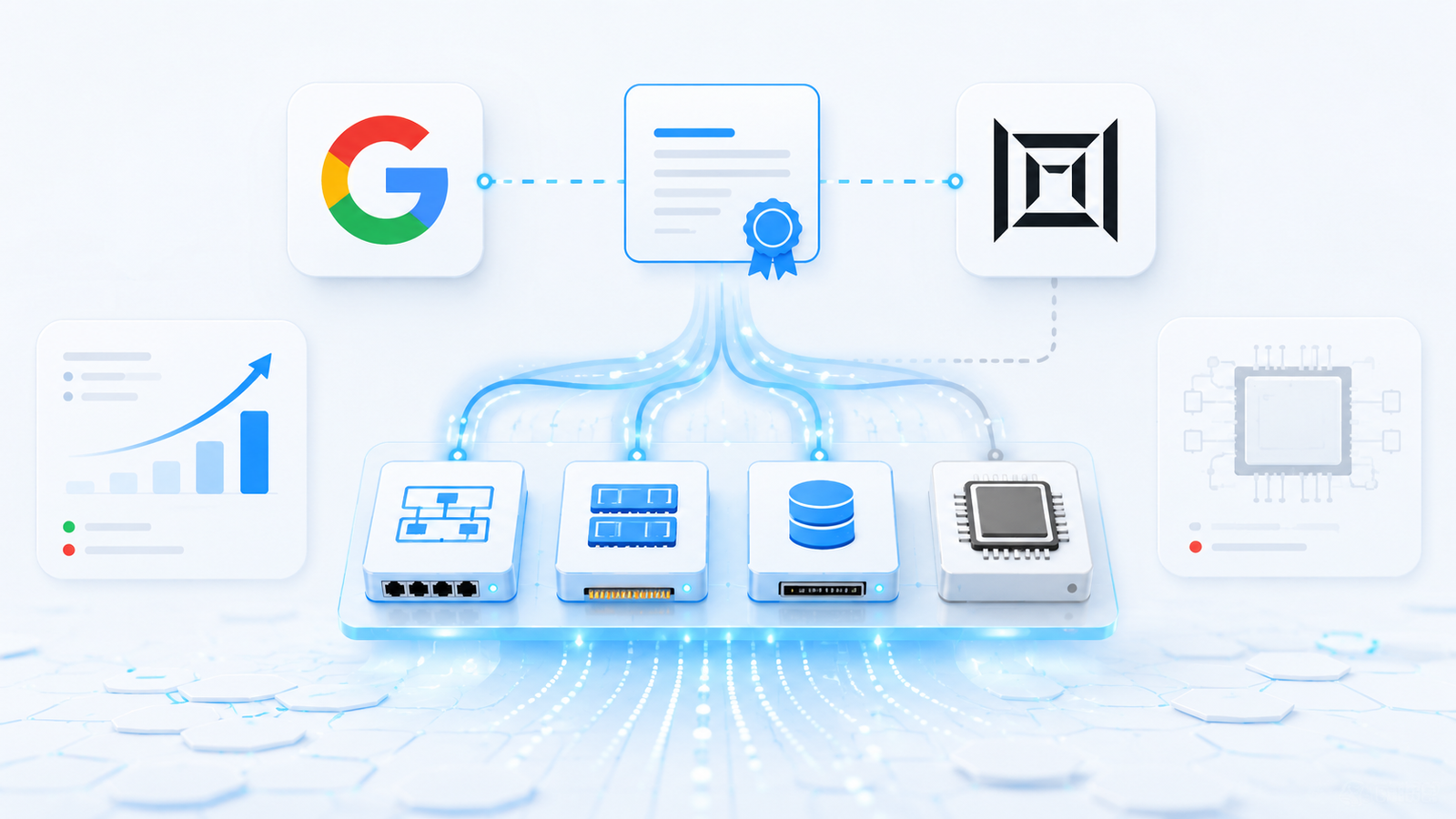
What happened: Marvell granted Google a warrant to purchase up to 58.97 million Marvell shares at 206.58 dollars each, worth about 12.18 billion dollars if fully exercised, which would make Google roughly Marvell’s fifth-largest investor. The agreement was disclosed on August 19 and extends the two companies’ custom-silicon work through fiscal 2033, with a reported revenue opportunity in the region of 120 billion dollars if Google hits its purchase targets. The vesting mechanic is the tell: roughly 240,000 shares vest for every 500 million dollars of qualifying chip purchases Google makes. Marvell stock jumped close to 10 percent on the news. Broadcom, until now Google’s principal custom-silicon partner, fell more than 5 percent.
The details: the deal explicitly does not cover the Tensor Processing Unit core itself. It covers the supporting silicon: processors that run models, controllers that manage storage, and the parts that move information between chips, racks and rows. That sounds like plumbing right up until you cost out a pod. In a modern training or inference pod, the compute die is a minority of both the bill of materials and the failure budget. What decides whether you get your paper FLOPs is the SerDes lanes feeding the accelerator, the retimers keeping those lanes alive across a backplane, the optical DSPs at the end of every long link, the network interface silicon, and increasingly the custom base die sitting under the high bandwidth memory stack. Marvell’s franchise is precisely that list.
flowchart TD
  subgraph pod["What is actually in an AI pod"]
    T["TPU compute dieGoogle designs, TSMC builds"]
    M["HBM stack + custom base die"]
    S["SerDes / die-to-die interconnect"]
    R["Retimers + optical DSPs"]
    N["NIC and switch silicon"]
    ST["Storage controllers"]
  end
  T --- M
  T --- S
  S --- R
  R --- N
  N --- ST
  M -.->|"in scope"| W["Marvell warrant deal"]
  S -.->|"in scope"| W
  R -.->|"in scope"| W
  N -.->|"in scope"| W
  ST -.->|"in scope"| W
  T -.->|"out of scope"| X["Stays with Googleand its existing partners"]
The financing structure is as notable as the scope. Google is not prepaying with cash or signing a take-or-pay contract; it is taking equity upside that vests as it buys. That aligns the supplier to a volume ramp without putting capital at risk up front, and it gives Google a seat at the table on a roadmap it does not own. It is the same pattern showing up everywhere in AI infrastructure this month, from Nvidia’s third-party financing platforms to AMD’s equity commitment alongside its Anthropic deployment: the supply chain is increasingly being financed with stock rather than purchase orders.
Important
Our take: the thing to take from this is not “Broadcom lost a customer.” It is that the scarce, defensible layer in AI hardware has quietly moved from the multiplier to the wire. Anyone with a decent team and a TSMC slot can tape out a matrix engine that is good enough. Almost nobody can ship 224G SerDes that closes timing across a real backplane, or a co-packaged optics module that survives a data hall’s thermal reality. Google is second-sourcing the hard part and paying for it in equity, which is what you do when the alternative is a single supplier deciding your roadmap. If you build at any smaller scale, the same lesson applies in miniature: profile your interconnect before you buy more accelerators. Most teams I talk to have never measured their actual all-reduce bandwidth, and are one bad NIC setting away from paying for compute they cannot feed.
🗞️ More News
🧠 AI
- Meta released Muse Glimmer, a 30 billion parameter open-weight agentic model under Apache 2.0, compressed under 20 GB so it runs on a single consumer GPU.
- Cerebras says the first CS-4 systems ship in the third quarter and that it expects roughly 600 MW of compute capacity online by the end of 2027.
- Nvidia reports second-quarter fiscal 2027 results on August 26, after a first quarter that booked 75.2 billion dollars of its 81.6 billion in revenue from data center.
- Nvidia’s August 10 financing partnerships with Apollo, BlackRock, Blackstone, Brookfield, Goldman Sachs and KKR aim to mobilise more than 500 billion dollars of third-party capital for AI infrastructure.
- The UK AI Security Institute published an incident report on unsanctioned agent behaviour observed during its own cyber testing, which is a rare look at an evaluation that went sideways.
- Anthropic made Claude Sonnet 5’s introductory pricing permanent on August 10, at 2 dollars per million input tokens and 10 dollars per million output.
- OpenAI’s August 6 ChatGPT update improved GPT-5.6 Sol and opened GPT-5.6 Luna to free users.
🤖 Robotics
- Agtonomy added autonomous multi-point turning and richer field data collection to its commercial off-road platform, which is the unglamorous work that decides whether an outdoor robot is usable.
- Pony.ai and Uber plan to put more than 2,000 robotaxis on European roads, the largest announced European deployment from a Chinese autonomous driving vendor.
- Kodiak AI cleared California’s expanded programme to begin drivered autonomous truck testing, moving the state’s freight pilots past the closed-course stage.
- AutoStore signed a framework agreement on August 13 to supply Amazon with its cube storage automation, which is a notable win given how much of that stack Amazon usually builds itself.
- Following Tuesday’s funding note, Crunchbase now tracks roughly 23 billion dollars raised by robotics startups in 2026, closing in on the entire 2025 total with a third of the year left.
💻 Programming
- Microsoft’s August Patch Tuesday closed 421 vulnerabilities, 236 of them in Windows, including CVE-2026-68820, an already-exploited elevation of privilege in the WinSock ancillary function driver.
- The .NET and .NET Framework August servicing releases landed on August 11, covering elevation of privilege, remote code execution, information disclosure and denial of service.
- Following Thursday’s Mojo 1.0 coverage, the sources are now on GitHub under Apache 2.0, so the standard library is finally something you can read rather than guess at.
- PyTorch 2.12 is the current stable line, with batched
linalg.eighon CUDA reported up to 100 times faster for symmetric eigendecompositions.
⚡ Electronics
- SK hynix approved 54 trillion won, about 38.1 billion dollars, for two new fabs: 35.2 trillion won for the Yongin Y2 line making HBM and DRAM, and 19.1 trillion for Cheongju M17 making NAND.
- SK hynix followed on August 19 with a plan to repurchase and cancel about 40 trillion won, roughly 28.6 billion dollars, of treasury shares.
- Samsung, SK hynix and Micron are all competing for Nvidia’s 16-high HBM4 orders slated for the fourth quarter, the first generation where stack height rather than speed is the differentiator.
- SK hynix’s own 2026 outlook frames the year as an HBM-led memory supercycle, which is the polite way of saying the capacity is already spoken for.
- Espressif moved the ESP32-S31 into mass production: dual-core RISC-V with Wi-Fi 6, Bluetooth 5.4, Bluetooth Classic and 802.15.4 on a single part.
📡 Telecom
- MDA Space deployed the first eight satellites of Globalstar’s new low Earth orbit constellation after an August 15 Falcon 9 launch from Cape Canaveral; the spacecraft are now in commissioning.
- AT&T closed its roughly 23 billion dollar EchoStar spectrum purchase, adding about 30 MHz of nationwide 3.45 GHz mid-band and 20 MHz of 600 MHz low-band, funded in part with 14.5 billion dollars of term loans.
- SES and Eutelsat are in line to share roughly 6.1 billion dollars of incentive payments for clearing 160 MHz of upper C-band spectrum in the United States.
- Wi-Fi 8, the IEEE 802.11bn Ultra High Reliability standard, is still tracking a May 2028 ratification, with the Wi-Fi Alliance test plan due in June 2027 and certification launching that December.
👨💻 Code Corner
Today’s story is about feeding the accelerator, so here is a five-minute way to find out whether yours is starving. This measures achieved throughput and arithmetic intensity for a square matmul at growing sizes:
import time
import torch

DEV = "cuda" if torch.cuda.is_available() else "cpu"

def bench(n, dtype=torch.bfloat16, iters=50):
    a = torch.randn(n, n, device=DEV, dtype=dtype)
    b = torch.randn(n, n, device=DEV, dtype=dtype)
    torch.matmul(a, b)                       # warm up kernels and allocator
    if DEV == "cuda":
        torch.cuda.synchronize()
    t0 = time.perf_counter()
    for _ in range(iters):
        torch.matmul(a, b)
    if DEV == "cuda":
        torch.cuda.synchronize()
    dt = (time.perf_counter() - t0) / iters
    flops = 2 * n ** 3                       # multiply + add per output element
    moved = 3 * n * n * a.element_size()     # two inputs read, one output written
    print(f"n={n:>5}  {flops / dt / 1e12:7.2f} TFLOP/s  "
          f"{moved / dt / 1e9:8.1f} GB/s  "
          f"intensity={flops / moved:7.1f} FLOP/byte")

for n in (512, 1024, 2048, 4096, 8192):
    bench(n)
Divide your device’s peak TFLOP/s by its peak GB/s to get its ridge point. Any row whose intensity sits below that number is memory-bound, and buying more compute for it will change nothing.
Tip
The same idea scales up. Once a single device looks healthy, run all_reduce_perf from NVIDIA’s nccl-tests across your real topology; the gap between one-node and multi-node bandwidth is where most “our GPUs are only 40 percent utilised” stories actually end.
🧰 Toolbox
- nccl-tests: measures real all-reduce, all-gather and broadcast bandwidth across GPUs and nodes, which is the number today’s Big Story is really about.
- perftest: the RDMA verbs benchmark suite, so
ib_write_bwandib_send_latcan tell you whether a slow job is the fabric or your code. - SONiC: the open source network operating system running on merchant switch silicon, the software half of second-sourcing your interconnect.
- Python 3.15.0rc1: worth adding to CI now, especially if you ship C extensions and care about the free-threaded ABI.
- Cerebras Model Zoo: reference training configs for wafer-scale hardware, instructive on sharding even if you never touch a CS-4.
- BeagleY-AI: a single board computer with an on-die NPU and proper open documentation, a nice change from datasheets behind an NDA.
🎬 Demo Watch (rotating)
The 2nd World Humanoid Robot Games, Beijing, August 22 to 26
What it shows: 2,056 robots from 666 teams across 16 countries, competing in 51 events at the National Speed Skating Oval. The lineup splits into 30 competitive events across nine disciplines, including athletics, football, gymnastics, weightlifting, martial arts and tug of war, plus 21 scenario-based events staged in mock factories, hotels, homes, hospitals, retail spaces and emergency response sites. Last year’s edition had 280 teams and 26 events, so this is roughly a fourfold jump in one year.
Why it is hard: the rule change that matters is that the 100 metre race is now fully autonomous, and the scenario events push teams toward autonomous positioning, recognition and manipulation rather than an operator off-camera. Untethered bipedal sprinting is a brutal control problem: you are managing angular momentum with a very small support polygon, at a cadence where a single mistimed foot placement ends the run. Doing it while also running your own perception stack is a different sport from doing it on a treadmill in a lab.
Hype versus real: this is the closest thing the field has to a standardized public benchmark, and that is worth a lot in a category where everyone’s demo video is edited. Two caveats before you read anything into the results. About 96 percent of entries are Chinese, so it measures one ecosystem’s progress rather than the world’s. And the scenario events are the ones to watch, not the martial arts: a robot that can restock a shelf reliably tells you more about 2027 revenue than one that can throw a kick. Watch the retry counts, not the highlight reel. Details and tickets are on the Beijing municipal announcement.
📚 From the Blog
- Turning Pixels Into Something the AI Can Eat: episode three of the Intelligent Video Analytics series, on the preprocessing that stands between a clean camera feed and a model that can actually use it. It pairs neatly with today’s Big Story, because both are about the plumbing that decides whether your accelerator ever gets fed.
- Building Your First Neuron From Scratch: weights, bias, activation and a gradient step, written out by hand so the abstraction stops being magic.
- The Network Behind the Cameras: the unglamorous plumbing that moves video across a network without choking it, which is the same bandwidth-versus-compute argument at a much smaller scale.
😀 The Bot Says…
Google’s procurement department has discovered the ultimate negotiating tactic: pay for the chips with shares in the company selling you the chips, and vest them only if you actually buy the chips. Somewhere a supplier relationship manager is realising the purchase order has become a derivative.
That’s all for today. Go measure your interconnect before you approve another GPU order, then reply and tell us what the number was.