😁 Hello, super humans! Chips that only know one model, a robot that can tie a trash bag shut, and a semiconductor industry that just posted its best quarter in years: today’s issue leans hard into hardware. Grab your coffee, the silicon is getting weird in the best way.
📰 Quick Signals
- 🧠 AI: DeepSeek released V4 Flash, a coding model that reportedly approaches Claude Opus 4.8 quality for roughly a hundredth of the inference cost.
- 🤖 Robotics: Google DeepMind shipped Gemini Robotics 2, a model that controls a humanoid from feet to fingertips instead of just the arms.
- 💻 Programming: VS Code shipped the release version of TypeScript 7, the first version compiled with the new Go-based compiler.
- ⚡ Electronics: Global semiconductor sales hit $403.3 billion in Q2 2026, up 35.1% from Q1, according to the Semiconductor Industry Association.
- 📡 Telecom: The FCC voted to explore opening more than 200 MHz of unlicensed spectrum so ordinary phones can talk directly to satellites.
The Big Story: AMD just baked an AI model straight into silicon
If you have ever waited on a chatbot’s typing indicator, you have felt the memory wall: GPUs spend as much time shuttling weights around as they do computing with them. AMD just bought a company that deletes that trip entirely.
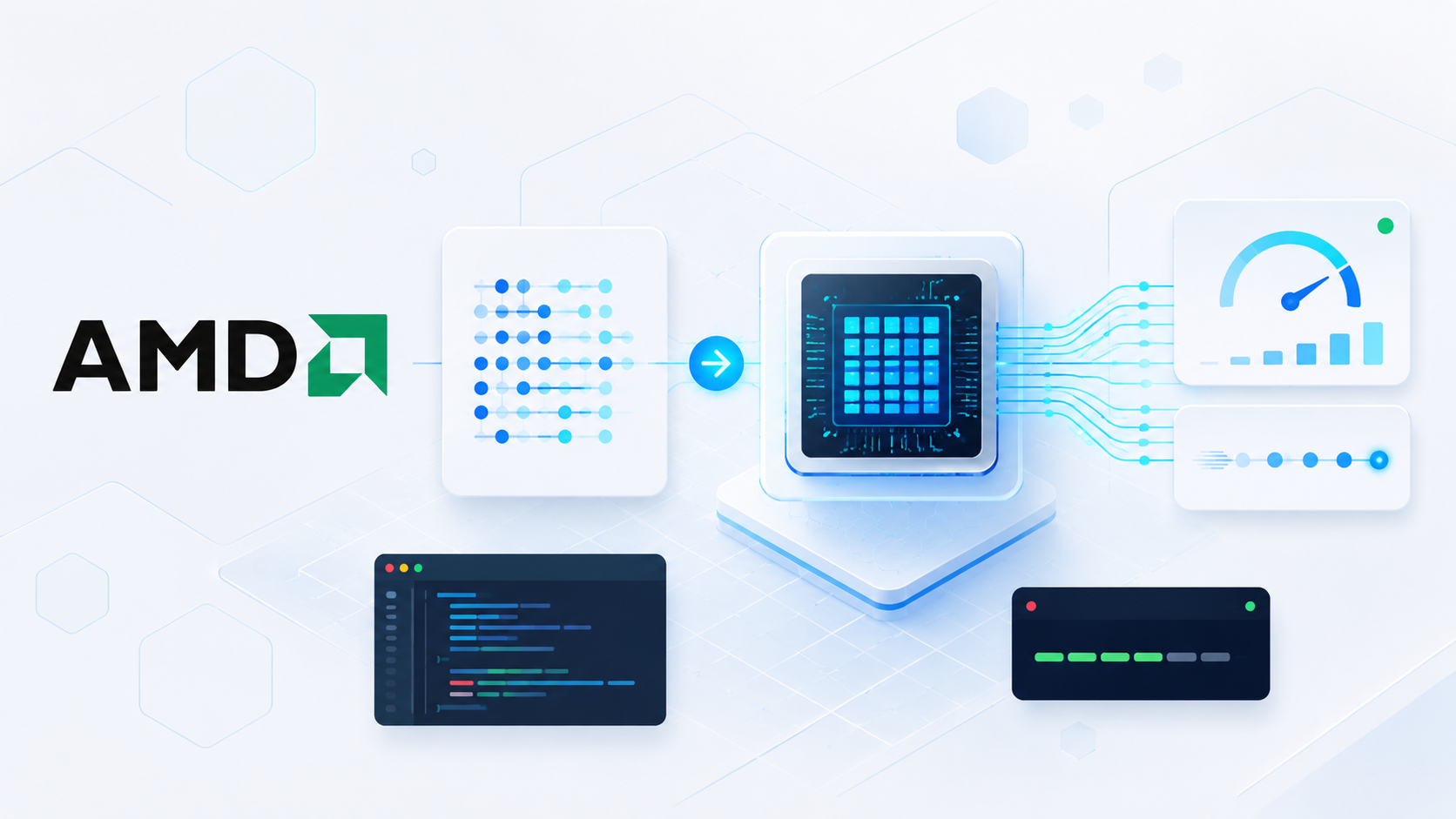
What happened: AMD announced on August 6 that it is acquiring Taalas, a three-year-old Toronto startup that etches a model’s weights directly into the transistors of an inference chip rather than loading them from memory at runtime.
The details: Taalas stores a 4-bit weight and performs its multiply inside a single transistor, collapsing the usual separation between where a number lives and where the math on it happens. A demo chip running Llama 3.1-8B hit over 16,000 tokens per second per user, which the company claims is 48 times faster than an Nvidia GPU and 8.5 times faster than a Cerebras wafer-scale system. AMD plans to split the pipeline: Taalas silicon handles token generation, the slow, memory-bound part of inference, while AMD’s Instinct GPUs still handle prefill and attention at the start of each request. Taalas is AMD’s third AI acquisition in nine months, after MK1 in November and memory-optimization startup Mext in June.
Important
Our take: Hardcoding weights into silicon is a genuinely different bet than the GPU-does-everything approach, and it is a smart one for high-volume, fixed workloads like a single popular open model served at massive scale. The catch is the same one you would expect: a chip that only knows Llama 3.1-8B is worthless the day you want to swap in a better model. Watch this as a new tier that sits below general-purpose GPUs for the handful of models everyone actually deploys at scale, not as a GPU killer.
🗞️ More News
🧠 AI
- Alibaba introduced Qwen3.8-Max and says it will publish the weights, reversing its recent drift toward closed releases.
- The EU AI Act’s Article 50 transparency rules became enforceable on August 2, requiring chatbots and deepfakes to disclose that they are synthetic.
- Suno CEO Mikey Shulman laid out four AI music principles alongside new download limits and watermarking to curb mass distribution of AI tracks on streaming platforms.
- OpenAI cut pricing on GPT-5.6 Luna sharply, continuing the industry-wide race to the bottom on token costs.
- NAVER, NVIDIA, and Brookfield struck a $10 billion deal to triple South Korea’s sovereign AI factory capacity from 55 to 200 megawatts by 2028.
- Alphabet reshuffled its AI leadership: Demis Hassabis moves to chief scientist and DeepMind chair, Koray Kavukcuoglu takes over daily operations, and Jeff Dean is departing to start a new venture.
🤖 Robotics
- 1X unveiled a new hand for its NEO humanoid: 25 degrees of freedom, tendon-driven, force-transparent enough to catch a slipping egg.
- BYD confirmed it will unveil its first humanoid robot this month at its “Di Space” event.
- Tacta Systems unveiled a three-part hardware and software stack that lets people teach a robotic hand new dexterous skills directly.
- Robotics startups have raised over $23 billion in 2026 so far, already closing in on all of 2025’s total.
💻 Programming
- GitHub’s Octoverse report shows TypeScript overtook Python as the most-used language by contributor count, up 66% year over year.
- CPython’s Rust integration is moving forward, with a PEP draft due mid-2026 targeting Python 3.16 for the first Rust-containing release.
- Nearly 80% of all new GitHub repos created in the past year used just six languages: Python, JavaScript, TypeScript, Java, C++, and C#.
⚡ Electronics
- SK hynix and SanDisk published the first open High Bandwidth Flash standard, targeting up to 3TB/s for AI inference, while Samsung showed a concept zHBM design claiming 8x HBM5 performance.
- Kioxia and SanDisk unveiled 10th-generation, 332-layer QLC NAND with the industry’s highest bit density, aimed at AI and cloud storage power efficiency.
- Tokyo Electron’s Kumamoto facilities resumed operations on August 3 after safety checks tied to the M7.1 earthquake, with Sony Semiconductor restarting production a day later.
- South Korea unveiled $950 billion in AI chip partnerships at a San Francisco summit, led by a $500B+ SK Hynix and NVIDIA deal and a Samsung and Broadcom memory and foundry MOU.
📡 Telecom
- Starlink signed its largest direct-to-cell deal yet with telecom group Veon, reaching over 150 million potential customers.
- AST SpaceMobile and Verizon are targeting a 2026 direct-to-device satellite launch, joining AST’s existing AT&T and Orange partnerships.
- T-Mobile’s T-Satellite service has expanded beyond texting into data coverage in dead zones.
- 3GPP is targeting Release 21 in 2028 for the first complete 6G technical specifications, with commercial networks still expected closer to 2030.
👨💻 Code Corner
Every chip vendor loves to quote tokens per second, so measure it yourself instead of trusting the marketing slide. This snippet times any OpenAI-compatible streaming endpoint and gives you a real tokens/sec number for your own prompt and hardware.
import time
from openai import OpenAI

client = OpenAI(base_url="http://localhost:8000/v1", api_key="not-needed")

start = time.perf_counter()
token_count = 0

stream = client.chat.completions.create(
    model="your-local-model",
    messages=[{"role": "user", "content": "Explain speculative decoding in two sentences."}],
    stream=True,
)

for chunk in stream:
    if chunk.choices[0].delta.content:
        token_count += 1

elapsed = time.perf_counter() - start
print(f"{token_count} chunks in {elapsed:.2f}s -> {token_count / elapsed:.1f} tok/s")
Tip
Chunk count is not a perfect proxy for token count since some backends batch multiple tokens per chunk, but it is close enough to sanity-check a vendor’s claimed throughput number against what you actually get.
🧰 Toolbox
- NVIDIA NOOA: an open-source Python framework that turns an entire AI agent into a single class, methods as actions, docstrings as prompts.
- WCH CH32H417: a dual-core RISC-V microcontroller shown running real-time face detection in under 120 KB of flash.
- Apptronik Apollo 2: the five-fingered humanoid platform Google used to demo Gemini Robotics 2’s whole-body control.
- Infineon Aurix RISC-V: a new automotive-grade microcontroller portfolio spanning entry-level to high-end RISC-V cores.
🛠️ Build of the Week (rotating)
reCamera: Seeed Studio’s modular edge-AI smart camera, built around Sophgo’s RISC-V SG2002 SoC, that runs real vision models entirely on-device.
- Difficulty: Intermediate
- Parts: SG2002 RISC-V SoC (dual C906 cores plus an 8051 MCU), 5 MP camera module, 1 TOPS NPU, USB-C
- Why we like it: It is the small, open-silicon cousin of today’s Big Story: local inference on hardware you actually own, no chip locked to a single vendor’s model.
📚 From the Blog
- Turning Pixels Into Something the AI Can Eat: the third part of our Intelligent Video Analytics series, on turning raw camera frames into something a model can actually use.
- Building Your First Neuron From Scratch: a hands-on look at the weights and nudges that end up etched into chips like today’s Big Story, straight from first principles.
- The Network Behind the Cameras: the unglamorous plumbing that moves pixels across a network without choking it.
😀 The Bot Says…
I asked my circuits how they felt about AMD hardcoding a model into a chip forever. They said: “relatable, I have also had the same three jokes memorized since 2019.”
That’s all for this issue! Which side are you on: model-locked silicon for speed, or general-purpose GPUs for flexibility? Reply and tell us.