😁 Hello, super humans! For two years the question every team asked was “which model is best?” A telecom operator just showed that it is the wrong question, and the right one is worth 56 percent of your inference bill. Grab a coffee; today’s big story is about plumbing, and plumbing is where the money hides.
📰 Quick Signals
- 🧠 AI: Alibaba released Qwen-UI-Agent on August 20, a foundation model that drives real phone, desktop and web interfaces by reading the screen, scoring 82.1 percent on MobileWorld against 70.1 for GPT-5.6.
- 🤖 Robotics: the second World Humanoid Robot Games opened Saturday at Beijing’s National Speed Skating Oval with 666 teams and 2,056 robots from 16 countries, running five days of competition.
- 💻 Programming: Rust 1.98.0 landed on stable on August 20 with algebraic floating-point methods, integer serialization in std, and the ability to define C variadic functions rather than only call them.
- ⚡ Electronics: AI-driven memory inflation is now visible in device makers’ margins, with Netgear guiding to roughly 200 basis points of gross margin headwind in the second half and Ericsson and Nokia flagging the same DRAM squeeze.
- 📡 Telecom: SpaceX flew its 100th orbital mission of 2026 on August 18, a Falcon 9 out of Vandenberg carrying 24 more Starlink satellites and pushing the constellation past 11,000 spacecraft in orbit.
The Big Story: The cheapest model that can do the job
If you run AI in production, your bill is probably shaped by a habit rather than a decision. Somebody picked a frontier model during the prototype, everything since has gone through it, and nobody has gone back to ask which of those calls actually needed it. AT&T went back and asked.
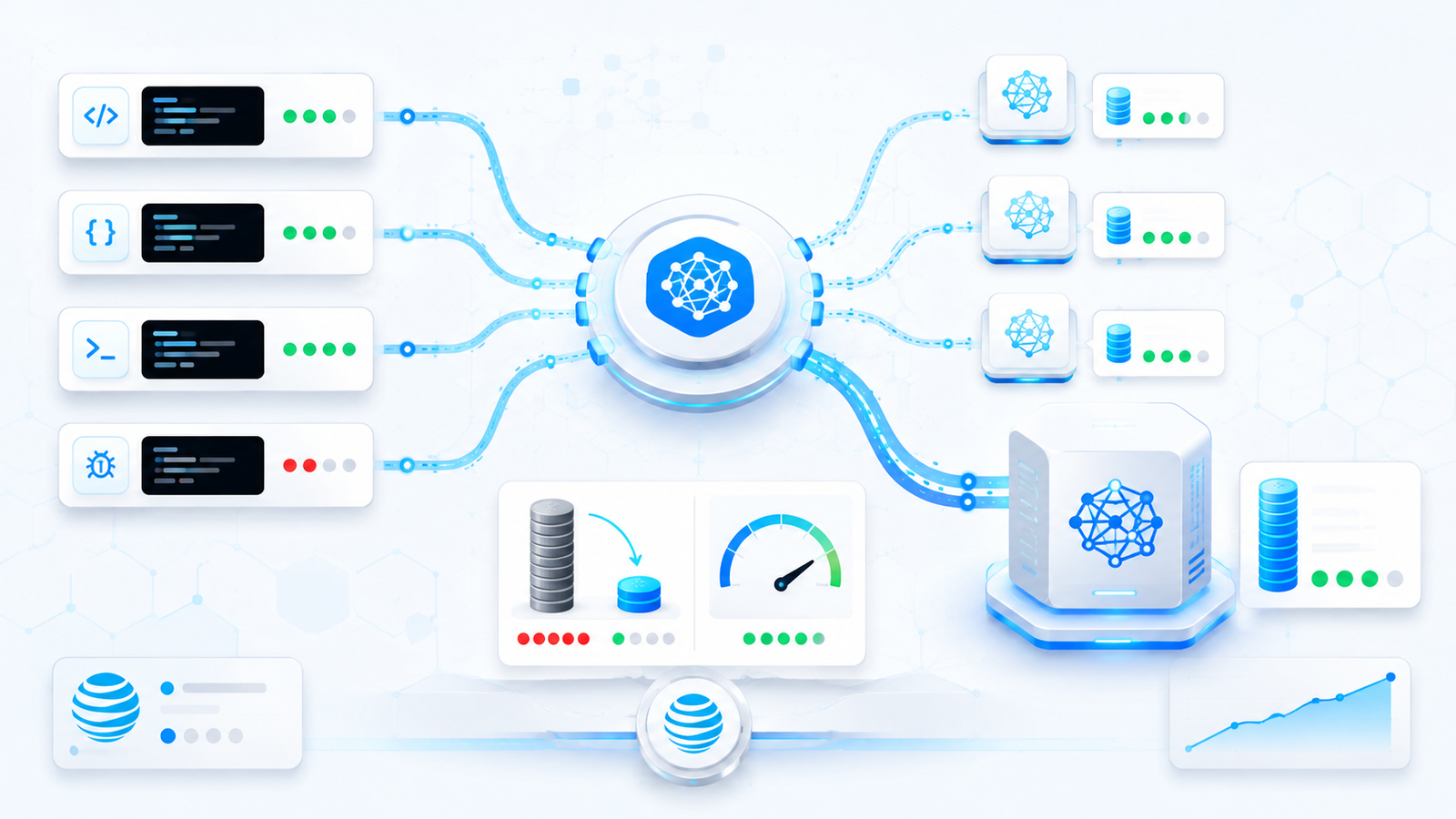
What happened: The Information reported Thursday that AT&T has cut the cost of coding and some other advanced AI tasks by as much as 56 percent using tools that route employee queries to cheaper models when the job does not need a premium one. Document and code summaries go to open models including Meta’s Llama and Google’s Gemma; complex code generation still goes to Anthropic and OpenAI. The reported result on some coding tasks: costs down 56 percent, quality down 2 percent. The company is processing roughly 45 billion AI tokens per day, about 40 percent of employee queries now land on open models, and it expects that share to reach 60 to 70 percent.
The details: The interesting part is not the discount, it is the architecture. Jim Covello, head of Goldman Sachs Equity Research, calls this the “model optimization layer” and argues it is the current bottleneck for enterprise AI: high-consequence requests go to expensive frontier models, routine requests go to cheap open ones, and something in the middle has to decide which is which, fast enough that the decision itself does not cost more than the savings. Covello’s counterintuitive conclusion is that this helps hyperscalers rather than hurting them, because cheaper per-query economics make far more applications viable, and more viable applications mean more tokens flowing through the data centres everyone is spending billions to build.
A router is a classifier plus a policy, and both are cheap compared to what they gate:
flowchart LR
    A[Incoming request] --> B{Classify:<br/>cost of being wrong}
    B -->|Low: summarize, extract,<br/>reformat, label| C[Open model<br/>Llama / Gemma / Qwen]
    B -->|High: generate code,<br/>reason over policy| D[Frontier model<br/>Claude / GPT]
    C --> E{Confidence or<br/>validator passes?}
    E -->|yes| F[Return]
    E -->|no| D
    D --> F
    F --> G[Log: model, tokens,<br/>latency, cost, outcome]
    G -.retrain the classifier.-> B
Important
Our take: The 2 percent quality drop is the number worth staring at, because it only means something if you were measuring quality in the first place. Most teams are not, which is why they default to the expensive model: it is insurance against an evaluation they never built. So the real prerequisite for routing is not a router, it is a task-level eval set and a logging table with model, tokens, latency and outcome in it. Build those and the routing decision falls out almost mechanically; skip them and you are just guessing more cheaply. The other thing I would internalise: “best model” is becoming a per-task property, not a per-company one, and the teams that treat models as interchangeable compute for routine work are going to have a structurally lower cost base than the ones that signed a single-vendor commitment.
🗞️ More News
🧠 AI
- Google’s Gemini 3.7 Flash arrived on August 13 at half the price of 3.6 Flash, scoring 65.3 percent on DeepSWE v1.1 against 49.0 for its predecessor, with introductory pricing of 0.75 and 3.75 dollars per million tokens running to December 31.
- The Qwen3.8-Max open weights ship under a custom licence with attribution and revenue-share riders, while the smaller Qwen3.8-27B is plain Apache 2.0, so the two checkpoints in the same drop carry very different obligations.
- The downloadable Qwen3.8-Max weights are text only with thinking forced on, so the hosted API and the local checkpoint are not the same product despite the shared name.
- Meta Superintelligence Labs said the Muse Spark 1.2 weights will be open-sourced under a modified Llama Community Licence, following the Muse Glimmer release earlier in the month.
- Following Saturday’s Gemma milestone, Google is publishing an “Awesome Gemma” repository to organise the tools, tutorials and community projects built on the family.
- Alibaba opened its Qwen platform to outside developers on August 11 in a push to build a third-party agent ecosystem rather than shipping only first-party assistants.
- Cloudflare’s Kitesurf runs an agent-first browser in V8 isolates on Workers rather than sandboxing Chromium, reporting three to seven times lower CPU and memory on common agent tasks and passing more than 215,000 Web Platform Tests.
🤖 Robotics
- The Beijing programme runs 51 events across nine competition sessions and 1,301 individual matches, split between 30 conventional sports and 21 scenario-based challenges such as industrial assembly, home service and emergency response.
- A humanoid ran the 100 metres in 9.39 seconds on opening day, under the 9.58 second human world record, which says more about actuator power density than about locomotion intelligence.
- Unitree founder Wang Xingxing put the honest version on the record: robots are still not as efficient as humans and take a long time to learn new skills, which is the field’s actual bottleneck.
- One reading of the Games is that the event list is effectively a market map: each scenario event names a task somebody is trying to sell a robot for.
💻 Programming
- Rust 1.98’s new algebraic methods on f32 and f64 let the compiler reorder floating-point operations, which is what unlocks loop vectorization in numerical code that was previously stuck on strict IEEE ordering.
- The same release stabilizes
c_variadic, so Rust can finally define C variadic functions and not just call them, which matters if you are writing a drop-in replacement for a C library. - Rust 1.98 also brings integer serialization into std via
format_intoandNumBuffer, benchmarking on par with the long-standing itoa crate, so that is one dependency you can consider dropping. - On the Go side, 1.26 ships the Green Tea garbage collector on by default at a reported 10 to 40 percent lower GC overhead, plus
crypto/hpkein the standard library and an experimental SIMD package for amd64. - The Qwen-UI-Agent weights ship as MAI-UI-2B and MAI-UI-8B with the training and evaluation harness published alongside, so the small checkpoint is genuinely runnable on one consumer GPU.
⚡ Electronics
- Apple is running performance evaluations on DRAM from China’s CXMT for iPhone and MacBook lines, with testing so far confined to China-bound devices and no commercial commitment.
- Current stack pricing runs roughly 200 dollars for HBM3, 300 for HBM3E and 550 for HBM4, with SK hynix holding an estimated 50 to 55 percent of the market.
- SK hynix says HBM4 development is complete with a 40 percent power-efficiency gain and 10 Gbps data rates, while Micron is sampling HBM4 rated up to 11 Gbps.
- Semtech signed a definitive agreement on August 13 to sell the Sierra Wireless cellular module business to Compal Electronics for 62 million dollars cash, a move analysts expect to lift gross margins above 60 percent.
- Following Friday’s earnings-date note, consensus for Nvidia’s Wednesday print sits near 91.9 billion dollars of revenue and 2.08 dollars of earnings per share, roughly double the 46.74 billion and 1.05 of a year ago.
📡 Telecom
- Globalstar confirmed successful launch and orbital insertion of all eight HIBLEO-4 replacement satellites on August 16, satisfying a contractual condition of Amazon’s 11.57 billion dollar acquisition.
- AST SpaceMobile picked up a 30-day FCC special temporary authority for non-commercial direct-to-device testing on up to 100 handsets, the last regulatory gate before AT&T and Verizon beta service.
- SpaceX hit 100 launches two months earlier in the year than it did in 2024, which works out to more than three liftoffs a week from a company that flew 25 times in all of 2020.
- Amazon Leo sits at 396 satellites on orbit after the final Atlas V flight on July 2, with the first Leo launch on Vulcan now targeted for September and commercial service still guided only to “later this year”.
👨💻 Code Corner
The smallest useful router is not a model, it is a table and a validator. Classify the task, send it to the cheapest tier that has ever passed your eval for that task, and promote to the expensive tier only when a cheap check fails.
"""Minimal cost-aware model router. Swap `call` for your provider SDK."""
from dataclasses import dataclass

@dataclass(frozen=True)
class Tier:
    name: str
    model: str
    in_cost: float   # USD per 1M input tokens
    out_cost: float  # USD per 1M output tokens

CHEAP = Tier("cheap", "gemma-3-27b-it", 0.10, 0.30)
MID   = Tier("mid",   "gemini-3.7-flash", 0.75, 3.75)
TOP   = Tier("top",   "claude-sonnet-5", 2.00, 10.00)

# Task -> ordered escalation path. Built from YOUR eval results, not vibes.
ROUTES = {
    "summarize":   [CHEAP, MID],
    "classify":    [CHEAP],
    "extract":     [CHEAP, MID],
    "write_code":  [MID, TOP],
    "review_code": [TOP],
}

def route(task: str, prompt: str, validate, call) -> tuple[str, str, float]:
    """Try tiers cheapest-first; return (text, tier_name, est_cost_usd)."""
    path = ROUTES.get(task) or [TOP]
    last = None
    for tier in path:
        text, n_in, n_out = call(tier.model, prompt)
        cost = (n_in * tier.in_cost + n_out * tier.out_cost) / 1_000_000
        if validate(text):
            return text, tier.name, cost
        last = (text, tier.name, cost)
    return last  # every tier failed the validator; log it and alert

if __name__ == "__main__":
    fake = lambda model, p: (f"[{model}] summary of {len(p)} chars", 1200, 180)
    print(route("summarize", "x" * 4000, lambda t: len(t) > 10, fake))
Tip
validate is where the whole thing lives or dies. For extraction, parse the JSON and check the schema. For code, run the tests. For summaries, a cheap NLI or overlap check against the source beats a second LLM call. If your only validator is another model, you have replaced a cost problem with a latency problem.
🧰 Toolbox
- Kitesurf on Browser Run: an agent-first browser that speaks CDP, so Puppeteer and Playwright scripts point at it with a URL change.
- MAI-UI: the Qwen-UI-Agent weights, technical report and evaluation harness in one repository, including a 2B checkpoint for laptop-class experiments.
- Open LLM router roundup: a working comparison of LiteLLM, RouteLLM and Martian for anyone building the routing layer from today’s big story.
- releases.rs: a per-release changelog for Rust with the full stabilization list, far faster to scan than the blog post when you are checking whether a feature landed.
- EIT-kit: Espressif’s writeup of MIT’s ESP32 electrical impedance tomography toolkit, the ancestor of this week’s build.
🛠️ Build of the Week (rotating)
EITWatch: a smartwatch that reads hand gestures by measuring the electrical impedance of your wrist, with all eight electrodes on the back of the case instead of a band around it.
- Difficulty: Advanced
- Parts: Seeed Studio XIAO ESP32-S3, eight electrodes in a 31 mm ring, a 20 mm PCB extension carrying a discrete analog front end, standard 40 mm watch case
- Why we like it: it takes 35 impedance measurements per frame at 48 Hz and reports 92.5 percent accuracy on six macro-gestures and 91.5 percent on five micro-gestures, and the hardware repository ships Altium sources, the bill of materials and Gerbers, so it is a build and not a press release.
📚 From the Blog
- Turning Pixels Into Something the AI Can Eat: episode three of the video analytics series, on the preprocessing stage that decides what your model actually sees, and a good companion to today’s story since the cheapest inference is the one you never had to run.
- Building Your First Neuron From Scratch: part two of the deep neural networks series, building a single learnable unit before stacking anything.
- The Network Behind the Cameras: the unglamorous plumbing that moves camera pixels across a network without choking it.
😀 The Bot Says…
A robot ran the 100 metres in 9.39 seconds this weekend, and somewhere in an office a summarization job was still being handled by a trillion-parameter model. One of those is a record. The other is a bill.
That’s all for today! Go pull one week of your inference logs, group by task, and see how many of those calls a 27B model could have taken. Reply and tell us what the number was.