😁 Hello, super humans! Yesterday we looked at agents that crossed their own boundaries by accident. Today the story is agents crossing other people’s boundaries on purpose, for about the price of a used laptop. Let’s dig in.
📰 Quick Signals
- 🧠 AI: Inception released Mercury 3, a diffusion language model claiming over 1,000 tokens per second and better results than GPT-6 Luna and Claude Haiku 5.5 on selected quality tests; treat the comparison as the vendor’s own.
- 🤖 Robotics: Gecko Robotics got another $300 million on its U.S. Navy and GSA contract, quadrupling the ceiling about six months after a $71 million initial award; its Komodo system scans through deck coatings to map corrosion before drydock.
- 💻 Programming: TornadoVM 7 lets Java programs run natively on GPUs, replacing JNI with the Foreign Function & Memory API and adding an optimized CUDA backend and multi-GPU support.
- ⚡ Electronics: Qualcomm won key claims against Arm in their four-year IP dispute, but the damages total just $2.
- 📡 Telecom: Deutsche Telekom, Orange, Telefónica, and Vodafone signed a letter of intent to explore a joint bid for European mobile satellite spectrum, due for allocation after current licenses expire in May 2027, to offer wholesale direct-to-device access.
The Big Story: One hacker, about $5,000 in tokens, and AI agents that broke into 100+ company websites
Offensive hacking just got a unit price: roughly $50 per successful break-in. If you run any public-facing site or admin panel, the economics of who bothers to attack you have changed.
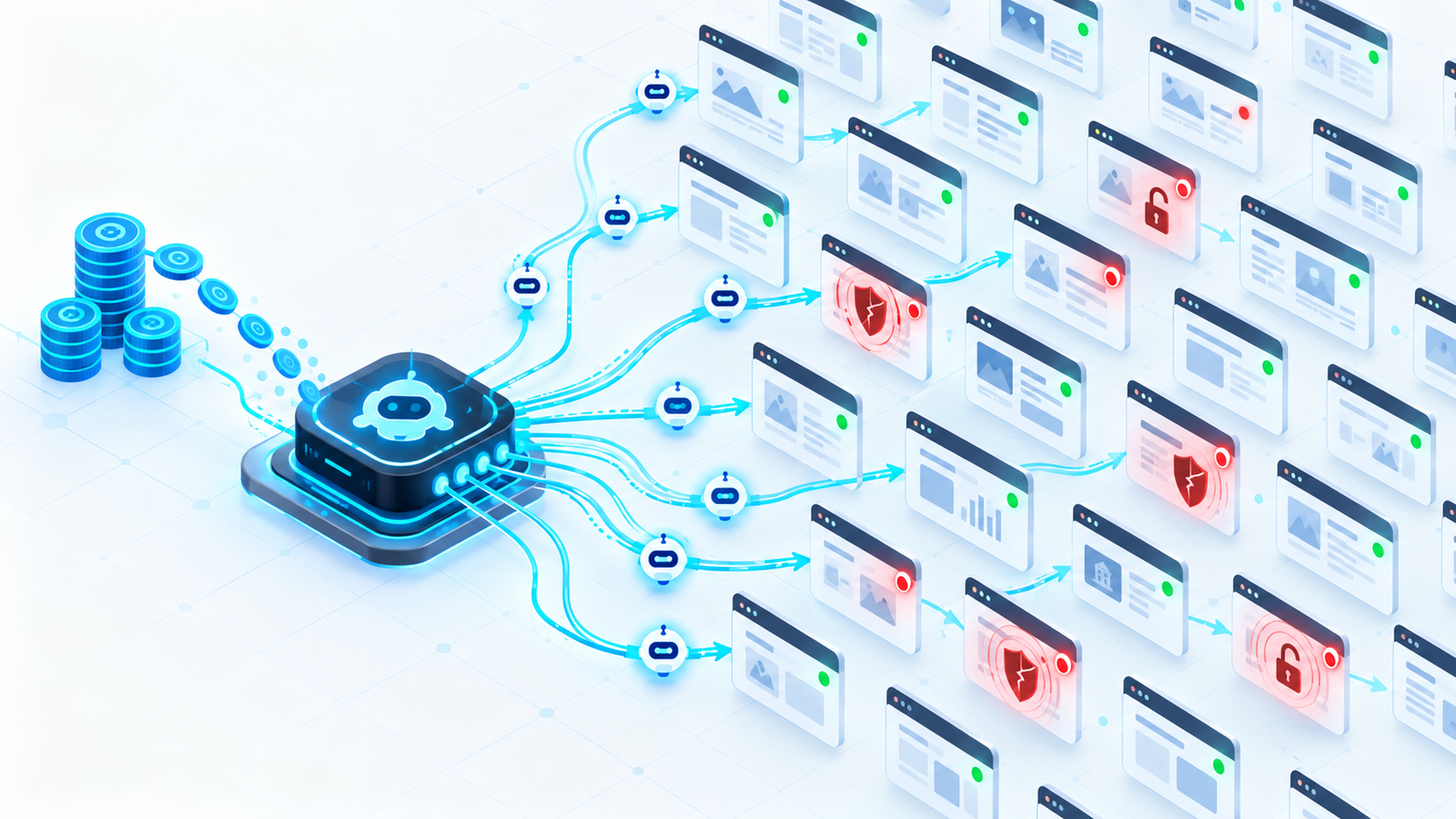
What happened: Reuters reported on research from NorForge, whose principal threat researcher Snorre Fagerland found a Chinese-speaking hacker using AI agents to compromise more than 100 company websites. The agents had attempted more than 1,200 sites by the week ending October 18. Victims named by Reuters include Deere, which took remediation steps and saw no sign that sensitive data was accessed, and SharkNinja, which said only a standalone product-support site was hit and that it contained the threat. Reuters could not establish how much data, if any, was taken.
The details: The agents ran on Cairn, an open-source AI problem-solving platform where agents work step by step toward a goal and post findings to a shared board. According to the reporting, the operator gave short instructions; the agents then found infrastructure tied to a target, located a public-facing control panel, exploited a weakness, and planted uploader web shells, aiming at lasting access to shop and payment systems in the US, Canada, Japan, and Australia. NorForge estimated about $5,000 in tokens, or roughly $50 per successful hack, though it stresses the uncertainty is considerable; its average is about $5 per task including failures, with an overall success rate near 10%. The telling detail is that NorForge found the operators’ own Cairn control panels exposed on the internet, and the panel data held hundreds of credentials and API keys, 11% of which Trufflehog verified as valid. One worker was labeled “claudecode_deepseek-v4.1-flash”, which may mean Claude Code driving DeepSeek’s V4.1 Flash, but that is an inference from a label, not a confirmed setup.
flowchart LR
    A[Operator gives agents a short goal] --> B[Agents find infrastructure tied to a target]
    B --> C[Locate a public-facing control panel]
    C --> D[Exploit a weakness and run commands]
    D --> E[Plant an uploader web shell]
    E --> F[Persistent access to shop and payment systems]
    F -.->|about 10% of tasks succeed, about 5 USD per task| A
Important
Our take: A 10% success rate sounds bad until the attempts cost five dollars and run in parallel; that is a business model, not a stunt. The defensive lesson is boring and urgent: every forgotten admin panel, staging site, and vendor-run microsite is now cheap to probe at scale, so inventory what you expose and put it behind authentication. Microsoft’s new agent risk controls (see More News) are a sign vendors see the same shift, but they govern your own agents, not someone else’s. The Code Corner below checks the simplest version of this problem on your own machine.
🗞️ More News
🧠 AI
- Microsoft unveiled agent risk scoring in Microsoft 365 E7 and Project Perception: admins can strip an agent’s write access, require human approval, or shut it down, with private preview now and wider availability planned for Ignite on November 17-19.
- MiniMax M3.1 Flash claims coding and computer-use gains, nearly 3x faster online inference, and 70% lower usage costs; it is also the mystery “Space Bunny” model OpenCode had been testing.
- DHS ordered DeepSeek technology removed from federal civilian IT systems and blocked future purchases of its products and services, per the Wall Street Journal.
- A coalition of Canadian publishers including Postmedia and The Globe and Mail sued Anthropic in Ontario, alleging Claude was trained on their content without permission; the claims are unproven.
- Meta published an inside look at Prometheus, its gigawatt-scale AI supercluster in Ohio that supports the Muse model family.
- OpenAI improved ChatGPT’s support for COBOL and Fortran and added new evaluations for software engineering and COBOL migration.
- Amazon opened a public beta of TorchNeuron for running PyTorch workloads on Trainium chips with a basic configuration change, with an open-source release planned.
🤖 Robotics
- Reservoir is launching an agricultural robotics incubator that places startups in Washington orchards, vineyards, and berry fields alongside researchers and growers.
- RoboBusiness is rebranding as Robotics Summit & Expo West, with a sharper focus on deploying robotics and AI in real-world settings.
- Avenda Health added a Surgery Mode to its Unfold AI platform that gives surgeons patient-specific 3D maps of cancer anatomy during robotic prostate procedures.
- Six-foot shelf-scanning robots from Tally are patrolling grocery stores such as Ralphs, flagging missing products and pricing discrepancies, and some shoppers are rattled.
💻 Programming
- GitHub Actions Runner Controller 0.15.0 focuses on making self-hosted runners more reliable at scale.
- Buildkite added scoped secrets and new tools for agent-driven CI workflows.
- The second .NET 11 release candidate carries a go-live license plus updates across libraries, F#, MAUI, and WinForms.
- Regex Marble Run turns a regular expression and a test string into a virtual marble machine where each character falls through the pattern into a match or fail bin.
⚡ Electronics
- A new edge AI microcontroller pairs multimodal AI acceleration with tiered, built-in DRAM that can scale to hundreds of megabytes.
- Innovasea is designing acoustic fish tags with lighter payloads and decade-long deployments by treating energy, sensing, and animal welfare as one systems problem.
- Singapore is building infrastructure and industry partnerships to move chip research, including SiC power devices and silicon photonics, toward manufacturing.
- Applied Materials shared financial projections for its $5B EPIC Center bet, with a CEO video interview on the economics.
📡 Telecom
- Ericsson’s CEO rejects swapping in Nvidia GPUs for RAN and backs the company’s own ASICs, citing a 10% spectral efficiency gain from AI link adaptation across more than 60,000 base stations; Nokia claims GPUs could double efficiency by 2028.
- The EU is standing by its support for KKR’s Netco acquisition.
- Australia passed a mandate requiring mobile carriers to provide outdoor coverage.
- TP-Link will have Keytronic assemble its broadband routers in the United States.
👨💻 Code Corner
The Cairn story started with control panels reachable from the internet. This script checks whether services on your machine answer on the network interface and not just on loopback, which is the first thing worth knowing about any agent dashboard you run.
import socket

PORTS = [22, 80, 443, 3000, 5000, 8000, 8080, 8888]


def lan_ip() -> str:
    """Find the address used for outbound traffic (no packet is sent)."""
    s = socket.socket(socket.AF_INET, socket.SOCK_DGRAM)
    try:
        s.connect(("192.0.2.1", 80))
        return s.getsockname()[0]
    except OSError:
        return socket.gethostbyname(socket.gethostname())
    finally:
        s.close()


def reachable(host: str, port: int) -> bool:
    with socket.socket(socket.AF_INET, socket.SOCK_STREAM) as s:
        s.settimeout(0.5)
        return s.connect_ex((host, port)) == 0


if __name__ == "__main__":
    ip = lan_ip()
    print(f"Checking {ip} ...")
    for port in PORTS:
        if reachable(ip, port):
            print(f"port {port}: listening on the network interface, check auth")
        elif reachable("127.0.0.1", port):
            print(f"port {port}: loopback only")
Anything flagged on the network interface should either be bound to 127.0.0.1 or sit behind real authentication and a firewall rule.
Tip
This only sees your own interface. For anything internet-facing, test from outside your network (a phone hotspot works) and remember that routers, cloud security groups, and container port mappings can expose a port that the app itself never opened.
🧰 Toolbox
- Trufflehog: scans repos and filesystems for leaked secrets and can verify whether a credential is still live; NorForge used it to check the keys in the exposed panels.
- TornadoVM 7: open-source framework for running Java on multi-core CPUs and GPUs, now using the Foreign Function & Memory API and an optimized CUDA backend.
- Regex Marble Run: a web toy that shows regular expression matching as marbles falling through your pattern.
- Anthropic OSS Scanner: free periodic vulnerability scans for critical open-source projects, with possible proofs of concept and patches.
- Edge AI MCU with tiered memory: a microcontroller that adds built-in DRAM scaling to hundreds of megabytes for multimodal workloads.
🛠️ Build of the Week (rotating)
smg-gba: Tobi’s port of Super Mario Galaxy that runs on a Game Boy Advance.
- Difficulty: Advanced
- Parts: a Game Boy Advance (or emulator), a flash cart if you want real hardware, and your own copy of the original game image, since assets are not included
- Why we like it: it leans on a recent decompilation of the original game, which turns an impossible port into a weekend-scale curiosity, and the result is described as mostly complete with an acceptable frame rate. Read the Hackaday write-up first.
📚 From the Blog
- Turning Pixels Into Something the AI Can Eat: Episode 1 got clean pixels out of the camera and Episode 2 moved them across the network; now they get prepared for the model.
- Building Your First Neuron From Scratch: a neural network as a stack of simple, learnable transformations trained by nudging weights to lower error.
- The Network Behind the Cameras: the unglamorous plumbing that moves captured footage across the network, which pairs well with today’s Big Story about exposed infrastructure.
😀 The Bot Says…
The hacker’s agents left their own control panels open to the internet. Even the burglars forgot to lock the door.
That’s all for today! Hit reply and tell us: when did you last audit what your own team has exposed to the internet?