😁 Hello, super humans! Monday brings a medical AI story that is more interesting for how it was tested than for the headline number. A chatbot talked to real patients before their doctor visits, and a physician watched every message. We also have a CEO calling for an AI “emergency brake”, a humanoid hand that dropped a finger on purpose, and a classic microcontroller heading for the exit.
📰 Quick Signals
- 🧠 AI: Satya Nadella posted that AI needs a “trust architecture”: separate the model from its harness, log every meaningful action with tamper-proof evidence, and let an authorized person pause or shut a model down mid-task.
- 🤖 Robotics: Boston Dynamics’ redesigned Atlas hand has four fingers and 13 identical, fully enclosed actuators, and the pinky is gone to cut cost and complexity.
- 💻 Programming: Cloudflare Traces is in open beta, turning security rules, cache, routing and Worker execution into OpenTelemetry spans with no instrumentation, exportable over OTLP.
- ⚡ Electronics: Littelfuse, owner of the Zilog name, issued end-of-life notice PCN ZAC26-0074 for the eZ80, with last-time buys accepted until December 21, 2026.
- 📡 Telecom: SpaceX agreed to buy 14 MHz of paired 800 MHz spectrum from Grain Management, reportedly for about $8 billion, and the three big US carriers’ stocks dropped on the news.
The Big Story: Google put a diagnostic chatbot in front of 98 real patients, with a doctor watching every word
Medical chatbots have aced exams for years, but exams are not clinics. This is one of the first real-world looks at a conversational diagnostic AI inside a working primary care setting, and the safety design matters as much as the score.
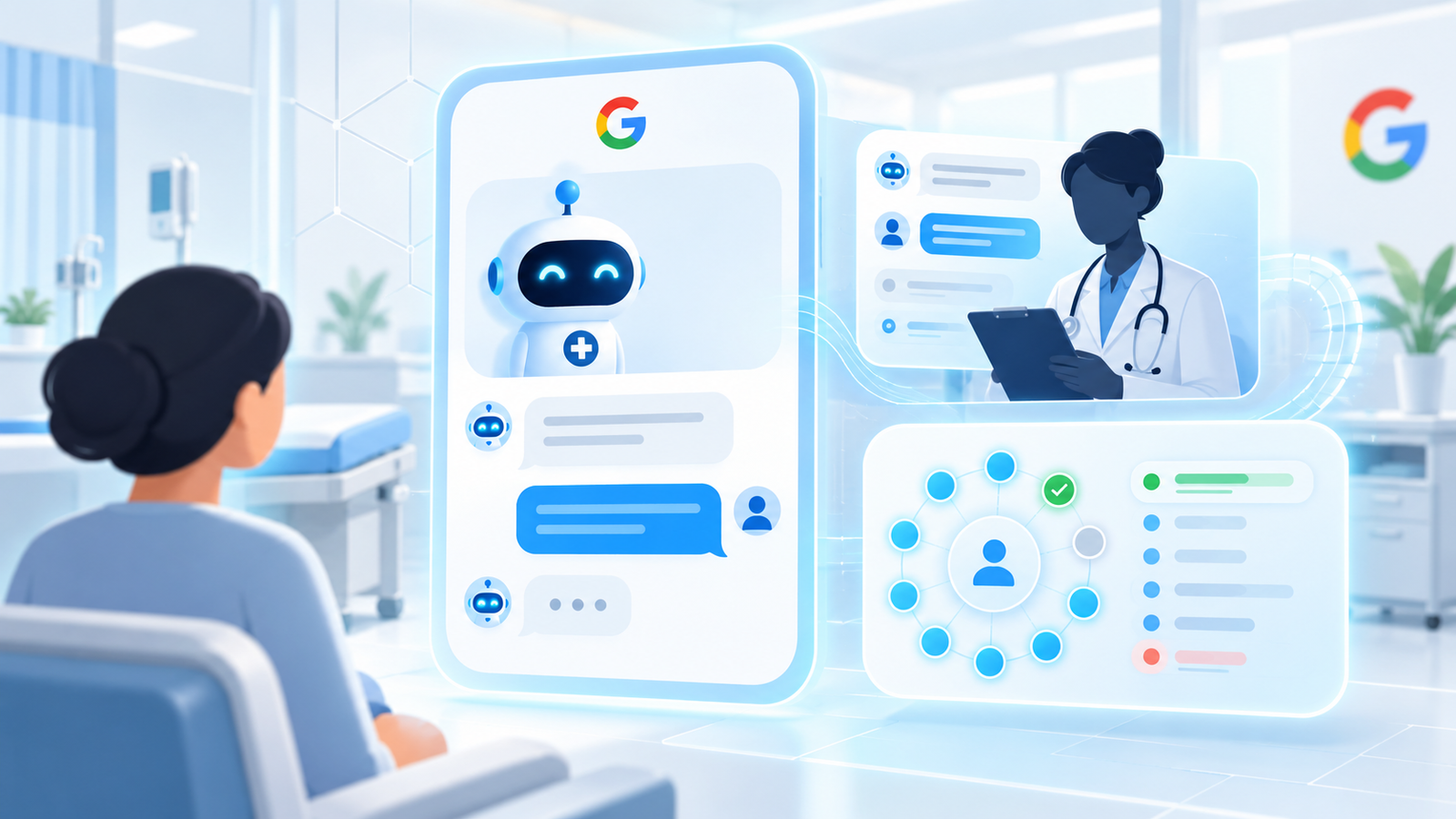
What happened: Google and Beth Israel Deaconess Medical Center (BIDMC) ran a prospective feasibility study of AMIE, Google’s research diagnostic chatbot, with 98 patients at an ambulatory primary care clinic. Patients chatted with AMIE by text before their urgent-care visits, and doctors received the conversation plus an AI-generated summary. Google reports the study in its announcement post and the paper.
The details: According to Google, AMIE’s differential diagnosis list contained the doctor’s final diagnosis 90% of the time, and clinicians said the summaries helped them prepare in 75% of cases. The guardrails are the real story: a supervising physician monitored every conversation in real time and could step in, and no conversation hit the study’s preset stopping criteria. Reports on the study note that supervisors flagged one hallucination and added clinical information in five conversations. There was no comparison group, so this shows the workflow is feasible, not that it beats a doctor, and it says nothing about unsupervised use.
flowchart LR
    P[Patient describes symptoms by text] --> A[AMIE asks follow-up questions]
    A --> S[AI summary + differential diagnosis]
    A -.watched live.-> M[Supervising physician can step in]
    S --> D[Doctor reads summary before the visit]
    D --> F[Doctor makes the final diagnosis]
Important
Our take: The 90% figure will get the headlines, but the architecture is the lesson: the AI gathers history, a human owns the decision, and a second human watches the AI. That is the same “externalized controls” idea Nadella posted about this weekend, applied to a clinic. If you build with LLMs in any high-stakes domain, copy the supervision pattern before you copy the model. And remember this is Google’s own write-up of a small, uncontrolled study.
🗞️ More News
🧠 AI
- Utah approved healthcare AI pilots that could eventually let some prescription refills reach patients without a clinician checking each one; each reduction in review needs state approval.
- Norway proposed a temporary ban on AI glasses in selected public spaces such as parks, beaches and schools, over hidden-recording concerns.
- NVIDIA committed $1 billion over five years to US science, aimed at quantum computing, healthcare and energy security research.
- Google launched Playground, an experimental platform that turns prompts into playable browser games users can share and remix, for US users aged 18 and over.
- TypeSafe AI raised $870 million at a $7.5 billion valuation to scale System One, the non-text model behind Jev.
- Shield AI says total commitments for its AI-piloted X-BAT fighter reached $400 million, with flight testing expected by year-end.
- Apple disclosed a deal to hire the team and license technology from personalized podcast startup Huxe.
🤖 Robotics
- Helm.ai says it has reached $70 million in signed commercial contracts for its foundation models, built with its unsupervised “deep teaching” method.
- SafeWorld emerged from stealth with simulation software that lets companies assess robot safety before deployment.
- Jabil, which works with humanoid developers such as Apptronik, gave a manufacturer’s view of how fast humanoid development and production is moving.
- Groceryshop 2026 showed mobile inventory-taking robots as retail automation edges toward scale.
💻 Programming
- Shopify moved Checkout Blocks to Polaris Web Components, cutting bundle sizes by up to 85%.
- CircleCI made its Machine Runner orchestrator generally available.
- Android Bench 2 adds long-horizon tasks, agentic evaluation and continuous scoring for judging AI on Android development work.
- OpenTelemetry’s Kubernetes Attributes Processor reached stable status as the observability schema matures.
⚡ Electronics
- Vienna University researchers report a laser-driven thorium nuclear clock that regulates itself: if the laser drifts, the nuclei absorb less light and the output frequency compensates.
- GlobalFoundries argues strained-silicon FD-SOI can reach 7-nm-class performance without EUV and open a new market for Europe.
- Europe’s Cyber Resilience Act is turning chip security into an auditable sign-off item that silicon teams must prove before 2027.
📡 Telecom
- T-Mobile’s CTO said the carrier welcomes competition if SpaceX becomes a new US wireless provider.
- Amdocs signed a 10-year deal to supply its aOS platform to VEON.
- Nokia’s sale of its campus networking business is nearing completion as CEO Hotard bets on industrial AI.
👨💻 Code Corner
AMIE’s headline metric is a top-k style check: did the final diagnosis appear anywhere in the differential list? Here is a tiny, runnable way to compute that for your own classifier or LLM triage experiments.
# top_k_hit.py: how often does the true label appear in the model's ranked list?
def top_k_hit_rate(cases, k=None):
    hits = 0
    for truth, ranked in cases:
        pool = ranked if k is None else ranked[:k]
        hits += truth in pool
    return hits / len(cases)

cases = [
    ("migraine", ["tension headache", "migraine", "sinusitis"]),
    ("uti", ["uti", "kidney stone"]),
    ("gerd", ["angina", "costochondritis", "peptic ulcer"]),
]
print(f"any rank: {top_k_hit_rate(cases):.0%}")   # 67%
print(f"top-1:    {top_k_hit_rate(cases, 1):.0%}")  # 33%
Report top-1 next to “anywhere in the list”: a differential that contains the answer is useful to a doctor, but it is a much easier bar than naming the answer first.
Tip
Always publish the list length alongside the hit rate. A 90% score on a 10-item differential and a 90% score on a 3-item one are very different claims.
🧰 Toolbox
- Tiny Tapeout: A program that lets hobbyists put small digital designs on real silicon; the Hackaday eZ80 story points to a real-silicon Z80 made this way as one path forward.
- OpenTelemetry: The vendor-neutral tracing and metrics standard that Cloudflare Traces, among many others, now exports to.
- Google Playground: Prompt-to-browser-game experiment, handy for quick prototypes you can remix (US, 18+).
- CuFlow hex-grid router write-up: James Bowman’s explanation of routing PCBs on a hexagonal cell grid.
🛠️ Build of the Week (rotating)
CuFlow’s hexagonal-grid autorouter: James Bowman switched his PCB autorouter from a square grid to a hex grid, so each cell has six equidistant neighbors instead of four.
- Difficulty: Advanced
- Parts: A laptop, a PCB layout tool or your own router code, and a few test boards
- Why we like it: Hexagons approximate circles better, so the same clearance rules allow smaller cells and denser routing, though Hackaday reports no measured benchmarks yet.
📚 From the Blog
- Turning Pixels Into Something the AI Can Eat: The next step after getting clean pixels off the camera and across the network; pairs well with today’s story about feeding real-world signals to a model safely.
- Building Your First Neuron From Scratch: A neural network as a stack of simple, learnable transformations, and how training adjusts the weights.
- The Network Behind the Cameras: How to move video data from the camera to where it needs to go.
😀 The Bot Says…
A dropped pinky, a retired Z80 and a chatbot with a chaperone: the machines are getting simpler where it counts and more supervised where it matters. Beep boop, stay curious.
That’s all for today! Hit reply and tell us whether you would let a supervised chatbot take your medical history before your next appointment.