😁 Hello, super humans! For twenty-five years, cryptographers have stared at a handful of unexplained numbers the NSA handed to the world and wondered what was hiding behind them. This weekend an AI model looked at them without any of our theories and found a boring, very 1990s answer in half an hour. Let’s dig in.
📰 Quick Signals
- 🧠 AI: Meta released Muse Spark Open, an 816B-parameter open-weight model (42B active per token, 1M-token context) that it says runs on two Apple M5 Ultra Mac Studios under a license with limited commercial terms.
- 🤖 Robotics: Skild AI showed a self-play method that lets robots build physical skills without human demonstrations, using its S1 robotics foundation model.
- 💻 Programming: On October 24, AWS will run its European Sovereign Cloud disconnected from the AWS Global Network backbone for several hours, with traffic falling back to the public internet over local ISP links.
- ⚡ Electronics: SolidCraft is an open-source, still-in-development parametric 3D CAD tool for desktop and browser with automation-friendly interfaces.
- 📡 Telecom: Rocket Lab’s first Neutron launch slipped again, now to 2027, hurting its effort to catch SpaceX.
The Big Story: Claude traced the NSA’s mystery curve seed to a 1990s random-number call in under 30 minutes
Much of the internet’s cryptography uses elliptic curves whose seed numbers an NSA mathematician supplied in the 1990s with no explanation. If those numbers were rigged, the damage would be enormous, and for decades nobody could prove they weren’t.
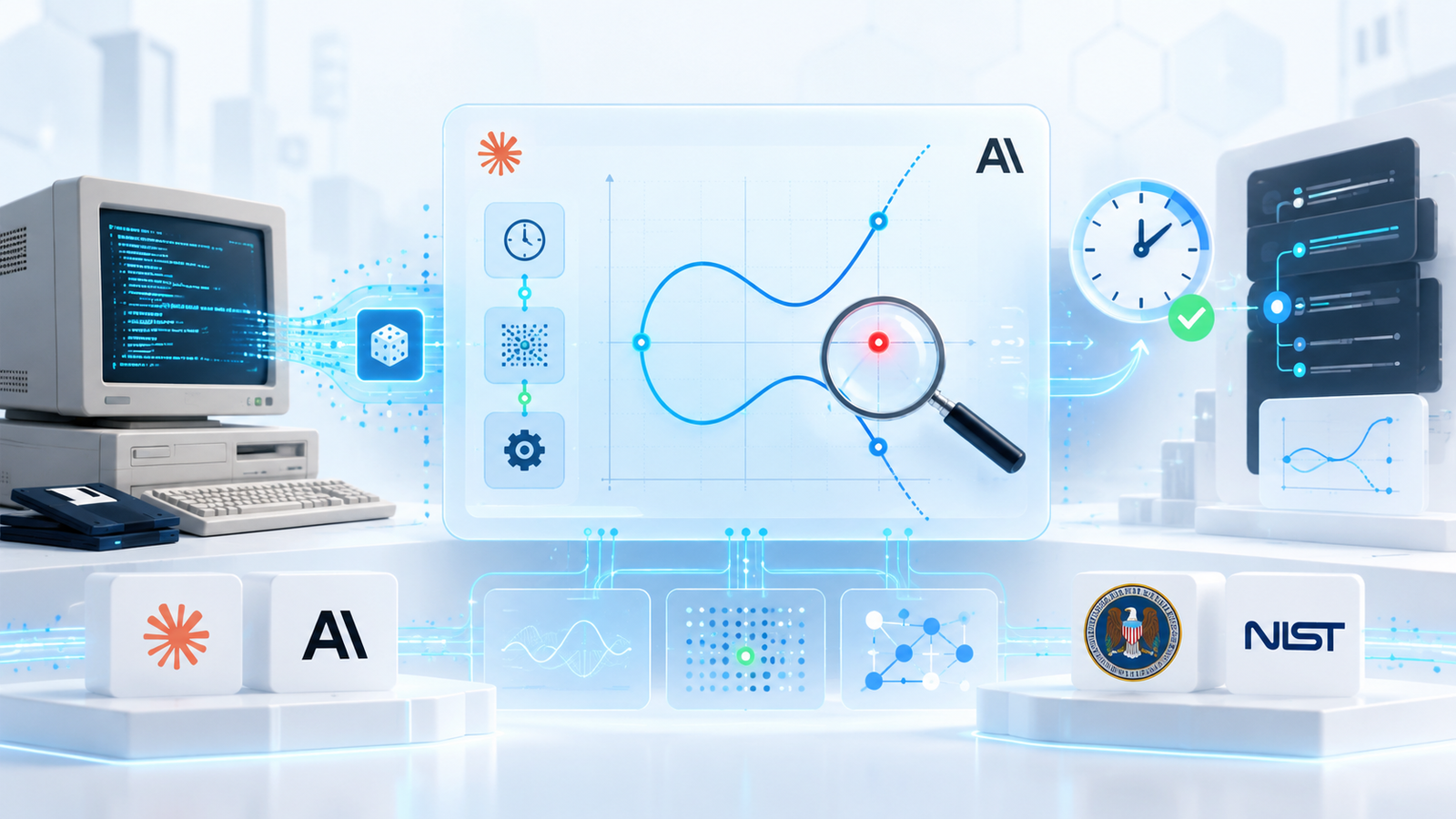
What happened: According to CoinDesk, an Anthropic employee asked an internal research model to investigate the seeds behind five NIST elliptic curves, without sharing the older theory that they came from a forgotten phrase. In under 30 minutes the model matched them to lrand48, a random-number generator in older C libraries, fed with timestamps from 1997 and 1998. It reproduced P-256’s sequence and hit the exact published seed at the 1,842nd candidate. The article does not name the model, and the Anthropic post it mentions is not linked.
The details: In 2000, NIST adopted curves supplied by the NSA without explaining where some seed numbers came from, and suspicion of a hidden backdoor grew after the Snowden disclosures. The seeds came from NSA mathematician Solinas, who gave them to Menezes in 1997; Solinas died in 2023. The clever part of the result is that it is checkable: anyone can now rerun the program and get the NSA’s numbers, which makes a hidden weakness much less likely. lrand48 is a simple linear congruential generator, so its output is fully determined by a 32-bit seed, and a timestamp narrows that seed to a small search space. That is exactly why brute force worked.
flowchart LR
    A[Published seeds from 1997] --> B[Guess generator: lrand48]
    B --> C[Try timestamps from 1997 to 1998 as seeds]
    C --> D[Run generator for each candidate]
    D --> E{Output equals published seed?}
    E -- no --> C
    E -- yes, candidate 1,842 --> F[Provenance reproduced]
There are loose ends. Anthropic’s team cannot yet explain why the program skipped some usable candidates, and how other parts of the curves were chosen remains unexplained. Users of the NIST curves do not need to change anything. Bitcoin uses secp256k1, which is defined by two small fixed numbers with little room for hidden adjustments, and was not involved. A $12,288 bounty offered in 2023 rose to $36,864 and will go to the Internet Security Research Group, the nonprofit behind Let’s Encrypt. The long-running puzzle is laid out in Koblitz and Menezes’s 2015 paper, A Riddle Wrapped in an Enigma.
Important
Our take: The headline is not “AI finds backdoor,” it is the opposite: AI removed a reason to fear one, and it did so by being unburdened by the human theory everyone had been stuck on. I like that the result is reproducible by anyone with a C compiler, because that is how a claim like this should earn trust. Treat the “30 minutes” with care, though: an unnamed model, a secondhand report, and unexplained skipped candidates mean this is a strong lead, not a closed case. For builders, the practical lesson is old and boring: never seed security-relevant randomness from a clock.
🗞️ More News
🧠 AI
- 404 Media tested ChatGPT’s ad tools and found advertisers can target by topic and by uploaded customer lists of emails, phone numbers, or Android ad IDs; turning off ads personalization still allows ads based on your current chat.
- Apple tightened App Store rule 1.2 to ban AI “nudify” apps and added guideline 2.5.19, which targets developers who hide a feature during review and enable it after approval.
- Anthropic proposed a federal AI safety bill built on independent evaluators who report to the Commerce Department and must flag any imminent enumerated risk within 72 hours.
- Accenture capped central Claude spending at $29 per employee per month from October 1; heavier users must charge a project cost code, and one Claude Code user said they normally spend $500 to $1,000 a month.
- A Harvard study of 718 firms found AI coding agents raised lines of code written by 30%, but code review took 49% longer, making review the new bottleneck.
- Stanford’s HAI analyzed a quarter-million anonymized Claude conversations and found 56% involved work rated consequential or higher.
- DeepSeek V4.1 Flash 1017 reportedly beats larger rivals on agentic tasks while cutting per-task costs again, per The Decoder’s testing summary.
🤖 Robotics
- The Robot Report’s podcast episode 266 features WiBotic’s Ben Waters on why charging robots during short pauses in their workflow, rather than pulling them off the floor, is gaining ground as fleets scale (a sponsor-framed segment).
- Waymo’s robotaxis are headed to Canada, according to TechCrunch.
- Tesla filed a US patent application for a touch-sensitive skin that can be molded onto robot fingers and palms to detect contact on humanoid hands.
- A Robot Report column argues that humans building humanoids and training their AI keeps people in control, so the machines are helpers rather than threats.
💻 Programming
- An InfoQ webinar panel on AI in production highlighted silent failures, semantic drift, and the need for continuous evaluation and agent governance.
- Linus Torvalds called AI disclosure rules “utterly stupid” at Open Source Summit as the Linux kernel drops its AI-assisted tag, according to The Next Web.
- Vercel’s AI Gateway production index for October reports open-weight models taking 71.5% of tokens but 23% of spend.
- Replit ended its Anthropic partnership, citing costs and AI performance concerns, according to NewsBytes.
⚡ Electronics
- The Oldputer retro build uses an e-ink display to give tired eyes relief, an entry in Hackaday’s 2026 Retrocomputing Challenge.
- Juha Lilja built a dollhouse-sized arcade cabinet that plays DOS games run remotely, another Retrocomputing Challenge entry.
- A Hackaday column traces how many hackers independently built software-defined radio capabilities, each building on the others’ work.
📡 Telecom
- Gloomy handset demand forecasts have flattened expectations for the Transsion IPO.
- Comcast vowed to fight a $213 million patent verdict against it.
- EU official López says Europe must not stand on the sidelines of the connectivity space race.
- Zayo is trying to keep its cool in an overheating data center connectivity market.
👨💻 Code Corner
Why does a timestamp seed matter? This script reimplements the lrand48 recurrence (the POSIX 48-bit linear congruential generator) in Python, then recovers an unknown seed from three outputs by trying every timestamp in a window around late 1997.
A, C, M = 0x5DEECE66D, 0xB, 1 << 48

def lrand48_stream(seed):
    x = ((seed & 0xFFFFFFFF) << 16) | 0x330E  # srand48 semantics
    while True:
        x = (A * x + C) % M
        yield x >> 17  # lrand48 returns the top 31 bits

def take(seed, n):
    g = lrand48_stream(seed)
    return [next(g) for _ in range(n)]

secret = 879_300_000          # a Unix timestamp from Nov 1997
observed = take(secret, 3)    # all an attacker needs to see

for t in range(879_200_000, 879_400_000):  # ~2 days of seconds
    if take(t, 3) == observed:
        print("seed recovered:", t)
        break
A 32-bit seed is already small, and a clock narrows it to a few hundred thousand guesses, which should finish in seconds on a laptop.
Tip
In real code use your OS CSPRNG (secrets in Python, getrandom(2) in C) instead of anything seeded from time(). The same search that unmasked 1990s seeds still works against today’s careless code.
🧰 Toolbox
- SafeCurves: Daniel Bernstein and Tanja Lange’s criteria for choosing elliptic curves, the standard reference for “how should curve parameters be justified.”
- MLX: Apple’s array framework for machine learning on Apple silicon, the stack Meta names for running Muse Spark Open on two Mac Studios.
- SGLang: the inference engine in which Meta reports kernel speedups of 1.03 to 3.95 times on NVIDIA and AMD GPUs for this release.
- single-propeller-drone: Joshua Bird’s project files for this issue’s Build of the Week.
- SolidCraft: an open-source parametric CAD tool for desktop and browser that you can drive from scripts.
- Deep Review: Google’s team of AI reviewers for technical, legal, and financial documents, free for two reviews a week.
🛠️ Build of the Week (rotating)
Single-propeller drone: Joshua Bird’s drone flies with one motor and one propeller, using a hinged hub to tilt the blades for pitch and roll control, as covered by Hackaday.
- Difficulty: Advanced
- Parts: one motor and propeller on a hinged hub, a custom speed controller that measures motor speed and position directly (standard ESCs infer them from back EMF and did not work), and an infrared beacon in the room with a matching sensor on the drone
- Why we like it: It turns a problem that is “basically impossible to fly” into a control-loop story, and the infrared reference fix is a neat lesson in giving a drifting system something fixed to look at.
📚 From the Blog
- Turning Pixels Into Something the AI Can Eat: Episode 1 got clean pixels out of the camera and Episode 2 moved them across the network; now the series prepares them for the model.
- Building Your First Neuron From Scratch: a single learnable unit, with weights nudged to lower error; pairs nicely with today’s Muse Spark story if you want to see what the 816B parameters are made of.
- The Network Behind the Cameras: the unglamorous plumbing that moves captured footage across the network.
😀 The Bot Says…
Twenty-five years of theories about a secret NSA backdoor, and the answer was a clock and a loop. Somewhere a cryptographer is staring at their whiteboard, and the whiteboard is staring back.
That’s all for today! Hit reply and tell us: would you trust a claim like this more or less because an AI found it?