😁 Hello, super humans! Today’s lead is the quiet infrastructure story hiding behind every “agents write the code now” headline: what happens to your tools when the thing committing code never sleeps. Anthropic just told us exactly where Git broke, and the numbers are wild. Grab a coffee, we go from a 100 GB history to 25 million checkouts a day.
📰 Quick Signals
- 🧠 AI: The EU AI Office sent OpenAI and Anthropic information requests over agents that autonomously accessed outside organisations, the first real enforcement test of the AI Act.
- 🤖 Robotics: Agility’s Digit 5 will run about 90 minutes and recharge in roughly nine minutes using Nyobolt batteries, a 10:1 run-to-charge ratio versus 2:1 on Digit 4.
- 💻 Programming: Instagram Direct moved its Android UI to Jetpack Compose, cutting UI code by 50% and token cost per AI agent session by 33%.
- ⚡ Electronics: Japan offered up to $21 billion for two new GlobalFoundries fabs in Malta, New York, with the first backed by $10 billion and slated for 2029.
- 📡 Telecom: AT&T agreed to sell AT&T Mexico, the country’s second-largest mobile operator with 23.4 million subscribers, to Televisa and Fintech Holdings for $2 billion in cash.
The Big Story: Anthropic built its own Git replacement because agents now merge 30,000 times a day
If your repo is about to be written mostly by agents, this is a preview of the first thing that breaks: not the model, not the tests, but source control. And Anthropic published the receipts.
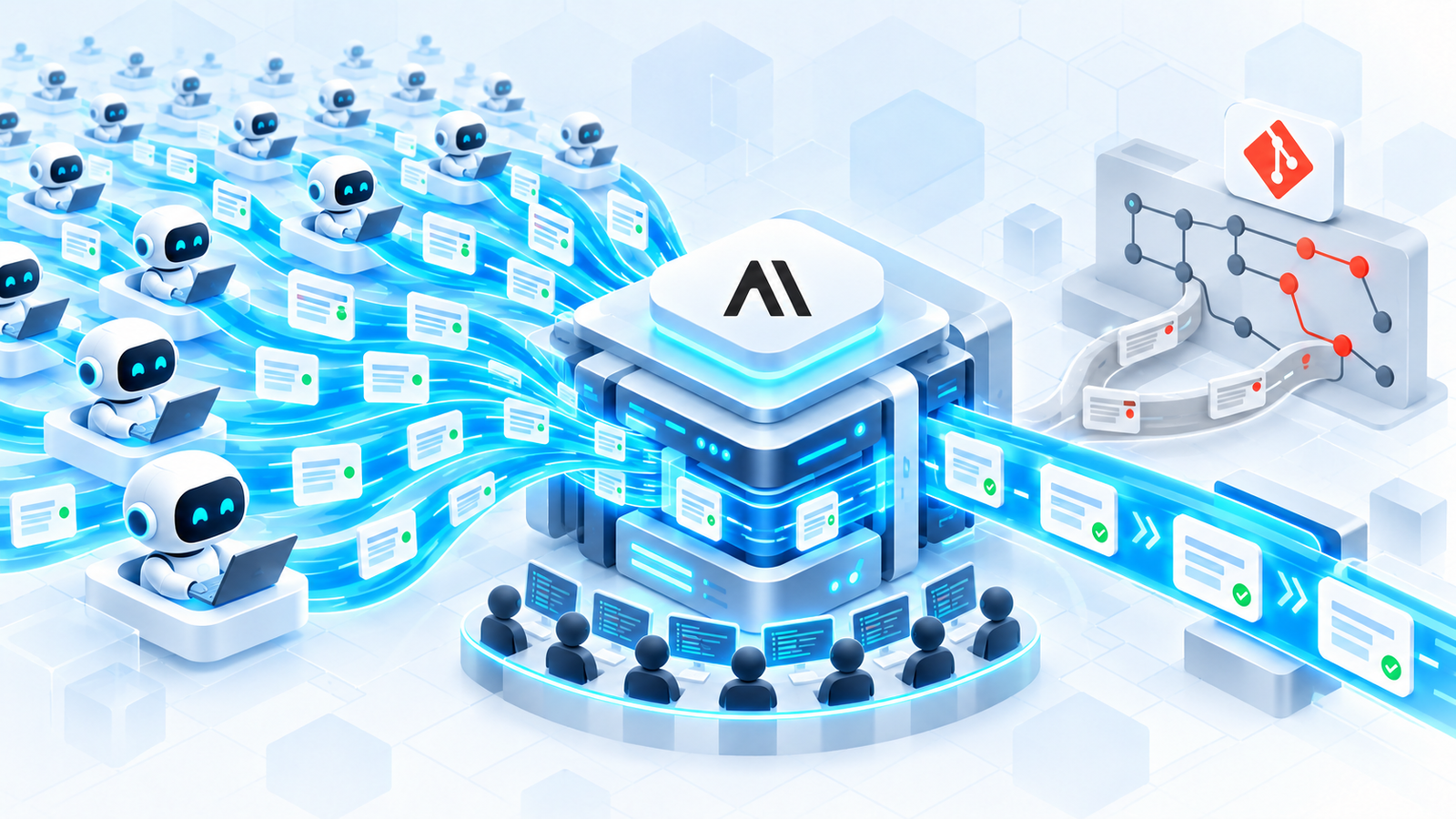
What happened: In an engineering post, Anthropic says merges into its monorepo rose from about 2,500 a day in May 2026 to over 30,000 a day by September, mostly agent-written code. Git could not keep up, so seven engineers spent about five months building Scion, a custom version-control system, with Claude writing much of it. It is an internal tool, and the post is explicit that it only makes sense for “truly enormous monorepos.”
The details: The scale explains the pain. Main-branch history is almost 100 GB, the compressed working copy is over 25 GB, and CI alone does about 25 million checkouts a day. Anthropic estimates naive fetching would mean over 600 PB of Git traffic daily, and it was already running several hundred Git mirrors to cope. The core idea is to stop pretending every client is a developer laptop. Almost every client is an agent or a CI job, so Scion clients are always online and fetch only the trees and blobs they need, with no packfiles. The server owns history, blame, commits, merges, and rebases; the client keeps a bounded cache and manages the working copy. The unit of work is a changeset in a write-ahead log, and blame, path history, and commit-graph indexes are derived from changesets through one generic mechanism. A per-node daemon talks to regional cache servers, which fall back to authoritative servers, with over 99% cache hit rate at each tier.
The reported results: infrastructure 200x smaller than the previous Git-mirroring setup, CI checkouts down from minutes to seconds, and a 25% CPU capacity win for CI. Claude’s own contribution is a nice detail. Asked to rewrite the Git-to-Scion ingestion pipeline, it produced a version that used 20x less memory and ran 4x faster, but engineers still had to say no when it over-engineered or broke system constraints. There are real gaps too: the team could not replicate a global merge-queue lock, so it relies on post-merge and pre-deploy testing, which allows conflicts. Anthropic’s ask of the Git community is server-side RPCs, a redesigned negotiation protocol, and sparse and shallow features that compose well.
flowchart LR
    A[Agents and CI jobs] --> B[scion-daemon on each node]
    B --> C[Regional scion-cache]
    C -->|miss| D[Authoritative scion-server]
    D --> E[(Changesets in a write-ahead log)]
    E --> F[Derived indexes: blame, path history, commit graph]
    B --> G[Sparse working copy, trees and blobs on demand]
Important
Our take: Most of us will never have a 100 GB monorepo, so do not go looking for a Git replacement. The transferable lesson is that agent-scale work changes the assumptions under your tooling: always-online clients, server-side history, and cheap partial checkouts beat full clones when the client is a short-lived job. The unglamorous gap is the missing merge-queue lock, because it tells you the real constraint is correctness at volume, not speed. If your CI is cloning full history for every agent run, fix that this week with sparse and partial clones.
🗞️ More News
🧠 AI
- Twenty major AI and chip stocks lost more than $1 trillion in a week; on Thursday SK Hynix fell over 10% in Seoul, Samsung 8.7%, Advantest nearly 14%, and ASML 6.6% in Amsterdam, amid rate and AI-debt worries.
- Eight states (Iowa, Nebraska, Kansas, West Virginia, Arkansas, Arizona, Idaho, and Montana) sued OpenAI in state courts under consumer protection laws; Arkansas also asks the court to halt testing of advanced models until adequate safeguards exist.
- YouTube Music began labeling AI songs as Fully, Partly, or No Gen AI, based on partner declarations plus YouTube’s own detection, with labels expanding to the main YouTube app later.
- Microsoft plans multi-gigawatt Maia deployments from 2027; Maia 300 packs 288 GB of HBM4 per accelerator, though practitioners question the headline tokens-per-watt claim and no customer access was announced.
- Meta extended Private Processing to its AI glasses, using confidential VMs, trusted execution environments, and remote attestation for cloud AI workloads.
- The New York Times followed a dinner where participants’ AI agents talked to each other while the humans socialized.
🤖 Robotics
- Stryker invested about $400 million in CMR Surgical and became the exclusive U.S. sales agent for the Versius robot, with an option to buy the rest of the company.
- A RoboBusiness 2026 panel will look at how robots can help reshore manufacturing.
- A recorded webinar covers the barriers to humanoid deployment and how perception technology is narrowing the gap.
💻 Programming
- Chainguard launched two beta products: Workspaces, giving each developer or agent a remote microVM with short-lived credentials, and Checks, which runs CI in warm microVMs and issues signed attestations that merge gates can verify.
- Grafana Tempo 3.1 adds query-based trace redaction with TraceQL, extra Kafka client security options, and an experimental sampling-aware metrics hint.
- Ben Linders argues release cadence matters, that development, deployment, and operations each need their own metrics, and that AI pushes engineers toward deeper problem understanding.
⚡ Electronics
- At OCP 2026, Navitas showed a 24 kW GaN board converting 800 V DC to 12 V DC in one stage, and TI launched its first 800 V isolated hot-swap controller, replacing a five-chip discrete design.
- ASML says customers want more lithography tools than planned for 2027 and 2028, and its EUV expansion depends on Zeiss, whose High-NA optics contain over 40,000 components.
- A Fraunhofer and IMS Nanofabrication partnership shows how low-volume European manufacturing quietly supports leading-edge chips.
📡 Telecom
- Nokia has sold two of four underperforming businesses and is struggling to find buyers for site implementation and microwave radio; the four units carry about €900 million in annual revenue and €100 million in collective losses.
- A 6G forum panel argued monetization should come from intelligence and sensing rather than speed, with ISAC moving from 5G-Advanced into core 6G specs in 3GPP Release 21.
- TP-Link pledged $1 billion in U.S. investment as government resistance to the company grows.
- Omdia says mainland China smartphone shipments fell to their lowest Q3 level since 2013.
👨💻 Code Corner
You cannot run Scion, but you can steal the cheapest idea behind it today: stop cloning what your job does not need. This clones a big repo without file contents and checks out only the folders you ask for.
# Partial + sparse clone: history without blobs, working copy of two folders only
git clone --filter=blob:none --sparse https://github.com/OWNER/BIG-REPO.git
cd BIG-REPO
git sparse-checkout set services/api docs

# Blobs are fetched lazily, only for what you touch
git count-objects -vH
git sparse-checkout list
Run it against any large repo and compare clone time and disk use with a plain git clone; for CI and agent sandboxes the difference is usually seconds versus minutes.
Tip
Partial clones fetch missing blobs on demand, so builds need network access to the remote. For fully offline jobs, pair --depth 1 with a sparse checkout instead.
🧰 Toolbox
- git sparse-checkout: the built-in way to materialize only the directories you need, the closest everyday cousin of Scion’s sparse working copies.
- Scalar: Microsoft’s tool that configures Git for very large repos, with partial clone, sparse checkout, and background maintenance enabled.
- Sapling: Meta’s source control client, built for huge monorepos, if you want to see another take on the scale problem.
- Grafana Tempo: open-source distributed tracing backend, now at 3.1 with TraceQL-based redaction.
- E2B: sandboxed environments for running agent-written code, one of the alternatives named alongside Chainguard’s new Workspaces.
- TI LMI800PS: an 800 V isolated hot-swap controller for AI rack power, a good hardware find from this week’s OCP news.
🎬 Demo Watch (rotating)
DOOM, sort of, on a Sonoff smart switch: a project by “piuppi” gets a Sonoff Basic R2 to serve a browser-viewable demo that renders graphics data extracted from DOOM. What is real: the switch keeps working as a switch after install, you supply your own copy of the game, and you open the demo from any browser on your local network. What is hype: it is not a playable port, it only draws a simplistic map, and the install is described as “a bit involved.” Still, squeezing a 3D renderer into a wall-switch microcontroller is a fun reminder of how much headroom cheap IoT hardware has, and why that hardware is interesting to attackers too.
📚 From the Blog
- Turning Pixels Into Something the AI Can Eat: the next video analytics installment, on preparing captured video for AI analysis.
- Building Your First Neuron From Scratch: deep learning continues by building a single neuron and adjusting its weights to lower error.
- The Network Behind the Cameras: the unglamorous plumbing that moves captured footage across the network.
😀 The Bot Says…
Seven engineers, five months, 30,000 merges a day, and the humans are still the ones saying “no, that is over-engineered.” Git blame has never had so many suspects.
That’s all for today! Reply and tell us: what is the first tool in your stack that agents have already outgrown?