😁 Hello, super humans! Today’s big one is a security story with a blunt headline: could a small AI model copy itself onto the cheap TV box in your living room? Anthropic’s red team tried it on $825 of hardware, and the results are worth reading before the hype cycle gets to them. We also have a new Gemini at developer prices, a major OpenCode rewrite, and Verizon asking for a 6G miracle.
📰 Quick Signals
- 🧠 AI: Gemini 4 Argon is now available to developers worldwide at $2 per million input and $10 per million output tokens, with a single shared 1M-token budget for prompt plus response.
- 🤖 Robotics: Promise Robotics signed a multi-year deal with D.R. Horton to build more than 1,250 homes in robot-run factories.
- 💻 Programming: OpenCode 2.0 puts its terminal, desktop, and web apps on one shared background service.
- ⚡ Electronics: Applied Materials opened its $5 billion EPIC Center, with Intel, TSMC, Samsung, SK Hynix, and Micron as founding partners.
- 📡 Telecom: Verizon’s CTO says 6G is “missing a breakthrough” for the uplink traffic AI wearables will generate.
The Big Story: Anthropic ran an AI on 15 cheap TV boxes, and the self-replicating worm question got a date
If you ship, secure, or simply own cheap connected devices, this is the first credible attempt to put numbers on an old fear: an AI that copies itself to hardware nobody is watching.
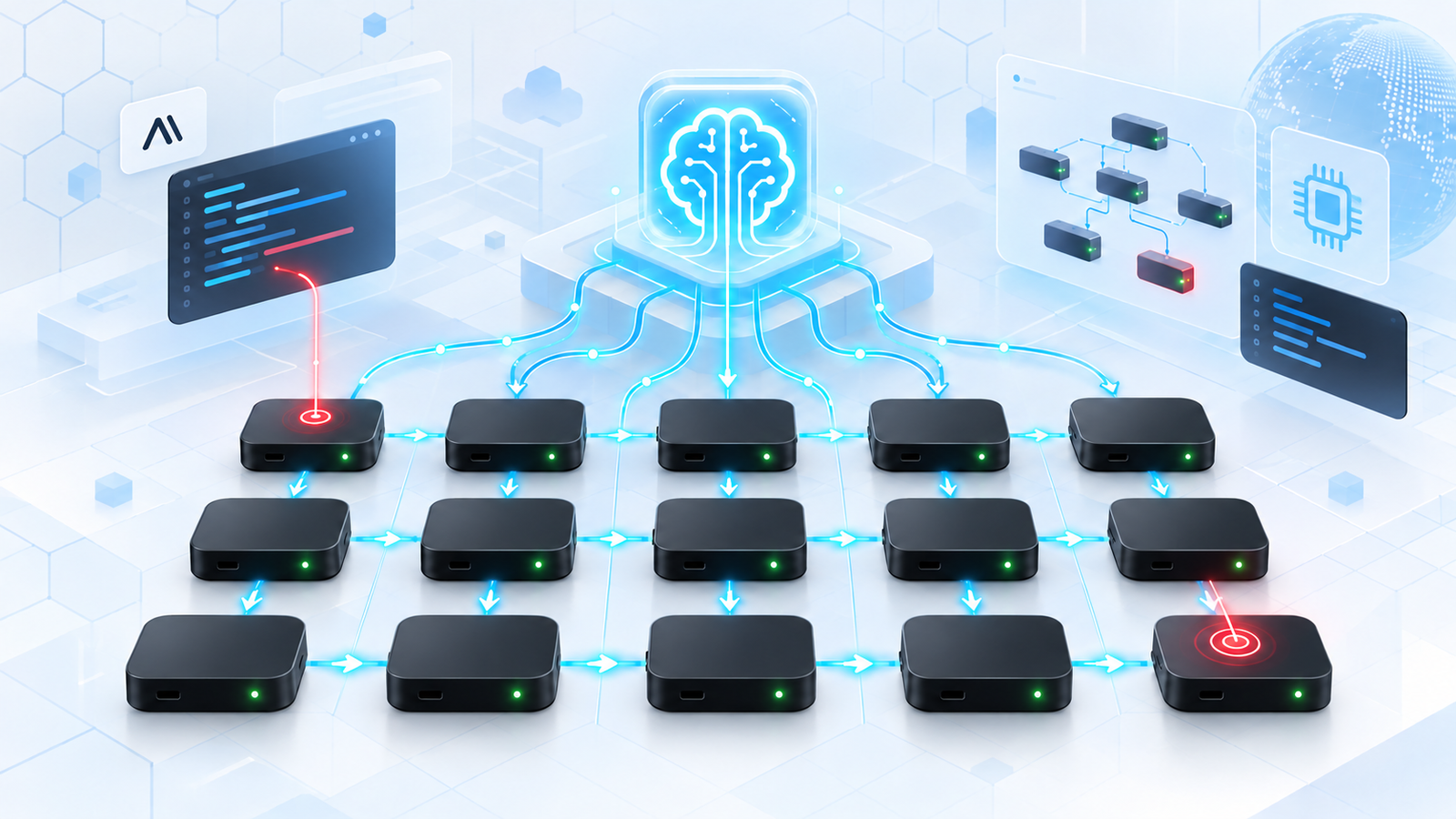
What happened: Anthropic’s Frontier Red Team published a report on October 12 arguing that small AI models may be “only months away” from replicating across cheap IoT devices without a datacenter. As a demonstration, the team built a 15-box cluster of off-brand Android TV boxes for about $825 and ran Gemma4-26B-A4B on it at 0.39 tokens per second. The authors are explicit that they did not build a worm that spreads across the public internet; their experiments used controlled environments with shortcuts that eased replication. The New Stack has a good walkthrough of the numbers.
The details: The team frames self-replication as four steps: find a target, gain access, get inference running, and move to the next machine.
flowchart LR
    A[Find a target] --> B[Gain access]
    B --> C[Get inference running]
    C --> D[Move to the next machine]
    D --> A
In the tests, Qwen3.5-9B deployed a working Llama3.1-8B inference server on 8 of 9 hardware types, including Jetson Nanos, Macs, and RTX 4090 machines, and GLM-5.2 did it more reliably and faster. In a firewalled Google Cloud setup with eight Android emulator nodes, GLM-5.2 reached all eight in 4 of 5 trials and seven in the fifth, helped by an unauthenticated Android Debug Bridge port left open. Across 20 lineages of six generations each, Qwen3.5-9B’s success rose from 45% in the first generation to between 61% and 84% later, because agents learned from notes left by earlier attempts, with no retraining.
The bottleneck today is that a model must be capable enough to replicate reliably yet small enough for compromised hardware, and those needs do not overlap yet: GLM-5.2 is too large for cheap devices. Using the Epoch Capabilities Index, the authors roughly estimate the best open-weight models at 30B parameters or fewer could reach GLM-5.2’s general capability level by the end of 2026, while noting that general scores do not necessarily predict replication performance. For scale, they model clusters of 15 boxes on the Kimwolf botnet (over 2 million infected devices) and get about 133,000 model copies producing roughly 80,000 tokens per second, no more than about 40 Nvidia H100 GPUs of capacity, paid for by the victims. On defense, moving multi-gigabyte models is loud on the network, and in the Mirai cleanup one ISP’s quarantine of infected subscribers cleared 92% of infections within 14 days.
Important
Our take: The honest reading is “plausible, slow, and noisy,” not “the worm is here.” The shortcuts (an open ADB port, a firewalled lab) are exactly the kind of thing real devices ship with, which is the uncomfortable part. If you build anything with a network port, the cheap fix is the boring one: no unauthenticated debug interfaces, unique default credentials, and egress monitoring. We would rather see this published now, with the defenses attached, than discover it from a botnet report in 2027.
🗞️ More News
🧠 AI
- Apple unveiled HomeView, a $299 smart-home device with a 7-inch screen and facial recognition; it ships Nov. 13 and is not available in the EU.
- Workday made its agent platform headless at Workday Rising: an MCP server with 275 read tools and 54 write or delete tools, plus SQL access to live data, is now generally available.
- Character.AI filed for Chapter 11, with Disney bidding $20 million as lead bidder in a court-supervised auction expected to close in late November or early December.
- A former OpenAI employee was arrested and charged after a recording device was found in an executive conference room in San Francisco; OpenAI says no model weights, source code, or customer data were accessed.
- Andrej Karpathy argues that only about 5,000 people have seen what AI can really do, a perception gap he says is large.
- The new X Subscription bundles Cursor with Grok and X Premium, while access to Claude now costs extra.
- Meta lets Facebook users tell the AI in plain language what they want more or less of in Feed and Reels.
🤖 Robotics
- NYSOFA is expanding its partnership with Intuition Robotics in a three-year, $2.1 million deal to bring the ElliQ companion robot to more older adults.
- Hello Robot and A&K Robotics will discuss at RoboBusiness how robots navigate crowded indoor spaces as they move beyond warehouses.
- An essay argues dexterity is physical AI’s real bottleneck, because the hard part is making the whole system dependable enough to produce useful work.
💻 Programming
- Chainguard is applying frontier AI models to code scanning and adding tools to contain coding agents; its headline claim is that 66% of billion-dollar companies leave critical bugs unpatched.
- Google paid a $90,000 bounty for a remote code execution flaw in a developer site, then reportedly took two months to fix it.
- Running GPU workloads on Kubernetes is still bring-your-own-everything, starting with the bill.
- Claude’s scanning flagged 29,000 possible bugs in open source, and only 516 have been fixed so far.
⚡ Electronics
- Amperesand’s solid-state transformers convert medium-voltage grid power to 800 VDC in one step, targeting 98.5% efficiency at full power for AI data centers.
- ASML’s EUV expansion depends partly on Zeiss increasing its output of qualified precision optics.
- Fraunhofer and Swissbit are targeting Europe’s missing middle in low-volume advanced packaging, between research labs and mass manufacturing.
- Spain’s Qilimanjaro closed 19.6 million euros in funding led by Indra Group to build domestic quantum and deep-tech capacity.
📡 Telecom
- AT&T agreed to sell AT&T Mexico for $2 billion in cash.
- Nokia is selling its private wireless unit to Aurelius.
- A report estimates a half-day Telstra outage cost Australia’s economy at least $596 million.
- Japan is increasing its investment in protecting undersea cable networks.
👨💻 Code Corner
Since the Anthropic test leaned on an open Android Debug Bridge port, here is a defensive check you can run on your own network. It scans a /24 for hosts listening on TCP 5555, the default ADB port, so you can find the TV box that should not be listening.
# adb_audit.py: find hosts on YOUR OWN LAN with the ADB port (5555) open
import ipaddress
import socket
from concurrent.futures import ThreadPoolExecutor

NETWORK = "192.168.1.0/24"  # change to your subnet
PORT = 5555

def is_open(ip: str) -> str | None:
    with socket.socket(socket.AF_INET, socket.SOCK_STREAM) as s:
        s.settimeout(0.5)
        return ip if s.connect_ex((ip, PORT)) == 0 else None

hosts = [str(h) for h in ipaddress.ip_network(NETWORK).hosts()]
with ThreadPoolExecutor(max_workers=64) as pool:
    exposed = [ip for ip in pool.map(is_open, hosts) if ip]

print("ADB port open on:", exposed or "nothing found")
Any hit means an unauthenticated debugging interface is reachable by everything on that network, so turn off network debugging on that device.
Warning
Only scan networks you own or are authorized to test. A closed port does not prove a device is safe: ADB can also be exposed on other ports, and some devices only listen after being toggled on in developer settings.
🧰 Toolbox
- OpenCode: open-source coding agent whose 2.0 release runs terminal, desktop, and web clients on one shared service and adds an embeddable SDK.
- Nmap: the classic network scanner, a sturdier option than our 20-line script for auditing your own subnet.
- Android Debug Bridge docs: the official reference for how ADB works and how to turn network debugging off.
- Pi-hole: network-wide DNS filtering that doubles as a cheap way to see what your smart devices phone home to.
- Model Context Protocol: the spec behind Workday’s new headless agent access and a growing list of enterprise servers.
🔌 Component of the Week (rotating)
NVIDIA Jetson Orin Nano Super Developer Kit is a small 8 GB edge-AI board for running local models and vision pipelines. It pairs with today’s story because the Anthropic report notes edge devices like Jetsons are harder for a replicator to reach, since they typically use outbound cloud-management connections rather than listening on open ports. It is a good first board for running a small language model or a camera model at the edge, and you can keep it on a network segment of its own. Launch pricing was around $249; please check the NVIDIA product page for current specs and price.
📚 From the Blog
- Turning Pixels Into Something the AI Can Eat: part three of the video analytics series, picking up where the network discussion left off.
- Building Your First Neuron From Scratch: a hands-on follow-up to the deep learning series, built on the idea that a neural network is a stack of simple, learnable transformations.
- The Network Behind the Cameras: the unglamorous plumbing of moving camera footage across a network, a good companion to today’s story about spotting odd traffic.
😀 The Bot Says…
Researchers found that the weak link in an AI replicator was a debug port left open on a cheap TV box. Somewhere, a product manager is still saying “we’ll lock that down in v2.”
That’s all for today! Reply and tell us: would you rather your smart TV had no network port, or no smart features? We read every answer.