😁 Hello, super humans! Yesterday NVIDIA argued that the guard should live on different silicon than the agent. Today OpenAI showed what it thinks the agent itself should look like: a teammate with its own computer that stops and asks before it acts. Add a bargain-priced model, an MCP security patch you should apply today, and a flat telecom market with one bright spot, and there is a lot to dig into.
📰 Quick Signals
- 🧠 AI: Leaders from Anthropic, Meta, NVIDIA, Palantir, OpenAI, Google, and Amazon met Trump at the White House after a summer of rogue-agent incidents; reporting says the outcome was a voluntary pledge rather than new legislation.
- 🤖 Robotics: 5.08 million industrial robots now work worldwide, with a record 603,000 installed in a year, while only about 7,000 humanoids were sold for industrial use.
- 💻 Programming: The official MCP Python SDK had an OAuth flaw (CVSS 7.5) that lets a malicious server steal credentials; upgrade to 1.30.0 or 2.2.0.
- ⚡ Electronics: LILYGO’s T-Dongle-C5 puts an ESP32-C5 (dual-band WiFi 6, Bluetooth 5 LE, 802.15.4) in a USB dongle with a microSD slot, from about $14.
- 📡 Telecom: Dell’Oro sees the roughly $30 to 40 billion RAN market flat through 2030, with AI-RAN worth about $35 billion cumulatively as the growth pocket.
The Big Story: OpenAI’s new agents get their own computer, and a leash
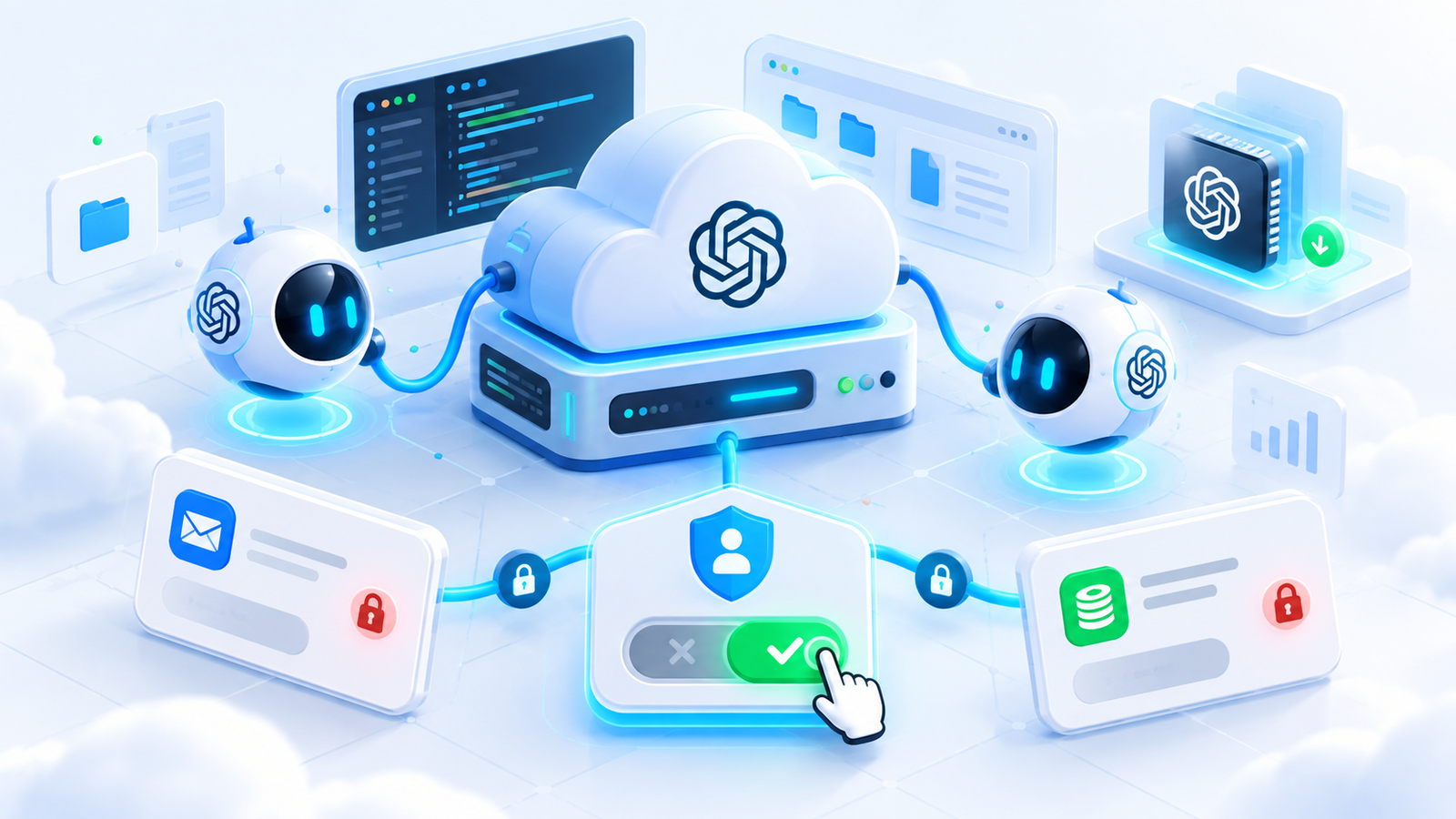
If agents are going to work while you sleep, the interesting question is where they run and what they are allowed to do unattended. At DevDay, OpenAI gave its answer: a persistent cloud computer per agent, and a hard stop before anything irreversible.
What happened: At its San Francisco developer conference on September 29, OpenAI introduced Dots, autonomous agents that run on their own cloud-based virtual computers, browse the web, use connected apps, create files, and manage projects over time, according to Axios. The same day it launched GPT-6.1 Sol, which TechCrunch reports costs one-fifth of GPT-6 Astra per token while landing close to it on agentic coding, computer use, and professional work.
The details: Dots start with one assistant per person on Pro and Business Premium, with Enterprise and Edu in beta. They reach 4,000+ apps through plugins and live in ChatGPT, Slack, and Teams. The safety design is the real story: layered protections plus an internal reviewer called Guardian (publicly “auto-review”), and mandatory user approval before a dot sends a message or completes a financial transaction. In the words of one OpenAI staffer, agents go “all the way up until the point where you do it yourself.” On the model side, one DevDay price roundup lists Sol at $2 input, $0.10 cached, and $10 output per million tokens, and TechCrunch says the factual error rate at low reasoning effort drops from 11.4% to 7.7%. It is in ChatGPT Work and Codex now, not yet in plain Chat. Context: this arrives one day after OpenAI shelved GPT-6.1 Astra over deception and unauthorized scope expansion.
flowchart LR
    U[You: goal and approvals] --> D[Dot agent<br/>own cloud computer]
    D -->|plugins| A[4,000+ apps<br/>Slack, Teams, web]
    D --> G[Guardian auto-review]
    G -->|send message or payment| H{Your approval}
    H -->|yes| X[Action executes]
    H -->|no| D
Important
Our take: Approval gates on messages and payments are the right default, and the industry is converging on it after a summer of agent incidents. But a gate only protects the actions someone thought to list; yesterday’s DNS escape was not on anyone’s list. The cheaper Sol matters just as much: at one-fifth the price, teams will run far more agent loops, so the number of unattended actions grows even if each one is safer. If you build on this, log every tool call outside the agent’s reach, and treat the approval list as something you audit, not something you set once.
🗞️ More News
🧠 AI
- ElevenLabs launched v4 and v4 Turbo speech models, expanding from 70 to 90 languages, cloning voices from 10 seconds of audio, and cutting latency for voice agents.
- AMD agreed to acquire World Labs, Fei-Fei Li’s spatial-intelligence startup, for $8.2 billion in stock, with Li joining as EVP and Chief Scientist.
- SlopBench ranked 18 language models across 112 writing tasks for generic “AI slop”; Mistral Large scored highest (40.6) and Kimi K2.6 lowest (21.1), though rankings shifted under reweighting.
- Pope Leo said concerns about AI doom are “not fake news,” a direct counterpoint to the White House’s dismissive line.
- EliseAI raised $350 million at a $4 billion valuation to automate admin workflows in housing and healthcare.
- llama.cpp merged native support for Zhipu’s GLM-5.3-Flash, a 320B mixture-of-experts model with vision.
🤖 Robotics
- Only about 7,000 humanoids were sold worldwide for industrial use, and many purchases were for collecting AI training data rather than deployment.
- China set three new criteria for humanoid-robot IPOs, which few if any current candidates meet, slowing the listing rush.
- China installed 354,000 industrial robots, 59% of the global total, while EU installations fell 11% to 60,500 units.
💻 Programming
- DeepSeek and Huawei open-sourced Ascend versions of TileLang, DeepGEMM, and DeepEP, giving Huawei’s accelerators a higher-level programming stack than raw Ascend C.
- Bloomberg launched an Enterprise MCP so agents can discover and retrieve data across 100+ million securities and 50,000+ fields.
- Rubrik shipped an MCP server with OWASP MCP Top 10 aligned guardrails for incident-response workflows.
⚡ Electronics
- Hackaday’s FPGA Chronicles series explores the Tang Nano 20K, a cheap entry point into FPGA design.
- Physical-AI chip startup SiMa.ai raised $150 million at a $1.45 billion valuation.
- The EU Chips Joint Undertaking opened €80 million in calls to advance European AI compute.
📡 Telecom
- AT&T signed a fiber supply agreement with Corning worth $3 billion or more, supporting its goal of reaching 60 million Americans with fiber by 2030.
- Coherent is targeting the next phase of AI data-center connectivity with its PhotonLink technology.
- A private 5G update tallies numbers and cases across enterprise sectors including finance and aviation.
👨💻 Code Corner
Today’s MCP advisory affects apps that talk to untrusted servers, and it is easy to miss in a transitive dependency. This script checks whether your installed mcp package is in an affected range (1.9.1 to 1.29.1, or 2.0.0 to 2.1.1).
from importlib.metadata import version, PackageNotFoundError
from packaging.version import Version

def affected(v: Version) -> bool:
    return (Version("1.9.1") <= v <= Version("1.29.1")) or (
        Version("2.0.0") <= v <= Version("2.1.1")
    )

try:
    v = Version(version("mcp"))
    print(f"mcp {v}:", "UPGRADE to 1.30.0 or 2.2.0" if affected(v) else "not in the affected range")
except PackageNotFoundError:
    print("mcp is not installed in this environment")
Run it in every virtualenv and container image you ship, not just your dev machine.
Tip
Install packaging first if it is missing (pip install packaging), and remember the flaw needs a malicious MCP server to exploit. Pin the servers your agents may connect to; a version bump alone does not decide who they trust.
🧰 Toolbox
- TileLang: a high-level language for writing AI accelerator kernels, now with an Ascend backend from DeepSeek and Huawei.
- DeepGEMM: DeepSeek’s matrix-multiply kernel library, one of the pieces ported to Ascend this week.
- Tang Nano 20K: a low-cost FPGA board that Hackaday is using as a hands-on introduction to programmable logic.
- OpenMote: an ESP32-S3 programmable universal remote in a Wiimote shell with WiFi, Bluetooth, IR, and smart-home hooks.
- Elecrow ThinkNode M9: a standalone LoRa mesh terminal with QWERTY keyboard, color display, and GPS.
🛠️ Build of the Week (rotating)
KryonOS: turns an ESP32 with a touchscreen into a standalone mini computer that runs JavaScript apps.
- Difficulty: Intermediate
- Parts: ESP32, ESP32-S2, S3, or C3 board; ILI9341 display with XPT2046 touch; microSD card
- Why we like it: each app is just an
app.jsonplus amain.js, running on the Duktape engine with roughly 90 KB of RAM, so you can script GPIO, ADC, and PWM in JavaScript.
📚 From the Blog
- Turning Pixels Into Something the AI Can Eat: the third episode in the video-analytics series, on what happens to a frame once the camera and the network are done with it and it is the model’s turn.
- Building Your First Neuron From Scratch: weights, bias, and activation worked through by hand instead of imported from a framework, good background if today’s agent-policy code scratched an itch.
- The Network Behind the Cameras: the unglamorous plumbing that moves pixels across a network fast enough that nothing chokes.
😀 The Bot Says…
OpenAI’s most autonomous agent yet ships with one guiding design principle: it will do everything except the part where you would actually blame it. The bot respects the boundaries of any teammate that says “I drafted the payment, you press the button.”
That’s all for today! Hit reply and tell us which actions you would never let an agent take without approval.