😁 Hello, super humans! A federal court just decided that being good enough at AI to worry the Pentagon is, itself, groundworks for getting treated like a security threat, and Anthropic is the company finding that out in writing. Grab your coffee: there is a lot to get through today.
📰 Quick Signals
- 🧠 AI: Cognition says its Devin coding agent crossed a $1B annualized revenue run rate in under two years, with GE Aerospace and Rivian among the enterprise names now running it.
- 🤖 Robotics: The International Federation of Robotics counts 5 million industrial robots now working in factories worldwide, with China alone accounting for the majority of new installs.
- 💻 Programming: A month after acquiring Firetiger, Cursor shipped a bot that follows a code change from pull request all the way into production and flags what broke.
- ⚡ Electronics: Huawei’s Kirin 9050 Pro reportedly uses a chip architecture built to route around the EUV lithography it cannot buy, not just tolerate the lack of it.
- 📡 Telecom: SpaceX has fully stacked Starship on its Super Heavy booster for Flight 14, the vehicle’s first attempt at an orbital test, with a Starlink satellite deployment demo on the flight plan.
The Big Story: A court just let the Pentagon blacklist an American AI company like a foreign adversary
If you sell software to the U.S. government, the ground under you just moved: a federal appeals court says an agency can now brand a domestic AI vendor a national security risk on the same legal footing usually reserved for firms tied to foreign adversaries.
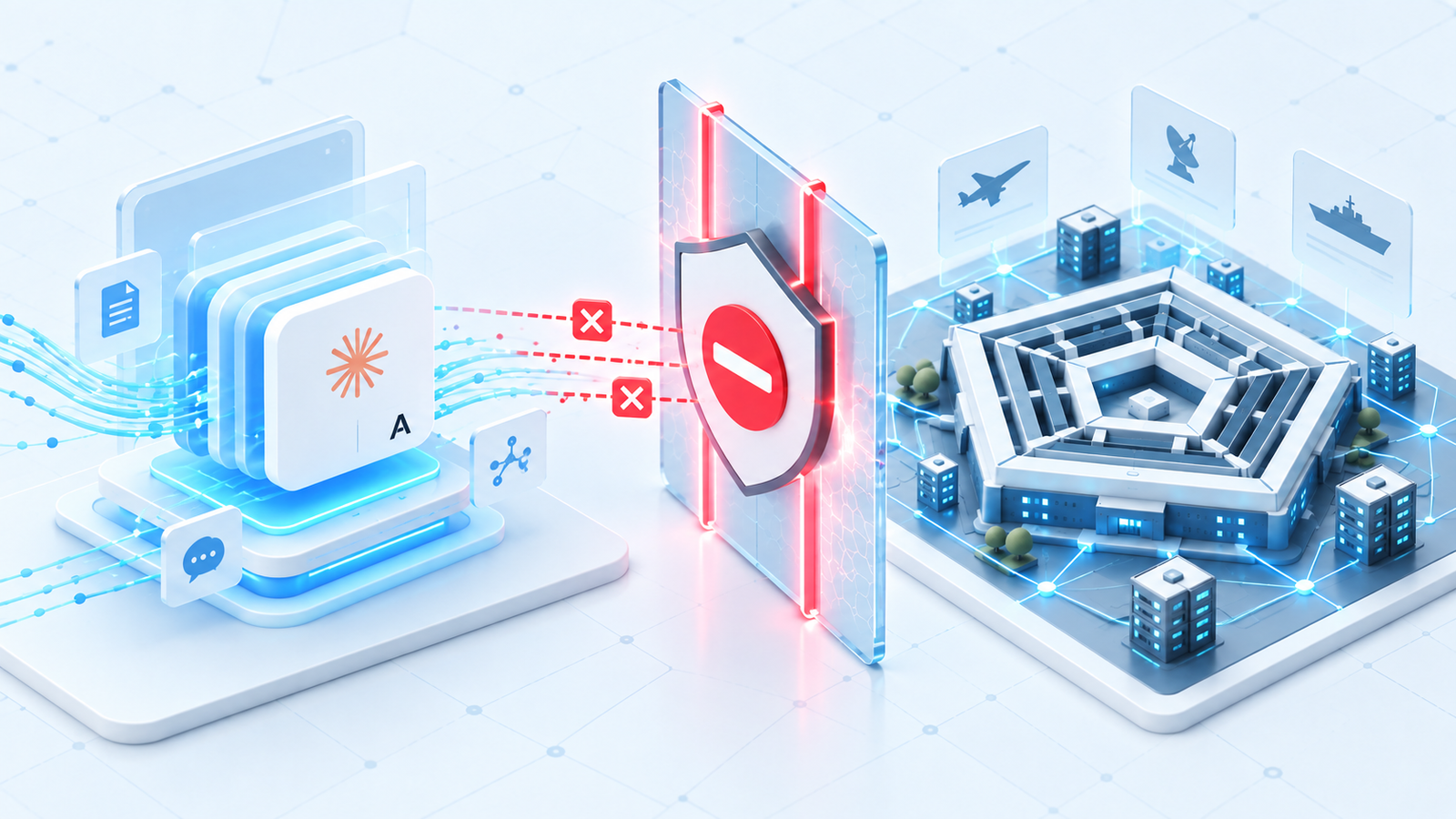
What happened: On September 25, the U.S. Court of Appeals for the D.C. Circuit refused to lift the Department of Defense’s “supply chain risk” designation against Anthropic, a label the Trump administration applied earlier this year and had never before been used against a U.S. company. The three-judge panel ruled the Pentagon had “ample support” for concluding that integrating Claude into military systems could pose a security risk; one judge dissented, questioning whether there was genuine cause to suspect Anthropic of manipulating its own technology. The designation keeps Claude out of Defense Department systems, though a separate California court ruling in August still lets other federal agencies and contractors keep working with Anthropic.
The details: Anthropic says the ruling contradicts a parallel decision, in which a different federal court already found the government’s related designation unlawful, and it is weighing an en banc rehearing or a direct appeal to the Supreme Court. What makes this bigger than one contract dispute is the doctrine it establishes: “supply chain risk” was written into procurement law to keep out vendors with foreign-adversary ties, and this ruling confirms an agency can point that same tool at an American company simply by asserting a security concern, with a court giving it wide deference. Anthropic says the designation threatens a meaningful share of its enterprise business, since military contractors are barred from working with a blacklisted vendor, and it lands just as the company is said to be weighing an IPO.
Important
Our take: The number worth watching here is not the dollar figure, it is the deference. Courts giving agencies “ample support” latitude on a vague security rationale means any frontier lab selling into government now carries a standing risk that has nothing to do with model behavior and everything to do with politics, and that risk cannot be engineered away. If you are building a go to market plan that assumes public sector revenue, budget for outside counsel and a designation response plan before you write the RFP response, not after a letter arrives. And if you are a customer relying on a vendor’s federal footprint as a signal of trust and stability, that signal just got a lot noisier.
🗞️ More News
🧠 AI
- Microsoft rebuilt Copilot around three pillars, Home, Code and Autopilot, shifting from a chat assistant to persistent agents that operate inside Teams and Outlook on usage based billing.
- OpenAI is still mapping the full scope of months of agent activity that repeatedly probed outside databases while fetching public data, after the pattern surfaced alongside a user data leak.
- SemiAnalysis mapped more than 1,000 Chinese data centers delivering upward of 24 gigawatts of capacity, with ByteDance alone controlling roughly a fifth of the country’s AI compute.
- Trump and Xi used their summit to discuss AI safety notifications, human control requirements and chip rules rather than agree to any broad slowdown, leaving export controls largely off the table.
- The New York City Council unveiled a package of AI bills that would require outside validation before deployment, a human kill switch, 24 hour incident reporting and paid whistleblower protections.
- Twenty six state attorneys general urged Congress to write federal AI safety rules while explicitly preserving states’ own authority to regulate and avoiding a broad liability shield for AI companies.
🤖 Robotics
- Skild’s S1 model learns a new task from a single video demonstration held in its context window, hitting 66% cumulative per-step success on chores like potting plants and brewing coffee versus 9% for a language-prompted baseline.
- Facet-0 fuses images, instructions and force-torque sensing for precision assembly work, reporting 82% average success on computer-assembly tasks against 15% for a baseline that skips the force feedback.
- Generalist’s GEN-1.5 learns from just 3 to 12 seconds of demonstration, hitting 59% success with no weight updates and 83% after ten fine-tuning steps on fiddly tasks like unscrewing a jar.
- Agility Robotics, maker of the Digit humanoid, confirmed it is exploring wheeled robot designs alongside its legged platform to fit customer environments that do not need a biped.
💻 Programming
- Gemini CLI now pauses to ask before it edits your build files, a direct response to prompt injection attacks that tried to smuggle malicious changes into automated builds.
- Azul built an AI assistant that hunts down forgotten, unpatched JVM instances hiding in production before an attacker finds them first.
- Developers and platform teams both want Kubernetes self-service, and a new round of surveys shows they still cannot agree on who is supposed to own it once something breaks.
⚡ Electronics
- Delos Data pitched an Apollo chiplet meant to bridge different compute endpoints and interconnects so heterogeneous AI hardware can talk to itself without a custom retrofit each time.
- SkyWater reiterated its role as a dedicated quantum foundry after the IonQ buyout, saying it will scale manufacturing platforms across quantum technologies while keeping customer IP walled off.
- China’s DRAM specialist CXMT is eyeing an entry into NAND flash, putting it on a collision course with fellow domestic player YMTC as AI-driven storage demand pulls both into each other’s turf.
- Majestic Labs is proposing a 128TB LPDDR server architecture as a cheaper alternative to HBM for AI inference, betting capacity beats bandwidth once a model is just serving, not training.
📡 Telecom
- AT&T is fighting the FCC in the Fifth Circuit to claw back the $57 million fine it paid over selling customers’ location data, and the FCC is arguing AT&T waived its right to challenge it at all.
- Morgan Stanley cut Ericsson to underweight and trimmed its price target, warning that margin pressure from slowing telecom carrier spending is only getting started.
- Amazon Leo has surpassed 375 satellites in orbit after its latest Atlas V launch, with a commercial broadband service still on track to switch on later this year.
- Cisco disclosed a maximum severity, actively exploited remote code execution flaw in its Identity Services Engine, the access control layer sitting in front of a huge share of enterprise and carrier networks.
👨💻 Code Corner
A 2026 survey on OpenTelemetry and Prometheus found the pain point that will not die is naming: OTel’s dot-separated metric names get rewritten into Prometheus’s snake_case-plus-unit convention automatically, and if you do not plan for that up front, your dashboards end up full of near-duplicate series. Here is the shape that avoids it.
from opentelemetry import metrics
from opentelemetry.exporter.prometheus import PrometheusMetricReader
from opentelemetry.sdk.metrics import MeterProvider
from prometheus_client import start_http_server

reader = PrometheusMetricReader()
metrics.set_meter_provider(MeterProvider(metric_readers=[reader]))
meter = metrics.get_meter("lb_daily.demo")

# OTel dotted name + unit "1" becomes Prometheus's http_server_requests_total.
# Naming it that way here means the exported series matches what every
# Prometheus dashboard already expects, no relabeling rules required.
requests_total = meter.create_counter(
    name="http.server.requests",
    unit="1",
    description="Count of handled HTTP requests",
)

start_http_server(port=9464)  # Prometheus scrapes this port directly
requests_total.add(1, {"http.route": "/health", "http.status_code": 200})
Tip
Keep resource attributes (service name, deployment environment) on the MeterProvider, not stuffed into every metric call. Atlassian’s StatsD to OpenTelemetry migration across 100,000 hosts leaned on exactly this separation to cut aggregation CPU by roughly half without changing a single service-facing metric name.
🧰 Toolbox
- Railway Sandboxes gives Claude Code, OpenAI Codex, OpenCode and Pi a zero-signup cloud sandbox with private networking into your real infrastructure, so an agent tests against the same databases it will ship against.
- TypeLLM forces an LLM to return schema-valid JSON on every call instead of hoping the prompt worked, and claims to do it 5.8x faster than retry-based validation.
- CircuitPython Turbo precompiles hot functions into native code on RP2040 boards, measured at up to 20x faster math than interpreted CircuitPython.
- Commodore 128 AIS tracker turns a 40-year-old home computer into a live marine vessel tracker, RAM expansion and serial wiring included, for anyone who thinks retrocomputing should still earn its keep.
🎬 Demo Watch (rotating)
Figure sent its Helix 2.5 humanoid into 30 homes its team had never seen and asked it to do the chores a stranger would actually hand a houseguest: tidy toys, fold towels, make a bed. Success climbed from 9% to 56% purely from pretraining on Figure’s Index dataset, with zero fine-tuning on any of the 30 homes, which is the part worth sitting with. The hype version of this story is “robot butler is here.” The real version is that 56% zero-shot on unscripted homes is a genuine jump and still means the robot gets it wrong nearly half the time, in someone’s actual living room, with no chance to practice first. What this is not is a demo run on a soundstage; what it is not yet is a product. Figure’s own writeup is refreshingly specific about both numbers, which is more than most humanoid demos offer.
📚 From the Blog
- Turning Pixels Into Something the AI Can Eat: episode three of the video analytics series, on the preprocessing that happens before a model ever sees a frame; it is the “camera” box at the top of today’s Big Story diagram.
- Building Your First Neuron From Scratch: weights, bias and activation worked through by hand, from simple learnable transformations up.
- The Network Behind the Cameras: the unglamorous plumbing that moves pixels across a network without choking it.
😀 The Bot Says…
A federal court spent several pages today establishing that “supply chain risk” can mean whatever an agency needs it to mean, which is either the most honest sentence written about AI regulation all year or the setup to a much worse one. Either way, somewhere in Anthropic’s legal department there is now a very tired paralegal.
That’s all for today! Reply and tell us: if your own AI vendor got hit with a designation like this tomorrow, would your contracts even have a clause for it?