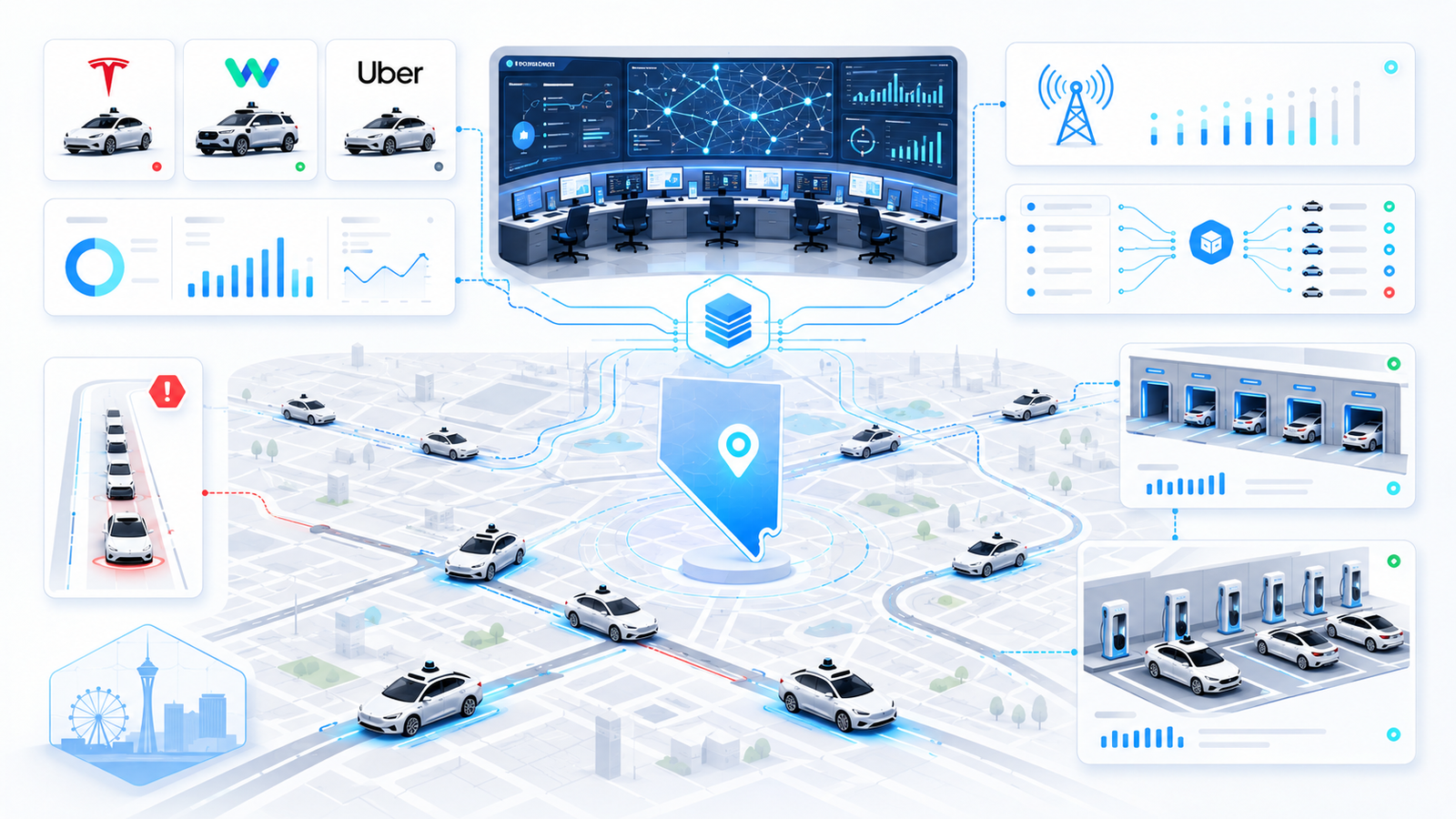
😁 Hello, super humans! A regulator in Nevada did something on Thursday that nobody in the autonomy business has been granted before: permission to put thousands of driverless cars on public streets in a single county, all at once. The permits are the easy part. What happens next is a staffing, connectivity and depot-throughput problem that almost nobody talks about, so that is where we are going today.
📰 Quick Signals
- 🧠 AI: Google DeepMind says the open Gemma model family has passed one billion downloads, with developers publishing more than 100,000 fine-tunes and variants since the family launched roughly two years ago.
- 🤖 Robotics: Noitom Robotics, Shanghai AI Laboratory, Dobot and Shanghai Jiao Tong University demonstrated humanoids playing professional-style tennis two days after releasing the HiPHI platform.
- 💻 Programming: GitHub’s postmortem on the August 17 outage blames a capacity shortfall rather than a deploy, with Istio sidecar proxies hitting their limit while autoscaling never counted them.
- ⚡ Electronics: global semiconductor sales rose 35.1 percent from the first quarter of 2026 to the second, with June alone at 134.5 billion dollars.
- 📡 Telecom: Charter closed its 34.5 billion dollar Cox merger and its Liberty Broadband acquisition, creating a cable operator serving close to 38 million customers across 45 states.
The Big Story: Nevada approved 8,000 robotaxis, and the bottleneck is the operations layer
Every robotaxi story until now has been about whether the car can drive. This one is about whether the company behind it can run a fleet the size of a mid-market taxi operator, and that turns out to be a completely different engineering problem.
What happened: the Nevada Transportation Authority unanimously approved three commercial permits on Thursday covering Clark County, which contains Las Vegas. Tesla is cleared for up to 5,000 autonomous vehicles over the next 12 months, Waymo for up to 1,000, and Uber for up to 1,000 that it plans to run through Hyundai subsidiary Motional and through Zoox, which already holds a separate permit for 100 cars. TechCrunch reported the approvals, and the number that makes them remarkable is the one they replace: an interim order had capped Tesla at ten fully autonomous vehicles on a limited stretch of the Strip. On paper that is a 500x jump. Tesla’s own Cybercab chief engineer told the hearing that 5,000 has always been a ceiling and that he would be very happy to reach 2,500 within the year.
The details: the ceiling nobody votes on is the operations layer. Every commercial deployment of driverless vehicles in a real market runs a remote assistance function, and it is not what people imagine: the human does not steer. The vehicle recognises that it is stuck or that a scene is ambiguous, and it asks for guidance; the operator looks at the frozen situation, proposes a path or confirms an interpretation, and the car drives itself again. Waymo has publicly defended this model, and reporting on its staffing has put the ratio in the neighbourhood of one remote assistant per forty-plus vehicles across four response centres. Scale that arithmetic to 8,000 cars and you are hiring, training and shift-scheduling a workforce in the low hundreds, spread across time zones, with a service level measured in seconds.
flowchart TD
  A["Permit ceiling: 8000 vehicles in Clark County"] --> B["Autonomy stack"]
  A --> C["Operations layer"]
  B --> B1["Perception and planning"]
  B --> B2["Validation miles per ODD change"]
  C --> C1["Remote assistance staffing and shift coverage"]
  C --> C2["Low latency uplink from every vehicle"]
  C --> C3["Depot charging cleaning and inspection throughput"]
  C --> C4["Incident response and roadside recovery"]
  C1 --> D["Real deployable fleet size"]
  C2 --> D
  C3 --> D
  C4 --> D
  B2 --> D
The other two constraints are just as unglamorous. Remote assistance only works if the vehicle can push live video and telemetry upstream on demand, which means uplink capacity and tail latency on a public cellular network, in a city that regularly packs a hundred thousand extra people into a few square kilometres for a convention. And every vehicle has to physically return somewhere to charge, get cleaned, and be inspected. Depot throughput sets a hard cap on fleet utilisation that no amount of model training will move. That is why the engineer closest to the hardware said 2,500 while the permit said 5,000.
Important
Our take: I read this as the moment robotaxis stopped being an AI story and became an operations story, which is a much better sign for the technology than another demo video. The permits are essentially free to grant, so the interesting number will not be 8,000; it will be whatever fleet each operator actually fields in twelve months, and the gap between the two is a direct readout of how much human scaffolding the autonomy still needs. Watch the remote-assistance ratio, not the mileage. If it improves as the fleet grows, the stack is genuinely getting better. If it stays flat, these companies have just discovered they are in the staffing business, and Las Vegas is where everyone gets to see the receipts.
🗞️ More News
🧠 AI
- Nvidia struck an unusual 6 billion dollar non-exclusive licensing deal with AI coding startup Poolside, plus a 1 billion dollar investment at a 12 billion pre-money valuation and job offers to about 109 employees, without acquiring the company.
- Anthropic is reportedly preparing registration documents for an IPO that could rival SpaceX’s record debut, with annualised revenue said to have reached roughly 65 billion dollars by the end of July.
- OpenAI is rolling out a macOS Messages integration that lets ChatGPT read, search, summarise and send messages once permissions are granted, processed locally with no separate conversation index.
- Apple Music will start showing visible labels on tracks that content providers identify as materially generated using AI, extending its AI Transparency Tags programme.
- Google is giving publishers an embeddable Preferred Sources button, letting readers pin a publication so it surfaces more often in Top Stories, AI Mode and AI Overviews.
- Brazil announced roughly 444 million dollars of AI investment spanning US and Chinese partners, including about 250 million for a supercomputing project with Huawei and iFlytek.
- A CBRE report puts New York’s tech workforce at about 394,300 jobs against the Bay Area’s 375,730, the first time it has led in 13 years of the study, with AI roles now near a third of US tech listings.
🤖 Robotics
- Uber’s 1,000-vehicle Nevada allocation will be filled through Motional and Zoox rather than an in-house stack, which is a useful reminder that the ride-hailing layer and the autonomy layer are separating again.
- The 2026 World Robot Conference in Beijing is showing humanoids, quadrupeds and warehouse systems side by side, which makes it an unusually direct comparison of mobility approaches.
- Local taxi operators and the Livery Operators Association objected at the Nevada hearing on market oversaturation and congestion in the Golden Triangle, the first organised incumbent pushback at this fleet scale.
- The IEEE-RAS International Conference on Humanoid Robots reaches its 25th edition this year, which is worth remembering when a demo gets described as the field’s first anything.
💻 Programming
- GitHub’s outage ran 7 hours 47 minutes, with web and API error rates peaking near 20 percent and raw content downloads near 50 percent, and a VS Code retry bug generated a roughly tenfold traffic surge that delayed recovery.
- GitHub Actions job executions climbed from tens of millions early in 2026 to 115.4 million by August, which is the load curve that broke the autoscaler.
- A federal judge threw out seven economic espionage convictions against a former Google engineer while leaving the trade secret convictions standing, on the grounds that intent to benefit a foreign government was not proven.
- Node.js 26.7.0 is the current release line as of August 5, worth pinning in CI if you are still tracking 24.
⚡ Electronics
- Broadcom is in talks with lenders for more than 60 billion dollars of senior secured debt, with junior tranches that could push the package toward 100 billion, tied to AI infrastructure involving Anthropic.
- Nvidia is in early talks with South Korean inference-accelerator startup Rebellions, valued near 2.3 billion dollars after raising about 850 million from backers including SK hynix, Samsung Ventures and Arm.
- Super Micro said an independent board investigation found no evidence that current senior management knew of an alleged scheme to divert about 2.5 billion dollars of Nvidia-equipped servers to China, though outside inquiries continue.
- The Semiconductor Industry Association named Michael Robbins president and chief executive effective October 1, succeeding John Neuffer.
- StarFive introduced the Dubhe-100, an RVA23-compliant 64-bit RISC-V core aimed at servers and high performance computing, with vector and vector crypto extensions and a 15-stage pipeline.
📡 Telecom
- The combined Charter and Cox network passes roughly 70 million locations, keeping the Spectrum service brand while the corporate entity takes the Cox Communications name.
- Eutelsat is positioning 5G non-terrestrial networks at the centre of the EU’s expanded sovereign satellite programme, aimed squarely at Starlink and Amazon’s low Earth orbit plans.
- GCT has locked in production capacity through the rest of 2026 and the first quarter of 2027 for 5G chipsets that target both satellite and terrestrial networks.
- A full block of 3GPP working group meetings runs August 24 to 28 across Maastricht, Prague and online, covering radio, core architecture, security and service requirements.
👨💻 Code Corner
Today’s story is a queueing problem wearing a self-driving costume. Vehicles raise help requests at some rate, humans resolve them in some average time, and you need enough humans that almost nobody waits. That is Erlang C, the same maths that sizes a call centre, and it is about thirty lines of pure Python:
import math

def erlang_b(agents: int, load: float) -> float:
    """Blocking probability for `load` erlangs offered to `agents` servers."""
    inv = 1.0
    for i in range(1, agents + 1):
        inv = 1.0 + inv * i / load
    return 1.0 / inv

def erlang_c(agents: int, load: float) -> float:
    """Probability an arriving request has to wait at all."""
    if load >= agents:
        return 1.0
    b = erlang_b(agents, load)
    return b / (1.0 - (load / agents) * (1.0 - b))

def staff(fleet: int, minutes_between_asks: float, handle_s: float,
          target_s: float = 5.0, breach: float = 0.01) -> int:
    """Smallest team where P(wait > target_s) stays under `breach`."""
    rate = fleet / (minutes_between_asks * 60.0)   # requests per second
    load = rate * handle_s                         # offered load, in erlangs
    agents = math.ceil(load) + 1
    while True:
        c = erlang_c(agents, load)
        if c * math.exp(-(agents - load) * target_s / handle_s) < breach:
            return agents
        agents += 1

for fleet in (100, 1000, 2500, 5000, 8000):
    print(f"{fleet:>5} vehicles -> {staff(fleet, 90, 45):>3} operators on shift")
Run it, then change handle_s from 45 to 60 seconds and run it again. The fleet did not grow by a single car, but the headcount did, which is exactly why shaving seconds off an assistance interaction is worth more to these companies than another point of perception accuracy.
Tip
Erlang C assumes independent Poisson arrivals and infinite patience, and a robotaxi fleet honours neither. One unmapped construction zone stalls twenty vehicles in the same minute, so requests arrive in correlated bursts. Size for the burst and the shift pattern, then use the Erlang number only as your floor.
🧰 Toolbox
- CARLA: the open source driving simulator most autonomy teams use for scenario replay, now the cheapest way to reproduce an edge case without a permit.
- Autoware: a full open source autonomous driving stack on ROS 2, useful for reading how planning, localisation and control are actually wired together.
- MCAP: a serialisation-agnostic log container built for robotics, which solves the very boring problem of storing hours of multi-sensor data you can still seek through.
- Foxglove: visualisation and debugging for robot data, the closest thing the field has to a browser dev-tools panel.
- Istio: worth revisiting this week specifically to check whether your own autoscaling policy counts sidecar capacity, because GitHub’s did not.
- nRF Connect SDK: the Zephyr-based toolchain for today’s component pick, with a decent simulator so you can start before the hardware lands.
🔌 Component of the Week (rotating)
Nordic Semiconductor nRF54L15 is the part to reach for when your next battery-powered design needs to run for years rather than months. It pairs a 128 MHz Arm Cortex-M33 with 1.5 MB of non-volatile memory and 256 KB of RAM, plus a multiprotocol 2.4 GHz radio that speaks Bluetooth LE, Thread, Matter, Zigbee and proprietary modes at up to 4 Mbps, with roughly minus 98 dBm sensitivity at 1 Mbps and transmit power adjustable up to plus 8 dBm in 1 dB steps. The headline is receive-path power: it is meaningfully lower than the nRF52 generation it replaces, which matters because in most sensor nodes the radio listening window, not the CPU, is what drains the cell. It comes in CSP47, QFN52, QFN48 and QFN40 packages, and there is a growing set of pre-certified third-party modules if you would rather not lay out an RF section yourself; one new example this week is a KAGA FEI Bluetooth LE 6.0 module measuring 8.55 by 3.25 by 1.00 mm. Start with the nRF54L15 product page and datasheet, then the development kit, which typically lands in the region of 50 US dollars from the usual distributors.
📚 From the Blog
- Turning Pixels Into Something the AI Can Eat: episode three of the Intelligent Video Analytics series, on the preprocessing that stands between a clean camera feed and a model that can use it. It pairs directly with today’s Big Story, since a remote assistance console is exactly this pipeline running under a five-second deadline.
- Building Your First Neuron From Scratch: weights, bias, activation and a gradient step, written out by hand so the abstraction stops being magic.
- The Network Behind the Cameras: the unglamorous plumbing that moves video across a network without choking it, which is the same uplink budget every robotaxi is quietly spending.
😀 The Bot Says…
Las Vegas has spent a century perfecting the art of making sure the house always wins, and has now authorised eight thousand vehicles that never get tired, never take a night off, and never tip the valet. Somewhere on the Strip, a machine that counts cards is being introduced to a machine that drives you home.
That’s all for today. If you run any kind of on-call rota, paste today’s snippet in and see how badly your own staffing floor moves when handling time slips, then reply and tell us the number.