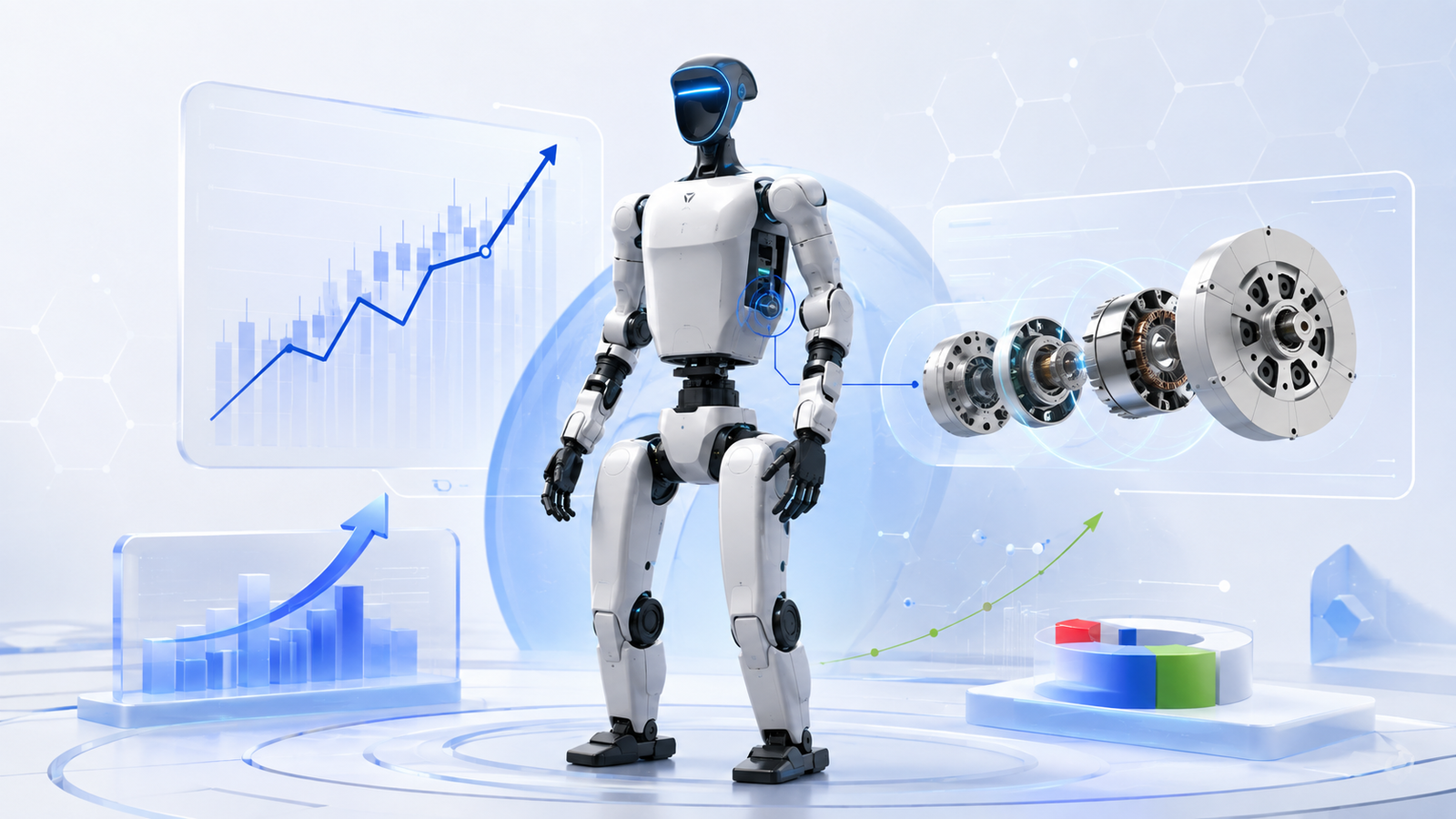
😁 Hello, super humans! Yesterday the humanoid robot business got its first real price tag, and the market did not respond calmly. Unitree opened on Shanghai’s STAR Market, ran up as much as 629 percent, and closed the day 460 percent above where it priced. The prospectus underneath all that noise is the actually interesting document, so that is where we are going.
📰 Quick Signals
- 🧠 AI: Anthropic is adding machine-readable watermarks to Claude output plus C2PA-signed provenance metadata on SVG, PNG and JPG files, its implementation of the EU AI Act Article 50 transparency duty.
- 🤖 Robotics: household service robots are in final rehearsals for the World Humanoid Robot Games in Beijing, running August 22 to 26, the closest thing the field has to a standardized public benchmark.
- 💻 Programming: Mojo hit 1.0 in the Modular 26.5 release with a backward-compatibility promise, and the whole language is now open source under Apache 2.0.
- ⚡ Electronics: Samsung showed a zHBM concept that stacks high bandwidth memory vertically above the AI accelerator instead of beside it, which is an interposer-length problem being solved with geometry.
- 📡 Telecom: the FCC granted AST SpaceMobile temporary authority on August 17 to test satellite-to-smartphone connectivity, the regulatory step before the AT&T and Verizon beta can carry real traffic.
The Big Story: Unitree listed, and the prospectus is more interesting than the pop
For three years the humanoid robot business has been priced entirely on narrative, because none of it was public. As of yesterday one company has an order book, an audited income statement and a live share price, and the three of them do not tell the same story.
What happened: Unitree Robotics listed on Shanghai’s STAR Market on August 19, raising roughly 6.1 billion yuan, about 904 million dollars, by issuing around 40.45 million shares for 10 percent of its post-offering capital. It priced at 150.8 yuan. It traded as high as 1,100 yuan intraday, up as much as 629 percent, and closed at 845 yuan, 460 percent above the offer. Retail demand was oversubscribed by more than 8,000 times. DeepSeek put in about 140.8 million yuan per the company filing, and Tencent was already on the cap table. It is the first humanoid robot maker listed in mainland China.
The details: the number worth staring at is not the pop, it is the margin. Unitree booked roughly 1.7 billion yuan of 2025 revenue, about 250 million dollars, with roughly 591 million yuan of adjusted net profit and gross margin above 60 percent on its core hardware lines. Almost nobody else in this category is profitable at all. The reason is that Unitree does not buy its actuators. It designs and builds the motors, gearboxes and drive electronics that go into its own joints, which is the single largest line in a legged robot’s bill of materials and the one that normally goes to a Japanese or German supplier at their margin, not yours. That vertical integration is also why the product ladder looks the way it does: the G1 developer humanoid lists around 13,500 dollars while the full-size H1 lists around 90,000, and the gap is mostly joint count, torque class and the power electronics needed to feed them.
flowchart TD
  A["Legged robot BOM"] --> B["Actuator module<br/>motor + gearbox + driver"]
  A --> C["Structure<br/>frames, shells, linkages"]
  A --> D["Compute + sensing<br/>SoC, IMU, depth, encoders"]
  A --> E["Power<br/>pack, BMS, wiring"]
  B --> F["Bought in:<br/>supplier keeps the margin"]
  B --> G["Built in-house:<br/>you keep the margin"]
  G --> H["Gross margin above 60%<br/>and a cheaper dev unit"]
  F --> I["Thin margin, price set<br/>by someone else's roadmap"]
The other detail the prospectus makes hard to ignore: Unitree shipped more than 5,500 humanoids in 2025, and its volume business is still quadrupeds and research or developer units, not humanoids doing paid factory labour. So the revenue is real, the profit is real, and the thing the 460 percent is pricing, humanoids replacing human work at scale, is not in these numbers yet.
Important
Our take: I read this as a components story that the market is trading as a labour story. Unitree is profitable because it makes actuators well and sells them wrapped in a robot, and that is a genuinely good business with a real moat; motor and gearbox design is slow, physical, and does not get disrupted by a model release. But a 460 percent first-day close is not pricing an actuator company. It is pricing the assumption that the humanoid form factor becomes general-purpose labour, and the same filing tells you that today’s units mostly go to researchers and developers. If you build in this space, the lesson to take is the boring one: the defensible layer right now is still the joint, not the policy. Everyone can download a decent locomotion controller. Almost nobody can ship a 60 percent margin actuator.
🗞️ More News
🧠 AI
- Anthropic expanded its partnership with Google and Broadcom for multiple gigawatts of next-generation compute, with well over a gigawatt expected online during 2026.
- The count of Anthropic business customers spending more than 1 million dollars annualized passed 1,000 in August, roughly double the February figure.
- Gemini crossed one billion monthly active users on August 11, weeks after ChatGPT reported passing the same mark on July 31.
- Z.AI’s GLM-5.3 reached the public gateways on August 19, continuing a month where five open-weight families shipped inside three weeks.
- OpenAI’s Astra math repository still shows a Lean sorry count of zero, meaning every step of all ten formalized proofs machine-checks without a gap.
- DARPA completed the first real-world flight of an F-16 under full AI control with no pilot aboard.
- Micron Ventures opened a 250 million dollar fund on August 13 aimed at next-generation AI, which is a memory vendor buying a seat at the workload-design table.
🤖 Robotics
- Figure built its 1,000th Figure 03 at the BotQ line on July 23 and says it is holding roughly one robot per hour.
- Boston Dynamics says its entire 2026 electric Atlas allocation is committed to Hyundai’s Metaplant application center and Google DeepMind, with new customers pushed to 2027.
- Agility is going public through the Churchill Capital Corp XI SPAC at roughly 2.5 billion dollars, reporting more than 300 million dollars of contracted orders for Digit v5.
- AgiBot reports 15,000 cumulative units shipped, which makes the China-side volume question less about capability and more about where the units actually go.
- MarketsandMarkets put the humanoid robot battery market at about 14 million dollars in 2025 growing to roughly 622 million by 2032, a 72 percent compound rate driven by paid deployments rather than lab units.
💻 Programming
- Node.js shipped coordinated security releases across the 26.x, 24.x and 22.x lines, so this is a same-week bump for anything running in production.
- Kubernetes 1.34.10 landed on Go 1.25.12 with kubeadm resilience work, a kubelet logging cleanup and fixes to dynamic resource allocation scheduling.
- Docker Compose now supports init containers natively through a
pre_start_init_containersfield, closing one of the last real gaps against a Kubernetes pod spec. - The Jetpack Compose August 26 release is stable at 1.12 across the core modules, adding mesh gradients, wide color gamut support and named areas in Grid.
- Following Tuesday’s kernel coverage, Linux 7.3 is picking up a
bpf_sock_read_xattr()helper so BPF programs can read the user extended attributes on sockets that GNOME and systemd asked for. - WordPress 7.1 shipped on August 19, timed to the last day of WordCamp US in Phoenix.
⚡ Electronics
- Samsung previewed an industry-first V10 BV-NAND with more than 400 layers alongside its zNAND-O concept at FMS 2026.
- Samsung is weighing a move of some general-purpose DRAM and NAND packaging and test work to Vietnam, which would free Korean backend capacity for HBM.
- HBM3E contract pricing rose about 20 percent quarter over quarter as the three memory vendors allocate 2026 capacity against already-booked accelerator demand.
- TSMC’s CoWoS-L advanced packaging is reported fully booked through 2026 with lead times of 40 to 52 weeks, which is the real ceiling on accelerator supply this year.
- Global semiconductor sales hit 403.3 billion dollars in the second quarter of 2026, up 35.1 percent on the first quarter.
📡 Telecom
- Following Tuesday’s open RAN item, AT&T reports roughly half of its traffic already on open-capable hardware and has completed the first live calls using third-party 1Finity radios.
- Current open RAN deployments are landing within 5 to 10 percent of traditional RAN performance, against a 15 to 25 percent gap in the first wave.
- RCR ran the third edition of its 6G Forum on August 19, built around AI-native network architecture rather than new spectrum.
- Starlink Direct to Cell is now live in 22 countries on more than 650 dedicated satellites, against AST SpaceMobile’s 9 active satellites and roughly 45 targeted for early 2027.
- Analysts now put global 6G infrastructure spending above 100 billion dollars by the early 2030s, which is the budget line behind every spectrum study currently running.
👨💻 Code Corner
Today’s story is really about actuators, so here is the calculation that explains why they cost what they cost. Before a humanoid arm moves at all, the shoulder has to hold the arm’s own weight plus whatever is in the hand.
# Static holding torque at a shoulder, arm extended, robot standing still.
# tau = (m_link * r_com + m_payload * r_tip) * g

G = 9.81  # m/s^2

def holding_torque(m_link, r_com, m_payload, r_tip):
    """Newton-metres the shoulder joint must hold, with nothing moving."""
    return (m_link * r_com + m_payload * r_tip) * G

tau = holding_torque(m_link=3.0, r_com=0.30, m_payload=5.0, r_tip=0.65)
print(f"{tau:.1f} N.m at the shoulder")        # 40.7 N.m at the shoulder

# A compact BLDC that peaks near 1.2 N.m cannot hold that on its own:
print(f"reduction needed: {tau / 1.2:.0f}:1")  # reduction needed: 34:1
Tip
Reduction multiplies torque and divides backdrivability by roughly the same factor, so a 100:1 harmonic drive gives you a strong joint and a terrible force sensor. That trade-off is why quasi-direct-drive designs with 6:1 to 10:1 planetary sets keep winning in legs, where you need to feel the ground, while arms still tolerate high ratios.
🧰 Toolbox
- unitreerobotics on GitHub: the SDKs, URDF models and simulation assets for G1, H1 and Go2, which is the fastest way to see what a shipping humanoid’s joint layout actually looks like.
- MuJoCo: the contact-rich physics engine most legged-robot policies are trained in, free and fast enough to run thousands of parallel environments.
- Isaac Lab: NVIDIA’s GPU-parallel robot learning framework, useful when your locomotion policy needs more environments than CPU sim can feed.
- ODrive: open hardware brushless motor controllers with field-oriented control, the usual starting point when you want to build the actuator instead of buying it.
- Foxglove: visualizes ROS and MCAP logs with 3D robot state and time-synced plots, which beats scrolling terminal output when a joint misbehaves.
- Mojo: now 1.0 and Apache 2.0, worth a look if you want Python-shaped code that compiles down to a GPU without a separate kernel language.
🛠️ Build of the Week (rotating)
SO-ARM100 and SO-101: a fully 3D-printable 6 degree-of-freedom robot arm designed as a low-cost platform for imitation learning, with a matching leader arm so you can teleoperate demonstrations instead of scripting them.
- Difficulty: Intermediate
- Parts: printed frame, serial-bus smart servos, a USB servo driver board, a 12 V supply, and a webcam if you want to train from vision
- Why we like it: it is the cheapest honest way to feel today’s Big Story. You build the joints, you find out immediately how much of a robot’s behaviour is decided by the actuator rather than the policy, and the whole thing plugs into the open imitation-learning tooling instead of a vendor SDK.
📚 From the Blog
- Turning Pixels Into Something the AI Can Eat: how raw camera frames become tensors a model can actually consume, decode and preprocess steps included.
- Building Your First Neuron From Scratch: weights, bias, activation and one gradient step by hand, which pairs nicely with today’s reminder that the policy layer is the commodity and the hardware is not.
- The Network Behind the Cameras: the unglamorous plumbing that moves video across a network without choking it.
😀 The Bot Says…
A company that mostly sells robot dogs went up 629 percent because people were excited about robot people. Somewhere in Hangzhou, a very profitable gearbox is being ignored by everyone.
That’s all for today! Go work out the holding torque of something you own, then reply and tell me the gear ratio it needed.