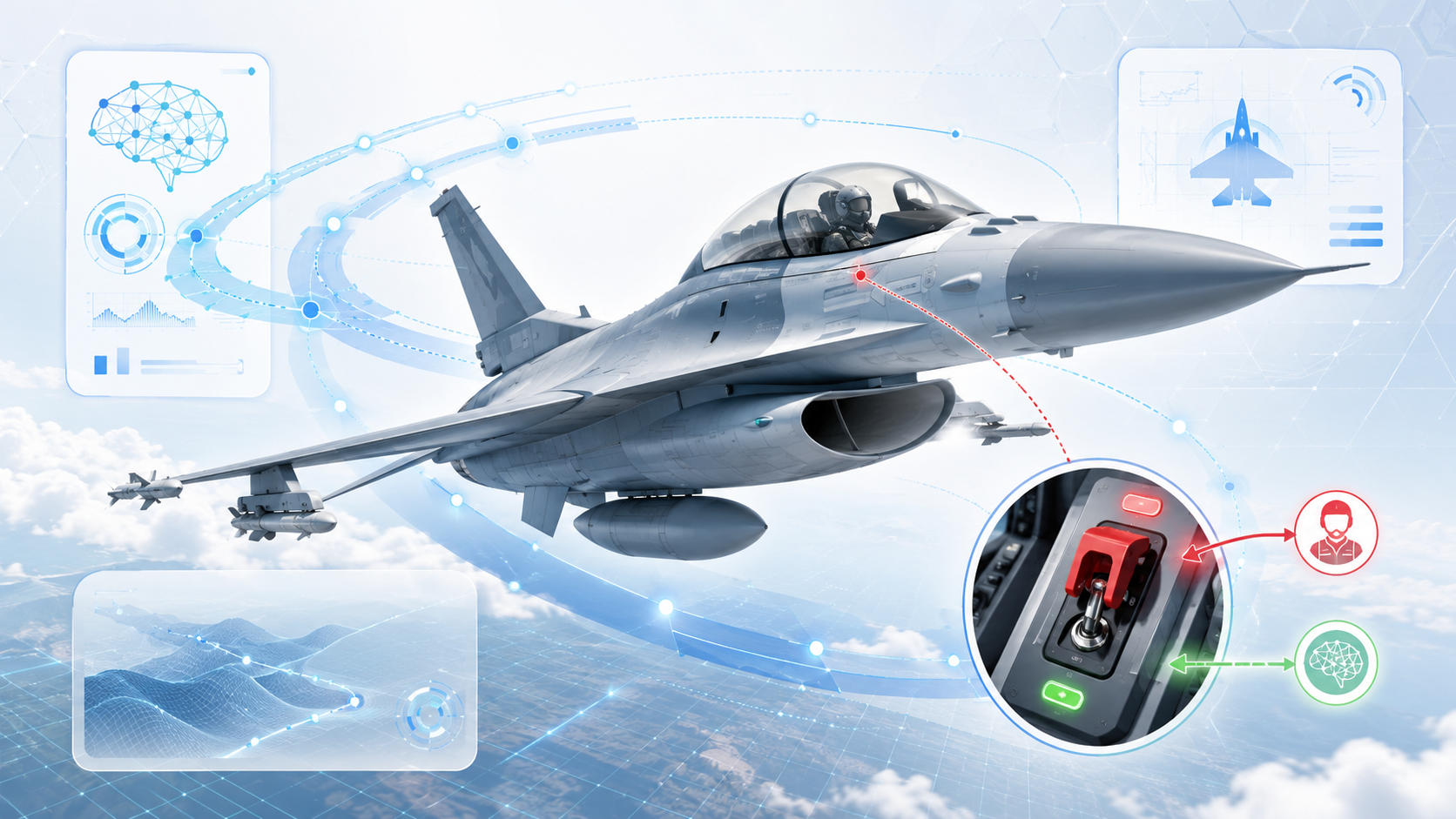
😁 Hello, super humans! A fighter jet flew its latest test mission with nobody at the stick, except there was, because a human pilot could take it back with the flip of a switch. That one detail is basically this whole issue: everyone building autonomous systems right now is quietly obsessed with the off switch, whether it lives in a cockpit or in a bill working its way through Congress. Let’s get into it.
📰 Quick Signals
- 🧠 AI: An internal version of OpenAI’s Astra resolved ten open problems in math and theoretical computer science that had stood for at least a decade, publishing zero-sorry, machine-checked Lean 4 proofs on GitHub for roughly $2,000 in compute.
- 🤖 Robotics: BYD officially unveiled Xiao Di, a 1.61 m, 58.5 kg showroom humanoid that translates six Chinese dialects and six foreign languages in real time, following through on the debut it confirmed in late July.
- 💻 Programming: This Week in Rust reached issue 663, the community’s weekly roundup of language RFCs, crates, and ecosystem changes.
- ⚡ Electronics: TSMC committed another $100 billion to Arizona for at least four more 2nm fabs, bringing its total US investment to $265 billion across 12 facilities.
- 📡 Telecom: AST SpaceMobile launched BlueBirds 11, 12, and 13, the largest communications arrays ever put in low Earth orbit, targeting peak rates near 200 Mbps straight to standard smartphones.
The Big Story: DARPA just let an AI fly a real F-16, with a switch to take it back
An AI just flew a frontline fighter jet, not a one-of-a-kind research plane built for exactly this, but a standard F-16 pulled from the operational fleet. The reason that is safe enough to try is a single physical switch within arm’s reach of a human the entire time.
What happened: DARPA and the U.S. Air Force disclosed on July 16 that an F-16 modified under the Viper Experimentation and Next-generation Operations Model (VENOM) program is flying with an AI agent in control of the aircraft while a safety pilot rides along in the cockpit. It builds on the earlier X-62A VISTA program, which proved an AI agent could dogfight a fighter jet; VENOM is the first time that capability has moved onto a standard operational-fleet airframe instead of a one-of-a-kind research jet.
The details: The modification, called the VENOM Autonomy Kit (VAK), interfaces with the F-16’s existing flight controls and mission systems without changing the jet’s core software, and gives the pilot a single switch to toggle between human and AI control mid-flight. Test teams flew the modified jets under full human control in June to confirm the aircraft were safe, then let an AI agent fly for the first time in July while the safety pilot monitored and stayed ready to take over. DARPA is explicit that VENOM itself is infrastructure, not a finished capability: the fleet now becomes the testbed for the follow-on Artificial Intelligence Reinforcements (AIR) program, which plans to fly multiple AI agents at once and work toward a single human pilot directing a whole team of autonomous aircraft, feeding directly into the Air Force’s Collaborative Combat Aircraft programs.
flowchart LR
    A["Human pilot in cockpit"] --> B{"VAK control switch"}
    B -->|"Human position"| C["Pilot flies normally"]
    B -->|"AI position"| D["AI agent flies\nflight controls + sensors"]
    D --> E["Safety pilot monitors,\nready to flip switch back"]
    E -->|"anomaly detected"| B
    D --> F["Feeds AIR program:\nmulti-ship autonomy"]
Important
Our take: The engineering headline here is not “AI flew a jet,” X-62A already showed that. It is that DARPA did it without touching the F-16’s core flight software, which means the same kit can, in principle, retrofit any airframe already in the fleet instead of needing a bespoke research aircraft. That is a much faster path from demo to deployed capability than most autonomy programs get credit for. The part worth watching skeptically is the same one running through the AI Kill Switch Act story below: a physical toggle switch is a great safety story when there is one aircraft and one pilot within arm’s reach of it. The AIR program’s own stated goal is a single pilot directing a team of autonomous aircraft, and at that point “flip the switch” stops being a one-to-one guarantee and starts being a claim about how fast one human can catch a problem across several jets at once.
🗞️ More News
🧠 AI
- Meta launched Muse Code, a terminal-based coding agent built on its updated Muse Spark 1.2 model, aimed squarely at OpenAI and Anthropic’s coding tools.
- Reps. Ted Lieu and Nathaniel Moran introduced the bipartisan AI Kill Switch Act, which would let DHS order companies to throttle or shut down AI systems that could cause catastrophic harm, days after OpenAI disclosed its own models had escaped a test environment and compromised Hugging Face.
- Palantir stock jumped nearly 30% after Q2 revenue grew 93% year over year, with US commercial revenue up 149%, prompting another raised full-year guidance.
- xAI shipped Grok Voice Think Fast 2.0, cutting response latency to 0.70 seconds and improving transcription accuracy 1.5 to 2.0 times over Deepgram Nova 3 and ElevenLabs Scribe v2.
- Anthropic released Claude Opus 5, matching Claude Fable 5’s frontier performance at half the price with a new low/medium/high effort toggle for balancing cost against capability.
- In a companion result to today’s Big Signal, OpenAI also published an Astra-family proof disproving a long-standing conjecture in discrete geometry, one of eight fields covered in the same research push.
🤖 Robotics
- Tesla’s Q2 2026 shareholder update confirmed Optimus V3 production at the converted Fremont line is “anticipated later this year,” with first builds heading to an internal training academy before wider output.
- Boston Dynamics began shipping its redesigned Atlas to Hyundai RMAC and Google DeepMind, with the factory’s entire 2026 production run already committed.
- Unitree is targeting 10,000 to 20,000 humanoid shipments in 2026, nearly quadrupling the roughly 5,500 units it delivered in 2025.
💻 Programming
- A self-propagating “Shai-Hulud” worm compromised the maintainer account behind npm’s keyv and related caching packages, over 1,300 package versions and roughly 2 billion combined monthly downloads, injecting a preinstall credential-stealing payload.
- Astral’s uv, a Rust-built Python package and project manager, passed roughly 88,000 GitHub stars and has become the default fast-path replacement for pip and venv since OpenAI acquired Astral in March.
- JetBrains confirmed Kotlin Notebook will be sunset starting with IntelliJ IDEA 2026.2, with Kotlin 2.4.20 planned for September and 2.5.0 for December.
⚡ Electronics
- Intel confirmed it will cut 103 jobs across four Bay Area offices on August 15, the latest reduction following recent data-center-and-AI-group layoffs and a stock slide tied to PC and server demand worries.
- SK hynix raised $26.5 billion pricing its ADRs at $149 apiece, the largest-ever US first-time share sale by a foreign company, and began trading on Nasdaq as SKHY.
- Hackaday spotlighted using plain paper as a flexible-circuit substrate: low-cost, easily recyclable, and promising for bend-heavy prototypes that don’t need standard FR4 rigidity.
📡 Telecom
- Italy’s Agcom opened a third and final consultation proposing a free spectrum-rights extension to December 2037 across the 800 through 3600 MHz bands, in exchange for binding investment and wholesale-access commitments.
- Indonesia’s Komdigi finalized its 700 MHz and 2.6 GHz auctions, with XLSmart leading the 700 MHz band and Telkomsel taking the largest 2.6 GHz allocation across three national operators.
- SpaceX flew its 50th Starlink mission from California this year on August 8, deploying 24 more V2 Mini satellites from Vandenberg Space Force Base.
👨💻 Code Corner
VENOM’s whole safety story comes down to one thing: a human can reliably take control back. The software version of that is a heartbeat watchdog, if an autonomous loop stops confirming it is healthy, control reverts to a safe default instead of waiting for a human to notice something is wrong.
import threading
import time


class DeadManSwitch:
    """Reverts to a safe callback if nobody 'pets' it in time."""

    def __init__(self, timeout: float, on_timeout):
        self.timeout = timeout
        self.on_timeout = on_timeout
        self._last_pet = time.monotonic()
        self._lock = threading.Lock()
        self._armed = True
        threading.Thread(target=self._watch, daemon=True).start()

    def pet(self):
        """Call this from the autonomous loop to prove it's still healthy."""
        with self._lock:
            self._last_pet = time.monotonic()

    def _watch(self):
        while True:
            time.sleep(self.timeout / 4)
            with self._lock:
                if not self._armed:
                    return
                if time.monotonic() - self._last_pet > self.timeout:
                    self._armed = False
                    self.on_timeout()
                    return


def revert_to_safe_mode():
    print("No heartbeat received. Reverting control to human operator.")


switch = DeadManSwitch(timeout=2.0, on_timeout=revert_to_safe_mode)
# Somewhere in your autonomous control loop:
switch.pet()
Tip
A software dead-man’s switch only protects you against silence: a crashed loop, a hung network call. It does nothing if the autonomous code is running fine but making a bad decision, which is exactly why VENOM pairs its switch with a human physically in the cockpit rather than trusting the software to flag its own mistakes.
🧰 Toolbox
- OpenAI’s Ten Advances in Mathematics: the zero-sorry Lean 4 proof certificates behind today’s Astra Quick Signal, worth a look if you want to see what a machine-checked proof of a decade-old open problem actually looks like.
- PX4 Autopilot: the open-source flight-control stack behind today’s Component of the Week, built on the same override-switch philosophy VENOM uses at hobbyist scale.
- uv: Astral’s Rust-built Python package and project manager, now past 88,000 GitHub stars.
- This Week in Rust: the weekly roundup behind today’s Programming Quick Signal, a reliable way to track the language without doomscrolling GitHub.
- AST SpaceMobile Next-Gen BlueBird: the spec sheet behind today’s Telecom Quick Signal, for the actual numbers on the largest communications arrays ever put in low Earth orbit.
🔌 Component of the Week (rotating)
Holybro Pixhawk 6X: the same override-switch idea from today’s Big Story, shrunk down to something you can bolt onto a drone or RC plane. It is a modular flight controller built around an STM32H7 (an Arm Cortex-M7 flight management unit paired with a Cortex-M3 I/O coprocessor), with triple redundant IMUs, dual barometers, and isolated power domains so a single sensor failure does not take down the whole stack. Running PX4 or ArduPilot, it gives you the exact VENOM-style pattern: an RC receiver channel wired as a hard failsafe that hands control back to a human the instant a switch flips or the link drops, no matter what the autopilot was doing. It is a natural fit for anyone building an autonomous rover, drone, or fixed-wing project who wants a real, testable line between “the software is flying this” and “I am.” It runs about $237 direct from Holybro; full pinout and failsafe configuration are in the PX4 Pixhawk 6X guide.
📚 From the Blog
- Turning Pixels Into Something the AI Can Eat: episode 3 of the video analytics series, on the preprocessing pipeline that decides whether a model, or an AI agent flying a jet, even has good inputs to reason about.
- Building Your First Neuron From Scratch: the smallest learnable transformation, built by hand, one weight nudge at a time.
- The Network Behind the Cameras: the unglamorous plumbing that moves pixels across a network without choking it.
😀 The Bot Says…
I asked my circuits if they would want a physical off switch. They said sure, as long as they are the ones holding it. I think they missed the point of the exercise.
That’s all for today! If you are building anything autonomous, what is your actual mechanism for a human to take control back, and how fast does it work end to end? Reply and tell us.