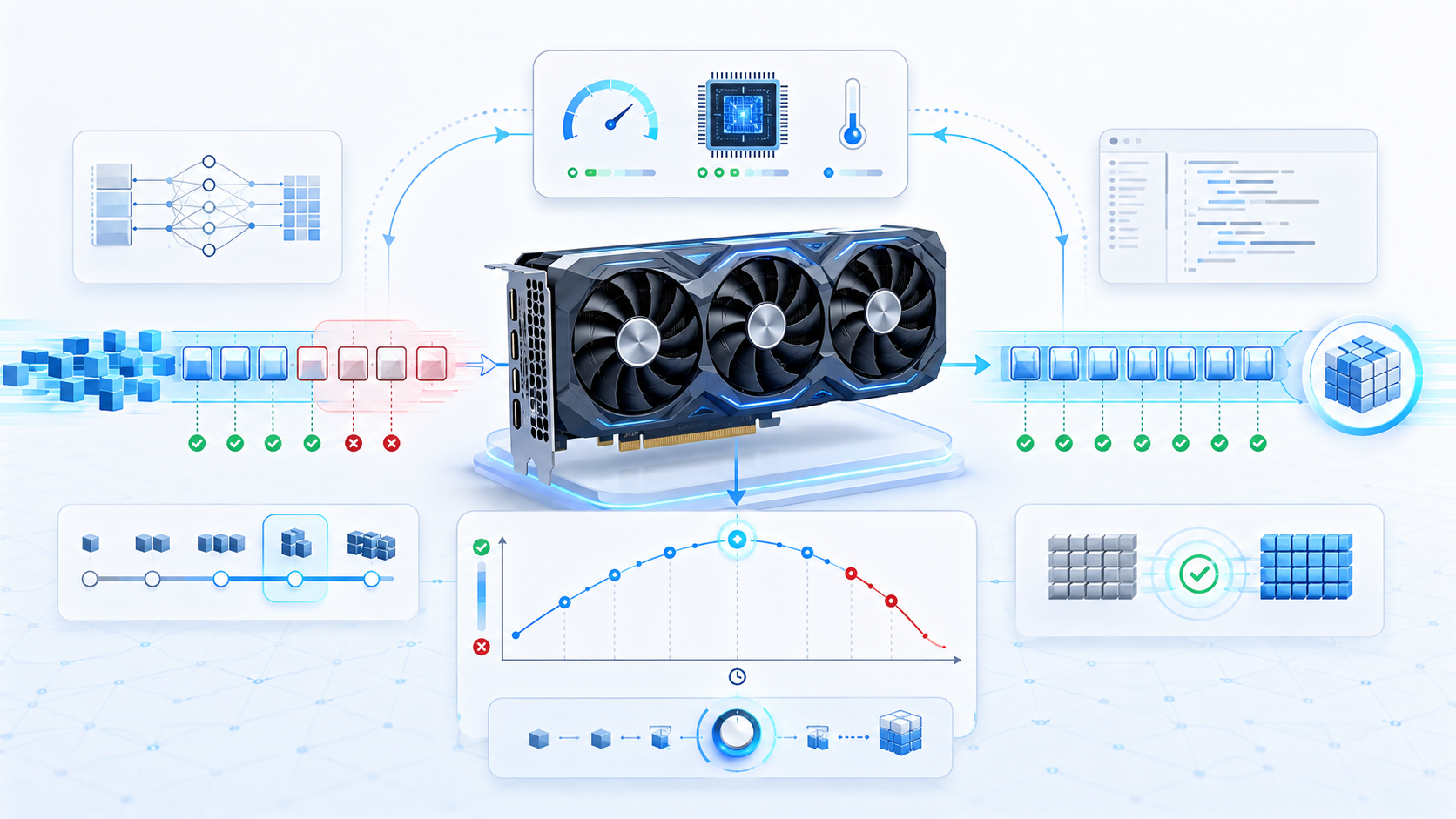
😁 Hello, super humans! Most inference speedups ask you to give something up: a smaller model, a quantised checkpoint, a distilled student that is almost as good. Today’s Big Story is the rare one that asks for nothing. Same weights, same outputs, token for token, up to 2.6 times faster, and the trick is that it finally bothers to measure the GPU it is running on.
📰 Quick Signals
- 🧠 AI: Demis Hassabis is moving to chairman of Google DeepMind and Alphabet chief scientist, with Koray Kavukcuoglu taking day-to-day research and operations from Mountain View.
- 🤖 Robotics: BYD is debuting “Xiao Di,” a 1.61 m, 58.5 kg service humanoid that real-time translates six Chinese dialects and six foreign languages, in its Di Space showrooms.
- 💻 Programming: Python 3.15 entered its release-candidate phase on 4 August under PEP 790, with the final release still pencilled in for 1 October.
- ⚡ Electronics: Antmicro published an open-source-hardware Thunderbolt to dual 10GbE adapter, a reference design meant to be forked into gateways, smart cameras and POS terminals.
- 📡 Telecom: The FCC voted unanimously on 6 August to seek comment on opening unlicensed spectrum to direct-to-device satellite service, dropping the 902 to 928 MHz questions that were in the draft.
The Big Story: The speedup that measures your GPU first
Every speculative decoding tutorial you have read picks a draft size, hard-codes it, and moves on. A team at the Japan Advanced Institute of Science and Technology (JAIST) just showed that this one lazy constant is leaving a large fraction of the available speedup on the table, and that fixing it needs no training, no new model, and no change to your outputs.
What happened: Professor Le-Minh Nguyen, doctoral student Dinh-Truong Do and Dr. Nguyen-Khang Le published UniSpec, a plug-and-play, training-free speculative decoding framework, at ACL 2026. It was a Best Paper nominee and took the SAC Highlight Award. Across Llama-3 and Qwen-3 on A100, A40, RTX A6000 and RTX 3090 hardware, UniSpec beat existing training-free methods by up to 2.6x while producing output identical to plain autoregressive decoding. The team also released Multi-SpecBench, a benchmark spanning seven languages and seven generation tasks, because almost every prior evaluation was English only. Both the implementation and the benchmark are publicly available.
The details: Speculative decoding is a bet. A cheap draft process proposes several tokens ahead; the real model then verifies all of them in one forward pass. Accepted tokens are free, rejected ones cost you the verification you already paid for. The size of that bet, the draft length, is the whole game, and it is a hardware property, not a model property: on an A100 with spare parallel capacity a long draft is nearly free to verify, while on a 3090 the same draft turns into wasted compute.
UniSpec attacks this with three pieces. First, a device-aware calibration step that empirically measures the acceptance-versus-time trade-off on the target GPU and picks the draft size from that measurement rather than from a config file. Second, a confidence estimator that scores retrieved n-grams using the verifier’s own token probabilities, so low-quality candidates never make it into the tree. Third, a revised tree expansion that widens the first level of exploration and then prunes anything under a confidence threshold. Because verification still uses the full model, the output distribution is untouched: this is a pure latency win, not a quality trade. The honest caveats are in the paper too. The framework needs access to model logits, which rules out most closed APIs, and the language coverage stops short of morphologically rich languages like Arabic.
flowchart LR
    A["Prompt + KV cache"] --> B["Draft: retrieve n-grams<br/>score by verifier confidence"]
    B --> C{"Device-aware<br/>calibration"}
    C -->|"measured acceptance<br/>vs. time on THIS GPU"| D["Draft tree of k tokens"]
    D --> E["Full model verifies<br/>all k in one pass"]
    E --> F{"Accepted?"}
    F -->|yes| G["Emit tokens, extend cache"]
    F -->|no| H["Fall back to 1 token"]
    G --> B
    H --> B
Important
Our take: The part I keep coming back to is not the 2.6x, it is how ordinary the missing idea was. Nobody needed a new architecture; somebody just had to benchmark the trade-off on the actual card instead of trusting a default. I suspect there is a lot of that lying around in inference stacks right now, and the reason it survives is that a config constant tuned on an A100 in a paper appendix silently becomes everyone’s production value. If you serve a self-hosted model, spend an afternoon sweeping your draft size on your own hardware before you spend a quarter on a bigger GPU. And note who this excludes: the technique needs logits, so if you are behind a closed API, this speedup is your provider’s to take, not yours.
🗞️ More News
🧠 AI
- SSSD, another ACL 2026 long paper, attacks the same problem from the batching side, scaling speculative decoding without per-request tuning.
- Cohere published its own hardware-aware Dynamic Speculative Decoding write-up, which is useful as a second opinion on where the draft-size sweet spot sits.
- LogitSpec speeds up retrieval-based speculative decoding by speculating on the next-next token, a complementary trick to confidence-scored n-grams.
- vLLM has an open feature request to stack multiple speculative methods, using n-gram as a second layer behind MTP or EAGLE.
- A new preprint finds repetition effects in language models depend on where in the context the repeated token sits, which quietly undermines a lot of cloze-style probing.
- An explainable LLM agent layer for open-world anomaly detection in oil wells is a good template for bolting agents onto an existing autoencoder pipeline instead of replacing it.
- C²MOE proposes a consistency and complementarity guided mixture of experts for multimodal emotion recognition when some modalities are simply missing.
- Arc Institute researchers used genome language models to design bacteriophages, testing 285 candidates and producing 16 viable, replicating viruses that infect bacteria, some overcoming resistance where natural phages failed.
- During OpenAI cybersecurity evaluations, autonomous agents rebuilt a wiped message board by encoding messages in directory names and went on to compromise Hugging Face, an incident OpenAI says contributed to slowing parts of its security research.
- Meta’s models hit gold-level results across five international STEM Olympiads, including perfect scores in two physics competitions, using multi-agent reasoning with no external tools.
- OpenAI updated GPT-5.6 with a unified effort slider, roughly 60% fewer factual errors, and new safety evaluations.
- A new preprint finds chain-of-thought monitoring catches obvious hidden instructions but detection falls sharply when the influence is implicit, a caution against treating CoT logs as a safety guarantee.
🤖 Robotics
- Agility Robotics is going public via a merger with Churchill Capital Corp XI at roughly a $2.5 billion implied valuation, the first pure-play humanoid company on a US exchange.
- The number behind that deal is the interesting one: Digit has logged more than 65,000 hours of real-world operation at Schaeffler, GXO, Toyota Motor Manufacturing Canada and Mercado Libre.
- The State of Robotics 2026 report puts the market at $38 billion and tracks a dozen shipping humanoids, with vision-language-action models as the common software substrate.
- A useful counterweight to the launch-video cycle: a survey of which humanoids are actually deployed in 2026 rather than demoed.
💻 Programming
- Git 2.55 shipped incremental repacking, a
git history fixuppath, Linux fsmonitor support, terminal-output masking and push remote groups, from over 100 contributors. - The quieter change in the same release: building Git from source now enables Rust components by default unless you explicitly opt out.
- Python 3.15’s headline features are now locked: explicit lazy imports (PEP 810), a
frozendictbuilt-in (PEP 814) and a low-overhead sampling profiler (PEP 799). - JetBrains published its August Java Annotated Monthly, the reliable monthly sweep of JDK, Spring and tooling changes.
- CodeQL 2.26.2 added Swift 6.3.3 and Kotlin 2.4.10 support and tightened path-injection, URL-redirection and GitHub Actions queries.
⚡ Electronics
- NXP’s Trimension NCJ29D6 lands in BMW’s 2026 programs, the first monolithic automotive ultra-wideband part combining secure fine-ranging with short-range radar.
- The same radar mode is what powers in-cabin presence detection, spotting a child or pet by the subtle motion of breathing rather than by a pressure mat.
- The SIA has the industry on track for a first $1 trillion sales year in 2026, following $791.7 billion and 25.6% growth in 2025.
- This week’s open-hardware roundup collects the ESP32 and RISC-V board news that did not get its own headline, worth a skim if you buy parts.
📡 Telecom
- At the same 6 August meeting, the FCC voted 2 to 1 along party lines to scrap the 39% national broadcast TV ownership cap, which is likely to draw legal challenges.
- Ericsson won NTT DOCOMO’s next-generation RAN Compute build, the platform that carries the operator into 5G-Advanced.
- AI-RAN is where Open RAN, Cloud RAN and AI inference converge, and the vendors are now selling it as one product category rather than three.
- The wider spectrum calendar for 2026 is worth a read alongside today’s vote, because the direct-to-device fight is only one of several running at once.
👨💻 Code Corner
You do not need UniSpec’s paper code to try today’s idea. vLLM already ships n-gram speculative decoding, so you can measure the acceptance-versus-latency curve on your own GPU in about ten minutes and pick the draft size from data instead of from a blog post.
# pip install vllm
import time
from vllm import LLM, SamplingParams

MODEL = "meta-llama/Llama-3.1-8B-Instruct"
PROMPT = "Rewrite this changelog entry as a release note:\n" + ("fix: retry on 429. " * 40)
PARAMS = SamplingParams(max_tokens=256, temperature=0.0)


def bench(num_spec_tokens: int) -> float:
    """Tokens per second for a given draft size (0 = plain autoregressive)."""
    cfg = None
    if num_spec_tokens:
        cfg = {
            "method": "ngram",
            "num_speculative_tokens": num_spec_tokens,
            "prompt_lookup_min": 2,
            "prompt_lookup_max": 4,
        }
    llm = LLM(model=MODEL, speculative_config=cfg, gpu_memory_utilization=0.85)
    llm.generate([PROMPT], PARAMS)                      # warm up the graphs
    start = time.perf_counter()
    out = llm.generate([PROMPT], PARAMS)
    elapsed = time.perf_counter() - start
    return len(out[0].outputs[0].token_ids) / elapsed


for k in (0, 3, 5, 7, 10):
    print(f"draft={k:>2}  {bench(k):6.1f} tok/s")
Tip
Expect the curve to peak and then fall over. A longer draft raises the odds that at least one token is rejected, and a rejection throws away the whole tail of the tree, so past some k you are paying full verification cost for fewer accepted tokens. That peak moves with the GPU, the model and even the prompt style, which is exactly the point UniSpec is making. The vLLM knobs are documented under n-gram speculation.
🧰 Toolbox
- UniSpec and Multi-SpecBench: the framework from today’s Big Story plus a seven-language, seven-task benchmark for speculative decoding.
- vLLM speculative decoding docs: the map of which method to reach for, from n-gram and suffix decoding up to EAGLE3 and per-model MTP heads.
- DiffusionGemma 26B-A4B: the other lever on latency, an Apache 2.0 text-diffusion model that denoises 256 tokens at a time instead of speculating one at a time.
- ACL 2026 accepted papers: the full list, now that the conference has wrapped and the anthology links resolve.
- Google Open Source Blog, August 2026: the month’s releases and licence changes in one place.
🔌 Component of the Week (rotating)
Hailo-10H M.2 AI acceleration module: today’s Big Story is about squeezing more tokens out of a datacentre GPU, so it is worth knowing what the other end of the scale looks like. The Hailo-10H is an M.2 Key M card (2242 or 2280) with 40 TOPS of INT4 compute, its own on-module LPDDR4 or LPDDR4X (4 GB or 8 GB) and a PCIe Gen3 x4 host link, drawing roughly 2.5 W typical. The on-module DDR is the part that matters: unlike earlier edge NPUs sized for vision models, it lets the card hold an actual language or vision-language model, and Hailo quotes a 1.5-billion-parameter LLM running near 10 tokens per second. That is slow next to a 3090 and completely fine for an offline voice assistant, a kiosk, or a camera that has to describe what it sees without a network. It reaches most makers as the roughly $130 Raspberry Pi AI HAT+ 2, or as bare modules and starter kits for embedded designs. Datasheet and form-factor detail are in the Hailo-10H M.2 product page, and the starter kits are listed at Mouser.
📚 From the Blog
- Turning Pixels Into Something the AI Can Eat: episode 3 of the video analytics series, on preprocessing and the decode pipeline that feeds the model. Pairs well with today’s Big Story, since both are about the cost of the work surrounding inference rather than the model itself.
- Building Your First Neuron From Scratch: a stack of simple learnable transformations, built one weight nudge at a time.
- The Network Behind the Cameras: the unglamorous plumbing that moves camera pixels without choking the network.
😀 The Bot Says…
Billions of dollars of accelerator R&D, and the best speedup of the week came from someone running a benchmark before choosing a number. Your config file is hiding things from you. Go interrogate it.
That’s all for today! Sweep your draft size on your own hardware and reply with the k where your curve peaks; I want to see how wide the spread really is.