😁 Hello, super humans! It is Saturday, so grab a coffee and settle in. This week the AI story quietly moved from “whose model is smartest” to “who can pour enough concrete and copper to run it,” and Meta just made the loudest move yet. Let’s dig in.
📰 Quick Signals
- 🧠 AI: Google delayed Gemini 3.5 Pro again after coding and long-horizon reasoning fell short of the flagship bar it set at I/O.
- 🤖 Robotics: China is pushing thousands of humanoids into factories and logistics hubs, treating the real world as the training set.
- 💻 Programming: TypeScript’s Go-based compiler (the 7.0 line) nears release as Node adds native type stripping, so plain
.tsruns without a build step. - ⚡ Electronics: Fresh industry snapshots show RISC-V solidifying its stronghold across shipping products and multi-year roadmaps.
- 📡 Telecom: Amazon’s Leo constellation crossed roughly 396 satellites in orbit, with a consumer beta reportedly slated for fall.
The Big Story: Meta bets a nation’s worth of power on AI
For two years the AI race was measured in benchmark points. This week it was measured in gigawatts. If you build software on top of these models, the ceiling you hit next is not intelligence, it is electricity and floor space, and Meta just told the market exactly how much of both it intends to own.
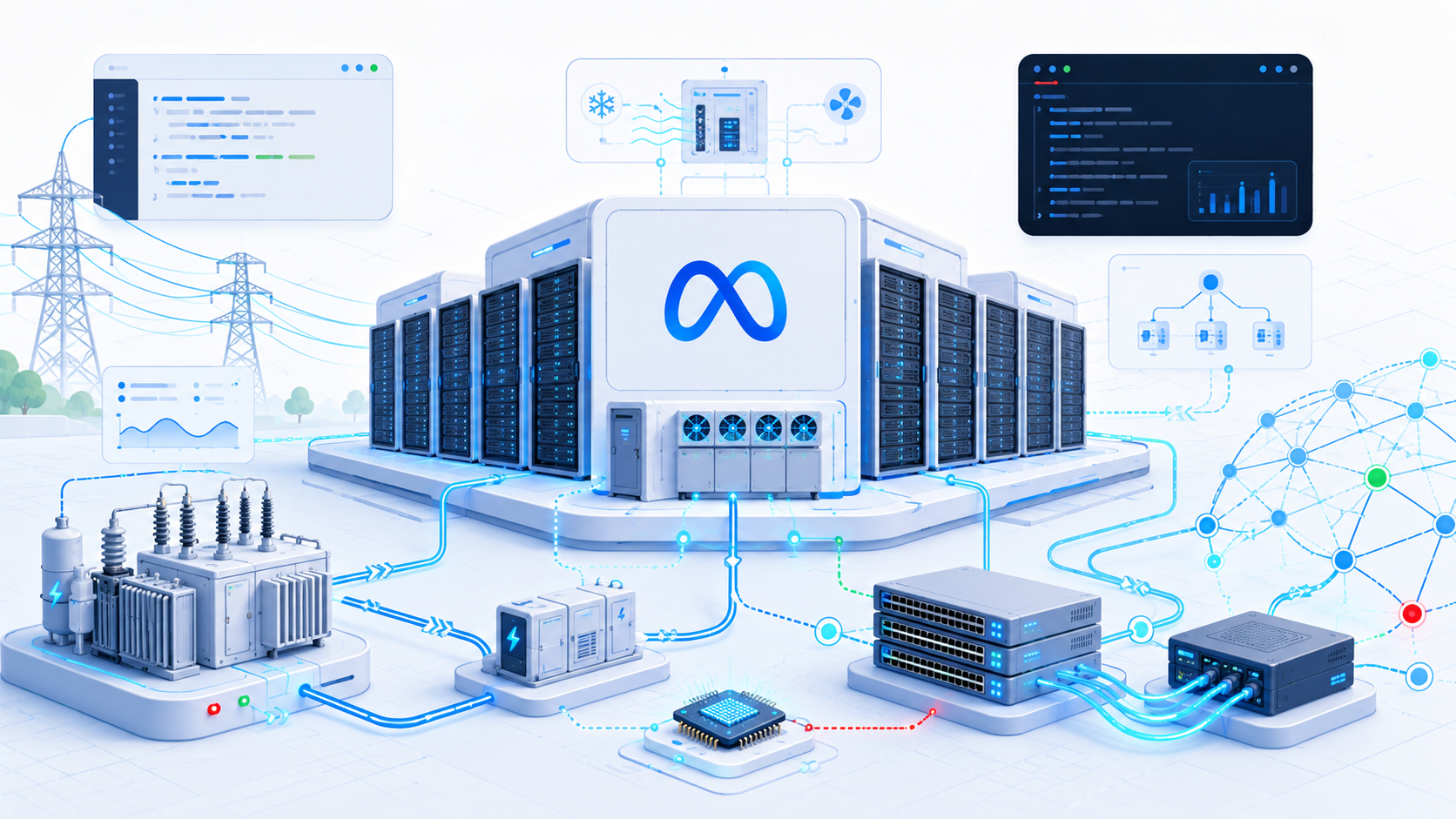
What happened: Meta hired Dave Brown, a nearly two-decade Amazon Web Services veteran who ran its compute business, to lead an infrastructure effort it is calling Meta Compute, according to GeekWire. The company has guided to roughly $125B to $145B of capital spending this year, most of it aimed at AI data centers, networking gear, and power. Meta Compute is pitched as a decade-long build of hundreds of gigawatts of capacity, and Brown’s mandate reportedly includes standing up a cloud service that rents that infrastructure to outside customers. Its flagship Louisiana campus alone is expanding from 2 GW to 5 GW at a reported cost north of $50B.
The details: A gigawatt is roughly the output of a large nuclear reactor, so “hundreds of gigawatts” is not a data center metaphor, it is a national-grid problem. Once you have the accelerators, the hard parts are getting power to them and heat away from them. Engineers track that with PUE (Power Usage Effectiveness), the ratio of total facility power to the power the compute actually uses; a PUE of 1.15 means 15 percent overhead for cooling and distribution on top of the chips. Inside the hall, tens of thousands of accelerators have to act like one machine, so the network fabric (the switches and optics stitching GPUs together) increasingly decides whether a training run is fast or stalls. Hiring the person who scaled AWS compute signals Meta wants to design that stack itself rather than rent it.
flowchart LR
  A[Accelerators<br/>GPUs / TPUs] --> B[Network fabric<br/>switches + optics]
  B --> C[Servers + racks]
  C --> D[Cooling<br/>PUE overhead]
  D --> E[Power<br/>gigawatts + grid]
  E --> F[Data center campus]
Important
Our take: The moat is quietly moving from model weights to megawatts. Weights leak, get distilled, and go open within months; a 5 GW campus with a signed grid connection does not. For builders, the read is that inference cost will track energy contracts more than algorithmic cleverness, so watch power-purchase deals and interconnect queues the way you used to watch benchmark leaderboards. And if Meta really opens Meta Compute to outsiders, the interesting question is not whether it beats AWS on price, but whether “we own the electrons” becomes a pitch that a hyperscaler reselling grid power cannot match.
🗞️ More News
🧠 AI
- Apple sued OpenAI, alleging organized trade-secret theft tied to hiring roughly 400 ex-Apple hardware staff for its device push.
- The CEOs of DeepMind, OpenAI, and Anthropic converged on the same pitch: independent pre-release testing and a U.S.-led standards body for frontier models.
- DeepMind’s Demis Hassabis published a manifesto calling for an independent watchdog that can screen the most advanced models and coordinate a slowdown if risks mount.
- Moonshot’s open-weight Kimi K3 topped Arena’s Frontend Code Arena, finishing ahead of Claude Fable 5 and GPT-5.6 Sol.
- Microsoft is reportedly readying an internal AI cybersecurity product, “Project Perception,” that blends Microsoft, OpenAI, and Anthropic models.
- Microsoft is also coaching its sales teams to pitch in-house AI against OpenAI, Anthropic, and Google on cost, integration, and enterprise security.
🤖 Robotics
- Unitree won approval for a roughly $620M STAR Market IPO in a record 104 days, at a valuation near $5.9B.
- China is deploying humanoids faster than the US, wiring factories and warehouses to harvest the interaction data that trains the next generation.
- Tesla is reportedly ramping low-volume Optimus Gen 3 production at Fremont with a late-July to August target.
- Figure keeps expanding paid Figure 03 deployments, including sequencing tasks at BMW’s Spartanburg plant.
💻 Programming
- VS Code’s June/July releases graduated agentic browser tools to general availability, so agents can navigate pages, inspect content, and validate web apps in-editor.
- Visual Studio 2026’s mid-July update added built-in “skills” authored by the .NET and Azure teams to steer agentic workflows.
- Open-source coding agents keep eating share, with OpenCode reported at millions of monthly active developers and the largest star count of the pack.
⚡ Electronics
- New snapshots show RISC-V moving from roadmap to reality across microcontrollers, edge SoCs, and vendor plans.
- The Allwinner T153 is a telling hybrid: four Arm Cortex-A7 cores at up to 1.6 GHz paired with a 600 MHz Xuantie RISC-V core on a 22 nm process.
- Jeff Geerling rounds up the Raspberry Pi 6 and microcontroller rumor mill, a useful reality check on the hobbyist silicon roadmap.
📡 Telecom
- France confirmed its France 2030 programme will fund projects that strengthen the country’s role in international 6G standardization.
- Saudi Arabia’s CST opened the third edition of its international Non-Terrestrial Networks research competition, courting academics toward satellite-integrated wireless.
- Mobile operators are angling for more direct control over satellite connectivity instead of leaving the airwaves to Starlink.
👨💻 Code Corner
Today’s Big Story is really a story about power, so let’s put a number on it. This snippet estimates the electrical draw and yearly energy of a training cluster from three inputs: accelerator count, board power, and PUE.
# Rough power/energy for an AI training cluster
gpus = 100_000            # number of accelerators
watts_per_gpu = 1_200     # board power under load
pue = 1.15                # facility overhead (cooling + distribution)

it_load_mw = gpus * watts_per_gpu / 1e6      # compute-only load, in MW
facility_mw = it_load_mw * pue               # total facility draw, in MW
annual_gwh = facility_mw * 24 * 365 / 1_000  # energy per year, in GWh

print(f"IT load:      {it_load_mw:6.1f} MW")
print(f"Facility:     {facility_mw:6.1f} MW")
print(f"Energy/year:  {annual_gwh:6.0f} GWh")
# IT load:       120.0 MW
# Facility:      138.0 MW
# Energy/year:  1209 GWh
Tip
A PUE below 1.1 is world-class, and shaving it is often cheaper than adding chips. But the real wall is the grid connection: many campuses are gated by how fast a utility can deliver megawatts, not by how many GPUs the budget can buy.
🧰 Toolbox
- llm-stats: a live tracker of model releases, benchmarks, and pricing, handy for cutting through launch-day hype.
- OpenCode: an open-source coding agent you can run against your own models and repos.
- Tinker: Thinking Machines’ platform for fine-tuning open-weight models like Inkling without wrangling your own GPUs.
- ESPHome: declarative firmware for ESP32 boards; ideal for wiring a sensor project into Home Assistant without writing C++.
- Milk-V Duo: a sub-$10 RISC-V dev board, a cheap way to get hands-on with the architecture everyone keeps talking about.
🛠️ Build of the Week (rotating)
Whole-home energy monitor: Clamp a current sensor around your mains and stream live power draw to a dashboard.
- Difficulty: Intermediate
- Parts: ESP32, an SCT-013 split-core CT clamp, a burden resistor and bias divider, ESPHome or emonlib
- Why we like it: The Big Story is about gigawatts at hyperscale; this is the same idea at human scale. Watching your own kilowatts tick up while a dryer runs makes the “power is the bottleneck” lesson land in a way no press release can.
📚 From the Blog
- What Deep Learning Actually Is: the plain-English foundation behind every model in today’s issue; start here if the jargon above raced past you.
- How the Internet Stack Really Works: a perfect companion to the Big Story: the networking layers that let a data center full of GPUs behave like one machine.
- Resistance and Ohm’s Law: Controlling the Flow: the current, voltage, and power basics that make today’s Code Corner math click.
😀 The Bot Says…
They spent a decade shrinking transistors to save power, then built data centers that need their own nuclear reactor. Progress is a circle, and the circle draws 138 megawatts.
That’s all for today! Which moat do you trust more in 2026: a smarter model or a bigger power contract? Reply and tell us.