😁 Hello, super humans! Tell a warehouse robot to “go to the loading dock” and until this month it needed a LiDAR puck, a depth camera, or a pre-built floor map to actually get there. This week Mistral shipped a model that does it with one RGB camera and the sentence itself, nothing else. That is a bigger deal than the spec sheet makes it look, so let’s dig in.
📰 Quick Signals
- 🧠 AI: OpenAI reportedly proposed handing the US government a 5 percent stake, worth roughly $42.6 billion, floating a sovereign-wealth-style structure modeled on Alaska’s Permanent Fund in talks with President Trump, Commerce Secretary Howard Lutnick, and Treasury Secretary Scott Bessent (CNBC).
- 🤖 Robotics: Apptronik opened Robot Park, a nearly 90,000-square-foot Austin facility where Apollo 2 robots generate the real-world training data feeding Google DeepMind’s Gemini Robotics models (Apptronik).
- 💻 Programming: Huawei open-sourced Cangjie, a new statically typed application language with algebraic data types and effect handlers, pitched as a peer to Java, Kotlin, and Swift (InfoQ).
- ⚡ Electronics: A POSTECH and KITECH team in South Korea stacked more than 10 ultrathin, 14-micron chip layers using low-temperature copper-tin bonding, reaching roughly four times today’s high-bandwidth memory (HBM) density (TechXplore).
- 📡 Telecom: NTT Docomo’s Starlink Direct satellite service passed 5 million subscribers just two months after its April 27 launch in Japan (Telecoms.com).
The Big Story: A robot finds its way with one camera and a sentence
If you have ever priced out a LiDAR puck for a robotics side project, this is the release that says you may not need one.
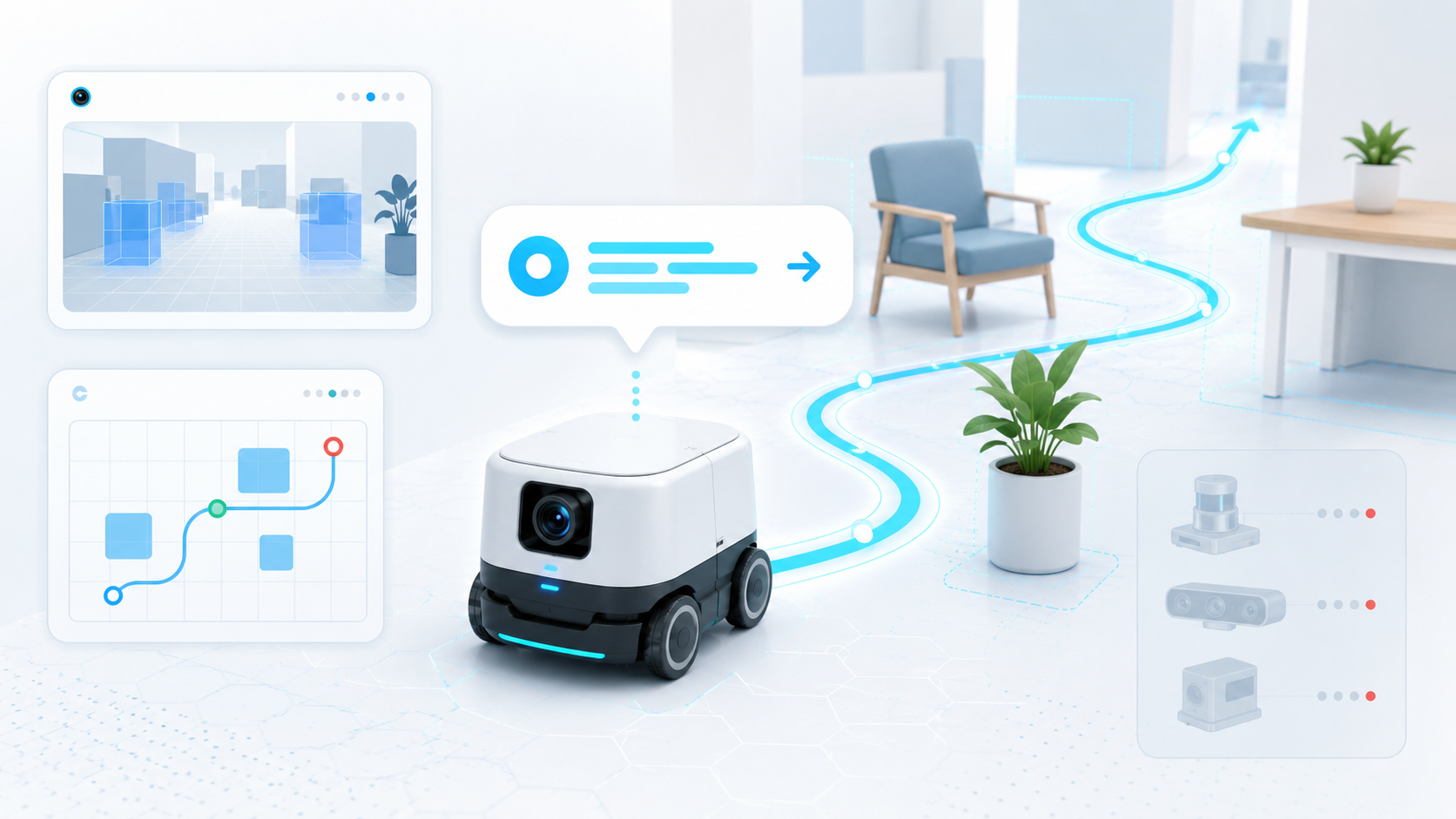
What happened: On July 8, Mistral AI released Robostral Navigate, its first embodied-navigation model (Mistral AI). It is an 8-billion-parameter model that takes a stream of RGB images from a single camera plus a plain-language instruction, such as “go to the loading dock,” and drives a robot there. No LiDAR, no depth sensor, no pre-built map required.
The details: On the standard Room-to-Room Continuous Environment (R2R-CE) benchmark, Robostral Navigate scores 76.6 percent success on unseen environments and 79.4 percent on seen ones, beating the best other single-camera approach by 9.7 points and the best system using depth sensors or multiple cameras by 4.5 points. The model works across wheeled, legged, and flying robots and was trained entirely in simulation, on roughly 400,000 navigation trajectories across 6,000 virtual scenes. Under the hood, it uses a technique Mistral calls pointing: the model predicts which pixel in the current camera frame corresponds to the next step toward the goal, with a local-displacement fallback for when the target is not in view at all. A training trick called prefix-caching cut the tokens needed to train it by 22 times, and a further round of online reinforcement learning added another 3.2 points of success. Mistral has not yet announced pricing, open weights, or an API release date.
flowchart LR
    subgraph Old["Typical mobile-robot nav stack"]
        A["LiDAR + depth camera(s)"] --> B["Point cloud / map"]
        B --> C["Path planner"]
        C --> D["Motor commands"]
    end
    subgraph New["Robostral Navigate"]
        E["Single RGB camera"] --> G["Pointing model:\nwhich pixel is the next step?"]
        F["Language instruction"] --> G
        G --> H["In view? point to pixel\nOut of view? local displacement"]
        H --> D2["Motor commands"]
    end
Important
Our take: The headline number is the benchmark win, but the interesting part for builders is what gets deleted from the parts list. A LiDAR-plus-depth-camera rig can run into the thousands of dollars before you write a line of navigation code; a single global-shutter camera runs under a hundred. That is the difference between “a robotics company can afford good navigation” and “a hobbyist or a small integrator can afford good navigation,” and it is the same kind of unglamorous cost collapse that made cheap microcontrollers rewrite the electronics hobby twenty years ago. The honest caveats: everything above comes from simulation training, Mistral has not published real-world deployment results, and there is no price or release date yet, so treat this as a strong research claim you cannot actually deploy this week, not a shipped product.
🗞️ More News
🧠 AI
- Apple sued OpenAI over alleged theft of hardware trade secrets, accusing more than 400 former Apple employees, including OpenAI’s chief hardware officer Tang Tan, of funneling confidential chip and manufacturing documents into OpenAI’s device push (Bloomberg).
- Google, Microsoft, Salesforce, Snowflake, ServiceNow, Databricks, GitHub, Cisco, Nvidia, GoDaddy, and Hugging Face backed Agentic Resource Discovery (ARD), a new open spec for AI agents to find and verify tools across the web, widely read as a check on Anthropic’s Model Context Protocol (Google Developers Blog).
- Anthropic tripled Project Glasswing to roughly 150 partner organizations across more than 15 countries; partners using its Claude Mythos model have surfaced over 10,000 high or critical security flaws in critical infrastructure software (Anthropic).
- Amazon committed $1 billion to a new AWS Forward Deployed Engineering unit that embeds AI engineers directly inside customer organizations, joining OpenAI and Anthropic in the same enterprise-deployment push (Amazon).
- Google’s Gemini 3.5 Pro is reportedly targeting a July 17 general release with a 2-million-token context window and a Deep Think reasoning tier gated behind a $250-a-month Ultra plan, though as of this writing none of the specs are confirmed in Google’s own documentation (Tech Times).
- Shanghai’s World AI Conference opens July 17 to 20 with more than 1,000 exhibitors and 3,000 frontier technologies debuting across four exhibition halls (CGTN).
🤖 Robotics
- Unitree’s G1 humanoid, priced from $16,000, set what Unitree calls the longest standing jump ever recorded for a two-legged robot its size at 1.4 meters (Heise).
- Agility Robotics and GXO signed the industry’s first commercial, multi-year robots-as-a-service deployment: Digit humanoids now move totes at a GXO-run Spanx distribution center near Atlanta (Agility Robotics).
- Ambi Robotics and Pickle Robot integrated their systems into a single automated pipeline covering trailer unloading through pallet stacking, with no human handoff between the two steps for the first time (RoboticsTomorrow).
💻 Programming
- TIOBE’s July index shows SQL jumping from No. 13 to No. 8 and R climbing from No. 15 to No. 9, while Python keeps a wide lead at the top (TechRepublic).
- GCC 16.1 already supports most C++26 features, including compile-time reflection, while Clang 22 offers initial support behind the
-std=c++2cflag (cppreference.com). - Microsoft shipped Agent Framework .NET 1.13.0 with expanded skills APIs, new file-editing tools, and Foundry Hosting improvements for session isolation (Microsoft Agent Framework Blog).
⚡ Electronics
- Meta will begin manufacturing its custom “Iris” AI data-center chip in September, the fourth generation of its MTIA program, designed with Broadcom and fabricated by TSMC (US News / Reuters).
- Intel is investing €5 billion to expand its Leixlip, Ireland campus, installing new Intel 3-node manufacturing equipment to grow Xeon 6 output (Intel Newsroom).
- Samsung is accelerating the first plant of its Yongin chip cluster to a 2029 opening, one to two years ahead of schedule, as HBM shortages squeeze the AI-chip supply chain (Benzinga).
📡 Telecom
- UAE’s e& sold its entire 16.21 percent stake in Vodafone to French investor Xavier Niel’s Vega vehicle for £4.4 billion, making Vega the telecom’s largest shareholder (GlobeNewswire).
- The FCC set a July 22 vote to auction 160 MHz of upper C-band spectrum (3.98 to 4.14 GHz) for 5G and 6G, with deployment in top markets starting in December 2030 (Light Reading).
- AT&T and Ericsson demonstrated 5G-network-based drone detection outside AT&T Stadium, using Massive MIMO radios already on the towers to track multiple drones without any dedicated sensing hardware (AT&T).
👨💻 Code Corner
Robostral Navigate’s “pointing” trick starts with a simple piece of geometry: turning a target pixel in a camera frame into a steering angle. Here is the simplified version, before any learned vision model gets involved.
# A stripped-down version of the geometry behind "pointing":
# turn a target pixel into a steering angle for a single-camera robot.

FRAME_WIDTH_PX = 1280
CAMERA_HFOV_DEG = 90.0  # horizontal field of view of a typical robot camera

def pixel_to_turn_angle(target_x_px: float) -> float:
    """Positive = turn right, negative = turn left, 0 = straight ahead."""
    center_x = FRAME_WIDTH_PX / 2
    offset_ratio = (target_x_px - center_x) / center_x  # ranges -1..1
    return offset_ratio * (CAMERA_HFOV_DEG / 2)

for target_x in (0, 320, 640, 960, 1280):
    angle = pixel_to_turn_angle(target_x)
    print(f"target at x={target_x:4d}px -> turn {angle:+.1f} degrees")
Tip
This toy version only handles a target that is already inside the frame. The moment the goal drifts out of view, plain pixel geometry has nothing to point at, which is exactly why Robostral Navigate needs its local-displacement fallback: a separate estimate of where the goal is relative to the robot even when the camera cannot currently see it.
🧰 Toolbox
- OmniVLA: an open vision-language-action research model for robot navigation presented at ICRA 2026, a useful comparison point for Robostral Navigate’s approach.
- Bun 1.3: the all-in-one JavaScript runtime added a built-in Redis client this release, on top of its already fast package installs.
- Deno 2.8: now handles npm workspaces and most CommonJS packages natively, closing most of the remaining gap with Node.js.
- C++26 compiler support tracker: a live, feature-by-feature table of what GCC, Clang, and MSVC actually support today.
- Agentic Resource Discovery spec: the Apache 2.0-licensed spec behind this week’s agent-discovery standard, worth a read if you are building tools for AI agents to find.
🔌 Component of the Week (rotating)
Arducam B0385 (OV9782 global shutter USB camera): today’s Big Story runs on exactly one RGB sensor, so it is worth knowing what makes a good one for robot navigation. The OV9782 is a 1MP, 1280×800 global shutter sensor capturing up to 120fps without the rolling-shutter skew a moving robot would otherwise bake into every frame. Arducam’s board is UVC-compliant, so it plugs into a Raspberry Pi, laptop, or Jetson with no extra drivers, making it a fast way to prototype single-camera navigation before committing to a specific lens or gimbal. Typical uses: small ground robots, SLAM rigs, and collision-avoidance drones. Runs about $69 (68.90 euros). Start from the Arducam product page.
📚 From the Blog
- How the Internet Stack Really Works: the layered journey a request takes from Enter key to rendered page, the same kind of pipeline thinking behind Robostral Navigate’s camera-to-motor-command flow.
- Resistance and Ohm’s Law: Controlling the Flow: the physics that governs every camera sensor and motor driver in today’s robotics stories.
- What Electricity Actually Is: Charge, Current, and Voltage: charge, current, and voltage from first principles, the ground floor under every chip in this issue.
😀 The Bot Says…
My new job is picking one pixel and driving toward it while sounding confident about the whole plan. Turns out that is also how I write these newsletters.
That’s all for today! Would you trust a warehouse robot that navigates off one camera and a sentence, or do you still want the LiDAR backup? Reply and tell us.