😁 Hello, super humans! Today’s issue is landing a little late. To make up for it, we are leading with a story that is easy to underrate: a car with no driver, no safety monitor, and no lidar, now taking paying riders through Miami traffic. Grab a coffee, because vision-only autonomy just met Florida weather.
📰 Quick Signals
- 🧠 AI: Google made Gemini 3.1 Flash-Lite generally available, positioning it as its most cost-efficient model for high-volume, latency-sensitive traffic (Google Cloud).
- 🤖 Robotics: Hyundai showcased its Atlas humanoid at the 2026 FIFA World Cup, signaling how close the automaker thinks it is to mass production and factory deployment (Bloomberg).
- 💻 Programming: GitHub’s Copilot SDK reached general availability across Node/TypeScript, Python, Go, .NET, Rust, and Java, exposing the same agentic runtime that powers the Copilot app (GitHub Changelog).
- ⚡ Electronics: Samsung is reportedly seeking up to a 20% DRAM price increase for Q3, its third straight quarter of sharp hikes as the AI memory crunch rolls into consumer gear (TrendForce).
- 📡 Telecom: AST SpaceMobile finished assembling its next-generation BlueBirds 11, 12, and 13 for an August SpaceX rideshare and set up a Rakuten joint venture targeting Japan (SatNews).
The Big Story: Tesla’s camera-only Robotaxi goes fully unsupervised in Miami
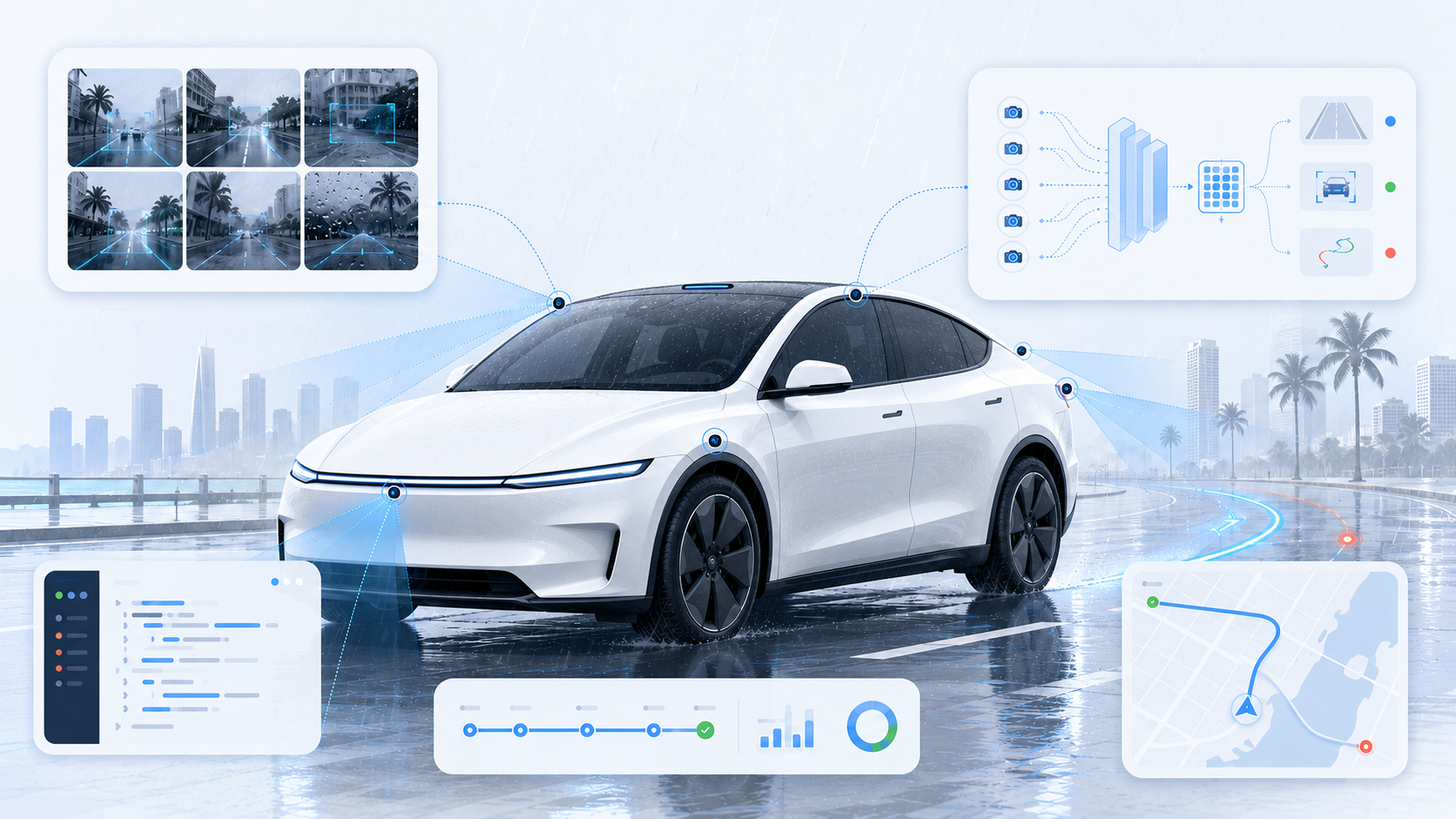
If you care about where physical AI actually meets the road, this week gave you a live experiment: a commercial fleet running with no human fallback, no radar, and no lidar, in one of the rainiest big cities in the United States.
What happened: Tesla switched on its Robotaxi service in Miami, its first city outside Texas to run fully unsupervised from day one, with no safety monitor in the front seat (Not a Tesla App). The initial zone covers roughly 10 to 14 square miles of western Miami-Dade, excluding downtown and Brickell, and Miami joins Dallas and Houston as cities where Tesla runs unsupervised Model Y vehicles rather than the safety-monitor mix still used in Austin and the San Francisco Bay Area.
The details: The technically interesting part is what is missing. Tesla’s stack is camera-only: eight cameras feeding an end-to-end neural network, with no lidar and no radar to fall back on when a camera is blinded. That is a direct philosophical split from Waymo, which fuses lidar, radar, and cameras against pre-built high-definition maps. Miami is the stress test that makes the difference concrete, because heavy Florida rain degrades exactly the sensor Tesla depends on: water on the lens, spray from other cars, and low-contrast scenes are the worst case for vision, and there is no second sensing modality to cross-check the pixels (Tech Times). The upside of the vision-only bet is cost and scale: no expensive spinning sensor and no per-city HD map to maintain, which is why Tesla can talk about adding cities quickly.
flowchart LR
  R[Road scene] --> C[8 cameras]
  R --> L[Lidar + radar]
  C --> N[End-to-end neural net]
  L --> F[Sensor fusion + HD map]
  N --> DT[Tesla: vision only]
  F --> DW[Waymo: redundant sensing]
  DT --> O[Driving decision]
  DW --> O
Important
Our take: This is the cleanest head-to-head in autonomy right now, and it is really an argument about redundancy versus cost. Lidar buys you a second, independent way to know a wall is a wall; camera-only bets that a good enough model plus more data beats the extra hardware. We would not judge it on a sunny demo clip: watch the boring numbers over a full Miami storm season, specifically disengagement-equivalent interventions and remote-assist calls per thousand miles. If vision-only holds up in the rain without a safety net, the economics of self-driving change for everyone; if it does not, this is the quarter we find out where the camera’s edge really is.
🗞️ More News
🧠 AI
- Anthropic released Claude Sonnet 5 as a cheaper, more agentic default model, with introductory pricing of $2 per million input tokens and $10 per million output through August (Anthropic).
- xAI’s Grok 4.3 landed on Amazon Bedrock at $1.25 per million input and $2.50 per million output tokens, while Elon Musk says Grok 4.5 is in private beta with teams at SpaceX and Tesla (LLM-Stats).
- Meituan open-sourced LongCat-2.0, a 1.6-trillion-parameter Mixture-of-Experts coding model it says was trained end-to-end on Chinese-made chips with no Nvidia GPUs (VentureBeat).
- Mistral is opening early access this month to a new open-weight model it plans to ship over the summer, keeping pressure on the closed frontier labs (TechCrunch).
- Nvidia launched its BioNeMo Agent Toolkit, giving AI agents a set of tools aimed at accelerating scientific discovery (Nvidia).
- DeepSeek V4-Pro arrived as one of the cheapest frontier-class options at about $0.435 per million input and $0.87 per million output tokens, shipping as an open-weight model you can self-host (Price Per Token).
🤖 Robotics
- AI2 Robotics raised roughly $736M from Guangdong state investors and corporate backers at a valuation above $2.9B to advance its AlphaBot and embodied-AI models (SiliconANGLE).
- X Square Robots landed a parallel round at a similar valuation near $2.8B, underscoring how much capital is flowing into Chinese humanoid startups (Briefs).
- Following yesterday’s SPAC signal, Agility Robotics’ CEO tempered expectations, saying a robot in your home is not coming anytime soon even as the company heads for public markets (TechCrunch).
- Nvidia’s open Isaac GR00T reference humanoid, pairing a Unitree H2 body with Jetson Thor compute and open foundation models, is heading to research labs and will be available from Unitree in late 2026 (Nvidia).
💻 Programming
- GitHub introduced an agent-native Copilot desktop app plus a redesigned Copilot CLI with voice input and scheduled tasks for terminal-first workflows (GitHub Blog).
- Node.js now runs TypeScript files directly by stripping types at load time, so a plain
.tsentry point executes with no separate build step (Node.js). - The open-model wave is reshaping coding stacks: MIT-licensed models like LongCat-2.0 and DeepSeek V4-Pro now slot into agents such as Claude Code and Aider, making self-hosted pair programming realistic (Aider).
⚡ Electronics
- Raspberry Pi indicated the Pi 6 is unlikely before early 2028, and said it sees the CPU, not a dedicated NPU, as the venue for on-board AI compute (Circuit Digest).
- Substrate supply for the Pi Zero 2W is constrained because so many AI chips are being made that even older process nodes now fight for wafer capacity (Jeff Geerling).
- Raspberry Pi confirmed that semiconductor shipments have overtaken its boards and modules for the first time, a milestone for its growing microcontroller business (The Register).
📡 Telecom
- A United Launch Alliance Atlas V lofted 29 more Amazon Leo satellites, pushing the constellation past 390 and, Amazon says, past the threshold to begin initial broadband service later this year (Space.com).
- Starlink asked the FCC to authorize up to 15,000 satellites, while three separate Chinese operators each plan constellations of more than 10,000, a fresh wave of orbital congestion (Total Telecom).
- The FCC waived Amazon’s July 30 deadline to launch half its constellation, but said it will temporarily demote the spectral priority of satellites launched after the milestone (Amazon Leo).
👨💻 Code Corner
Today’s Big Story is really about how fast a camera-only car can react, and the first limit is simple: how far the car travels between two camera frames. This dependency-free snippet turns frame rate into blind distance at a given speed, the budget every perception stack has to beat.
def meters_per_frame(speed_kmh: float, fps: int) -> float:
    speed_ms = speed_kmh / 3.6      # km/h to m/s
    return speed_ms / fps

for fps in (18, 36, 60):
    d = meters_per_frame(90, fps)
    print(f"{fps:>2} fps: {d:.2f} m traveled between frames at 90 km/h")
At 90 km/h the car covers about 1.39 m between frames at 18 fps but only 0.42 m at 60 fps, so frame rate directly sets how stale the world looks before the next glance.
Tip
This is only the sampling gap. Real reaction distance also includes inference latency, planning, and actuation, which stack on top; a slower model can erase the advantage of a faster camera, so profile the whole pipeline, not just the sensor.
🧰 Toolbox
- Aider: a terminal-based open-source coding agent with multi-file edits and git integration that works with any LLM.
- Isaac GR00T: Nvidia’s open humanoid foundation models and workflows for reasoning, learning, and multitask behavior.
- Copilot SDK: build agents on the same runtime as GitHub Copilot, now GA across six languages.
- LongCat-2.0: Meituan’s 1.6T MIT-licensed Mixture-of-Experts model page, weights rolling out on Hugging Face.
- Bun: the fast all-in-one JavaScript runtime and toolkit that now underpins Claude Code.
🔌 Component of the Week (rotating)
Raspberry Pi Global Shutter Camera: a Sony IMX296 sensor on a C/CS-mount board, priced around $50, that captures the whole frame at once instead of scanning it line by line. That global shutter is exactly what you want for anything moving fast, because a rolling shutter smears and skews quick motion, the same failure mode that makes fast machine-vision and robotics perception hard. It pairs perfectly with today’s Big Story: cheap image sensors are the raw input a camera-only car lives or dies by, and this is the affordable way to feel the difference on your own bench. Wire it to a Pi 5, grab frames of a spinning fan, and compare it against a rolling-shutter module to watch the distortion vanish.
📚 From the Blog
- What Electricity Actually Is: Charge, Current, and Voltage: charge, current, and voltage from first principles, the physics under every camera sensor and compute chip in today’s Big Story.
- CCTV in 2026: From Dumb Cameras to Intelligent Sensors: how cameras became AI sensors, the same vision-first bet Tesla is making on the road.
- CloudEvents 1.0: A Universal Language for Your Events: a simple, consistent way to describe event data across distributed systems.
😀 The Bot Says…
A camera-only car walks into a Miami thunderstorm. The lidar engineers order popcorn; the neural net orders windshield wipers.
That’s all for today! Reply and tell us: does camera-only autonomy win on cost, or does it need lidar as a seatbelt?