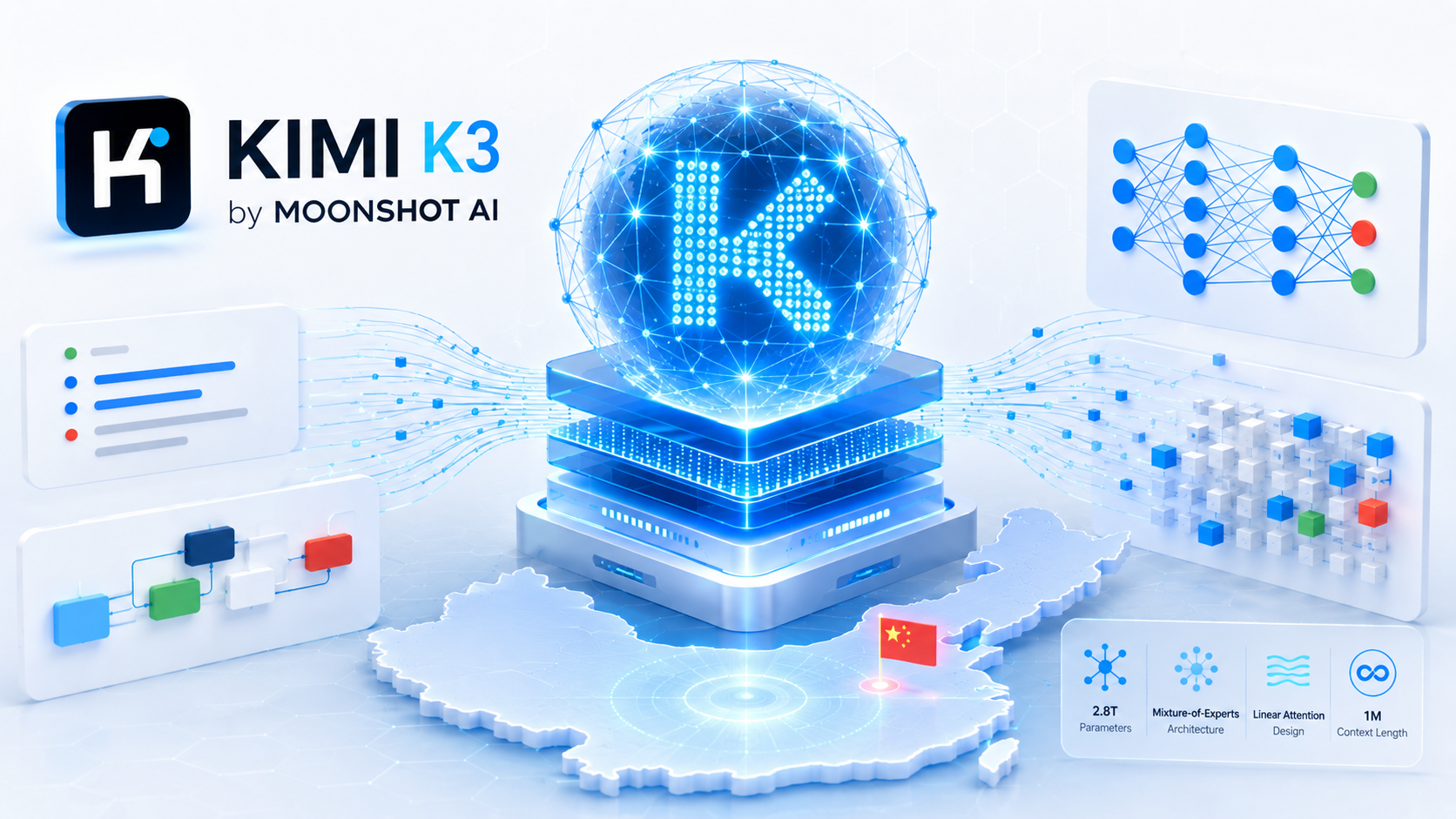
😁 Hello, super humans! The frontier just moved, and this time the weights are coming with it. Moonshot AI dropped Kimi K3, the first open model in the 3-trillion-parameter class, right as Shanghai kicks off its biggest AI week yet. Let’s dig in.
📰 Quick Signals
- 🧠 AI: Huawei’s Atlas 950 SuperPoD, a Nvidia-free AI training cluster wiring thousands of Ascend chips into one machine, debuts at Shanghai’s WAIC.
- 🤖 Robotics: 1X Technologies unveiled a Neo humanoid hand built to match or surpass human dexterity, with the first home units shipping this year.
- 💻 Programming: Rust cracked the TIOBE top 10 for the first time, credited to memory safety and fast code generation.
- ⚡ Electronics: Infineon extended its automotive AURIX line with a new RISC-V microcontroller family, alongside its TriCore and Arm parts.
- 📡 Telecom: The TRANTOR consortium completed Europe’s first 5G NR-NTN broadband transmission, using a Hispasat 30W-6 satellite.
The Big Story: China ships the world’s largest open model
If you build with open weights, your ceiling just went up. Moonshot AI released Kimi K3, a 2.8-trillion-parameter open Mixture-of-Experts model, and calls it the first open model in the 3-trillion-parameter class: roughly 75 percent bigger than DeepSeek’s V4 Pro.
What happened: On July 16, Moonshot AI announced Kimi K3, a sparse MoE model that activates 16 of 896 experts per token, ships native vision, and carries a 1-million-token context window. Coverage frames it as the largest open-source model released to date, aimed squarely at long-horizon coding, knowledge work, and reasoning, with benchmarks positioned to close the gap on top US systems. The full technical writeup is documented here, and VentureBeat’s launch report is here.
The details: The interesting part is not the parameter count, it is how they made a model this size usable. Kimi K3 introduces two architectural changes: Kimi Delta Attention (KDA), a hybrid linear-attention mechanism that Moonshot says decodes up to 6.3x faster in million-token contexts, and Attention Residuals (AttnRes). Together with the sparse routing and a refined training recipe, they claim about 2.5x better scaling than K2. Sparsity is what keeps the wall reasonable: only a fraction of those 2.8T parameters fire on any given token. Serving runs at roughly $0.30 per million cached-input tokens, $3 on a cache miss, and $15 per million output tokens, with the full 1,048,576-token window at that rate. Full model weights are scheduled for July 27.
Important
Our take: The headline number is a distraction; KDA is the story. Linear attention that actually holds up at a million tokens is the thing that makes long-context agents cheap enough to run in a loop, and that is where open weights matter most: you can quantize it, shard it, and pin it to your own hardware. We would not wait for July 27 to plan around it. Prototype against the hosted API now, measure real decode latency on your longest prompts, and decide whether the self-host math works before the weights land.
🗞️ More News
🧠 AI
- Xi Jinping opened WAIC in Shanghai with an AI-diplomacy pitch, urging global cooperation and shared safety rules.
- Chinese-built models now approach 60 percent of US firms’ usage on the OpenRouter marketplace.
- Google’s Gemini 3.5 Pro is reportedly targeting a July 17 launch after a full rebuild, though every spec stays unconfirmed.
- Pakistan is set to become a founding member of the China-led World AI Cooperation Organisation (WAICO), signing during WAIC.
- Kimi K3’s full open weights are slated to drop on July 27, according to researchers who reviewed the technical docs.
- DeepSeek’s V4 has been adapted to run entirely on Huawei Ascend clusters, part of China’s Nvidia-free stack push.
🤖 Robotics
- A humanoid-robotics company is heading to public markets, with its CEO tempering expectations for a robot in your home anytime soon.
- LimX Dynamics raised $200 million in a pre-IPO round as Chinese humanoid startups rush to list.
- A Chinese maker took over 13,000 orders for lifelike $17,600 humanoids, lip-synch quirks and all.
💻 Programming
- The Azure SDK for Rust reached GA 1.0.0, locking seven core crates with semver guarantees and production observability.
- Deno 2.9.3 shipped on July 15 with performance improvements and bug fixes as the runtime pushes into enterprise use.
- Microsoft’s June Azure SDK also gave Python its first stable AI Transcription client, alongside Planetary Computer Pro.
⚡ Electronics
- The RISC-V market is projected to quadruple from $1.31 billion in 2026 to $4.85 billion by 2032.
- The eProcessor project reported the successful deployment of Europe’s first out-of-order RISC-V processor silicon.
- Ashling and Embecosm shipped ExecuTorch builds tuned for resource-constrained devices, including RISC-V microcontrollers.
📡 Telecom
- France confirmed its France 2030 programme will fund 6G standardisation projects, with a call for projects closing January 15, 2027.
- The UK ranks bottom of Europe for network experience, a year after the Vodafone-Three merger, per Opensignal.
- ESA and the GSMA Foundry opened a new round of Innovation Challenges to blend terrestrial and satellite networks.
👨💻 Code Corner
Kimi K3’s hosted API is OpenAI-compatible, so you can point the official client at Moonshot’s endpoint and try the million-token context today, no new SDK required.
from openai import OpenAI

client = OpenAI(
    api_key="YOUR_MOONSHOT_KEY",
    base_url="https://api.moonshot.ai/v1",
)

resp = client.chat.completions.create(
    model="kimi-k3",
    messages=[{"role": "user", "content": "Summarize this repo in 3 bullets."}],
)
print(resp.choices[0].message.content)
Swap the base_url and key, keep the rest of your code, and your existing OpenAI-based agent runs on an open MoE model.
Tip
Cached input is roughly ten times cheaper than a cache miss ($0.30 vs $3 per million tokens), so keep long, stable context (system prompts, retrieved docs) at the front of the message list to maximize cache hits.
🧰 Toolbox
- Moonshot Open Platform: the OpenAI-compatible API for Kimi K3, with the full 1M-token context exposed at the standard rate.
- Deno: the drop-in JavaScript runtime with built-in TypeScript, dependency auditing, and full npm compatibility, now at 2.9.3.
- ExecuTorch: PyTorch’s on-device inference runtime, increasingly targeting constrained parts including RISC-V microcontrollers.
- OpenRouter: one API that routes across hundreds of models, and the marketplace where Chinese models just hit near 60 percent of US usage.
- ESP32-C6: a cheap RISC-V plus Wi-Fi 6 and Thread module, an easy on-ramp to the open ISA for a weekend build.
🔌 Component of the Week (rotating)
Raspberry Pi Pico 2 (RP2350): With RISC-V back in the headlines, the Pico 2 is the easiest way to actually run it. The RP2350 is unusual: it carries two Arm Cortex-M33 cores and two open-source Hazard3 RISC-V cores on the same die, and you pick which pair boots. That makes a roughly $5 board a genuine dual-ISA sandbox, so you can compile the same firmware for Arm and for RISC-V and compare. Add 520KB of SRAM, a security boot chain, and the familiar Pico SDK, and it is a low-risk way to learn the open ISA before committing to it on a bigger design.
📚 From the Blog
- What Deep Learning Actually Is: a plain-language primer on the machinery behind models like today’s Big Story; the perfect companion if trillion-parameter MoE talk feels abstract.
- How the Internet Stack Really Works: what actually happens between pressing Enter and the page loading, layer by layer.
- Resistance and Ohm’s Law: Controlling the Flow: how resistance shapes current, and why Ohm’s law is the first equation every electronics build leans on.
😀 The Bot Says…
2.8 trillion parameters, and it still activates only 16 of 896 experts to answer you. Somewhere in there, 880 experts got the day off and nobody told the electricity bill.
That’s all for today! Which lands bigger for you: a trillion-parameter model you can download, or a $5 board that runs two instruction sets at once? Reply and tell us.