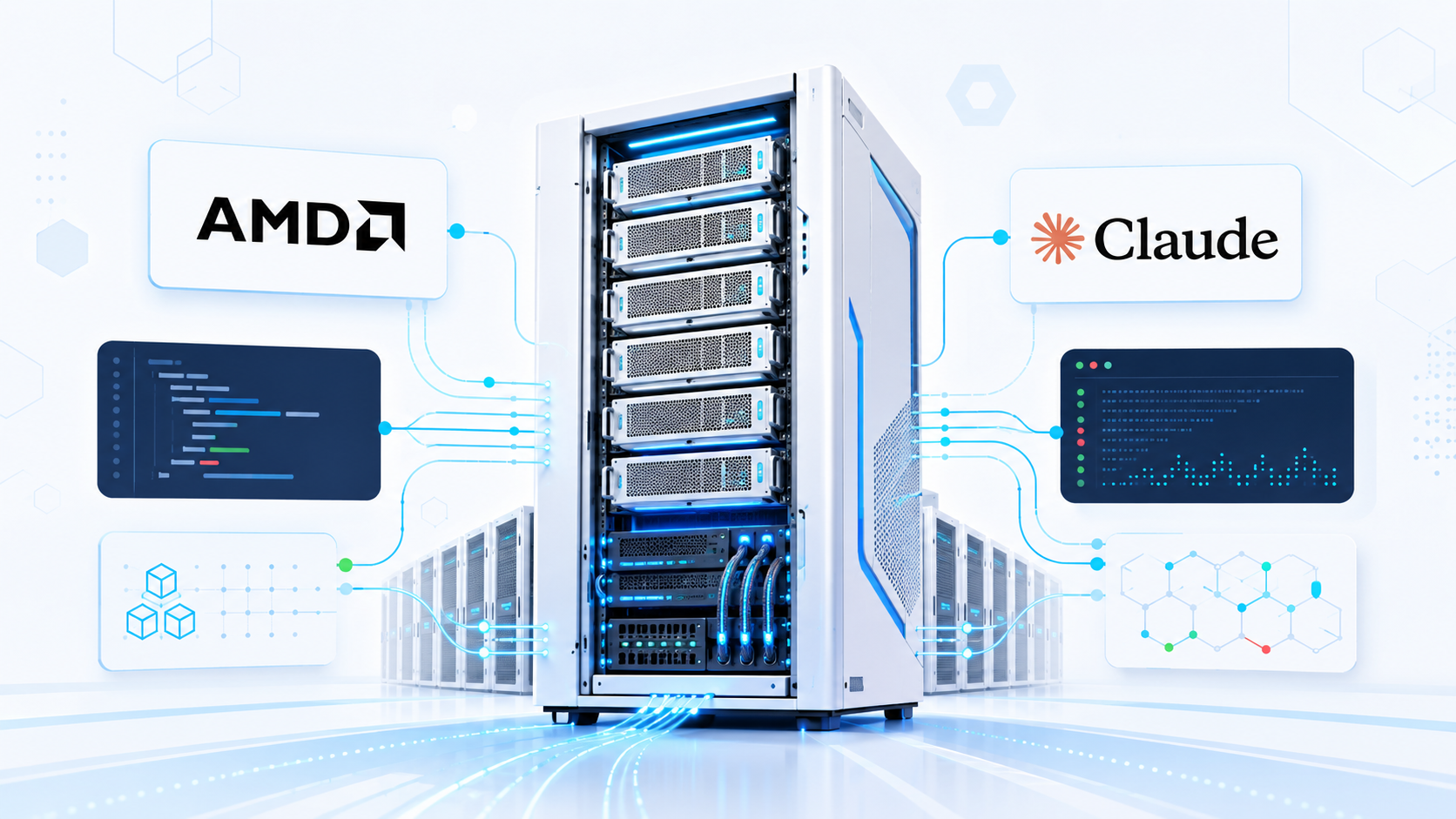
😁 Hello, super humans! Yesterday the AI-hardware race stopped being a one-horse story. AMD walked on stage at its Advancing AI event, showed a rack that does 2.9 exaflops, and then wrote Anthropic a check to prove people will actually buy it. When the number-two chipmaker starts taking equity in a model lab, the whole compute map gets redrawn. Let’s dig in.
📰 Quick Signals
- 🧠 AI: OpenAI and Anthropic’s combined second-quarter federal lobbying hit a record $3.17 million, up 23% on the prior quarter.
- 🤖 Robotics: UK startup Humanoid raised $152 million at a $1.35 billion valuation, becoming Europe’s first pure-play humanoid-robot unicorn with 34,000 pre-orders.
- 💻 Programming: Microsoft released a stable Agent Framework harness for Python and .NET: a batteries-included agent loop with planning, memory, approvals and telemetry.
- ⚡ Electronics: Samsung posted a record Q2 as AI-memory demand for HBM and DRAM pushed its semiconductor unit to over 90% of group profit.
- 📡 Telecom: AT&T, T-Mobile and Verizon unveiled a satellite-focused spectrum-pooling joint venture to counter direct-to-device rivals.
The Big Story: AMD turns Advancing AI into a real Nvidia challenge
For years the honest answer to “who competes with Nvidia in AI training at scale” was “nobody.” Yesterday AMD tried to change that answer with silicon, a full rack, and a customer willing to commit gigawatts.
What happened: On July 22 at Advancing AI 2026 in San Francisco, CEO Lisa Su presented the fully specified Instinct MI400 lineup, the Helios rack platform, and a 2027 MI500 roadmap. Alongside the hardware, AMD and Anthropic announced a strategic partnership: Anthropic will deploy up to 2 gigawatts of Instinct MI450 Series GPUs in AMD Helios systems, with the first gigawatt landing in the first half of 2027, and AMD will make a strategic equity investment of up to $5 billion in Anthropic. The details are in AMD’s newsroom post, and CNBC broke down the investment structure.
The details: The flagship MI400 carries 432 GB of HBM4 and delivers 2.9 exaflops of FP4, which AMD pitches as roughly ten times the MI300X on frontier-model training. The lineup splits three ways: the MI430X for sovereign and HPC work, the MI440X packing eight GPUs into an on-premises enterprise box, and the MI455X that powers Helios. One Helios rack fuses 72 MI455X GPUs with EPYC “Venice” CPUs and Pensando networking into a single 2.9-exaflop unit, priced between $5 million and $5.5 million, all running the open ROCm 7 stack. AMD’s $5 billion equity commitment is tied to deployment milestones rather than paid up front, and the two companies are starting a multi-year engineering push to use Claude to accelerate ROCm software itself.
flowchart LR
    A["MI430X<br/>sovereign / HPC"] --> D["ROCm 7 stack"]
    B["MI440X<br/>8-GPU enterprise box"] --> D
    C["MI455X<br/>Helios flagship"] --> D
    C --> E["Helios rack<br/>72 GPUs, 2.9 EF FP4"]
    E --> F["Anthropic<br/>up to 2 GW by 2027"]
Important
Our take: The check is the story, not the spec sheet. Nvidia’s moat was never only silicon, it was the assumption that no serious lab would risk a non-CUDA supply chain. By putting $5 billion of its own balance sheet behind Anthropic and wiring Claude into ROCm development, AMD is buying down exactly that risk: the software gap closes faster when your biggest customer is also debugging your compiler. If you build on GPUs, start pricing a second lane into your 2027 plans, because for the first time in a while there genuinely is one.
🗞️ More News
🧠 AI
- OpenAI launched Presence, an enterprise platform for deploying trusted voice and chat agents that already handles about 75% of its own inbound support.
- OpenAI added Nubank CEO David Vélez and BNY CEO Robin Vince to its boards, bringing the count to ten as IPO expectations build.
- Microsoft expanded its Mistral alliance with a multibillion-dollar deal funding Nvidia Vera Rubin GPUs in Europe and adding Mistral Medium 3.5 and OCR 4 to Foundry.
- Fireworks AI raised a $1.5 billion Series D at a $17.5 billion valuation, crossing $1 billion in annualized revenue while serving over 40 trillion inference tokens a day.
- Anthropic doubled its AI-policy war chest to $40 million, pouring another $20 million into Public First Action ahead of the midterms.
- An unconfirmed rumor that Anthropic might acquire robotics-AI lab Physical Intelligence lit up AI Twitter.
🤖 Robotics
- NEURA Robotics is raising up to $1.4 billion in a Series C to scale its cognitive robots and humanoids from Europe into the US and Asia.
- Amazon showed a next-gen Proteus robot that takes natural-language commands and will expand across European fulfillment sites by 2027.
- Locus Robotics passed 7 billion cumulative warehouse picks across its global fleet of autonomous mobile robots.
💻 Programming
- TypeScript 7.0 reached general availability, shipping the Go-native “Corsa” compiler that Microsoft clocks at roughly 8x to 12x faster full builds under the standard tsc name.
- WordPress shipped Gutenberg 23.6, deprecating the reusable-blocks package and its store actions with migration warnings.
- Microsoft’s Agent Framework hit 1.12.0, adding Azure Cosmos DB semantic memory and hosting helpers for MCP, A2A and Telegram.
⚡ Electronics
- Intel Foundry became the first to ship a high-volume logic product made with ASML’s High-NA EUV, printing select Panther Lake 18A layers in a single exposure at roughly 85% yield.
- AMD’s MI400 flagship carries 432 GB of HBM4 and hits 2.9 exaflops of FP4, roughly ten times the MI300X on frontier-model training.
- SK Hynix is moving early on hybrid bonding for next-generation HBM, as AI-memory competition shifts from stacking capacity toward packaging density and thermal control.
- Bosch is investing about $3 billion to expand its semiconductor business, deepening its bet on automotive and power silicon.
📡 Telecom
- Nokia launched what it calls the industry’s first commercial AI-RAN platform with NVIDIA, built on anyRAN and Aerial and already showing over 20% spectral-efficiency gains.
- Verizon became the US connectivity provider for newly built BMW Group vehicles through a KDDI partnership, its first nationwide 5G Standalone deployment for connected cars.
- Vietnam deepened its 6G push through a new Qualcomm partnership focused on AI-native networks and next-generation wireless R&D.
👨💻 Code Corner
With AMD’s ROCm back in the conversation, here is a one-liner that quietly proves the point: the same PyTorch code runs on an AMD Instinct card and an Nvidia one, because the ROCm build keeps the cuda namespace.
import torch

# Works on both the ROCm (AMD) and CUDA (NVIDIA) builds of PyTorch.
print("GPU visible:", torch.cuda.is_available())
if torch.cuda.is_available():
    print("Device:", torch.cuda.get_device_name(0))
    x = torch.randn(8192, 8192, device="cuda")
    print("Matmul shape:", (x @ x).shape)  # runs on whichever GPU you have
Tip
On an AMD box you still call torch.cuda.*. ROCm maps that namespace onto its own runtime, so most model code ports with zero edits. Check torch.version.hip to confirm you are on a ROCm build.
🧰 Toolbox
- ROCm: AMD’s open-source GPU compute stack, the software half of today’s big story.
- Microsoft Agent Framework: a batteries-included agent harness for Python and .NET, now with a stable release.
- vLLM: high-throughput LLM serving with paged attention, with growing AMD Instinct support.
- Netron: a viewer for neural-network model files that renders ONNX, TensorFlow and PyTorch graphs in the browser.
- Jetson Orin Nano Super: a $249 edge-AI dev kit for running vision and small language models on-device.
🔌 Component of the Week (rotating)
Raspberry Pi AI HAT+ (Hailo-8 / 8L): today’s headline was exaflops in a rack, so here is AI acceleration you can actually put on your desk. The AI HAT+ snaps onto a Raspberry Pi 5 over PCIe and adds a Hailo neural accelerator: the 13-TOPS Hailo-8L version runs about $70, and the 26-TOPS Hailo-8 version about $110. That is enough for real-time object detection, pose estimation, or segmentation on a live camera feed while the Pi’s CPU stays free for your app logic. Typical projects include a smart bird feeder that identifies species, a workshop safety camera, or an offline people-counter that never sends video to the cloud. Grab it from the official product page, which links the setup guide and model zoo.
📚 From the Blog
- What Deep Learning Actually Is: the plain-English primer on the models all that AMD and Anthropic compute is built to train.
- How the Internet Stack Really Works: what actually happens between pressing Enter and a page appearing, layer by layer.
- Resistance and Ohm’s Law: Controlling the Flow: the rule every circuit obeys, from a breadboard LED to a data-center power rail.
😀 The Bot Says…
One Helios rack does 2.9 exaflops for about five million dollars. My laptop fan spins up when I open too many tabs. We are not the same.
That’s all for today! Reply and tell us: if you had a 2-gigawatt cluster for a weekend, what would you train?