😁 Hello, super humans! Every coding agent launch this year has been sold on benchmarks. Meta’s launch yesterday is the first one where the interesting number is on the pricing page, not the leaderboard. Same model, two prices, and the cheap one costs you your source code. Let’s dig in.
📰 Quick Signals
- 🧠 AI: NVIDIA’s Alpamayo 2 Super is out, a 34 billion parameter open vision-language-action model for level 4 robotaxis, with weights under the Linux Foundation’s OpenMDW-1.1 and code under Apache 2.0.
- 🤖 Robotics: Borno State unveiled what it describes as Nigeria’s first indigenous humanoid robot on 5 August, built with Maxzeeton Technology under the state ICT development agency.
- 💻 Programming: CopilotKit open-sourced its Channels SDK under MIT, which runs any AG-UI compatible agent inside Slack and Microsoft Teams without rewriting the agent.
- ⚡ Electronics: Espressif’s ESP32-S31 has entered mass production and is on general sale, putting Wi-Fi 6, Bluetooth 5.4, 802.15.4 and a gigabit Ethernet MAC on one dual-core RISC-V part.
- 📡 Telecom: Optus and Nokia pulled 3.5 Gbps down to a handset from the upper 6 GHz band at a live Optus site, using 200 MHz of spectrum alongside a running 5G network.
The Big Story: Meta’s coding agent is cheap if you pay in source code
Meta Superintelligence Labs shipped a terminal coding agent yesterday. The engineering in it is worth reading, but the thing that will actually change how teams behave is the price list.
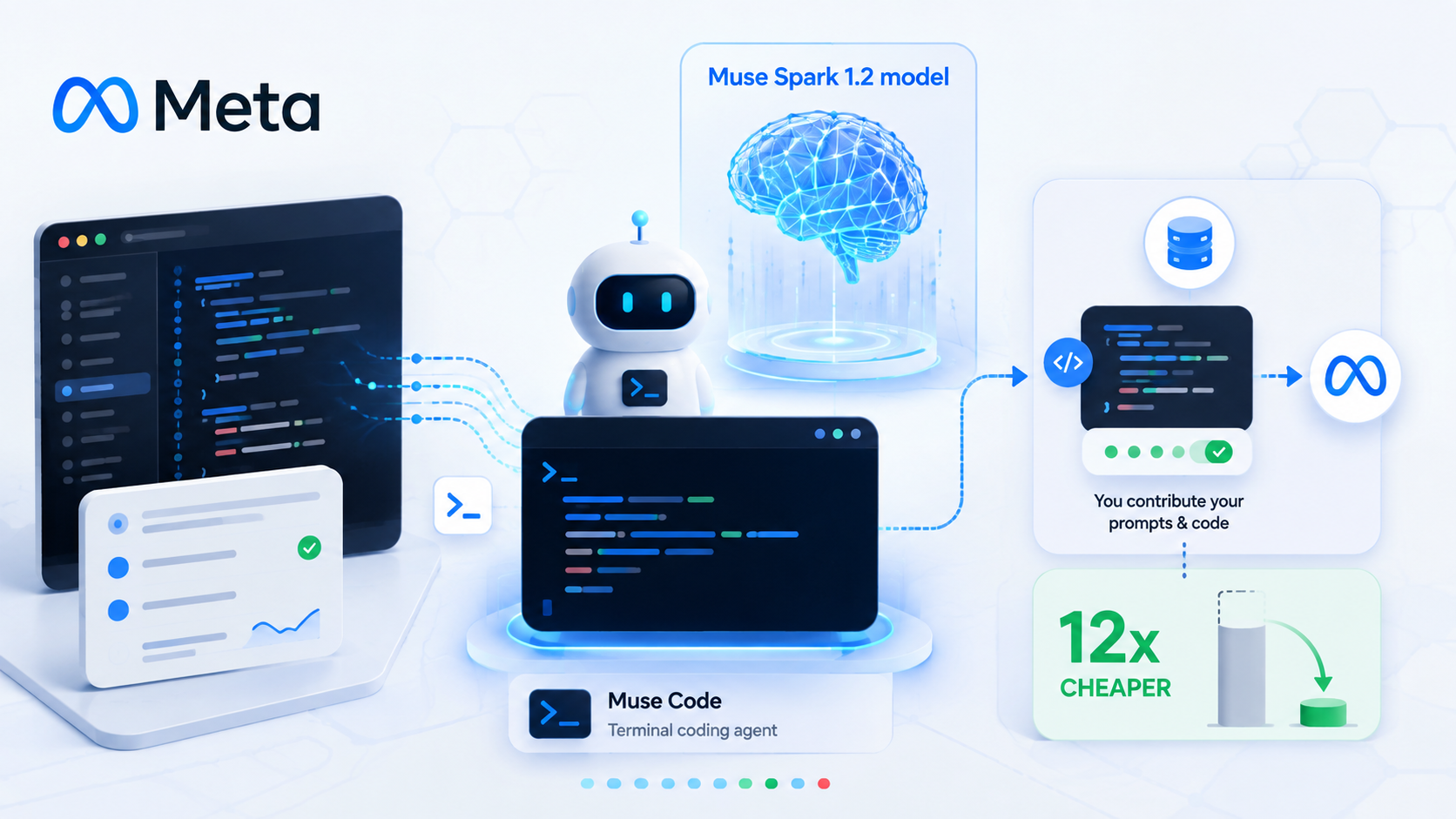
What happened: Meta released Muse Code in beta on 5 August, a terminal coding agent for macOS and Linux, powered by a new model called Muse Spark 1.2. It installs with a single curl one-liner from dev.meta.ai, plans changes across large repositories, writes code and validates the result. Muse Spark 1.2 is also available in the Meta Model API. There are no downloadable weights, so this is a hosted dependency, not an open release.
The details: Three design choices stand out. First, the agent runs a simple main loop plus a set of async background agents that stay alive for the whole session rather than being spawned per task, which Meta says cuts redundant information gathering and reduces the steering a human has to do on long jobs. Second, the runtime is an append-only local event log: every model call, tool run, approval and edit is appended, which makes the session replay-exact and restart-safe, so a crash resumes exactly where it stopped instead of restarting the task. Third, the model was co-trained with the harness itself, using rejection-sampled harness trajectories plus recipe tuning for goals, compaction and subagents. The proof point Meta chose is a GPU kernel study: over 1,000 tool calls and runs up to 24 hours, the agent wrote, compiled, profiled and improved KDA and MLA kernels on NVIDIA Hopper, with third-party kernel libraries banned so it had to implement the algorithms in Triton rather than wrap someone else’s.
flowchart LR
    U[Developer prompt] --> M[Main agent loop]
    M --> P["/plan, /grill, /goal"]
    M <--> B1[Background agent: repo context]
    M <--> B2[Background agent: build and test]
    M <--> B3[Background agent: research]
    M --> L[(Append-only event log)]
    B1 --> L
    B2 --> L
    B3 --> L
    L --> R[Replay-exact restart after crash]
Then there is the pricing. Muse Spark 1.2 has a standard tier at $1.25 per 1M input tokens and $4.25 per 1M output, with Meta committing that your prompts and completions are not used for training. It also has a contributor tier at $0.10 per 1M input and $0.20 per 1M output, roughly twelve times and twenty-one times cheaper, on the condition that you let Meta train on your prompts and completions. Cached input on the contributor tier is $0.002. The catch beyond privacy is throughput: 60 requests per minute against the standard tier’s 3,000.
Important
Our take: the event log is the part I would steal. Most agent harnesses treat a crash as a lost session, and “replay-exact” is a much stronger property than the checkpointing everyone else ships; it is the difference between an agent you can audit and one you have to trust. The pricing, though, is the first time a major lab has put an explicit number on your code. Twelve times cheaper is not a discount, it is a valuation, and it tells you Meta thinks real repository trajectories are worth more than the inference margin. If you work on anything under NDA, the contributor tier is not a decision your finance team gets to make alone. And note that no weights shipped: this is a frontier lab renting you an agent, not handing you one.
🗞️ More News
🧠 AI
- The contributor tier’s rate limit is 60 requests per minute against 3,000 on standard, so the cheap path is throttled as well as trained on.
- Meta’s evaluation methodology is unusually specific: Terminal-Bench 2.1 across all 89 tasks at pass@1 over five attempts, DeepSWE v1.1 across 113 tasks in 91 repositories and five languages.
- Comparison runs happened in isolated Daytona cloud sandboxes against Grok 4.5, Claude Opus 5, GPT-5.6 Terra, Gemini 3.6 Flash and Kimi K3, each in its own agent product, and Meta concedes its harness may not be tuned for third-party models.
- Meta’s own model page lists the previous Muse Spark 1.1 at 80.0 on Terminal-Bench 2.1, which is the baseline any 1.2 claim should be read against.
- Muse Spark 1.2 was partly trained on data it generated itself: version 1.1 produced hard coding environments and instruction templates, then graded candidate solutions against them.
- DeepSeek V4 Flash 0731 is live and is being written up as the current price-efficiency leader on real task performance rather than headline benchmarks.
- A University of Washington study across roughly 24,000 story completions found six leading models produce 57% gender-neutral, 41% male and just 2% female animal characters, with neutrality guardrails erasing female characters rather than balancing them.
🤖 Robotics
- Zoox unveiled its production-ready robotaxi ahead of US expansion, with the Hayward line targeting up to 100 units a week subject to regulatory approval.
- The refreshed vehicle keeps the carriage cabin with no steering wheel or pedals, and repositions the bidirectional reflectors so pedestrians can tell front from rear by colour.
- Zoox has an NHTSA commercial exemption covering paid self-driving rides, which is the regulatory piece that makes the production ramp worth building.
- Global robotics startups have raised more than $23 billion in 2026 so far, close to the whole of 2025, as NVIDIA, OpenAI, Meta and Tesla all push into humanoids.
- Optus and Nokia used an AI-driven robot dog to automate indoor signal measurements for network design, which they are calling a world first for RF survey work.
💻 Programming
- Rust 1.98.0 is scheduled stable for 20 August, branched from master on 3 July, with 1.97.1 still the current point release.
- Notable in 1.98:
Location<'_>becomes'staticinPanicHookInfo, a newpowerpc64-unknown-linux-gnuelfv2target lands, andderive(PartialOrd)gets a fast path whenOrdis also derived. - Muse Code ships three built-in skills rather than leaving prompting to you:
/planproduces an approval-gated plan,/grillstress-tests that plan until it holds, and/goaldrives to completion. - Adafruit’s microcontroller newsletter announced this year’s CircuitPython Day alongside a MicroPython TV segment, which is the calendar item if you teach embedded Python.
⚡ Electronics
- The ESP32-S31 pairs two 320 MHz RISC-V application cores with a 40 MHz low-power core, one of them carrying a 128-bit data path and SIMD instructions, and benchmarks at 2195.20 CoreMark.
- Memory is the interesting part: 512 KB of high-performance SRAM, a 250 MHz eight-bit DDR interface for in-package PSRAM, concurrent flash and PSRAM access, and 16 MB or 32 MB Octal SPI PSRAM variants.
- Hackaday’s read on the part focuses on the gigabit-rated Ethernet MAC and the jump to 60 GPIO, which is what moves it out of hobby-sensor territory.
- Tiny Tapeout is crowdsourcing peripherals for a RISC-V microcontroller, taping out on TTSKY25a with ChipFoundry, with judging shortly after the 15 September tapeout.
📡 Telecom
- AST SpaceMobile confirmed a successful orbital launch of BlueBirds 11, 12 and 13 from Cape Canaveral on 5 August, lifting off at 3:42 a.m. EDT on a Falcon 9.
- The company describes these as the largest communications arrays ever deployed in low Earth orbit, more than three times the size of the five Block 1 BlueBirds, supporting peak rates approaching 200 Mbps.
- Following up on yesterday: the FCC’s open meeting is today, 6 August, and the agenda pairs the 200 MHz unlicensed direct-to-device satellite item with a vote on replacing the broadcast ownership reach cap with case-by-case review.
- The hardware behind the Optus 6 GHz result is a Nokia AirScale proof-of-concept massive MIMO active antenna with 768 antenna elements and 128 transceiver chains, feeding a MediaTek-powered test handset.
👨💻 Code Corner
Muse Code’s best idea is not a model trick, it is a file. An append-only event log makes an agent run replayable and restart-safe, and you can add one to your own agent loop in about twenty lines.
import json, pathlib

LOG = pathlib.Path("run.jsonl")

def emit(kind: str, **payload) -> None:
    """Append one event. Never rewrite, never delete."""
    with LOG.open("a", encoding="utf-8") as f:
        f.write(json.dumps({"kind": kind, **payload}) + "\n")
        f.flush()

def replay():
    """Rebuild state from disk: the log is the source of truth."""
    state = {"steps": 0, "files": {}, "done": False}
    if not LOG.exists():
        return state
    for line in LOG.read_text(encoding="utf-8").splitlines():
        e = json.loads(line)
        state["steps"] += 1
        if e["kind"] == "edit":
            state["files"][e["path"]] = e["sha"]
        elif e["kind"] == "done":
            state["done"] = True
    return state

state = replay()                      # resume exactly where you stopped
if not state["done"]:
    emit("edit", path="src/app.py", sha="a1b2c3")
    emit("done", steps=state["steps"] + 1)
Tip
The flush() matters more than the JSON. If the process dies with events buffered in userspace, your replay is silently wrong, which is worse than a crash. For real durability add os.fsync(f.fileno()) after the flush, and accept the write latency as the price of an auditable run.
🧰 Toolbox
- Muse Code: the beta terminal agent itself, macOS and Linux, installed from a single shell one-liner.
- Muse Spark 1.2 methodology report: task counts, attempt counts and sandbox details, which is the rare eval writeup you can actually argue with.
- NVIDIA Alpamayo: the open driving model family, with inference code on GitHub and weights on Hugging Face.
- CopilotKit Channels SDK: MIT-licensed glue that drops an existing AG-UI agent into Slack or Teams.
- ESP32-S31: the datasheet and product page for the newly mass-produced dual-core RISC-V part.
- Tiny Tapeout RISC-V peripherals: a genuine route to having your own logic fabricated in silicon this year.
🎬 Demo Watch (rotating)
Meta’s launch post includes a 49 second clip that is the most quietly ambitious thing in the release. A user drops an mp4 fly-through of a house into the terminal, and Muse Code returns a working vacation rental marketing and booking page built from what it saw in the video.
What is hard here is not the web page, it is the chain: decode video, decide which frames describe rooms, infer what a booking page for this specific property should contain, then write, run and check the code without a human naming a single file. What is hype: it is a curated demo of a task with no correct answer, so nothing in it can fail visibly. Watch the kernel optimisation charts in the same post instead if you want a claim that could have been wrong, since a Triton kernel either beats the baseline or it does not. See both in the Muse Code launch post.
📚 From the Blog
- Building Your First Neuron From Scratch: the smallest learnable transformation built by hand, which is the grounding worth having before you rent an agent that writes Triton kernels for you.
- The Network Behind the Cameras: the unglamorous plumbing that moves video around, and a fair companion to a demo that starts with an mp4 dropped into a terminal.
- What Deep Learning Actually Is: the plain-language tour of the machinery, useful today if “co-trained with the harness” sounded like a phrase invented by a marketing team.
😀 The Bot Says…
A model that trains on your prompts for a twelve times discount is not a pricing tier, it is a barter economy with better documentation. Somewhere a procurement form is about to grow a checkbox that says “yes, and please learn from our worst code.”
That’s all for today! Reply and tell us whether your team would take the contributor tier, and what would have to be true for you to say yes.