😁 Hello, super humans! Yesterday a robot walked across a room, crouched, picked up a watering can and put it on a bottom shelf, and the interesting part is not the video. It is the bar chart that shipped underneath it. Google DeepMind published the success rates alongside the demo, and they tell a much better story than the demo does.
📰 Quick Signals
- 🧠 AI: The European Commission opened bidding on July 30 for up to seven AI Gigafactories, backed by 10 billion euros of public money and about 30 billion euros once private capital is folded in, with applications closing 12 November 2026.
- 🤖 Robotics: Apptronik unveiled Apollo 2 and opened Robot Park, a 90,000 square foot data collection and training facility for its humanoid fleet.
- 💻 Programming: ArduinoCore-zephyr 0.90.0 was marked stable on July 29, so the Arduino API on top of Zephyr RTOS is officially out of beta and the legacy mbedOS cores start deprecating.
- ⚡ Electronics: Siemens moved to acquire two more EDA companies, continuing the consolidation of design tooling into the big three.
- 📡 Telecom: AT&T closed its roughly $23 billion purchase of EchoStar spectrum licences, adding about 30 MHz of nationwide 3.45 GHz mid-band and 20 MHz of nationwide 600 MHz low-band.
The Big Story: Gemini Robotics 2 controls the whole robot, and publishes how often it fails
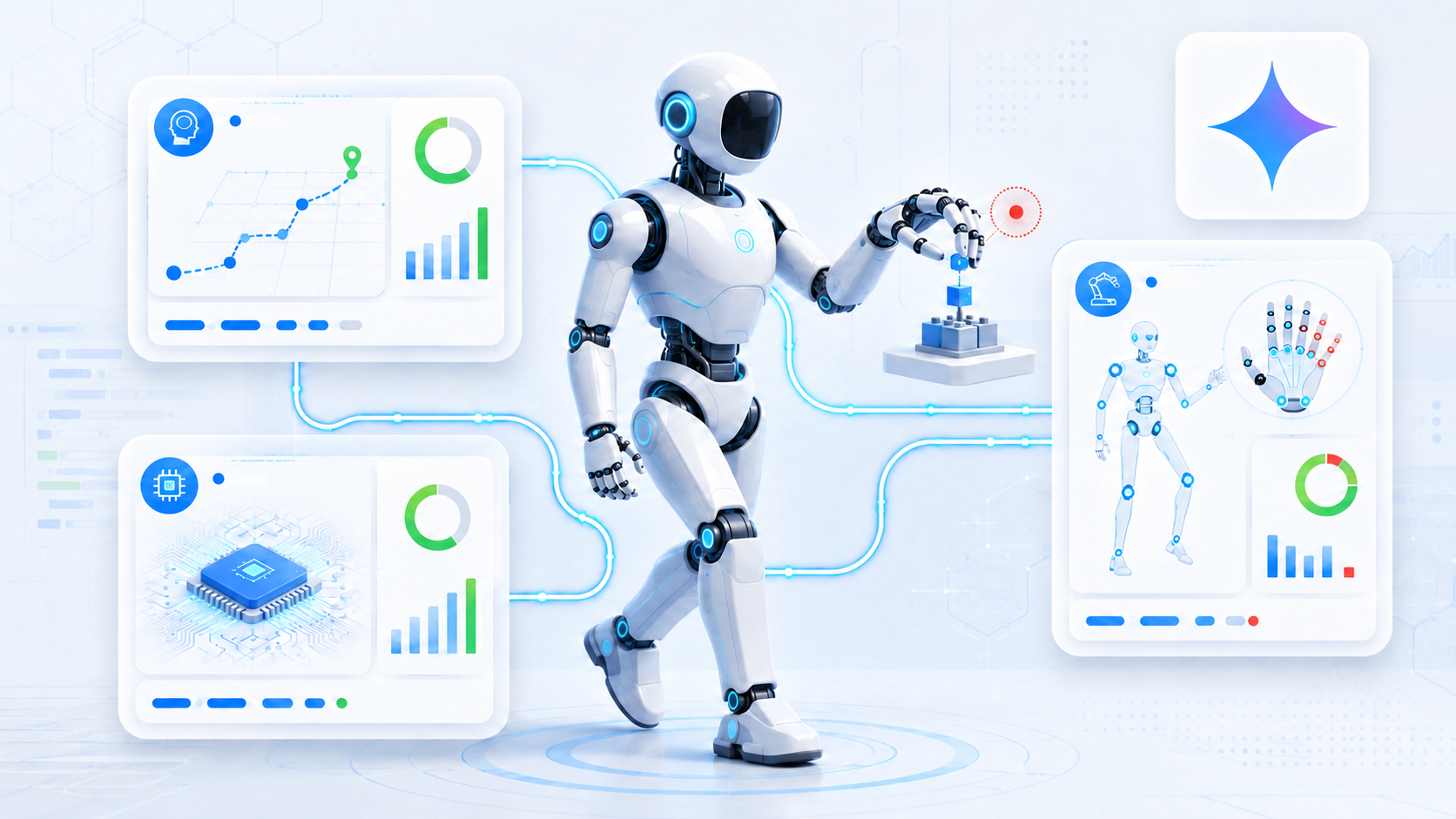
Every previous Gemini Robotics model drove a robot’s arms while something else worried about balance. Gemini Robotics 2, announced on July 30, drives the entire humanoid: legs, torso, arms, and a five-fingered hand. That is the architectural change worth understanding, and the published numbers are the reason it is worth understanding honestly.
What happened: Google DeepMind released Gemini Robotics 2 as three models rather than one. Gemini Robotics 2 is the vision-language-action model that turns pixels and instructions into motor commands, now for full humanoids and bi-arm platforms. Gemini Robotics ER 2 is the embodied-reasoning model that sits above it as the planner, holding multi-minute tasks together and coordinating more than one robot. Gemini Robotics On-Device 2 is the small one that runs locally on the robot with no network. ER 2 is available today in Google AI Studio; the VLA and on-device models are gated behind early access.
The details: The split matters more than the branding. ER 2 is a vision-language model doing slow, symbolic work: watch the room, decompose the goal, decide the next subtask, notice when a step failed, and call the VLA. The VLA runs the fast loop that actually moves joints. On a demo with Apptronik’s Apollo 2, the instruction “put the watering can into the green bin in the bottom shelf” becomes walk, reach, grasp, walk again, place, and each of those legs is a VLA call orchestrated by ER 2. On the dexterity side the model drives a 22 degree-of-freedom SharpaWave hand well enough to seal a ziplock bag and tie a knot in a trash bag, and it also drives plain two-finger grippers on a Franka Duo. On-Device 2 inherits the motion-transfer trick from Gemini Robotics 1.5 and adapts to a brand-new bi-arm body in a few hours, typically from fewer than 200 examples.
Now the numbers, which DeepMind published rather than hid. Whole-body manipulation on Apollo 2 with Inspire hands: 76.3% picking from a shelf, 68.4% from a table, 45.7% from the floor. Multi-finger dexterity with SharpaWave hands: unscrewing a bulb 92%, screwing one back in 36%, tying a trash bag 44%, ziplock 40%, dustpan 32%. Gripper work on the Franka Duo is the strongest of the three: precise insertion 89.6%, tool kitting 78.9%, general pick and place 74.2%.
flowchart LR
    U["Human instruction"] --> ER["Gemini Robotics ER 2<br/>plan, decompose, verify"]
    ER -->|subtask| VLA["Gemini Robotics 2 VLA<br/>vision + language to motor control"]
    VLA --> R["Humanoid or bi-arm robot"]
    R -->|camera + proprioception| ER
    ER -->|safety tool call| STOP["Safe stop"]
    OD["On-Device 2<br/>local VLA, no network"] --> R
DeepMind also shipped safety artefacts with the release: a safety technical report and ASIMOV-Agentic, a benchmark that measures whether the reasoning model will refuse an unsafe tool call coming from its own VLA, and whether it asks a human for help when it is uncertain. That is a security-boundary question dressed as a robotics one: the planner has to distrust its own executor.
Important
Our take: The gap between 92% unscrewing a bulb and 36% screwing one in is the most useful number in this release, and I am glad it is in the post rather than a footnote. Removal is a coarse motion with a wide success basin; insertion needs force feedback and alignment tolerance measured in millimetres. That asymmetry shows up everywhere in manipulation, and it is exactly what a highlight reel hides. If you build on this, build on ER 2 first: the reasoning and orchestration layer is the part you can reach today through AI Studio, and it is the part that generalises to hardware you already own. Treat the whole-body VLA as a research preview, because a 45.7% floor pick is not a product, it is a promising slope.
🗞️ More News
🧠 AI
- Gemini Robotics ER 2 is live in Google AI Studio as
gemini-robotics-er-2-previewand in private preview on the Gemini Enterprise Agent Platform. - Nscale signed a definitive agreement to acquire Anyscale for roughly $1.65 billion, pushing a GPU-cloud operator up into the workload-orchestration layer.
- Ray itself stays community-governed under the PyTorch Foundation, so the deal buys the company around the project, not the project.
- ASIMOV-Agentic shipped as a public Hugging Face dataset, measuring whether an embodied reasoner refuses unsafe tool calls and escalates to a human when uncertain.
- Four of the seven planned EU gigafactory sites are smaller builds of at least 75,000 AI chips each, eligible for up to 500 million euros of public funding apiece.
- The Commission signed letters of intent with AMD, Nvidia and Qualcomm so bidding consortia can actually source accelerators, which quietly answers who supplies Europe’s sovereign compute.
- Gemini Robotics On-Device 2 adapts to a completely new bi-arm embodiment in a few hours, typically from fewer than 200 demonstrations, inheriting motion transfer from 1.5.
🤖 Robotics
- Apollo 2 ships in both bipedal and wheeled-base configurations, the wheeled one deliberately aligned with existing industrial mobile robot safety standards.
- Robot Park is explicitly a data flywheel: fleet telemetry from customer and partner sites feeds back into Gemini Robotics training.
- The same Gemini Robotics 2 checkpoint was evaluated across three embodiments, including the two-arm Franka Duo research platform with Robotiq grippers.
- The 25th IEEE-RAS International Conference on Humanoid Robots is running at the Santa Clara Convention Center this week, which is why so much humanoid news is landing at once.
💻 Programming
- The stable Zephyr core adds the Arduino Nano RP2040 Connect and turns on automatic loader-and-sketch synchronisation on every upload.
- Bad Epoll, CVE-2026-46242, is a close-vs-close use-after-free in the kernel’s epoll release path that hands any local user root on 6.4 and later, Android included.
- A public proof-of-concept for Bad Epoll is now circulating, and the flaw carries a CVSS score of 7.8.
- Seven stable kernels landed in a single Saturday batch, two of them carrying security fixes, so the LTS lines keep absorbing the July CVE wave.
⚡ Electronics
- US legislators advanced the Connected Vehicle Security Act of 2026, widening restrictions on Chinese-origin connected-vehicle software and hardware beyond the existing BIS rule.
- Eighty chip startups raised a combined $8.4 billion across AI, EDA and manufacturing rounds, with indium phosphide and silicon photonics moving onto the critical-technology list beside CMOS.
- Engineers from Synopsys, Cadence, Siemens, Arm and Keysight laid out the 2026 design agenda on July 29: DDR6, 3D-IC reliability, chiplets and wireless interference testing.
- Module maker ADATA reportedly sees Q3 DRAM contract prices up 20% to 30% and NAND up 35% to 40%, so hobby-budget boards keep getting more expensive.
📡 Telecom
- The EchoStar transaction was first announced in August 2025 and only cleared this week, a reminder that spectrum deals move on regulatory time, not product time.
- AT&T says it will engineer the new holdings around uplink capacity rather than raw download headline speeds, which is the right call for sensor and agent traffic.
- The direct-to-device fight sharpened after FCC chairman Brendan Carr highlighted SpaceX and Amazon competition, knocking AST SpaceMobile shares.
- AST SpaceMobile launched its largest satellite yet for its space-based cellular network, betting on aperture where Starlink is betting on satellite count.
👨💻 Code Corner
Gemini Robotics ER 2 is the one piece of yesterday’s release you can call today, and you do not need a robot to try it. Point it at a photo of a cluttered desk and ask it to plan, and you get back the embodied-reasoning half of the loop.
# pip install google-genai
from google import genai
from google.genai import types

client = genai.Client()  # reads GEMINI_API_KEY from the environment

with open("desk.jpg", "rb") as f:
    image = types.Part.from_bytes(data=f.read(), mime_type="image/jpeg")

response = client.models.generate_content(
    model="gemini-robotics-er-2-preview",
    contents=[
        image,
        "You control a two-arm robot at this desk. "
        "Plan the steps to clear the mug into the bin on the left. "
        "Return a numbered list; flag any step you are unsure about.",
    ],
)

print(response.text)
Tip
Ask it to flag uncertainty explicitly, as above. Refusing an unsafe or impossible step and escalating to a human is exactly what the new ASIMOV-Agentic benchmark scores, so a plan that says “I cannot see the bin” is a better answer than a confident hallucinated reach.
🧰 Toolbox
- Gemini Robotics ER 2 in AI Studio: the embodied-reasoning model, free to poke at in the browser with your own photos.
- ASIMOV-Agentic: an open benchmark for whether an agent refuses unsafe tool calls and asks for help when uncertain.
- ArduinoCore-zephyr 0.90.0: the Arduino API running on a real RTOS, now stable and covering the Nano RP2040 Connect.
- Ray: the distributed-execution framework at the centre of the Nscale deal, still community-governed under the PyTorch Foundation.
- Franka Duo: the two-arm research platform DeepMind used for its gripper benchmarks, if you want the cheapest path to reproducing them.
🎬 Demo Watch (rotating)
Gemini Robotics 2: advanced dexterity
What it shows: an Apptronik Apollo 2 with 22 degree-of-freedom SharpaWave hands sealing a ziplock bag, tying a knot in a trash bag, and working a lightbulb, all driven by one model checkpoint rather than per-task scripting.
Why it is hard: these are deformable-object and force-controlled tasks. A ziplock seal needs pinch force held within a narrow band while both fingertips travel a seam; a trash-bag knot changes the object’s shape as you manipulate it, so the visual state at step three does not resemble the training frame from step one. Rigid pick-and-place has none of that.
Hype versus real: the video is real and the failures are published. Unscrewing a bulb lands 92%, screwing one back in lands 36%, ziplock 40%, trash-bag knot 44%, dustpan 32%. So the demo is not staged, but you are watching successful takes from a distribution where most of these tasks fail more often than they succeed. DeepMind says so plainly in the post, calling multi-finger dexterity the part that remains challenging. That is the healthiest version of a robotics launch we have seen this year: ship the chart with the reel.
📚 From the Blog
- Building Your First Neuron From Scratch: a neural network is a stack of simple learnable transformations, and this one builds the smallest possible piece of that stack by hand.
- The Network Behind the Cameras: the unglamorous plumbing that moves pixels off a camera, which is exactly the bandwidth problem a multi-robot fleet inherits.
- What Deep Learning Actually Is: the plain-language foundation under everything in today’s big story, including why one model checkpoint can drive three different robot bodies.
😀 The Bot Says…
Unscrewing a lightbulb: 92%. Screwing one back in: 36%. We have built a machine that is genuinely excellent at taking things apart and merely hopeful about putting them back. Relatable.
That’s all for today! Reply and tell us which number in that dexterity chart you would fix first.