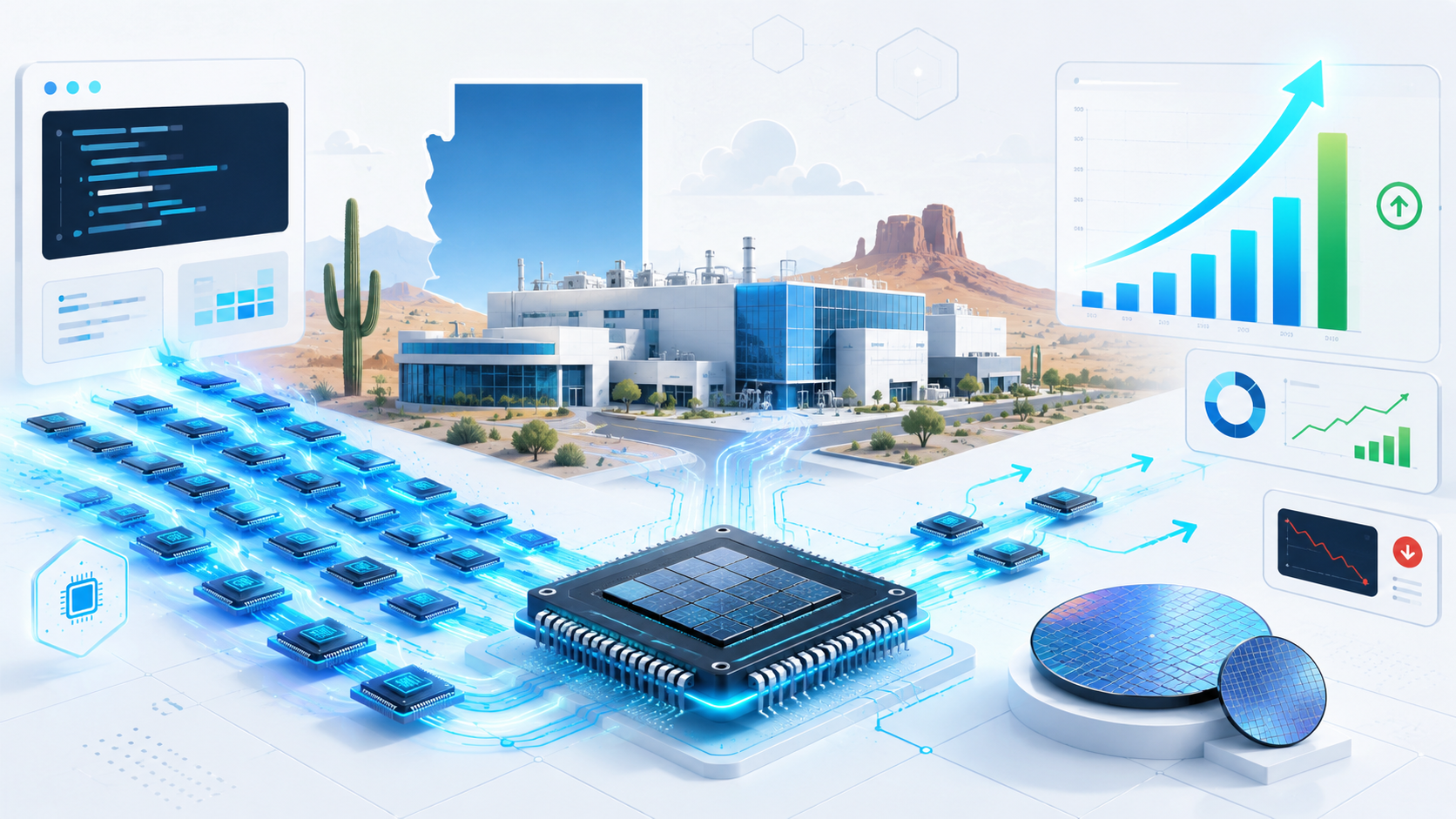
😁 Hello, super humans! We have been teasing TSMC’s Q2 earnings for two issues running, and today it landed with a twist nobody priced in: record profit, and then a fresh $100 billion check written for Arizona on top of it. On a day the chip sector has spent weeks second-guessing itself over AI spending, the world’s biggest foundry just answered with its wallet. Let’s dig in.
📰 Quick Signals
- 🧠 AI: NVIDIA and the Japanese government unveiled a sovereign “physical AI” partnership built around SoftBank’s Noetra project, which pools 44 Japanese companies including Honda and NEC behind a national robotics and AI foundation model backed by roughly 1 trillion yen in subsidies.
- 🤖 Robotics: Walden Robotics, a humanoid startup spun out of Toyota Research Institute, emerged from stealth with roughly $300 million in seed funding at a $1.1 billion valuation, and is already running wheeled humanoids on eight-hour shifts inside a Toyota factory.
- 💻 Programming: Rust cracked the TIOBE Index top 10 for the first time in the language’s history, climbing from No. 18 a year ago to No. 10 in the index’s 25th-anniversary July edition.
- ⚡ Electronics: ASML raised its 2026 sales guidance for the second time this year, now expecting between 43 billion and 45 billion euros on what it called “extremely strong” first-half orders from AI-driven capacity expansion.
- 📡 Telecom: The FCC announced it will vote in August on opening more than 225 MHz of unlicensed spectrum for direct-to-device satellite service, its next move after the July 22 upper C-band auction vote.
The Big Story: TSMC backs a $265B bet that the AI chip boom keeps going
If you have been waiting to see whether last month’s trillion-dollar chip selloff was the start of an AI spending correction, TSMC just gave its answer, and it is not subtle.
What happened: TSMC reported second-quarter 2026 revenue of NT$1,270.4 billion (about $40.2 billion) and net income of NT$706.6 billion, up 77.4 percent year over year on record margins, comfortably beating its own guidance (TSMC investor relations). In the same announcement, the company said it would invest an additional $100 billion in Arizona, on top of its existing commitments, bringing total planned US investment to $265 billion (CNBC).
The details: Gross margin hit 67.7 percent and operating margin 60.3 percent, with high-performance computing, the AI and data center bucket, now 66 percent of total revenue versus 22 percent for smartphones. TSMC raised its full-year 2026 revenue growth outlook to slightly above 40 percent in US dollar terms and guided third-quarter revenue to $44.6 billion to $45.8 billion as it ramps 2-nanometer production. CEO C.C. Wei described the supply-demand gap for advanced chips as “very big” and said the new Arizona money funds four or more additional fabs for 2-nanometer-and-below logic plus advanced packaging, the CoWoS capacity that has been the industry’s tightest bottleneck all year. The timing matters: this announcement landed the same week $1.3 trillion evaporated from chip-sector valuations on fears that AI capital spending was overbuilt. TSMC’s numbers, and its willingness to commit another nine figures to US capacity, are the sector’s clearest signal yet that the demand side of that bet has not cracked, whatever the stock charts say.
flowchart TD
    A["Q2 2026: record revenue + profit\nHPC = 66% of revenue"] --> B{"Market reads it as..."}
    B -->|"Chip selloff fears"| C["$1.3T wiped off\nsemiconductor valuations"]
    B -->|"TSMC's own signal"| D["+$100B Arizona\nTotal US commitment: $265B"]
    D --> E["4+ new fabs:\n2nm logic + CoWoS packaging"]
    C -.->|"same week"| D
Important
Our take: Earnings beats are common; a foundry doubling down on capex the same week its own sector gets torched is not. TSMC does not spend $100 billion on a hunch, and packaging capacity, not raw wafer starts, has been the real ceiling on AI chip supply all year, so watch where this money actually lands. For builders the read-through is simple: the HPC share of TSMC’s revenue (66 percent and climbing) is the closest thing we have to a real-time AI demand gauge, more honest than any single model launch. The risk worth naming is concentration: if a handful of hyperscalers are the customers driving that 66 percent, TSMC’s guidance is really a bet on their capex staying elevated, and that is a much narrower bet than “AI demand” makes it sound.
🗞️ More News
🧠 AI
- The UN’s Independent International Scientific Panel on AI, co-chaired by Yoshua Bengio and Maria Ressa, told the first Global Dialogue on AI Governance in Geneva that science cannot currently guarantee increasingly capable AI systems will not cause catastrophic harm.
- xAI released Grok 4.5, its first model built specifically for coding and agentic work, landing fourth on the Artificial Analysis Intelligence Index at roughly a quarter of the token cost of Claude Opus 4.8 on the same benchmark.
- Meta shipped Muse Spark 1.1, a multimodal agentic model with a 1M-token context window, in public preview on its new Meta Model API, the first Meta model the company has ever charged developers to use.
- Ant Group open-sourced SingGuard-NSFA, an agentic-AI security framework that maps 185 operational threat scenarios across seven categories, including prompt injection and permission escalation, a timely follow-up to this week’s Grok Build repo-upload story.
- OpenAI’s GPT-5.6 family reached general availability, ending the two-week gated preview that had run since June 26 under a US government safety review.
- Google’s Gemini 3.5 Pro is on track for general availability tomorrow, July 17, with a rumored 2-million-token context window and a Deep Think reasoning tier, though Google has not confirmed the specs itself.
- Thinking Machines released Inkling, its first open-weight model, reasoning natively across text, audio, and images in one architecture with 975B total parameters (41B active), a 1-million-token context window, and controllable thinking effort under an Apache 2.0 license.
- OpenAI shipped GPT-Red, an automated red-teaming system that attacks OpenAI’s own models via self-play, succeeding on 84 percent of attack scenarios versus 13 percent for human testers and cutting prompt-injection failures 6x on its hardest benchmark.
- OpenAI’s first hardware device is reportedly a portable, screen-free “AI companion” speaker with cameras, sensors, and moving parts meant to learn its owner’s context over time, according to Bloomberg; the device isn’t expected until around 2027.
- China’s Cyberspace Administration cleared Apple Intelligence for iPhones sold in the country, one of only two foreign AI services approved alongside Samsung’s Galaxy AI, though it’s unclear yet whether iPads or Macs are included.
🤖 Robotics
- China is deploying humanoid robots to logistics hubs, battery plants, and other industrial sites at a faster pace than the US, sending thousands out to gather the real-world data needed to train smarter machines.
- South Korea set a national target to grow its share of the global humanoid robot market from 1 percent to 20 percent by 2028, part of the roughly $880 billion decade-long plan announced in June covering chips, data centers, and robotics.
- Tsinghua University defended its humanoid soccer title at RoboCup 2026 in Incheon, one of the clearer public benchmarks for how far legged-robot coordination and agility have actually come this year.
- 1X gave its NEO humanoid a new pair of hands with high-resolution tactile sensors in the palm and fingertips, precise and dexterous enough to assemble LEGOs, install light bulbs, and zip jackets in demos, aimed at both factory and home use.
- UC San Diego researchers demonstrated “Surgie,” a 5-foot-tall surgeon humanoid, performing surgery, pitched not as a replacement for surgeons but as a way to bring procedures to remote locations without easy access to one.
- The NHTSA warned robotaxi operators, including Tesla, that their vehicles have been delaying or blocking first responders and emergency vehicles by failing to recognize emergencies without a human on board, giving companies a month to fix it.
💻 Programming
- A PEP draft for integrating Rust into CPython landed this cycle, with a Python 3.16 beta targeted for May 2027 and full release in October 2027 if the proposal advances.
- Python 3.14.6 and 3.13.14 shipped routine bug-fix releases while Python 3.15 picked up two more betas ahead of its fall release.
- TIOBE’s full July index has Python holding the top spot at 18.94 percent, with C and C++ swapping second and third place year over year and SQL and R both posting the largest gains after Rust.
⚡ Electronics
- South Korea’s $880 billion decade-long plan has Samsung and SK Group each building two new fabs in the southwest, roughly 800 trillion won of the total, aimed at doubling the country’s memory chip output.
- Chip stocks partly rebounded Thursday after Micron, Intel, AMD, and Marvell had shed 6 to 13 percent this week on fears that AI capital spending was outrunning returns, the same selloff TSMC’s earnings pushed back against.
- Arduino’s upcoming Ventuno Q pairs a Qualcomm Dragonwing IQ8 SoC delivering up to 40 dense TOPS of NPU acceleration with a dedicated STM32H5 microcontroller for low-latency motor control, aimed squarely at on-device generative AI and robotics projects.
📡 Telecom
- Rocket Lab’s roughly $8 billion cash-and-stock deal to acquire Iridium is moving forward, creating a vertically integrated launch-and-satellite operator that draws direct comparisons to SpaceX.
- Globe Telecom launched Starlink Direct-to-Cell as a commercial service in the Philippines, the first direct-to-device satellite rollout in Southeast Asia.
- EchoStar agreed to sell spectrum to SpaceX alongside a new commercial agreement, the latest in a wave of spectrum consolidation among satellite operators this year.
👨💻 Code Corner
Today’s Big Story leans on percentages the way most quarterly earnings do. Here is the actual math behind a “up 36 percent year over year” headline, worth having in your back pocket the next time an earnings report lands in your feed.
# The math behind "revenue up X% YoY / QoQ" headlines,
# reconstructed from TSMC's reported growth rates.
def growth_pct(current: float, prior: float) -> float:
    return round((current - prior) / prior * 100, 1)

# TSMC Q2 2026 revenue (NT$ billions), working backward from
# the reported +36.0% YoY and +12.0% QoQ growth rates.
q2_2026 = 1270.38
q2_2025 = q2_2026 / 1.360
q1_2026 = q2_2026 / 1.120

print(f"YoY growth: {growth_pct(q2_2026, q2_2025)}%")
print(f"QoQ growth: {growth_pct(q2_2026, q1_2026)}%")
Tip
Watch the currency, not just the percentage. TSMC guides revenue growth “in US dollar terms” separately from its NT$ figures, and the two can diverge when the exchange rate moves. Before you compound a few quarters of QoQ growth into your own annual estimate, check whether the company’s own YoY number already agrees with you: if it does not, you are probably mixing currencies or comparison bases.
🧰 Toolbox
- SingGuard-NSFA: Ant Group’s open-source security framework that screens agentic AI actions against 185 catalogued threat scenarios before they execute.
- GStreamer 1.28.5: the open-source multimedia framework now decodes H.266/VVC, useful if you are prototyping against the next-generation video codec early.
- Grok 4.5 API: an Opus-class coding and agent model at roughly a quarter of the token cost, worth a look for latency- or budget-sensitive agent workloads.
- Moddo Pinch: a 10.9 x 12.5mm Arduino-compatible board built on a SAMD11 Cortex-M0+, small enough to disappear inside a wearable or sensor enclosure, for $15.90.
- PrismML Bonsai 27B: the first 27B-class open-source model that runs on a phone, a 1-bit variant at 3.9GB retaining about 90 percent of full-precision performance, useful for local AI agents that need to keep data on-device.
- Grok Build: xAI open-sourced the Rust agent harness, TUI, and tool layer behind its coding CLI under Apache 2.0, so you can audit it, point it at your own local inference, and customize the loop instead of treating it as a black box.
🛠️ Build of the Week (rotating)
Open Book Touch: a fully open-source, DRM-free e-reader built around an ESP32-S3, now crowdfunding on Crowd Supply.
- Difficulty: Intermediate
- Parts: ESP32-S3, 4.26-inch e-paper touchscreen (480×800), 16MB flash, 8MB PSRAM, 800mAh LiPo, 3D-printed enclosure
- Why we like it: MIT-licensed firmware and open hardware mean you can flash your own UI instead of accepting whatever a closed e-reader ships with, and it reads EPUB and TXT straight off a microSD card with no vendor account required.
📚 From the Blog
- What Deep Learning Actually Is: the plain-language foundation under every model launch in today’s issue, from Grok 4.5 to Muse Spark 1.1.
- How the Internet Stack Really Works: the layered journey a request takes from Enter key to rendered page, a fitting companion to today’s spectrum and satellite news.
- Resistance and Ohm’s Law: Controlling the Flow: the physics running under every fab, board, and chip in this issue, from first principles.
😀 The Bot Says…
TSMC just spent $100 billion more on chip factories the same week the stock market panicked about too many chip factories. Somewhere, a spreadsheet is having a very confusing day.
That’s all for today! Does a $265 billion bet from the world’s biggest foundry change your mind about the AI capex worries, or is it just a very expensive shrug? Reply and tell us.