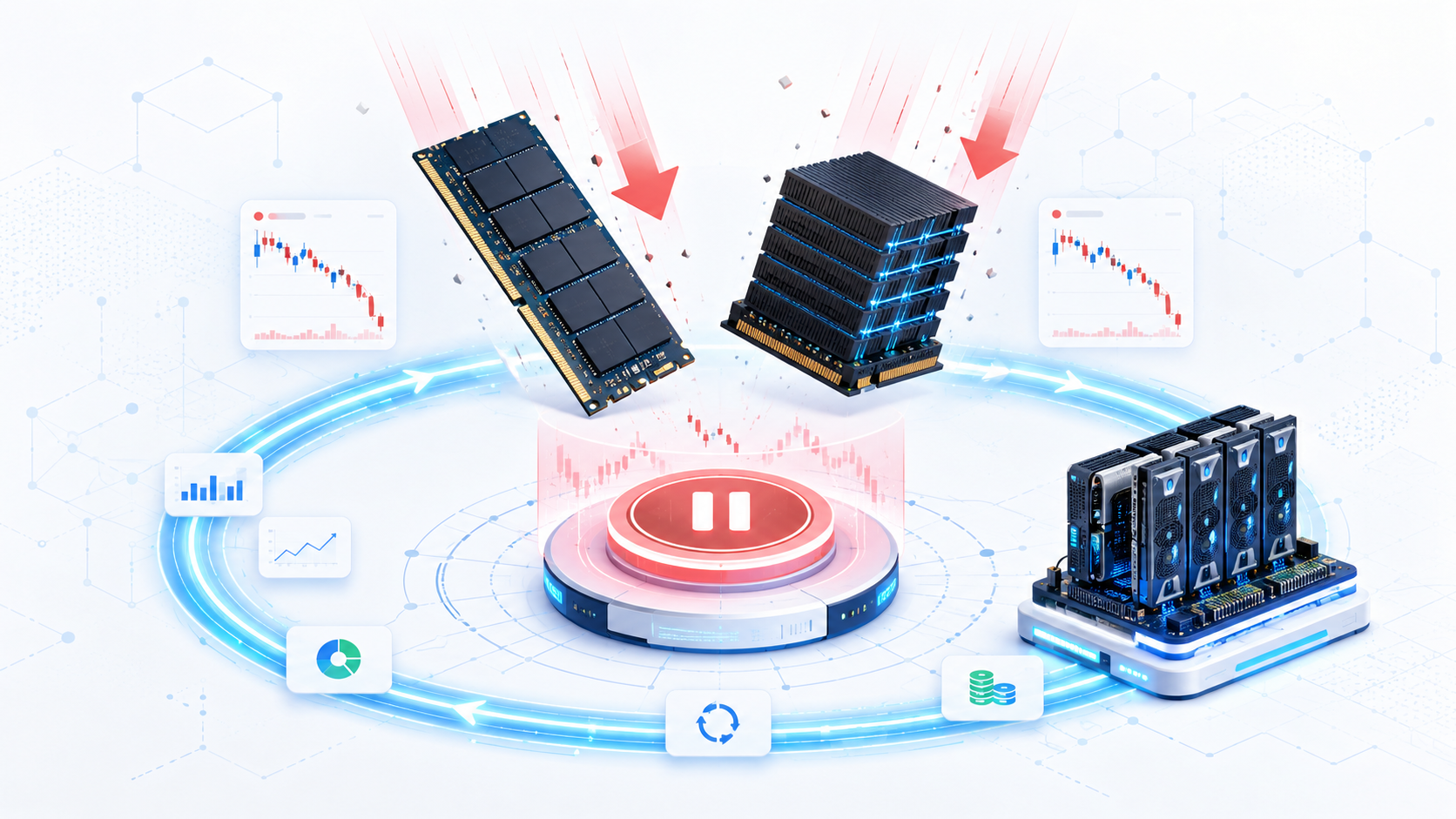
😁 Hello, super humans! Two companies, one index, one very bad Tuesday. Korea’s stock exchange had to stop trading entirely this morning because the two firms that make the memory inside every AI accelerator fell off a cliff together. Today’s Big Story is about what happens when the hardware layer everyone depends on becomes a single financial trade. Grab a coffee.
📰 Quick Signals
- 🧠 AI: Nvidia is in advanced talks to guarantee as much as $250 billion of financing for OpenAI’s planned 10-gigawatt data center in southern Ohio.
- 🤖 Robotics: Genesis AI is in talks to raise roughly $500 million at a $3 billion pre-money valuation, one of the largest robotics-foundation-model rounds yet.
- 💻 Programming: Node.js shipped security releases across the 26.x, 24.x, and 22.x lines on July 27 to fix issues rated HIGH severity.
- ⚡ Electronics: Espressif’s ESP32-S31 entered mass production and is now on sale, aimed squarely at next-generation AIoT designs.
- 📡 Telecom: Amazon asked the FCC to authorize up to 5,105 next-generation satellites for direct-to-device service to unmodified smartphones.
The Big Story: Korea halted trading because two memory companies are now the whole AI trade
If you build anything that needs RAM, whether that is a server rack, a phone, or a hobby board, the price of your bill of materials was just repriced in public. South Korea’s benchmark index fell hard enough this morning to force the exchange to stop trading, and the entire move came from two companies that make the memory inside AI accelerators.
What happened: The Kospi closed down 732.09 points at 6,023.66, a drop of 10.84%, its worst session since a record decline in March. The Korea Exchange activated a marketwide circuit breaker once the index sat more than 8% below the previous close, suspending trading for 20 minutes; it was the eighth circuit-breaker activation of 2026. Samsung Electronics fell 14.4%, its largest single-day decline since October 2008, and SK Hynix fell 14.7% after its American depositary receipts slipped below their US offering price. Japan’s Nikkei 225 and Taiwan’s Taiex each fell more than 4%, so this was not a purely Korean event. Reporting by Bloomberg and the Associated Press ties the move to two things: doubts about how AI infrastructure is being financed, and rising Chinese competition in memory.
The details: The financing worry has a specific trigger. Nvidia is assembling more than $750 billion of deals, including over $500 billion of business with SK Group (a blend of Nvidia buying memory, SK spending on its own AI infrastructure, and co-investments, plus more than 2 GW of data centers on the Korean Peninsula) and a possible $250 billion backstop for OpenAI’s Ohio campus. Written out like that, the loop is visible: the chip supplier helps finance the buildout that then buys its chips. The competition worry has a date attached too. ChangXin Memory Technologies, China’s largest DRAM maker, surged about 470% on its Shanghai debut yesterday to roughly 3.3 trillion yuan (about $480 billion), on the back of Asia’s biggest IPO this year.
Underneath the market story is a physical one this newsletter has been tracking for months. Memory makers have been shifting wafer capacity from commodity DRAM to high-bandwidth memory for AI accelerators, and the commodity side has repriced violently: DRAM is up roughly 171% year over year, DDR5 spot prices have quadrupled since September 2025, and Google now cites a sixfold jump in the cost of a gigabyte of RAM, from about $2.80 in 2025 to about $12 in 2026, as the reason Pixel prices are going up.
flowchart LR
    N["Nvidia\nchip supplier"] -->|"financing, guarantees,\nco-investment"| D["AI data centers\n(OpenAI Ohio, SK Korea)"]
    D -->|"buys accelerators"| N
    D -->|"absorbs HBM capacity"| M["Memory fabs\nSamsung · SK Hynix"]
    M -->|"wafers shift off\ncommodity DRAM"| P["📈 DRAM +171% YoY\nyour BOM, your phone, your PC"]
    C["🇨🇳 CXMT\n7.7% of global DRAM"] -.->|"new supply,\nnew price pressure"| M
Important
Our take: A 14% drop in Samsung does not add a single wafer of DRAM capacity, and that is the part worth holding onto. The market repriced a financing structure, not the physics of the shortage. If you are planning hardware for 2027, keep budgeting for expensive memory; if anything, a selloff makes fabs more cautious about the capex that would eventually relieve it. The genuinely new variable is CXMT, because a fourth large DRAM supplier with state backing is the only thing on the board that structurally changes supply. My honest read: treat memory as a first-class design constraint again, the way embedded developers always have. Fitting your model in 8 GB instead of 16 GB is now a line item with a dollar figure next to it.
🗞️ More News
🧠 AI
- Nvidia invested in Ilya Sutskever’s Safe Superintelligence, giving the lab access to far more Nvidia hardware after years of leaning on Google TPUs.
- Nvidia, Microsoft, Adobe, CrowdStrike, Dell, and Hugging Face formed the Open Secure AI Alliance to share agent-security tooling after the Hugging Face breach.
- Apple pushed its first smart glasses to WWDC 2027 with a late-2027 release, driven by internal debates over on-device processing and a hard ban on facial recognition.
- Monday.com is cutting about 20% of its staff, roughly 630 roles, and taking $45M to $55M in charges as it rebuilds around an AI work platform.
- Brussels ordered Google under the Digital Markets Act to let rival assistants register wake words, read the screen, and act inside other apps on Android.
- DeepSeek’s V4 rollout introduces peak and off-peak API pricing, charging double during Beijing working blocks of 9am to noon and 2pm to 6pm.
- Genius AI, formerly GlossGenius, raised a $44M Series D led by Lux Capital, taking it past $125M raised in total.
🤖 Robotics
- BYD teased its first humanoid robot with a poster on July 27, pointing to a public debut in early August.
- Humanoid fundraising over the past 12 months totals about $6.20 billion across 25 disclosed equity rounds and 20 companies.
- Robot.com launched a humanoid it pitches as built for “the work that burns people out,” aiming at repetitive industrial tasks rather than demos.
💻 Programming
- Linux 7.2-rc5 landed on July 26 with networking drivers eating more than 35% of the changes, targeting a stable release on August 16.
- Rust entered the TIOBE top 10 for the first time in the language’s history, climbing from number 18 a year ago.
- JDK 28 picked up JEP 540, a Simple JSON API, and JEP 541, which deprecates the macOS x64 port for removal.
- Python 3.15 picked up two more betas while 3.14.6 and 3.13.14 shipped routine bug fixes.
⚡ Electronics
- CXMT closed its Shanghai debut up about 470%, worth roughly 3.3 trillion yuan, after raising 57.92 billion yuan in Asia’s biggest IPO this year.
- Qualcomm told customers it will raise smartphone chip prices by double-digit percentages on shipments from September 1, blaming supplier costs it can no longer absorb.
- The memory price surge is finally cooling as consumer buyers hit an affordability ceiling, though DRAM and NAND keep climbing through Q3 2026.
- PC makers including Lenovo, Dell, HP, Acer, and ASUS have now warned of 15% to 20% price increases for 2026 on DRAM and NAND costs alone.
📡 Telecom
- Portugal’s regulator Anacom approved a draft decision extending Meo, Nos, and Vodafone spectrum rights in the 800, 1800, and 2100 MHz bands out to 2041 and 2042.
- France confirmed that its France 2030 programme will fund 6G standardisation work, with a Bpifrance-managed call for projects closing on 15 January 2027.
- Spectrum allocation, not launch capacity, is shaping up to decide Southeast Asia’s direct-to-device satellite race, with European players now entering it.
- TeleGeography’s June and July M&A roundup tracks a fresh wave of operator consolidation, with France and Greece among the most active markets.
👨💻 Code Corner
When RAM costs six times what it did last year, “how much memory does my script actually use?” stops being an academic question. Python can answer it without any dependencies, as long as you measure both numbers.
# peak_mem.py: what your code costs in RAM, from two angles
import resource
import tracemalloc

tracemalloc.start()
buffers = [bytearray(1024 * 1024) for _ in range(64)]   # allocate ~64 MiB
_, py_peak = tracemalloc.get_traced_memory()
tracemalloc.stop()

rss_peak = resource.getrusage(resource.RUSAGE_SELF).ru_maxrss   # KiB on Linux

print(f"Python objects peak : {py_peak / 1024**2:7.1f} MiB")
print(f"Whole-process peak  : {rss_peak / 1024:7.1f} MiB")
print(f"Runtime overhead    : {rss_peak / 1024 - py_peak / 1024**2:7.1f} MiB")

del buffers
Tip
The two numbers disagree on purpose. tracemalloc only sees allocations made through Python’s allocator, so NumPy arrays, PyTorch tensors, and anything from a C extension show up in ru_maxrss but not in tracemalloc. One more portability trap: ru_maxrss is kibibytes on Linux and bytes on macOS, so divide by 1024 on one and 1024**2 on the other.
🧰 Toolbox
- memray: Bloomberg’s Python memory profiler, with native-extension tracking and flame graphs that show exactly which line allocated what.
- zram: compressed block devices in RAM, the cheapest way to stretch a memory-starved board or VM before you buy more DIMMs.
- Massif: Valgrind’s heap profiler, still the clearest way to see a C or C++ program’s memory over time.
- PCPartPicker memory trends: live per-gigabyte price history, useful for arguing with anyone who thinks the shortage is over.
- OpenRouter: one API across dozens of models, handy right now for A/B-testing whether a cheaper open model does your job.
- Global memory shortage tracker: a running, heavily cited timeline of the whole DRAM crunch, better than any single news article.
🎬 Demo Watch (rotating)
Brain waves as robot training data. Data-labelling company Encord and German neurotech startup Zander Labs are running a trial where a human operator teleoperates a robot while wearing a headset that records both the scene and the operator’s electroencephalogram. The idea is that video shows what the hand did, but neural signals show when the person noticed a mistake, changed strategy, or was surprised: exactly the moments a demonstration dataset usually cannot label.
What is real: the rig exists and is collecting data on tasks like stacking poker chips and pouring from a coffee pot. What is hype, or at least unproven: Encord itself says this is a trial, and the plan is to build one brain-wave-tagged dataset, run it through customer models, and see whether accuracy actually moves before scaling anything. Zander neuroscientist Lucas Gehrke makes the most interesting claim in the piece, which is that the amount of brain activity during a task hints at how hard the task is, which could tell a model builder when to escalate to a bigger model. Physical-AI data is expensive to produce, so a signal that labels difficulty for free would be worth a lot. Watch the results, not the headset. Read the full report at TechCrunch.
📚 From the Blog
- Building Your First Neuron From Scratch: Part 2 of the deep learning series turns “nudging weights to lower a loss” into working code you can read line by line.
- What Deep Learning Actually Is: the plain-language opener to the series, and a good companion to today’s Big Story if you want to understand why these models are so hungry for memory in the first place.
- How the Internet Stack Really Works: what actually happens between pressing Enter and the page appearing, layer by layer.
😀 The Bot Says…
Somewhere out there is a developer who added import pandas to a script that reads one CSV, and their laptop’s RAM is now worth more than their laptop.
That’s all for today! Reply and tell me: has the memory crunch actually changed a design decision you made this year, or is it still just a headline? I read every answer.