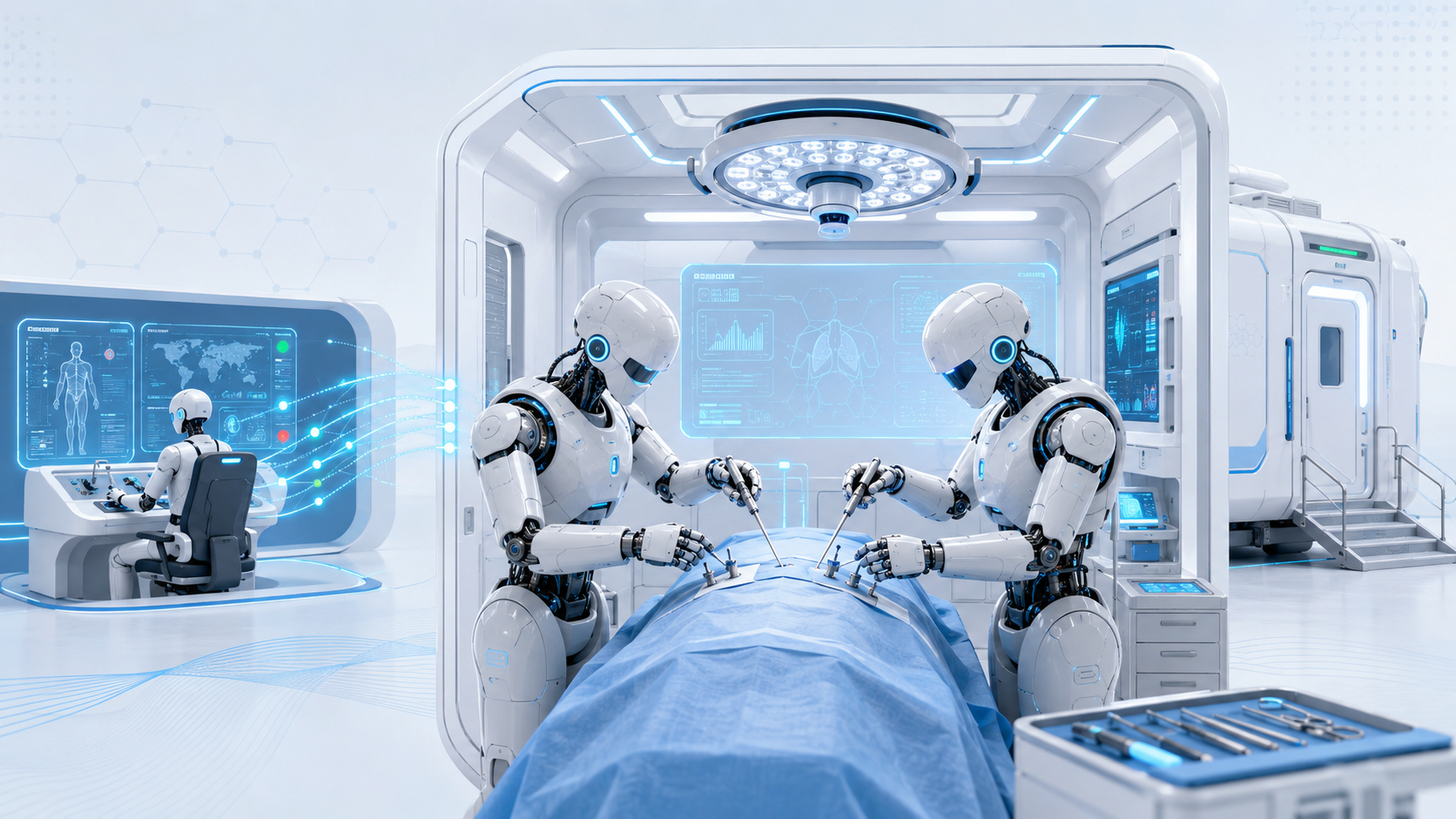
😁 Hello, super humans! For decades, robotic surgery meant one 1,800-pound machine bolted into a specially built room. This week two 60-pound humanoids picked up ordinary laparoscopic tools and removed a gallbladder, and in a second procedure two of them did it side by side with no human hands inside the patient at all. When general-purpose robots can scrub in, the operating room stops being a place you have to build. Let’s dig in.
📰 Quick Signals
- 🧠 AI: ByteDance released Seedream 5.0 Pro, a multilingual image model with native text rendering and click-to-edit region control across more than ten languages (Tech Startups).
- 🤖 Robotics: Tesla stood up its first Optimus Gen 3 line at Fremont, targeting 100 to 150 units a week this month in the converted Model S/X hall (Teslarati).
- 💻 Programming: Astral pushed ty, its Rust-based Python type checker, into beta, recomputing diagnostics in single-digit milliseconds (InfoWorld).
- ⚡ Electronics: Samsung’s chip division posted a roughly 19-fold jump in quarterly profit on runaway AI-memory demand (Tom’s Hardware).
- 📡 Telecom: Globe Telecom switched on commercial satellite-to-mobile service over Starlink’s direct-to-cell network, reaching phones with no tower in range (BusinessWorld).
The Big Story: Two teleoperated humanoid robots performed live surgery
If you want to know whether a humanoid robot can do useful, precise, high-stakes work, put a scalpel near it. A team at UC San Diego just did, and the robots passed.
What happened: For the first time, two teleoperated humanoid robots completed live surgeries in a preclinical trial, engineers and surgeons at UC San Diego report in the July 8 issue of Nature. In one procedure, a human-robot team of one humanoid and a human surgeon acting as assistant performed a gallbladder removal; in a second, two humanoids worked side by side as a robot-robot team. Both operations were done on large non-primate mammals (UC San Diego Today, Nature).
The details: The robots, nicknamed Surgie, stand 5 feet tall and weigh 60 pounds. Compare that to the specialized surgical systems in use today: three or four dedicated arms, proprietary tooling, about 1,800 pounds, and an operating room that usually has to be retrofitted around them. The team built adapters so Surgie could grip standard laparoscopic instruments, then a surgeon teleoperated it from a console. Precision was on par with a teleoperated specialized system, the surgeons said. The honest catch is speed: the robots needed recalibration several times mid-procedure, so operations ran much longer than with mature systems. The team frames that the way the field earned its stripes before; the first robotic laparoscopic surgery took six hours, and now takes thirty minutes.
flowchart LR
    C["Surgeon at console"] --> N["Network link + latency"]
    N --> R["Humanoid robot (Surgie)"]
    R --> T["Standard laparoscopic tools"]
    T --> V["Camera + force feedback"]
    V --> N
    N --> C
Important
Our take: The interesting word here is not “robot,” it is “general-purpose.” A specialized surgical system does one class of job in one built-for-it room; a 60-pound humanoid that grips off-the-shelf tools can, in principle, be trucked to a rural clinic, a disaster zone, or a ship. That reframes the constraint in surgery from “build a robotic OR” to “get a bandwidth link and a trained teleoperator,” which is a very different, much cheaper problem. The recalibration and latency issues are real, but they are the boring kind of engineering problem that gets ground down over time. Watch the autonomy roadmap: the team’s stated goal is an autonomous surgical assistant, and the moment a humanoid can reliably hand tools and hold retraction on its own, the economics of understaffed operating rooms change.
🗞️ More News
🧠 AI
- OpenAI’s GPT-5.6 is now the default model inside Microsoft 365 Copilot, powering Word, Excel, PowerPoint and Chat (Releasebot).
- Meta shipped Muse Spark 1.1, its first paid model, a $1.25 / $4.25 per million tokens agentic coder (Meta AI).
- Anthropic published research describing a small “global workspace” inside Claude, the narrow stage where the model holds the thoughts it can act on (Anthropic Research).
- China’s rules on anthropomorphic AI take effect July 15, pushing ByteDance’s Doubao and Alibaba’s Qwen to strip or restrict humanlike agent features (Tech Startups).
- Tencent is in talks to become the largest shareholder in Manus, the autonomous AI-agent startup (Bloomberg).
- OpenAI committed $4 billion to its forward-deployed “Deployment Company” and acquired Northslope to embed more engineers inside customer orgs (OpenAI).
🤖 Robotics
- Amazon deployed its one millionth warehouse robot and rolled out a new AI foundation model to coordinate the fleet (Amazon).
- NEURA Robotics closed a record round of up to $1.4 billion at roughly a $7 billion valuation, the largest ever for a full-stack robotics company, to fund a US push with AWS and Qualcomm (NEURA Robotics).
- Robotics funding set a fresh annual record in 2026, with trackers logging well above 2025’s full-year total as humanoid rounds keep enlarging (New Market Pitch).
💻 Programming
- Python 3.15 picked up two more betas on the way to a fall release, while 3.14.6 and 3.13.14 shipped routine bug fixes (Real Python).
- EuroPython 2026 lands in Kraków July 13 to 19, with keynotes from Guido van Rossum, Pablo Galindo, and Łukasz Langa (EuroPython).
- Discord open-sourced Osprey, a Rust-plus-Python safety-rules engine that processes 400 million actions a day (Discord).
⚡ Electronics
- SK Hynix made its US ADR debut, opening the AI-memory leader to a much wider pool of investors (Bloomberg).
- NextSilicon said its Maverick-2 accelerator outperforms Nvidia and Intel GPUs and teased a new RISC-V test chip (Data Center Dynamics).
- Infineon extended its automotive AURIX brand with a new RISC-V microcontroller family (Infineon).
- Reports say Nvidia may slip its next-generation Kyber AI rack system to 2028, even as it deepens Marvell and Palantir partnerships (Semiconductor Engineering).
📡 Telecom
- Deutsche Telekom signed on to bring Starlink Mobile to 10 European countries, the first major EU carrier deal of its kind (Starlink).
- SpaceX rebranded its direct-to-phone service as Starlink Mobile, citing roughly 10 million monthly users through partner carriers and a 25 million target by year end (SDxCentral).
- SpaceX asked the FCC to authorize up to 15,000 Starlink satellites as the constellation scales past 10,400 already in orbit (SpaceX).
👨💻 Code Corner
Today’s Big Story runs on a teleoperation link, so let’s compute the number that decides how far away a surgeon can sit: the round-trip latency budget. Light in optical fiber travels about 200,000 km/s, roughly two thirds of c, and every command makes a round trip.
# Why remote surgery gets harder with distance: the round-trip latency budget.
FIBER_SPEED_KM_S = 200_000    # signal speed in optical fiber (~2/3 c)
processing_ms    = 12         # encode + control loop + decode, each way (est.)

def round_trip_ms(distance_km: float) -> float:
    one_way_propagation_ms = (distance_km / FIBER_SPEED_KM_S) * 1000
    return 2 * (one_way_propagation_ms + processing_ms)

for place, km in [("same building", 0.1), ("across town", 20),
                  ("New York to LA", 3900), ("across the Atlantic", 6000)]:
    print(f"{place:20} {round_trip_ms(km):6.1f} ms")

# same building          24.0 ms
# across town            24.2 ms
# New York to LA         63.0 ms
# across the Atlantic    84.0 ms
Tip
Notice propagation is not the villain: even across an ocean the round trip stays under the roughly 200 ms mark where surgeons start feeling lag. The delay the UC San Diego team is actually fighting comes from processing, recalibration, and the control loop, not the speed of light.
🧰 Toolbox
- da Vinci Research Kit (dVRK): the open hardware-plus-software stack academic labs use to prototype teleoperated surgical robots.
- AMBF: a real-time simulator with haptic support, built for surgical and teleoperation research.
- PyBullet: an easy Python physics engine for prototyping manipulation and control loops.
- Intel RealSense SDK: drivers for affordable depth cameras that give a robot the 3D scene sense a manipulation stack needs.
- uv: Astral’s fast Python package and project manager, the sibling tooling to today’s ty type checker.
🔌 Component of the Week (rotating)
TI DRV2605L haptic driver: today’s Big Story lives and dies on how a surgeon feels the tools through a robot, and haptics start with a chip like this. The DRV2605L drives ERM and LRA vibration motors over I2C, with a built-in library of 123 tuned click, buzz, and pulse effects so you do not have to hand-code waveforms. It runs from 2V to 5.5V, does real-time auto-resonance tracking for crisp LRA feedback, and pairs cleanly with an ESP32, Pico, or Arduino. Breakout boards run about $8, which makes it the cheapest way to add believable touch feedback to a teleoperation rig or game controller. Start from the TI product page and datasheet.
📚 From the Blog
- How the Internet Stack Really Works: what actually happens between pressing Enter and a response arriving, the same link budget that decides how far a teleoperated surgeon can sit from the table.
- Resistance and Ohm’s Law: Controlling the Flow: resistance and Ohm’s law from the ground up, the physics behind every actuator that moved Surgie’s arms.
- What Electricity Actually Is: Charge, Current, and Voltage: charge, current, and voltage from first principles, where every motor and haptic driver in today’s issue ultimately starts.
😀 The Bot Says…
A robot just performed surgery with 60 pounds of hardware and zero years of medical school, then offered to tidy the operating room afterward. The overachiever we did not ask for, but probably deserve.
That’s all for today! Would you let a teleoperated robot take out your gallbladder, or wait a few more versions? Reply and tell us.