😁 Hello, super humans! The model everyone has been refreshing their dashboards for is finally here, and OpenAI shipped it as a trio, not a single flagship. Same day, same platform, three price points. That little detail changes how you should build, so let’s dig in.
📰 Quick Signals
- 🧠 AI: OpenAI also rolled out GPT-Live, a new class of voice models that can listen and speak at the same time, making conversations feel less like walkie-talkie turns (CNBC).
- 🤖 Robotics: Shenzhen-based AI2 Robotics raised roughly $735M Series B at a near $3B valuation, planning to scale its AlphaBot wheeled humanoids from 1,000 to 10,000 units this year (The Robot Report).
- 💻 Programming: Python’s Steering Council put CPython’s experimental JIT on a six-month clock: prove it earns its complexity or it gets pulled (Real Python).
- ⚡ Electronics: A semiconductor selloff wiped more than $1T in market value this week as Wall Street questioned AI capex, pushing Intel down about 21% (Forbes).
- 📡 Telecom: Nokia is charting a course to “AI-native 6G,” leaning on an Nvidia tie-up and planning to phase out purpose-built 5G hardware for GPU-based infrastructure in the 2030s (Telecoms.com).
The Big Story: GPT-5.6 goes global, and it comes in three flavors
If you build on LLM APIs, today is a config change and a cost decision, not just a headline.
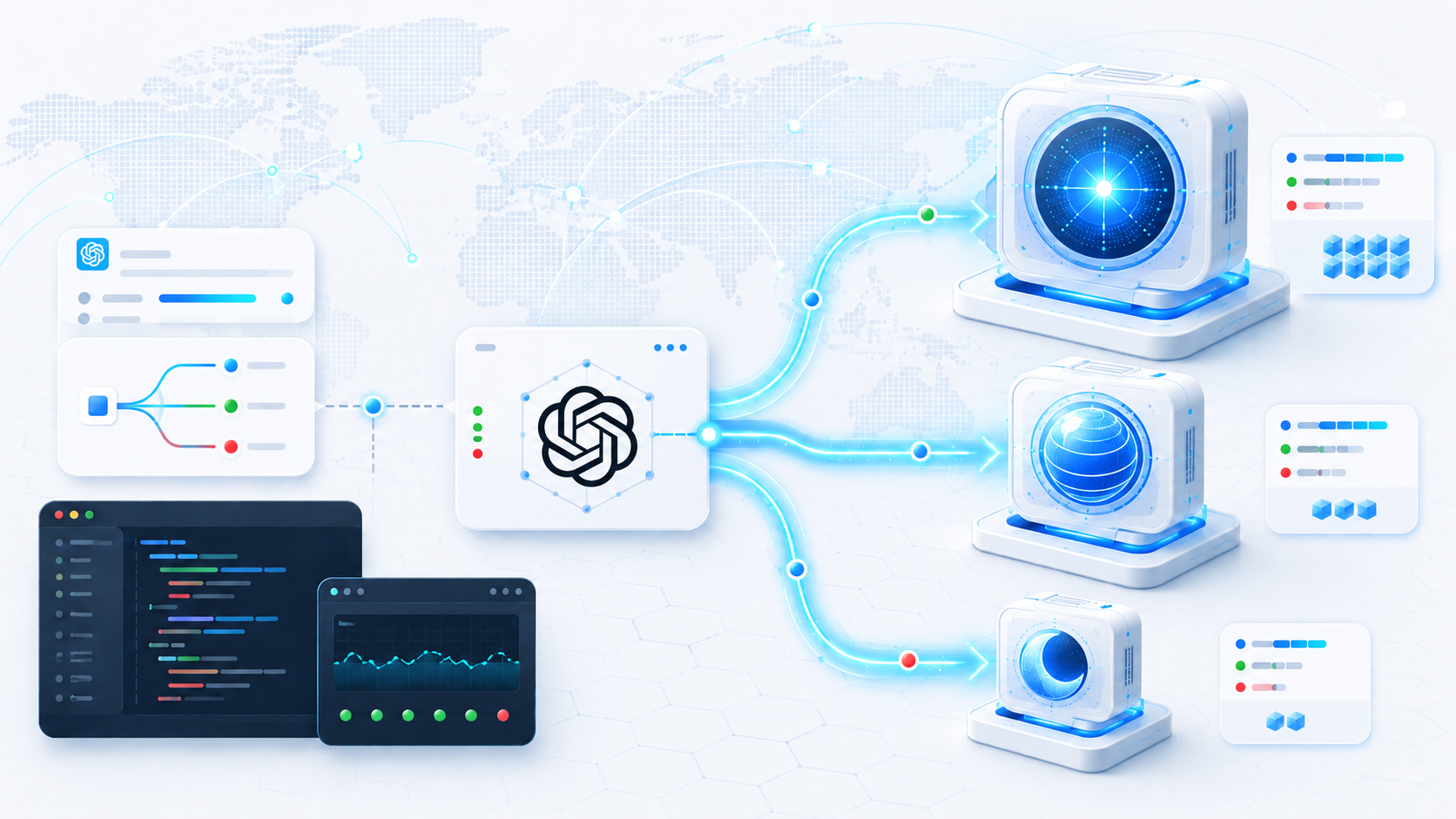
What happened: OpenAI is releasing its GPT-5.6 family publicly, after a late-June review with government partners that held the rollout back over the models’ capabilities (OpenAI). The lineup is three models, not one: Sol, the strongest variant tuned for biology, chemistry, and cybersecurity work; Terra, the everyday workhorse; and Luna, the cheapest option for high-volume jobs. Reporting puts the global switch-on around July 9, with the government limits lifted (Dataconomy).
The details: The interesting engineering decision is the tiering. OpenAI is telling you, explicitly, that most requests do not need the frontier model, and it priced the lineup so the cheap path is the default and the expensive one is opt-in. Sol being singled out for biology, chemistry, and security is also why the launch went through a safety review: those are exactly the capability areas regulators watch (Nextgov). For builders, a three-tier family turns “which model?” into a routing problem you own: classify the request, send the boring 90% to Luna, and reserve Sol for the jobs that actually need it.
flowchart TD
    R["Incoming request"] --> C{"How hard is it?"}
    C -->|"bulk / simple"| L["GPT-5.6 Luna: cheapest"]
    C -->|"everyday"| T["GPT-5.6 Terra: balanced"]
    C -->|"deep reasoning, bio / chem / security"| S["GPT-5.6 Sol: strongest"]
    L --> O["Response"]
    T --> O
    S --> O
Important
Our take: A three-model launch is a pricing strategy dressed as a product. The money is not in always calling the smartest model; it is in a router that sends most traffic to the cheapest one that still passes your evals. Build that classifier now and treat the model name as a runtime variable, not a hardcoded string. The teams that win on unit economics this year are the ones that made “which tier?” a measurable decision instead of a default to the flagship.
🗞️ More News
🧠 AI
- Anthropic published a Cyber Jailbreak Severity framework with Amazon, Microsoft, and Google, a shared five-tier scale (CJS-0 to CJS-4) for scoring how dangerous a jailbreak really is, plus a HackerOne disclosure program (Anthropic).
- Google launched Nano Banana 2 Lite, generating images in about 4 seconds at $0.034 per 1K, alongside Gemini Omni Flash for conversational video editing at $0.10 per second of output (Google).
- Together AI raised an $800M Series C at an $8.3B valuation led by Aramco Ventures, betting that enterprises keep shifting inference to open models (TechCrunch).
- 8090 Labs, Chamath Palihapitiya’s enterprise AI-coding startup, closed a $135M Series A led by Salesforce Ventures (TechCrunch).
- Mistral is reportedly in talks to raise €3B at a €20B valuation, with most of it earmarked for data centres (Tech Funding News).
- GPT-5.6 Sol’s tuning for biology, chemistry, and cybersecurity is exactly why the launch went through a government safety review before going public (Nextgov).
🤖 Robotics
- Figure exceeded $1B in Series C funding at a $39B post-money valuation while ramping Figure 03 to roughly one robot per hour at its BotQ factory (Figure).
- Agility Robotics agreed to go public via a $2.5B SPAC merger with Churchill Capital XI, with a $200M PIPE led by Foxconn and a planned “AGLT” ticker (TechCrunch).
- A Chinese humanoid startup says it has taken 13,000-plus orders for its $17,600 pop-star-styled robots, lip-synch quirks and all (The Register).
💻 Programming
- EuroPython 2026 opens July 13-19 in Kraków for its 25th anniversary, with keynotes from Guido van Rossum, Pablo Galindo Salgado, and Łukasz Langa (EuroPython).
- Microsoft’s Azure SDK for Rust reached GA at 1.0.0, locking seven core crates behind semver guarantees with production-grade observability (NT Compatible).
- Rust climbed to #12 in the June 2026 TIOBE index, its highest ranking ever, as Python slipped (TechRepublic).
- Python 3.15 picked up two more betas on its way to a fall release, while 3.14.6 and 3.13.14 shipped routine bug fixes (Real Python).
⚡ Electronics
- A new report warns the US chip industry could be short as many as 157,000 skilled workers by 2030, threatening billions in planned fab construction (Bloomberg).
- Samsung posted a record Q2 operating profit near $58.4B, yet the stock still sent investors on a rollercoaster as revenue missed and capex worries lingered (Bloomberg).
- For the hardware crowd, Semiconductor Engineering’s July 8 technical-paper roundup collects fresh research on packaging, memory, and reliability (Semiconductor Engineering).
📡 Telecom
- The US Department of War is betting on open-source code, not just open interfaces, to crack the Ericsson-Nokia radio duopoly, awarding a $28M contract to Cohere Technologies for 6G drone-detection prototypes (TechTimes).
- Nokia won a three-year deal to replace Ericsson at Telecom Italia’s 5G sites, swinging roughly 40 points of the operator’s RAN share (Light Reading).
- Ericsson is scaling AI-native Cloud RAN and network infrastructure across US operators to support private 5G and automated networks (Telecoms Tech News).
👨💻 Code Corner
Today’s launch makes model choice a runtime decision. Here is a dependency-free router that sends each request to the cheapest GPT-5.6 tier that can handle it, so you only pay for Sol when a job truly needs it.
# Route each request to the cheapest GPT-5.6 tier that can do the job.
# Sol = strongest (hard reasoning, bio/chem/security), Terra = everyday, Luna = bulk.
def pick_model(task: str, deep_reasoning: bool, tokens_out: int) -> str:
    if deep_reasoning or task in {"biology", "chemistry", "security"}:
        return "gpt-5.6-sol"
    if tokens_out > 4000:
        return "gpt-5.6-terra"
    return "gpt-5.6-luna"

jobs = [("chat", False, 200), ("security", True, 500), ("report", False, 8000)]
for name, deep, out in jobs:
    print(f"{name:>8} -> {pick_model(name, deep, out)}")
Tip
Gate the Sol path behind an explicit flag, not a guess. Because it is the model tuned for biology, chemistry, and security, an accidental default there is both your priciest calls and your most safety-sensitive ones.
🧰 Toolbox
- Together AI: open-model inference cloud used by tools like Cursor and Cognition; handy when you want to serve open weights instead of a closed API.
- Google AI Studio: where you can try Nano Banana 2 Lite and Gemini Omni Flash right now, including conversational video editing.
- Anthropic Cyber Jailbreak: a HackerOne disclosure program to responsibly report AI cyber jailbreaks; a good read even if you never file one.
- Polars: blazing-fast DataFrame library with fresh releases this month; a drop-in speed upgrade over pandas for many pipelines.
- Raspberry Pi Pico 2: the $5 RP2350 board with selectable Arm and RISC-V cores, a cheap way to experiment with on-device voice capture.
🔌 Component of the Week (rotating)
INMP441 I2S MEMS microphone: with real-time voice AI in the headlines, this is the cheapest way to give a microcontroller ears. The INMP441 is a 24-bit omnidirectional MEMS mic with a built-in ADC and a standard I2S digital output, so it wires straight to an ESP32 or Raspberry Pi with no separate audio codec. It runs on 1.8V to 3.3V at about 1.4mA, with a 60Hz to 15kHz response that is plenty for speech capture and wake-word projects. Boards sell for roughly $3 to $5, which makes it a great pairing with the Pico 2 above for a DIY voice front end. See the module overview and pinout to get started.
📚 From the Blog
- What Electricity Actually Is: Charge, Current, and Voltage: charge in motion, from coulombs to amperes to volts; the perfect primer before you wire up that INMP441.
- CCTV in 2026: From Dumb Cameras to Intelligent Sensors: how ordinary cameras became AI sensors, a nice companion to today’s model-routing theme.
- CloudEvents 1.0: A Universal Language for Your Events: a common schema for event data across distributed systems.
😀 The Bot Says…
OpenAI named its models after the sun, the earth, and the moon. Give it a year and we will all be routing overflow traffic to gpt-6-oort-cloud.
That’s all for today! Reply and tell us: are you building a model router, or just hardcoding Sol and hoping the invoice is kind?