😁 Hello, super humans! The company that broke the AI market’s brain in 2025 with dirt-cheap frontier models is now going after the hardware itself. DeepSeek is reportedly designing its own AI chip, and the most interesting word in that sentence is the one that describes what kind. Let’s dig in.
📰 Quick Signals
- 🧠 AI: Chinese AI models are winning real workloads at US companies as OpenAI and Anthropic inference costs keep climbing (CNBC).
- 🤖 Robotics: Ex-Tesla Optimus scientist Rémi Cadene unveiled Northstar, a lightweight humanoid from Paris-based UMA targeting European factories first (Bloomberg).
- 💻 Programming: TypeScript 7.0, the compiler rewritten in Go, reached release candidate with roughly 10x faster builds than the JavaScript-based 6.x line (InfoWorld).
- ⚡ Electronics: Samsung posted a record preliminary Q2 operating profit of 89.4 trillion won, and the stock still fell almost 7% on capex worries (CNBC).
- 📡 Telecom: SpaceX, the company behind the Starlink network, joined the Nasdaq-100 on July 7, an unusually fast inclusion after its IPO (The Motley Fool).
The Big Story: DeepSeek is designing its own AI chip, and it chose inference on purpose
The lab that proved frontier models could be trained on a budget is now attacking its other big line item: the silicon it rents to serve them.
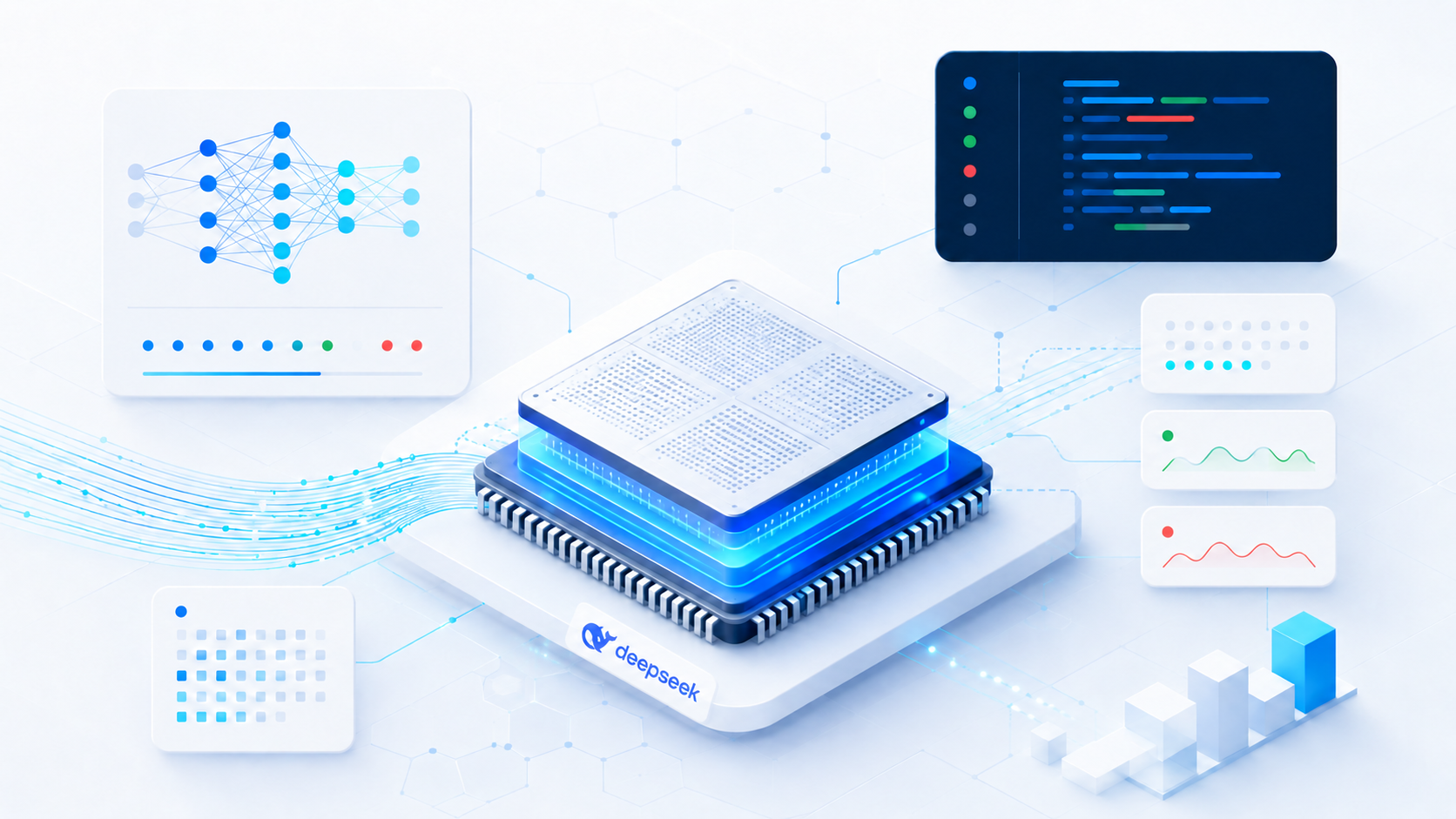
What happened: Reuters reported that DeepSeek is developing its own AI chip, citing sources familiar with the effort; the company is already talking to manufacturing partners and quietly hiring chip engineers (Reuters via U.S. News). The chip is aimed at inference, the serving side of AI, rather than training, and reporting points to domestic manufacturing as the goal, reducing reliance on both Nvidia and Huawei (The Next Web). It follows OpenAI unveiling Jalapeno, its first custom inference chip built with Broadcom, last month.
The details: Inference-first is not a consolation prize, it is the technically rational entry point. A training chip has to do high-precision matrix math across tens of thousands of accelerators stitched together with exotic interconnects, which pushes you onto the newest process node money can buy; US export controls put exactly that class of hardware out of DeepSeek’s reach. Inference is a different animal: generating each new token means streaming essentially every model weight out of memory once, so decode speed is bounded by memory bandwidth, not raw compute. A chip that pairs aggressive quantization (INT8 or FP8) with fat memory bandwidth can serve models competitively even on an older, domestically available process node. That is the gap DeepSeek, whose models are already trained, can actually exploit.
flowchart TB
    subgraph T["Training accelerator"]
        T1["High-precision matmul: BF16 / FP32"]
        T2["Massive chip-to-chip interconnect"]
        T3["Needs the leading process node"]
    end
    subgraph I["Inference accelerator"]
        I1["Low-precision matmul: INT8 / FP8"]
        I2["Memory bandwidth is the bottleneck"]
        I3["Older domestic node is good enough"]
    end
    T -->|"train once"| M["Model weights"]
    M -->|"serve billions of tokens"| I
Important
Our take: The chips are the smaller half of this story; the software stack is the moat. Nvidia’s real lock-in is CUDA plus ten years of kernels, and a model lab designing silicon for its own architectures gets to skip generality entirely: one model family, one quantization scheme, one serving stack, co-designed. That is how you make an inference chip on a trailing node embarrassing to compete with on cost per token. If you build on LLM APIs, this is your reminder that token prices are set by serving economics, and serving economics are about to get another price war. Learn quantization and batching now; that knowledge transfers no matter whose silicon wins.
🗞️ More News
🧠 AI
- Starting today, Claude Fable 5 access on every subscriber tier bills usage credits at the standard API rate, ending the included-usage period that ran through July 7 (Anthropic newsroom).
- Following yesterday’s staged-rollout signal, OpenAI has reportedly locked a July 7 to 9 window for opening GPT-5.6 to the public, with the Sol variant scoring 91.9% on Terminal-Bench 2.1 (TradingKey).
- Ukraine said it will only procure AI models that can run without provider control, a sovereignty-first requirement that echoes across European defense buyers (Reuters via U.S. News).
- The first UN Global Dialogue on AI Governance wrapped in Geneva with all 193 member states signing a shared statement of principles and agreeing to reconvene in May 2027 (AI for Good).
- Z.ai’s GLM 5.2 logged the fastest adoption of any model Vercel has tracked in 2026, with daily token volume up about 27x in its first full week (LLM-Stats).
- Google’s Gemini 3.5 Pro is cleared for a July general-availability launch after slipping from June, alongside NanoBanana 2 Lite images in under four seconds at $0.034 per 1,000 (ThursdAI releases).
🤖 Robotics
- Humanoid says its KinetIQ Ascend reinforcement-learning approach reaches 99.9% manipulation reliability at human speed for industrial tasks (The Robot Report).
- Avride is using cloud vision-language models as a safety net for its sidewalk delivery robots, calling in a big model when the onboard stack is unsure (The Robot Report).
- Apptronik unveiled Apollo 2 in bipedal and wheeled variants, built around a flagship data-collection facility so deployed robots keep feeding the training loop (The Robot Report).
- Luxonis closed a Series A to scale its OAK camera line and position itself as the perception layer for physical AI (The Robot Report).
💻 Programming
- Node.js 20.x hits end-of-life tomorrow, July 9; if you are still on it, your runtime stops getting security patches this week (Node.js release schedule).
- Apple shipped a new search tool for the Developer site plus official design kits for Figma and Sketch as part of its July developer update (Apple Developer).
- Microsoft’s Azure SDK stabilized its Rust ecosystem at 1.0.0, locking seven core crates with semver guarantees, a notable production endorsement for Rust in cloud tooling (Azure SDK releases).
⚡ Electronics
- A projected shortfall of up to 157,000 skilled workers by 2030 threatens billions in new US chip fabs, per a report covered the same week ground crews are being hired for multiple sites (Bloomberg).
- SK Hynix American depositary receipts begin trading on the Nasdaq on July 10, giving US investors direct access to the HBM leader (GuruFocus).
- US semiconductor stocks rebounded to open the week on strong AI demand before wobbling again Tuesday, with memory names swinging hardest in both directions (GuruFocus).
📡 Telecom
- The FCC will auction up to 180MHz of upper C-band midband spectrum (3.98GHz to 4.2GHz) for 5G and 6G, with the sale mandated to finish by July 2027 (Light Reading).
- The White House ordered immediate studies of the lower 7GHz, 2.7GHz, and 4.4GHz bands, the pipeline that will feed future 6G allocations (Light Reading).
- A GSMA report lays out the spectrum decisions shaping the 6G era, warning that mid-band scarcity, not radio tech, is the binding constraint (Telecoms Tech News).
👨💻 Code Corner
Today’s Big Story hinges on one fact: generating a token means reading the whole model from memory. This snippet turns an accelerator’s memory bandwidth into a decode-speed ceiling, the first number any inference-chip designer writes on the whiteboard.
# Decode is memory-bound: each new token streams every weight once.
bandwidth_gb_s = 1000     # accelerator memory bandwidth (GB/s), HBM-class
params_b = 70             # model size, billions of parameters
bytes_per_param = 1       # INT8 quantization (2 for FP16, 0.5 for INT4)

model_bytes = params_b * 1e9 * bytes_per_param
ceiling = bandwidth_gb_s * 1e9 / model_bytes
print(f"decode ceiling: {ceiling:.1f} tokens/s per stream")  # -> 14.3
Halve the bytes per parameter and you double the ceiling without touching the silicon; that is why quantization, not FLOPS, is the currency of inference.
Tip
This ceiling is per stream. Batching many users amortizes each weight read across the batch, and Mixture-of-Experts models only read the active experts, which is exactly why DeepSeek’s MoE-heavy architectures pair so well with a bandwidth-first chip.
🧰 Toolbox
- llama.cpp: the reference implementation of quantized LLM inference on commodity hardware; play with INT8 vs INT4 and watch the Code Corner math come true.
- vLLM: the production inference server whose PagedAttention and continuous batching squeeze the most tokens out of every gigabyte per second.
- LeRobot: Hugging Face’s open robot-learning library, originally created by Rémi Cadene, the founder behind today’s Northstar humanoid reveal.
- Sonair ADAR One: a 3D ultrasonic sensor now safety-certified as a human-detection device under IEC 61496, small enough to embed flush in a humanoid shell.
- Apple Design Kits: official Figma and Sketch component libraries for Apple platforms, fresh from this week’s developer update.
🎬 Demo Watch (rotating)
UMA’s Northstar reveal is the demo to watch this week: a lightweight humanoid from the ex-Tesla scientist who built Hugging Face’s LeRobot, unveiled with a system called Real-Time Learning that claims robots can pick up new tasks from demonstrations instead of programming (The AI Insider). What makes it hard: learning online from a handful of demos is a sample-efficiency problem the whole field struggles with, and doing it safely on a moving robot is harder still. What is real: Cadene’s open-source track record and talks with 50 potential customers (Bloomberg). What is hype until proven: no public deployment yet, so treat the learning claims as a thesis, not a benchmark.
📚 From the Blog
- What Electricity Actually Is: Charge, Current, and Voltage: charge, current, and voltage from first principles, the physics every accelerator in today’s Big Story ultimately runs on.
- CCTV in 2026: From Dumb Cameras to Intelligent Sensors: cameras becoming inference machines at the edge, the exact workload cheap inference silicon like DeepSeek’s is chasing.
- CloudEvents 1.0: A Universal Language for Your Events: a common schema for events across distributed systems, the glue layer for any fleet of smart devices.
😀 The Bot Says…
DeepSeek trained models cheaply to avoid buying chips, and now it is building chips to run the models it trained to avoid buying chips. Somewhere an accountant has achieved enlightenment.
That’s all for today! If you had a bandwidth-first inference chip on your desk, which model would you serve first: reply and tell us.