😁 Hello, super humans! The three US carriers that spend fortunes trashing each other in ads just agreed to sit at the same table and share spectrum in orbit. It is a holiday-weekend surprise with real engineering behind it, and it lands right before an FCC vote that rewrites the satellite rulebook. Let’s dig in.
📰 Quick Signals
- 🧠 AI: Anthropic’s Mythos and Fable models are back online after a 20-day export-control blackout; Axios details the multi-agency safety showdown that got them there (Axios).
- 🤖 Robotics: China’s securities regulator cleared Unitree for a roughly $619 million STAR Market IPO, one of the year’s biggest robotics listings (Caixin Global).
- 💻 Programming: PostgreSQL 19 Beta 1 landed with SQL/PGQ property graphs, parallel autovacuum, and a new REPACK command (PostgreSQL news).
- ⚡ Electronics: Samsung, SK Hynix, and Micron were hit with a US class action alleging they coordinated to inflate DRAM prices by roughly 700 percent (Tom’s Hardware).
- 📡 Telecom: The FCC will vote July 22 on a satellite-licensing overhaul, a new Part 100 “licensing assembly line,” alongside teeing up an upper C-band auction (SpaceNews).
The Big Story: AT&T, T-Mobile, and Verizon agree to pool spectrum for satellite dead-zone coverage
The three carriers that never agree on anything just agreed on the sky. If you have ever watched your signal die on a hiking trail or a rural highway, this is the plan meant to fix it.
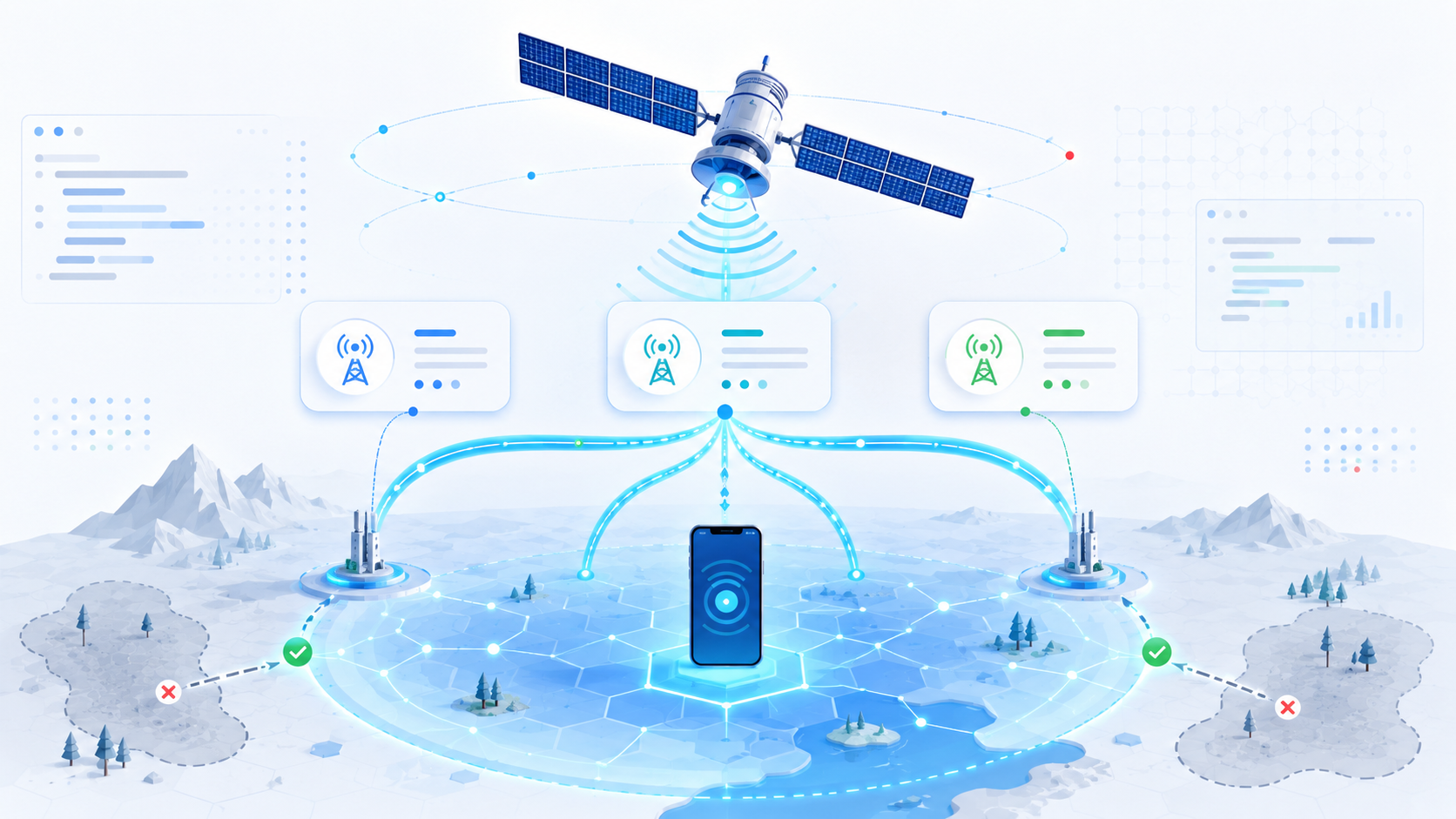
What happened: AT&T, T-Mobile, and Verizon announced an agreement in principle to form a joint venture built around satellite direct-to-device (D2D) connectivity, aimed at eliminating wireless dead zones across the US. The carriers say they will pool limited spectrum and build a unified platform so satellite operators can plug into all three terrestrial networks at once, rather than negotiating one-off exclusives (AT&T).
The details: Direct-to-device means an ordinary phone talks straight to a low-Earth-orbit satellite using terrestrial mobile spectrum, no special antenna required. The physics are brutal: a phone radiating a fraction of a watt has to close a link with a satellite hundreds of kilometers up, so every extra decibel of spectrum and every larger satellite array matters. Pooling spectrum lets the JV hand satellite operators a wider, shared channel and a single interconnection standard instead of three fragmented ones. It arrives as the field heats up: T-Mobile and SpaceX’s T-Satellite service is set to launch commercially, AST SpaceMobile is unfolding record-size arrays for AT&T and Verizon, and the FCC is about to rewrite how all of these constellations get licensed.
flowchart LR
    P[Your phone<br/>terrestrial 5G band] -->|D2D uplink| S[LEO satellite]
    S --> U[Shared JV platform<br/>pooled spectrum]
    U --> C[AT&T core]
    U --> D[T-Mobile core]
    U --> E[Verizon core]
Important
Our take: Rivals pooling spectrum is the tell here: direct-to-phone is so link-starved that even fierce competitors would rather share a fatter channel than each fail alone with a thin one. As builders, the interesting bit is the unified interconnection platform, because a single standard for satellites to reach terrestrial cores is exactly the kind of plumbing that turns a demo into an industry. We would watch two things before cheering: whether regulators bless three national carriers jointly controlling a spectrum pool, and whether “no dead zones” means real data or just emergency texting. The FCC’s July 22 licensing vote will tell us how fast this can actually move.
🗞️ More News
🧠 AI
- Microsoft launched the “Frontier Company,” a $2.5 billion unit with 6,000 forward-deployed engineers sent to fix failing enterprise AI pilots from inside customer operations (Microsoft).
- Meta is building a cloud business to rent out its excess AI compute; the stock popped roughly 9 percent on the news (CNBC).
- OpenAI’s GPT-5.6 remains on hold amid daily technical discussions over how and when it can be released (Axios).
- Google’s 2026 environmental report shows electricity use jumped 37 percent in 2025, its largest annual rise ever, driven by the AI buildout (Google).
- Crunchbase says global startups raised a record $510 billion in the first half of 2026, with more than 70 percent of Q2 capital going to AI (Crunchbase).
- Anthropic paired the models’ July 1 return with stronger safety classifiers and broader platform availability (Anthropic).
🤖 Robotics
- Boston Dynamics unveiled a fifth-generation Atlas re-engineered for mass production, cutting complexity by “almost an order of magnitude” (Forbes).
- NVIDIA released Halos for Robotics, a full-stack humanoid safety system, with Agility’s Digit as the first commercial humanoid to adopt it (The Robot Report).
- Unitree plans to put its IPO proceeds into robot-AI models, new hardware, and a smart-robot manufacturing base as it heads to the STAR Market (Caixin Global).
💻 Programming
- SpaceX confirmed its intent to acquire Anysphere, maker of the AI coding tool Cursor, for $60 billion, reported as the largest startup acquisition ever (Crunchbase).
- The Zig 0.17.0 cycle is progressing with compiler work that trims executable size by around 4 percent (Zig devlog).
- AWS will ship Amazon Linux 2023-based Lambda runtimes for Java 8, 11, and 17 before the end of July, retiring the end-of-life Amazon Linux 2 base (AWS docs).
⚡ Electronics
- Qualcomm detailed its near-memory “HBC” architecture behind the AI250 accelerator, claiming six times the bandwidth per watt of HBM by stacking compute beneath LPDDR memory (Tom’s Hardware).
- South Korea detailed a 392 trillion won (about $252 billion) package funding new Samsung and SK Hynix HBM and NAND advanced-packaging fabs in the Chungcheong region (Korea JoongAng Daily).
- Google’s report tied a 25 percent jump in supply-chain emissions largely to chipmaking on carbon-heavy grids in Taiwan, Japan, Vietnam, and India (Google).
📡 Telecom
- T-Mobile and Starlink’s “T-Satellite” direct-to-cell service is set to officially launch commercially on July 23 (Broadband Breakfast).
- AST SpaceMobile completed the in-orbit unfolding of BlueBird 6, which it calls the largest commercial comms array in low Earth orbit, targeting 45 to 60 satellites by year-end (Gizmodo).
- SpaceX’s June 27 IPO filing recast Starlink Mobile as a direct-to-smartphone carrier rival, sharpening the competitive backdrop for today’s Big Story (Tech Times).
👨💻 Code Corner
Today’s Big Story is really a fight against the laws of physics, so here is the number that explains it. This tiny Python snippet computes free-space path loss, the signal you lose just from distance, for a phone talking to a low-Earth-orbit satellite. No dependencies.
import math

def free_space_path_loss_db(distance_km: float, freq_ghz: float) -> float:
    # FSPL(dB) = 20*log10(d_km) + 20*log10(f_GHz) + 92.45
    return 20 * math.log10(distance_km) + 20 * math.log10(freq_ghz) + 92.45

# A LEO bird ~550 km up, phone in a 2 GHz band shared with terrestrial 5G
loss = free_space_path_loss_db(550, 2.0)
print(f"Free-space path loss: {loss:.1f} dB")  # ~153.3 dB
That ~153 dB of loss, before you even add rain and pointing losses, is exactly why direct-to-phone needs enormous satellite arrays and the fatter, pooled spectrum the carriers just agreed to share.
Tip
The 92.45 constant assumes distance in kilometers and frequency in gigahertz. Swap to meters and hertz and the constant becomes about -147.55; mixing units is the classic link-budget bug.
🧰 Toolbox
- Skyfield: pure-Python library for precise satellite and planet positions and pass predictions from TLE data.
- Gpredict: open-source real-time satellite tracker and orbit predictor, a favorite for ham and SDR builds.
- CelesTrak: the canonical source for up-to-date TLE orbital element sets to feed the two tools above.
- N2YO: live, browser-based satellite tracking and pass predictions, no install required.
- PostgreSQL 19 Beta 1: try SQL/PGQ property graphs, parallel autovacuum, and the new REPACK command before the stable release.
🎬 Demo Watch (rotating)
Boston Dynamics’ electric Atlas stars in Hyundai’s “School of Football” film series, building to a “Ghost Rabona,” a cross-legged trick kick that demands precise timing, whole-body balance, and controlled dynamic motion. Boston Dynamics says every movement was performed by the robot with no CGI (New Atlas). What is real: the balance and dynamic control genuinely are hard, and Atlas doing them on hardware is impressive. What is hype: this is a choreographed, take-after-take film shoot, not an autonomous robot reading a match and improvising, so read it as a controls showcase, not game intelligence.
📚 From the Blog
- What Electricity Actually Is: Charge, Current, and Voltage: charge, current, and voltage from first principles; the physics under every satellite phone and radio link in today’s Big Story.
- CCTV in 2026: From Dumb Cameras to Intelligent Sensors: how cameras turned into intelligent sensors, the same perception stack humanoids like Atlas lean on.
- CloudEvents 1.0: A Universal Language for Your Events: a simple, consistent way to describe event data across distributed systems.
😀 The Bot Says…
Three carriers that can’t agree on who has the fastest 5G suddenly agree the answer is: space. Somewhere, a dropped call on a mountain trail is finally getting its revenge.
That’s all for today! Which vertical do you want more of tomorrow: satellites, silicon, or humanoids? Reply and tell us.