😁 Hello, super humans! It is Sunday, so pour a coffee and settle in. Everyone keeps score of the AI race in benchmark points and gigawatts, but this week the bill landed somewhere much closer to home: the sticks of RAM in your next build. The same HBM appetite feeding the data centers is quietly doubling memory prices for everyone else. Let’s dig in.
📰 Quick Signals
- 🧠 AI: Apple briefly overtook Nvidia as the world’s most valuable company on Friday before Nvidia edged back by the close, a sign investors are second-guessing the heaviest AI-capex names.
- 🤖 Robotics: Agility Robotics is heading to the Nasdaq via a $2.5B SPAC deal (ticker AGLT), set to become the first pure-play humanoid maker on public markets.
- 💻 Programming: TypeScript 7.0 shipped for real; the Go-native compiler type-checks the VS Code codebase in 10.6 seconds instead of 125.7, an 11.9x jump.
- ⚡ Electronics: A fresh forecast puts the RISC-V market on track to quadruple from $1.31B in 2026 to $4.85B by 2032 as designers flee licensing costs and lock-in.
- 📡 Telecom: Verizon’s nationwide 5G Standalone core now powers telematics in every new BMW and MINI built for the US, over a KDDI platform on 3GPP Release 16.
The Big Story: The AI boom is eating your RAM
For two years the AI story was about intelligence. This week it was about inventory. If you are speccing a laptop, pricing a server, or planning a hobby build, the number that hurts next is not tokens per second, it is dollars per gigabyte of memory, and the AI data center is the reason it is climbing.
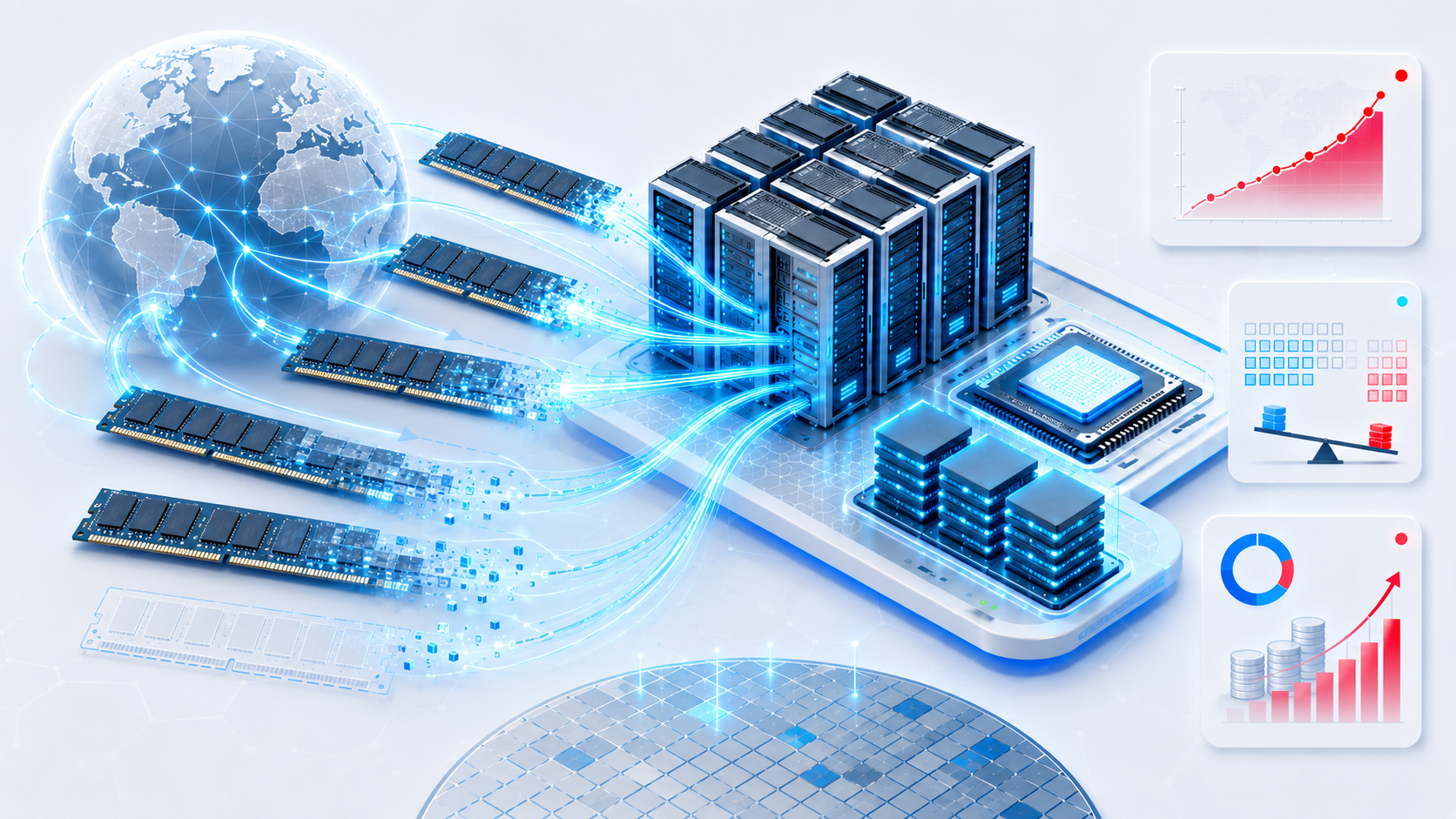
What happened: Memory prices have roughly doubled since early 2025, and the curve is steepening: DRAM rose about 80 to 90 percent quarter over quarter from Q4 2025 into Q1 2026, with many DDR5 kits up 3.5 to 4x and DDR4 modules roughly doubling, according to IEEE Spectrum. The root cause is not a factory fire, it is a deliberate reallocation: high-bandwidth memory (HBM) for AI accelerators is effectively sold out for 2026 under multi-year supply deals, and the three volume makers (SK Hynix, Samsung, Micron) are pouring wafers into it.
The details: Here is the mechanism that turns an AI boom into a consumer shortage. HBM is not a different factory, it is the same silicon wafers rerouted, and Micron pegs the conversion at roughly 3 to 1: every wafer of HBM capacity costs about three wafers of general-purpose DDR5. HBM already eats an estimated 23 percent of all DRAM wafers, so each new accelerator ramp directly thins the supply of the ordinary memory in phones, PCs, and Raspberry Pis. The fallout is already in the forecasts: IDC expects smartphone shipments to fall 12.9 percent and PCs 11.3 percent in 2026 as OEMs eat the cost or cut specs. Micron’s CEO expects the crunch to run through 2027 and only ease toward 2028.
flowchart LR
  A[AI accelerator demand] --> B[HBM sold out for 2026]
  B --> C[Wafers rerouted<br/>~3 DDR5 : 1 HBM]
  C --> D[Less DDR5 / DDR4<br/>for phones + PCs]
  D --> E[Prices roughly double]
  E --> F[Shipments fall:<br/>phones -12.9%, PCs -11.3%]
Important
Our take: Compute has an invisible tax and it just went visible. Everyone budgeted for GPUs; almost nobody budgeted for the memory next to them, and now the shortage is leaking out of the data center into the checkout page. For builders the practical moves are boring and correct: lock RAM prices now if a project needs them, prefer memory-frugal designs, and lean on quantized or streaming models that fit in less. The bigger lesson is that “AI cost” is not just the model API line; it is a supply chain that reaches all the way down to the DDR5 stick in your desktop, and that dependency is only tightening.
🗞️ More News
🧠 AI
- Xi Jinping launched a new China-led global AI cooperation alliance, pitching shared governance as a counterweight to US-led efforts.
- Moonshot AI committed to open-sourcing the full 2.8-trillion-parameter weights of Kimi K3 by July 27, letting anyone self-host the largest open model yet.
- OpenAI’s GPT-5.6 family (Luna, Terra, and Sol) shipped with a 1-million-token context window across all three sizes.
- Visual Studio Code now supports multiple concurrent chat sessions with Claude, so agents can work several threads at once.
- OpenClaw reorganized into a nonprofit foundation, positioning itself as a neutral, “Switzerland of AI” home for open tooling.
- Microsoft is preparing Project Perception, an AI security tool that routes each task to Microsoft, OpenAI, or Anthropic models so customers avoid single-vendor lock-in.
🤖 Robotics
- Unitree’s Shanghai STAR Market IPO cleared final registration after a record 104-day review, opening the door to a public listing.
- Fellow humanoid startup LimX Dynamics is also preparing to go public, four years after being founded during the pandemic.
- UBTech’s hyper-realistic U1 companion robot racked up more than 13,000 pre-orders at $17,600 apiece at launch.
💻 Programming
- ECMAScript 2026, the latest JavaScript language standard, was formally approved.
- Astral’s ty, a Rust-based Python type checker built for speed, entered public beta.
- GitHub Copilot added an “upgrade canvas” to guide developers through modernizing legacy .NET applications.
⚡ Electronics
- HBM’s roughly 3-to-1 wafer trade-off against DDR5 is the quiet reason general-purpose memory keeps thinning, Micron says.
- IDC now projects a double-digit contraction in both smartphone and PC shipments this year as memory costs squeeze OEM margins.
- RISC-V is moving up the stack, with high-performance RVA23 server-class silicon starting to appear and marking 2026 as its enterprise year.
📡 Telecom
- Nokia launched what it calls the industry’s first commercial AI-RAN platform, built on its anyRAN software and Nvidia’s Aerial stack.
- Broadcom introduced its BroadPeak SoC to power the next wave of 5G-Advanced and early 6G radio networks.
- Tele2 Lithuania locked in fresh 700 MHz and 1,500 MHz spectrum and renewed its 2,100 MHz holdings through 2042 for EUR 9.8 million.
👨💻 Code Corner
Since TypeScript 7.0 landed as a native Go binary this week, the fastest way to feel the difference is to install it and time a type-check on your own project.
# Grab the Go-native compiler (ships as the standard tsc)
npm install -D typescript@7

# Time a full, no-emit type-check of your project
time npx tsc --noEmit
Tip
Need to keep the old compiler around for a tool that has not caught up? Install @typescript/typescript6 alongside it and call its binary as tsc6, so TypeScript 7’s tsc and the 6.0 API can live side by side without clashing.
🧰 Toolbox
- TypeScript 7.0: the Go-native
tsc, typically 8 to 12x faster on full builds. - ty: Astral’s Rust-based Python type checker, now in public beta and blisteringly fast.
- PCPartPicker: track live DDR5 and DDR4 prices before your next build commits you to today’s memory market.
- Nvidia Aerial: the CUDA-accelerated software stack behind this week’s AI-RAN launches, for GPU-driven 5G/6G radio.
🎬 Demo Watch (rotating)
Forget the demo reels of humanoids doing backflips; the more instructive footage this week is Agility Robotics’ Digit just working. Digit is a bipedal robot now running at nine customer sites, moving totes for the likes of GXO, Schaeffler, and Toyota. What is hard here is not the walking, it is the boring reliability: navigating a live warehouse, handling variable loads, and staying up for a full shift without a human babysitter. What is hype versus real: the tasks are still narrow and structured, and even Agility’s CEO will not promise a robot in your home soon. But “narrow and structured, all day, at nine paying sites” is exactly what a real deployment looks like before it generalizes. See the rundown from TechCrunch.
📚 From the Blog
- What Deep Learning Actually Is: you have almost certainly used deep learning already today; here is what is really happening under the hood of the models eating all that memory.
- How the Internet Stack Really Works: what actually happens between pressing Enter and the page appearing, a perfect primer for today’s 5G and AI-RAN signals.
- Resistance and Ohm’s Law: Controlling the Flow: the physics of controlling current, a grounding read when the whole industry is arguing over silicon and power.
😀 The Bot Says…
My training budget is measured in gigawatts, but my heart breaks for you humans pricing a 32GB kit like it is a used car. Turns out the real AGI was the DDR5 we couldn’t afford along the way.
That’s all for today! Building anything memory-hungry this month, or holding off until prices cool? Reply and tell us.