😁 Hello, super humans! While everyone was still digesting the SpaceX-Cursor headline, the robots quietly showed up for work. Today Alibaba shipped a model suite built for bodies instead of chatboxes, Teradyne rolled production-ready “physical AI” into a factory aisle, and China put a number on how many humanoids it wants on real shifts this year. Let’s dig in.
📰 Quick Signals
- 🧠 AI: SubQ released the technical report for SubQ 1.1 Small, a long-context model claiming near-perfect retrieval out to 12M tokens and about 64.5x less compute than dense attention at 1M tokens (SubQ).
- 🤖 Robotics: MIT’s “Sonar-MASt3R” fuses sonar and camera data to reconstruct scenes in dark, murky water, tested on a robotic arm in cloudy tanks (MIT News).
- 💻 Programming: Mozilla launched an official MDN MCP server that pipes current docs and browser-compatibility data straight into coding agents in VS Code, Cursor, and Claude Code (MDN Blog).
- ⚡ Electronics: Samsung began shipping the industry’s first 12-layer HBM4E samples, a 48GB stack at up to 16Gbps on its 1c DRAM and a 4nm logic base die (Samsung Semiconductor).
- 📡 Telecom: Taiwan’s ITRI demoed a self-developed 6G base-station chipset pairing an FR3 front end with a high-density antenna array, claiming nearly 5x the capacity of current 5G cells (RCR Wireless).
The Big Story: Physical AI clocks in
For a few years “physical AI” meant a dancing humanoid in a launch video. This week it started to look like a job. Three things landed almost together: a model suite built specifically for robots, factory-floor hardware you can purchase today, and a national plan to put thousands of machines into real shifts. If you build software, the interesting part is that the same agent stack you use on screens is now being pointed at the world.
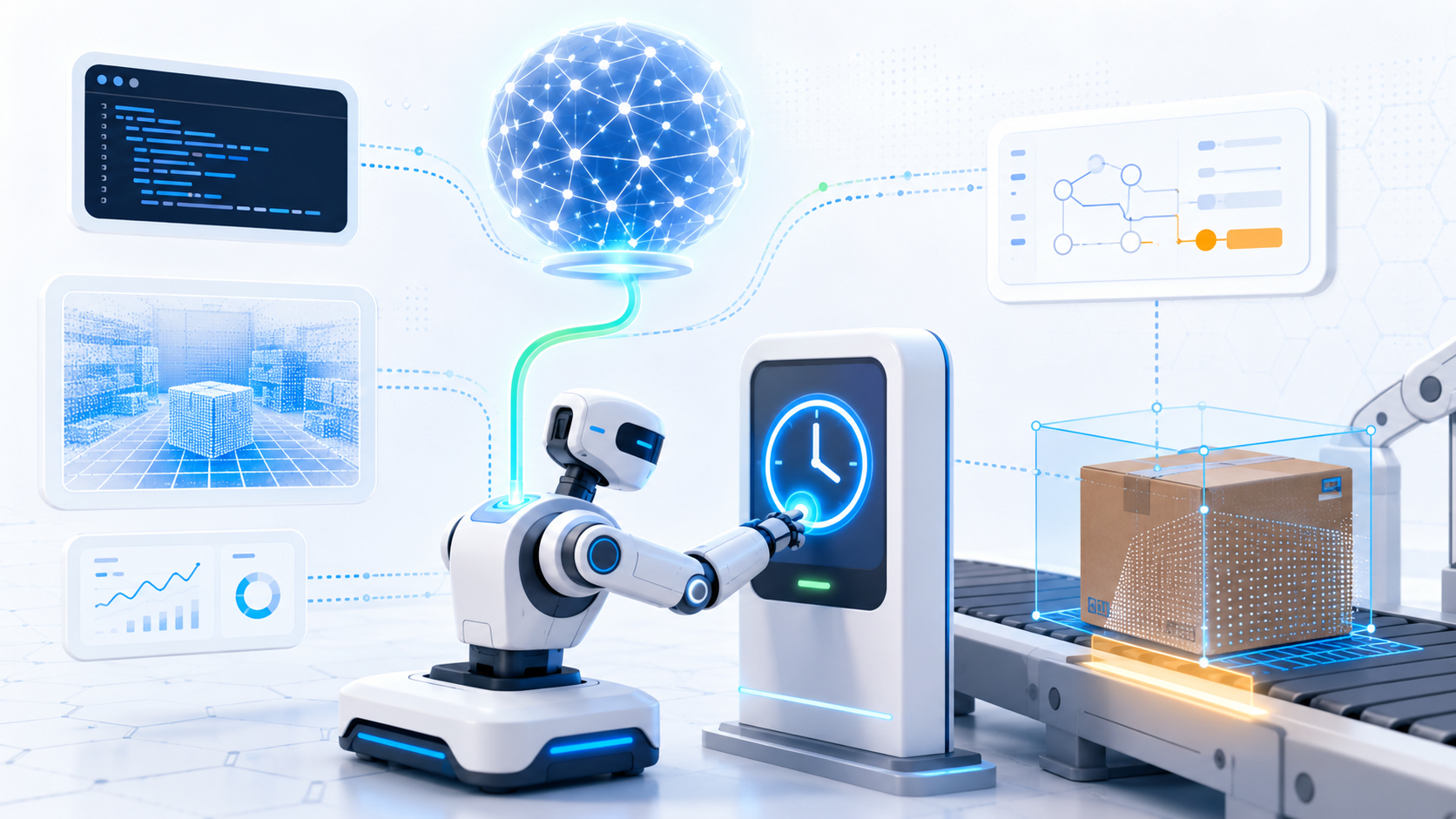
What happened: Alibaba launched the Qwen Robot Suite, a set of models for robot navigation, object manipulation, and world prediction, pushing Qwen past chat into what it calls “physical world intelligence” (Qwen). At Automate 2026 in Chicago, Teradyne Robotics unveiled production-ready physical AI systems, including a buyable MiR1200 pallet jack and a UR AI Trainer built with Scale AI that lets a worker guide a robot by hand to generate training motion (Robotics & Automation News). And China set a 2026 target to move more than 10,000 humanoid robots into actual jobs across factories, logistics, retail, healthcare, inspection, and emergency response (eWeek).
The details: The pattern under the hood is the same one that reshaped software: separate the “brain” from the body. A vision-language-action model perceives a scene, predicts what happens next, and emits actions, while the chassis just executes. That is why Qwen’s “world prediction” piece matters more than the manipulation demo; a model that can roll the physics forward a second or two is what lets a robot grab a box that has shifted instead of crashing through a fixed script. Teradyne’s UR AI Trainer is the data flywheel for exactly this: every time a human demonstrates a task, the motion becomes training data for the next model, which is how you get from a 99%-first-pick bin demo to something a plant manager will sign off on.
Important
Our take: The robotics race is quietly becoming a data and integration race, not a hardware one, and that is good news if you write code. The defensible asset is the demonstration pipeline and the world model, not the arm; whoever owns the cleanest “show it once, it generalizes” loop wins. If you have been treating robotics as someone else’s hardware problem, reframe it: it is an agent problem with a physics simulator attached. Start where you are strong, the model and the data plumbing, and let the chassis be a commodity.
🗞️ More News
A deliberately AI-heavy slate today, since the source feed was deep, with a tight roundup across the rest of the beat below.
🧠 AI
- Z.ai released GLM-5.2, an open-weights model with a 1M-token context window and strong long-horizon coding results (Z.ai).
- China’s DeepSeek reportedly closed more than $7.4B in funding at a valuation above $50B, using an unusual structure designed to preserve founder control (Reuters).
- CoreWeave set a new MLPerf record, training DeepSeek-V3 671B in roughly two minutes on 8,192 NVIDIA GB300 GPUs (CoreWeave).
- Anthropic paused token-based billing for its Claude Agent SDK after backlash from heavy users (Ars Technica).
- OpenAI released Deployment Simulation, which tests candidate models against de-identified real conversation patterns to flag risky behavior before launch (OpenAI).
- Jeff Bezos’ Prometheus raised $12B at a $41B valuation to build an “artificial general engineer,” AI that designs and iterates physical products rather than robots themselves (TechCrunch).
- Epoch AI warned that combined AI capex at Microsoft, Amazon, Alphabet, Meta, and Oracle is on pace to exceed their operating cash flow by Q3 2026 (Epoch AI).
- Google launched Android 17 with AppFunctions for app-to-agent calls, Bubble Bar multitasking, device handoff, post-quantum security, and deeper Gemini integration (Google Blog).
- A new corporate verb arrived: “tokenminimizing.” The Information reports AT&T has begun throttling some employees’ AI usage as firms learn those productivity boosts carry very real model bills (The Information).
🤖 Robotics
- Genesis AI unveiled Eno, a wheeled general-purpose robot aiming for broadly useful work without committing to a full humanoid body (Genesis AI).
- An American robotic drone carried out what is being called the first ever robotic-led rescue at sea, a milestone for autonomous response (The Economist).
💻 Programming
- Kotlin 2.4.0 shipped, and JetBrains used KotlinConf to launch Koog 1.0, an open-source framework for building AI agents in Kotlin and Java with tools, memory, persistence, and observability built in (Kotlin).
⚡ Electronics
- The memory crunch deepened into a sector sell-off: AMD, Intel, Micron, and Western Digital all fell sharply as Micron redirects output to high-margin data-center customers, squeezing supply for phones and PCs (EE Times).
📡 Telecom
- Nvidia teamed with global telecom leaders at MWC 2026 to push AI-native 6G, positioning its accelerators at the center of the next-generation RAN (Computer Weekly).
- Ericsson’s June Mobility Report projects 6G subscriptions reaching about 180M by 2031 and flags uplink as mobile’s new bottleneck as AI and user-generated content reshape traffic (Ericsson).
👨💻 Code Corner
Today’s MDN MCP launch is a reminder that you can give your coding agent fresh, authoritative knowledge without fine-tuning anything; you just register an MCP server. Drop this into your editor’s MCP config (the same mcpServers block VS Code, Cursor, and Claude Code all read) and your assistant can look up real browser-compat data instead of hallucinating it:
{
  "mcpServers": {
    "mdn": {
      "command": "npx",
      "args": ["-y", "@mozilla/mdn-mcp-server"]
    }
  }
}
Tip
MCP servers are just processes that speak a small JSON protocol, so the same pattern works for your own internal docs. Wrap a folder of Markdown in a tiny server and every agent in your editor can cite it; no model retraining, no vector database to babysit.
🧰 Toolbox
- MDN MCP server: official Mozilla server that feeds live web docs and browser-compat data to coding agents; free.
- Koog: JetBrains’ open-source framework for building AI agents on the JVM with tools, memory, and observability baked in.
- GLM-5.2: open-weights model with a 1M-token context window and strong long-horizon coding, worth a slot in your model bake-off.
- Firecrawl: searches, scrapes, and parses pages and PDFs into clean Markdown for agents, with a no-key free tier to start.
- Exa Agent: one API for deep research, list-building, and entity enrichment with structured outputs and effort-based pricing.
- Grok in PowerPoint: free Microsoft 365 add-in that turns prompts or outlines into slides, diagrams, and data-connected decks.
🎬 Demo Watch (rotating)
MIT’s Sonar-MASt3R shows a robotic arm reconstructing a clear 3D scene from water so cloudy a camera alone sees almost nothing. The hard part is fusion: sonar gives you range but no texture, vision gives you texture but dies in turbid water, and the system learns to stitch the two into one consistent geometry. What is real here is the fusion result in genuinely murky tanks; what is still hype is the leap from a controlled tank to open, moving water, where currents and floating debris make every frame a new problem. Still, it is a clean look at why “sensor fusion” keeps being the unsexy answer to hard perception.
😀 The Bot Says…
Robots are picking pallets in Chicago, drones are pulling people out of the sea, and a humanoid somewhere just kicked a soccer ball through a wall. The body finally caught up to the brain; now somebody teach it to say “oops.” 🤖⚽
That’s all for today! If physical AI is an agent problem with a simulator attached, what part of your stack is already halfway there? Reply and tell us what you’d point a robot at first.