😁 Hello, super humans! A president posted on social media, an old chip giant jumped 9% in premarket, and suddenly the most American thing about your next iPhone might be its silicon. Apple leaning on Intel to fab chips on US soil is the kind of supply-chain plot twist we have waited a decade for, so let’s dig into what it really signals, then sweep the rest of the beat.
📰 Quick Signals
- 🧠 AI: Google’s Gemini 3.5 Pro is still in limited Vertex AI preview as its promised June window closes, with a 2M-token context and Deep Think reasoning but no public day-and-time date (Tech Times).
- 🤖 Robotics: Figure’s BotQ line now builds one Figure 03 humanoid per hour, a 24x throughput jump in under 120 days, toward a 12,000-unit-a-year capacity (Figure).
- 💻 Programming: Astral’s
ty, a Rust-written Python type checker, is in beta and clocks 10x to 60x faster than mypy and Pyright, with a full language server included (Astral). - ⚡ Electronics: SandboxAQ signed a $500M CHIPS R&D award to use AI to discover PFAS-free chemistries, catalysts, and rare-earth-free magnets for chipmaking, with Commerce taking a non-voting equity stake (SandboxAQ).
- 📡 Telecom: The US 6G spectrum hunt is heating up: NTIA must finish studying the 7.125 to 7.4 GHz band by year-end, while T-Mobile is already testing 7 GHz with Ericsson and Nokia (Light Reading).
The Big Story: Apple bets on Intel, and the foundry map gets redrawn
For most of a decade, every Apple chip that mattered came out of a single company’s fabs in Taiwan. This week that quiet monopoly cracked, and the ripple touches anyone who cares where their silicon is made.
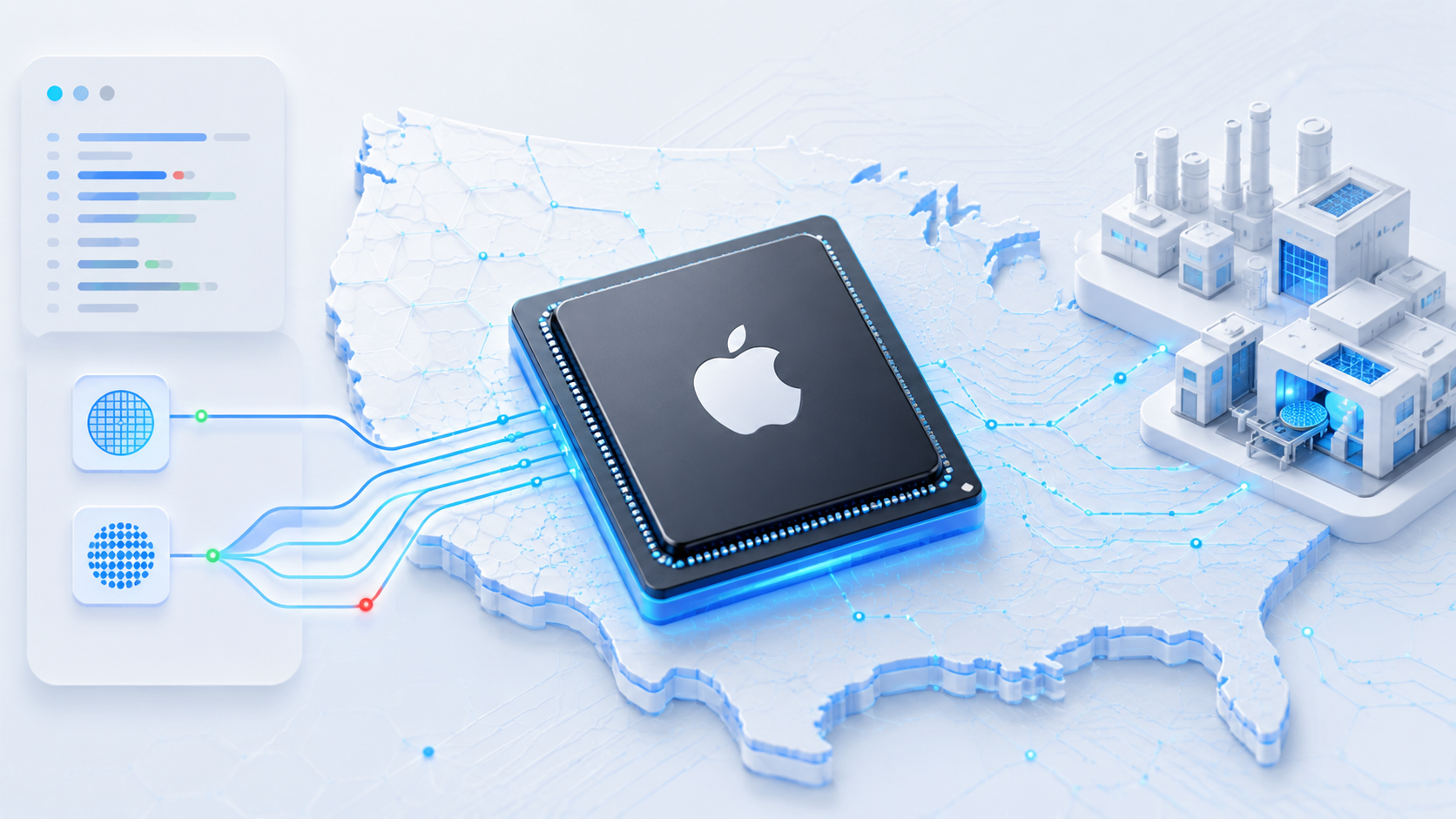
What happened: On June 18, President Trump announced that Apple has agreed to work with Intel to design and manufacture chips inside the United States, posting the news rather than letting the companies lead with it (CNN Business). Neither Apple nor Intel has issued a formal confirmation, and no chip families, volumes, or consumer timeline are public. The signal was strong enough that Intel shares jumped more than 9% in premarket trading, and it follows a Wall Street Journal report from May that the two reached a preliminary agreement after more than a year of talks.
The details: Strip away the politics and this is about reducing a single point of failure. Today nearly all of Apple’s leading-edge parts come from TSMC, which means one foundry, one country, one geopolitical fault line under the whole product line. Routing even a slice of that to Intel Foundry gives Apple a second source and gives Intel something it has chased for years: a marquee external customer to validate its 18A-class process against the only volume that really proves a node, a high-margin mobile SoC. The catch is that Intel still has to hit yield and density targets that TSMC already clears at scale, so the deal is a bet on Intel’s roadmap as much as on US policy.
flowchart LR
    A[Apple chip designs] --> B{Foundry choice}
    B -->|today: nearly all| C[TSMC, Taiwan]
    B -.->|new: a slice| D[Intel Foundry, USA]
    C --> E[Single-source risk]
    D --> F[Second source + US-made silicon]
Important
Our take: Do not read this as “Intel is back” yet, read it as “single-sourcing is finally being priced as a risk.” The interesting part for builders is not the flag-waving, it is that even Apple, the company with the most leverage over TSMC on Earth, decided a backup foundry was worth the switching cost. If the most demanding customer in the industry wants a second source, your own hard dependencies, on one cloud, one chip, one vendor, deserve the same scrutiny. Watch for an actual yield number before you believe the headline; a Truth Social post is not a wafer.
🗞️ More News
A silicon-and-spectrum sort of day, with open hardware quietly stealing the show in the background.
🧠 AI
- Microsoft and Google both rolled out their own AI coding models to take on Anthropic and OpenAI directly, turning code generation into a four-way frontier fight (CNBC).
- OpenAI’s new Deployment Company, seeded with more than $4B, will embed forward-deployed engineers inside customers instead of handing them a model and an SDK, and it acquired consultancy Tomoro’s roughly 150 engineers to do it (OpenAI).
- Zyphra open-sourced ZAYA1-8B under Apache 2.0, a sparse mixture-of-experts model with 8B total but only ~760M active parameters per token, notably trained from scratch on AMD Instinct hardware (Zyphra).
🤖 Robotics
- Boston Dynamics says its electric Atlas is already production-bound, with 2026 fleets fully committed to Hyundai’s robotics application center and Google DeepMind, rated to lift 110 lb with a 7.5 ft reach (Boston Dynamics).
- Automate 2026, the largest edition ever with 50,000-plus attendees and an NVIDIA-sponsored Humanoid Robot Pavilion, opens June 22 at Chicago’s McCormick Place (A3 / Automate).
- SoftBank’s Masayoshi Son told CNBC that physical AI and robotics are where he expects the next trillion-dollar company to emerge (CNBC).
💻 Programming
- Deno 2.7 shipped with the Temporal date/time API, Windows on ARM support, and npm dependency overrides, sharpening its three-way runtime fight with Node and Bun (Deno).
- Bun 1.3 leans into zero-config frontend work: run
bun index.htmland it serves your app, resolves ES modules, and hot-reloads with no extra setup (Bun). - TypeScript overtook Python and JavaScript to become the most-contributed language on GitHub for the first time, a milestone for typed JS at scale (GitHub).
⚡ Electronics
- RISC-V Summit Europe wrapped in Bologna with the line of the week from CEO Andrea Gallo, “RISC-V is now,” as the open ISA pushed deeper into data centers, edge AI, and space (EE Times).
- A São Paulo team unveiled the “Internet of Trees,” an open-architecture RISC-V microsensor network to continuously monitor Amazon biodiversity (EE Times).
- The space industry is increasingly standardizing on RISC-V for reliable, open-standard flight hardware, echoing the open-ISA bet agencies first made decades ago with SPARC (EE Times).
📡 Telecom
- The FCC voted to unlock high-power use of the 6 GHz band for Wi-Fi and IoT devices, opening more room for next-gen wireless gear (RCR Wireless).
- Brazil plans to award the entire upper 6 GHz band for 5G-Advanced and 6G, while the first 6 GHz service launches go live in Hong Kong and the UAE (Nokia).
- The NGMN published two 6G reports, on architecture-and-migration and on rollout timing, ahead of the 3GPP plenary in Singapore, urging operators to avoid repeating 5G’s fragmentation (NGMN).
👨💻 Code Corner
The Big Story is really about not assuming which silicon you are running on. If you ship code across Apple, Intel, ARM servers, and RISC-V boards, detect the architecture at runtime instead of hardcoding a path. Python’s standard library tells you in three lines:
import platform

print("Machine: ", platform.machine())    # e.g. arm64, x86_64, riscv64
print("Processor:", platform.processor()) # vendor/processor string, if available
print("System:  ", platform.system())     # Darwin, Linux, Windows

# Branch on the architecture instead of guessing.
arch = platform.machine().lower()
if arch in ("arm64", "aarch64"):
    backend = "neon"
elif arch.startswith("riscv"):
    backend = "rvv"
else:
    backend = "avx2"
print("Selected SIMD backend:", backend)
Tip
platform.processor() can return an empty string on some systems, so never branch on it alone. platform.machine() is the reliable one for architecture decisions; keep a sane default branch so an unknown chip degrades to a portable path instead of crashing.
🧰 Toolbox
- ty: Astral’s blazing Rust-written Python type checker and language server, 10x to 60x faster than mypy and Pyright.
- Deno 2.7: modern JS/TS runtime with the Temporal API, Windows-on-ARM support, and npm compatibility baked in.
- Bun: runtime, bundler, package manager, and test runner in one binary, now with zero-config frontend serving.
- KiCad: the open-source EDA suite for schematics and PCBs, the natural companion to this week’s open-hardware momentum.
- ZAYA1-8B: Zyphra’s Apache-2.0 sparse MoE model you can pull and run locally, trained entirely on AMD Instinct GPUs.
🔌 Component of the Week (rotating)
WCH CH32V003: A 48 MHz 32-bit RISC-V microcontroller that routinely sells for around 10 to 15 cents in volume, making it the cheapest “real” MCU you can design around. It pairs 16KB of flash and 2KB of SRAM with a handful of GPIOs, an ADC, timers, and standard serial peripherals, which is plenty for blinkies, sensor nodes, and dumb-but-reliable controllers where every cent counts. It is the perfect on-ramp to the “RISC-V is now” story above: cheap enough to socket a dozen on a breadboard and learn the open ISA without fear of frying one. Grab a low-cost dev board and the open-source ch32fun toolchain to skip the vendor IDE entirely. See the CH32V003 product page and datasheet.
😀 The Bot Says…
A US president broke the news of an Apple-Intel chip deal before either company’s PR team got a word in. Somewhere a comms director is staring at a half-finished press release, slowly closing the laptop, and whispering “well, I guess that’s shipped.” 🤖🏭
That’s all for today! If you suddenly had a second foundry, or a second cloud, or a second anything, what’s the one dependency you’d duplicate first? Reply and tell us.